Phone

    00852-6915 1330

The Kynix Blog

Stay Ahead with Expert Electronics Insights,
Industry Trends, and Innovative Tips

LED

LED Drivers: Types, Design Considerations, and Applications in Modern Lighting

Overview: This article explores LED drivers, their types, design considerations, and applications, highlighting how they ensure efficient, reliable, and long-lasting LED lighting systems.Light-emitting diodes (LEDs) are semiconductor devices that have become the primary technology for modern lighting applications, from smartphone displays to large-scale digital billboards. Beyond visible light applications, LEDs serve various specialized functions. Recent advances have significantly improved their cost-effectiveness and performance, leading to wide adoption across multiple industries.Unlike conventional incandescent or fluorescent lights, LEDs require precise current regulation to function properly. Direct connection to a power source without proper current control can result in device failure or reduced lifespan. LED drivers address this fundamental requirement by providing the necessary current regulation and voltage conversion.What is an LED driver?An LED driver is a power regulation circuit designed to control the electrical characteristics supplied to an LED or LED array. The primary function of an LED driver is to maintain constant current output in varying input voltage and environmental conditions.LED driver performance directly impacts LED system efficiency and reliability. To maximize the advantages of LED technology, drivers must meet several design requirements: high power conversion efficiency, compact form factor, proper construction for extended operation, compliance with electromagnetic compatibility standards, and precise current control across varying load conditions.Types of LED DriversBased on the integration of the driver with the LED systemThere are two types, as shown in Fig. 1Integrated driverExternal driver Fig. 1 Integration of the driver with the LEDs: a) Integrated driver, b) External driver. Source: IEEE AccessIntegrated driverIn an integrated structure, the driver is built into the fixture, offering a simple, compact installation but potential heat management issues as the driver and LEDs share a single housing. There are two types: internal drivers, which are permanently installed and require replacement of the whole fixture if they fail, and plug-and-play drivers, which are replaceable via standard connections. They are ideal for residential and small commercial spaces.External driverExternal structures keep the driver separate from the LEDs, enabling better heat dissipation and a longer lifespan, but installation is more complex due to wiring, electromagnetic interference, and grounding requirements. These are preferred for outdoor, street, and industrial lighting where reliability and longevity are most important.Based on primary operating modes:LED drivers are classified into two typesConstant Current (CC) LED driversConstant Voltage (CV) LED driversThese fundamental approaches determine how the driver maintains stable output characteristics under varying load and input conditions.Constant current driversLEDs are highly sensitive to current changes; excessive current can cause overheating and failure, while insufficient current results in poor brightness. CC LED drivers provide a stable current to LEDs, regardless of fluctuations in their forward voltage or changes in the number of LEDs connected in series, up to the driver’s maximum voltage limit. By maintaining a steady current, CC drivers maximize LED lifespan and ensure consistent performance.CC drivers are preferred for high-power LEDs, such as those used in street lighting, high-bay fixtures, and commercial signage, where consistent brightness and reliability are essential. Typical output currents for commercial CC drivers are 350 mA, 700 mA, 1050 mA, and others. CC drivers are compatible with both constant current reduction (also called analog dimming) and pulse width modulation (PWM) dimming methods.Constant voltage driversConstant voltage drivers maintain a stable voltage output across the LED load while allowing current to vary within specified operating limits. Since LEDs require precise current for optimal operation, CV driver systems typically incorporate impedance elements (such as current-limiting resistors) between the driver output and LED connections.Commercial CV drivers commonly provide standardized output voltages of 12 V and 24 V, corresponding to typical LED strip and module voltage requirements. Unlike CC drivers, CV drivers require only PWM control to maintain proper LED current regulation during dimming operations.Based on different circuit topologiesBoth regulation CC and CV modes can be implemented using various circuit topologies, includingBuckBoostBuck-BoostSEPIC(Single-Ended Primary Inductor Converter)FlybackCukCharge PumpBased on their input power sourceLED systems fall into two main categories, as shown in Fig. 2AC-supplied systemDC-supplied systems Fig. 2 Classification of LED systems based on power source. a) AC-LED system b) DC-LED system Source: IEEE AccessAC-supplied LED systems use different circuit blocks than their DC counterparts and can power both DC-LED modules and AC-LED modules. DC-LED systems are applied in direct current-powered environments, including automotive systems and Power-over-Ethernet applications.ApplicationsAn LED driver has several key applications, each with distinct requirements, which are listed below. General lighting includes indoor systems like bulbs, lamps, and tubes, which are AC-powered, cost-sensitive, and must efficiently manage heat within compact designs. Street lighting is subject to temperature swings and surges, demanding an improved thermal and magnetic design, strong surge protection, and sometimes powers IoT or telecom features for smart city integration.Automotive lighting, including both exterior (headlights, tail lights) and interior (cabin, dashboard), requires high reliability and efficiency, to handle large voltage fluctuations, transients, and low quiescent current to avoid draining batteries.Specialized LED lighting includes grow lights, which offer tunable spectra for plants and require low ripple and humidity-safe, multi-string drivers. UV LEDs are used for curing and disinfection, with flexible power needs. Portable lights prioritize efficiency, robustness, and low weight. Decorative lights focus on low cost and multi-color support. Signage/traffic lights demand high reliability, efficiency, and operation under harsh conditions.Display LED applications cover large billboards and micro-LED panels, which use multiplexing and parallelization for high-quality visuals. LCD backlighting relies on efficient, high-contrast dimming for optimal battery life and image quality. LED animation enables dynamic color mixing and pattern control, while status indication requires precise current for uniform brightness and longevity.Future trends in LED drivers focus on higher efficiency, greater integration, and smart connectivity for IoT and emerging uses like visible light communication.An effective LED driver to considerTexas Instruments TPS92512 It is a highly efficient, integrated buck (step-down) LED driver designed to power high-brightness LEDs in a variety of lighting applications. It operates over a wide input voltage range of 4.5 V to 60 V, making it suitable for both low- and high-voltage systems. The device can deliver up to 2.5 A of output current and features an integrated MOSFET, which simplifies the design and minimizes external components. Fig. 3 TPS92512 Buck LED Driver. Source: Texas InstrumentsThe TPS92512, as shown in Fig. 3, supports analog and PWM dimming, providing flexible brightness control for different lighting needs. Its robust design and precise current regulation makes it ideal for commercial, industrial, emergency, and street lighting applications, where reliability and efficiency are essential.Summarizing the Key PointsLED drivers are essential for regulating current and voltage, ensuring LED longevity, stability, and optimal performance across various lighting applications and environmental conditions.Designing LED drivers involves considerations for efficiency, thermal management, EMI standards, and matching electrical characteristics to prevent system limitations and ensure reliability.Future LED driver developments focus on higher efficiency, greater integration, IoT connectivity, and support for advanced lighting solutions like visible light communication.ReferenceEsteki, M., Khajehoddin, S. A., Safaee, A., & Li, Y. (2023). LED Systems Applications and LED Driver Topologies: A review. IEEE Access, 11, 38324–38358. https://doi.org/10.1109/access.2023.3267673Lamar, D. G. (2020). Latest developments in LED drivers. Electronics, 9(4), 619. https://doi.org/10.3390/electronics9040619LED drivers | TI.com. (n.d.). https://www.ti.com/power-management/led-drivers/overview.htmlFoolish Engineer. (2024, September 15). How to drive LED? What Is LED Driver? Understanding LED Driver | LED Drivers [Video]. YouTube. https://www.youtube.com/watch?v=XDhOvJ_TexETexasInstruments TPS92512- https://www.kynix.com/productdetails/3119083/texasinstruments/tps92512dgqr.htmlTPS92512HV | Buy TI Parts | TI.com. (n.d.). https://www.ti.com/product/TPS92512HV/part-details/TPS92512HVDGQT
Rakesh Kumar, Ph.D. On 2025-06-16   54
Amplifiers

Isolation Amplifiers: A Critical Technology Explained in Modern Electronic Systems

Technology Overview: Why Do You Need Isolation Amplifiers?In the design of modern electronic systems, isolation amplifiers play a critical role. As a bridge between systems with different ground potentials, they not only safeguard the system but also ensure the integrity and accuracy of signal transmission.Think about it: when you need to perform precision measurements in high-voltage environments, can a standard operational amplifier handle the task?Electronic engineers often face these challenges:How to achieve precise signal amplification in a high common-mode voltage environment?How to prevent ground loop interference from affecting measurement accuracy?How to ensure the safety of personnel and equipment in high-voltage systems?The answers to these questions all point to one solution—the high-precision isolation amplifier.A Deep Dive into Isolation Amplifier TechnologyCore Working MechanismAn isolation amplifier is a special type of differential amplifier that achieves complete separation between its input and output through electrical isolation. At its core, it utilizes technologies such as:Transformer CouplingUses magnetic fields to transmit signals and achieve electrical isolation.Optical CouplingTransmits signals using light, thus avoiding current loops.Capacitive CouplingUtilizes capacitive properties for AC signal transmission.Key Performance ParametersParameterTypical ValuesImportanceIsolation Voltage1kV - 10kVDetermines the level of safety protectionCommon Mode Rejection Ratio (CMRR)80dB - 120dBInterference suppression capabilitySignal Bandwidth10kHz - 1MHzIndicator of response speedNon-linearity0.01% - 0.1%Guarantees measurement accuracyApplications ExplainedIndustrial AutomationIndustrial automation isolation amplifiers play a pivotal role in modern manufacturing:Motor Control Systems: Accurate measurement of motor current and voltage.Process Control: Isolating sensor signals to enhance system reliability.Data Acquisition: Ensuring signal integrity in harsh industrial environments.Real-World Case Study"In our steel mill renovation project, using high-precision isolation amplifiers improved current measurement accuracy by 300% and reduced the system failure rate by 60%. This not only increased productivity but, more importantly, ensured operator safety."— Engineer Li, Automation Department of a large steel companyMedical Electronic DevicesMedical device isolation amplifiers are critical for protecting patient safety:Signal isolation in Electrocardiogram (ECG) devicesPatient safety protection in medical monitorsPrecision signal processing in medical imaging equipmentSafety Standards: Medical devices typically require an isolation voltage above 4000V to ensure patients are protected from electrical shock.Other Key ApplicationsPower System MonitoringHigh-voltage line monitoring, power quality analysisAutomotive ElectronicsBattery management systems, hybrid vehicle controlTelecommunicationsBase station equipment, network isolation protectionFeatured Product RecommendationsTexas Instruments AMC1100DUBR±250mV input range, 8x fixed gain, 4250V peak isolation voltage, designed for precision current sensing.Core Features:Low offset error: 1.5mV (max) to ensure measurement accuracyHigh common-mode rejection ratio: 108dB for excellent noise immunityWide operating temperature: -40°C to +105°C for harsh environments60kHz bandwidth: for fast response timesTypical Applications: Motor drives, solar inverters, UPS systemsView Detailed DatasheetTexas Instruments ISO124P±10V bipolar operation, 1500Vrms isolation, 140dB high IMR, 0.010% max non-linearity.Core Features:Unity-gain configuration: Simplifies peripheral circuit design50kHz signal bandwidth: Ideal for audio and control applications±4.5V to ±18V supply range: Flexible power adaptability200µV/°C low temp drift: Excellent temperature stabilityTypical Applications: Data acquisition systems, medical instruments, industrial controllersView Detailed DatasheetSelection GuideHow to choose the right isolation amplifier for your application?Determine Isolation Voltage Requirements: Select based on the highest system operating voltage.Evaluate Accuracy Requirements: Consider offset, drift, and linearity specifications.Analyze Bandwidth Needs: Ensure it can handle the required signal frequency.Consider Environmental Factors: Temperature range, humidity, vibration, etc.Market Trends and Technological DevelopmentMarket Outlook AnalysisAccording to a new market research report, the global Isolation Amplifier market is expected to reach $19.15 billion by 2031, growing at a CAGR of 10.56%. This strong growth is primarily driven by:Industry 4.0Surging demand for precision measurement in smart manufacturingNew EnergyGrowing demand from electric vehicles and solar energy systemsMedical TechnologyExpanding use in wearables and remote monitoringTechnological Development TrendsHigher Integration: Single-chip solutions with fewer peripheral components.Wider Bandwidth: Support for higher frequency signal processing.Lower Power Consumption: Adaptable for portable and battery-powered applications.Digital Interfaces: Integrated ADCs and digital communication protocols.Learn more about amplifier technology trends in our feature article on Operational Amplifier Trends. For audio applications, Class-D audio amplifiers also show tremendous growth potential.Frequently Asked Questions (FAQ)Q1: What is the difference between an isolation amplifier and a regular op-amp?A: Isolation amplifiers provide electrical isolation between their input and output stages, allowing them to withstand common-mode voltages of thousands of volts, a capability that standard op-amps lack. This enables them to operate safely in high-voltage environments, preventing dangerous voltages from being transmitted to the rest of the system.Q2: How do I choose the right isolation voltage level?A: The selection of the isolation voltage level should be based on the specific application environment:Industrial Control: Typically requires 1-3kV of isolation.Medical Equipment: Requires 4-5kV to ensure patient safety.Power Systems: May require even higher levels of isolation (>5kV).Q3: What are the bandwidth limitations of isolation amplifiers?A: Due to the complexity of the isolation barrier, the bandwidth of isolation amplifiers is typically lower than that of non-isolated amplifiers, with common values ranging from 10kHz to 1MHz. The choice must match the signal frequency requirements to avoid compromising system performance.Q4: When do I need to use an isolation amplifier?A: A high-precision isolation amplifier is necessary in the following situations:In measurement environments with high common-mode voltages.When there is a need to eliminate ground loop interference.To protect personnel and sensitive equipment from high voltages.When transmitting signals between systems with different ground potentials.Q5: How can I minimize noise in an isolation amplifier circuit?A: Effective ways to reduce noise include:Selecting a low-noise model of a precision isolation amplifier.Optimizing the PCB layout to reduce parasitic effects.Using appropriate filtering circuits on the input and output.Ensuring good power supply decoupling.Paying close attention to shielding and grounding design.Extended ReadingIEEE Standard for Test Methods for Isolation Amplifiers IEC Standard for Safety in Isolation UL1577 Isolation Certification GuideDeeper ThinkingHow would you balance the cost and performance of isolation amplifiers when designing next-generation smart manufacturing systems?With the evolution of 5G and IoT technologies, what new challenges and opportunities will isolation amplifier technology face? // Simple script to show/hide the back-to-top button const backToTopButton = document.getElementById('back-to-top'); window.onscroll = function() { if (document.body.scrollTop > 100 || document.documentElement.scrollTop > 100) { backToTopButton.style.display = 'block'; } else { backToTopButton.style.display = 'none'; } }; backToTopButton.onclick = function() { document.body.scrollTop = 0; // For Safari document.documentElement.scrollTop = 0; // For Chrome, Firefox, IE and Opera };
Kynix On 2025-06-10   81
FPGA

The Complete Guide to FPGAs: Principles, Applications, and Programming

In today's digital era, the innovation and development of hardware technology is driving change in every industry at an unprecedented rate. FPGA (Field Programmable Gate Array), as a revolutionary reconfigurable hardware technology, is becoming a key bridge between traditional hardware and future smart applications. Whether it's communications infrastructure, artificial intelligence acceleration, industrial automation, or medical devices and automotive electronics, FPGAs are showing their unique technical appeal and application value. </p For engineers, technology decision makers, and electronics enthusiasts, an in-depth understanding of the working principles, application scenarios, and programming methods of FPGAs has become a necessary ability to grasp the trend of digital technology. However, in the face of complex technical details and rapidly evolving application scenarios, many people are still skeptical about FPGAs: what is the difference between it and traditional ASICs? How to choose the right FPGA programming language? In the field of artificial intelligence and high-performance computing, can FPGA really play its unique advantages? </p This article will unveil the mystery of FPGA technology, from basic concepts to in-depth applications, from the working principle to programming practice, an all-round analysis of the core value of this reconfigurable hardware technology and development prospects. Whether you are new to FPGAs or a senior engineer looking for a breakthrough, this in-depth guide will provide you with a clear technical path and practical application references. </p Let's explore the wonderful world of FPGAs and unlock the infinite possibilities of digital hardware design! What is an FPGA?Definition and Core Features of FPGAsFPGAs (Field Programmable Gate Array) are integrated circuits that can be programmed and reprogrammed by the user after fabrication to implement specific digital logic functions. As a semi-customized circuit, FPGAs combine the high performance of an application-specific integrated circuit (ASIC) with the flexibility of a general-purpose processor, providing a unique technology path for digital system design. The name FPGA directly reflects its three core characteristics: Field: This means that the FPGA can be programmed in the actual application environment without having to remove the chip and return it to the manufacturer. This "on-the-fly" programmability makes system design more flexible, allowing for quick adjustments and optimizations as needed.Programmable: The internal structure of FPGA can be configured by software tools to realize different logic functions. More importantly, this configuration can be modified multiple times, allowing the same FPGA chip to be adapted to different application requirements.Gate Array: Inside the FPGA consists of a large number of programmable logic units that are connected by programmable interconnect resources to form complex digital circuits.Historical Development of FPGAsThe evolution of FPGA technology can be traced back to the 1980s. in 1984, Xilinx introduced the world's first commercial FPGA chip, the XC2064, which opened a new era of programmable logic devices. Early FPGAs were mainly used for simple logic substitution and prototyping, but as technology continues to advance, modern FPGAs have evolved into complex system-on-chips containing millions of logic units, high-speed transceivers, embedded processors, and specialized hardware gas pedals. From simple programmable logic to today's heterogeneous computing platforms, the development of FPGAs has witnessed a revolutionary change in digital electronics technology. Today, FPGAs have become a key technology connecting traditional hardware design with emerging application areas, playing an increasingly important role in artificial intelligence, high-performance computing, communication networks, and other fields.Basic Architecture for FPGAsThe basic architecture of a modern FPGA consists of the following key components: This highly configurable architecture enables FPGAs to adapt to a wide range of application requirements from simple control logic to complex system-level designs, providing unprecedented flexibility and possibilities for digital system design.FPGAs vs. ASICsThe essential difference between the two technology pathsIn the field of digital integrated circuits, FPGAs (Field Programmable Gate Arrays) and ASICs (Application Specific Integrated Circuits) represent two distinct technology paths. represent two very different technology paths. While they both enable complex digital logic functions, there are significant differences in design concepts, performance characteristics, and application scenarios. ASICs are integrated circuits that are customized for a specific application, and once designed and manufactured, their internal logic functions cannot be changed. FPGAs, on the other hand, utilize a reconfigurable hardware architecture that allows users to modify their internal logic functions multiple times after deployment. This fundamental difference determines the unique strengths and limitations of both technologies in their respective fields.Strengths and Limitations of FPGAsCore Benefits of FPGAsFlexibility and Reconfigurability: The most significant advantage of FPGAs is their programmability, which allows designers to modify the hardware logic after deployment in response to changes in requirements or functionality upgrades without replacing the physical chip. This flexibility is especially important during the prototyping, technology iteration, and functional verification phases of a product.Fast Time to Market: FPGA development cycles are significantly shorter than those of ASICs, typically taking only a few weeks to a few months, whereas ASIC development can take a year or more. This enables organizations to get to market faster and grab a head start.Low Risk and Low Upfront Cost: FPGAs eliminate the need for expensive mask fabrication and fab production processes, greatly reducing the risk of upfront investment. Design errors can be fixed by reprogramming rather than remanufacturing an entire batch of chips.Adaptable: In areas where standards and protocols are frequently updated (e.g., communications and networking), FPGAs are able to adapt to new standards through firmware updates, extending the product lifecycle.Major Limitations of FPGAsHigher unit cost: Compared to mass-produced ASICs, FPGAs typically have a higher unit cost, which can be a constraint in mass-produced consumer electronics.Larger power consumption: Due to the overhead of general-purpose architectures and programmable interconnects, FPGAs typically consume more power than ASICs performing the same function, which is a significant disadvantage in portable devices and low-power applications.Performance cap: Despite the power of modern FPGAs, custom ASICs can still deliver higher processing speeds and lower latency in applications with extreme performance requirements.Less efficient resource utilization: The general-purpose architecture of FPGAs means that implementing specific functions may consume more hardware resources.Strengths and Limitations of ASICsCore Benefits of ASICsExcellent performance: ASICs are optimized for the highest processing speeds and lowest latency through application-specific hardware optimization for performance-critical applications.Low Power Consumption: Custom designs allow ASICs to optimize power consumption at the transistor level, allowing them to consume less energy than FPGAs for the same functionality, making them suitable for battery-powered and thermally sensitive applications.Low cost for mass production: Although the upfront development cost is high, the unit cost of ASIC in mass production is significantly lower than FPGA, making it suitable for large-scale markets such as consumer electronics.High Integration: ASICs can integrate more functionality, including analog circuits, RF circuits, and special interfaces, to achieve a true system-on-chip (SoC).Major limitations of ASICsHigh upfront costs: ASIC development requires huge investments in design, verification, mask making, etc., which can only be amortized in high-volume production.Long development cycle: From design to mass production, ASICs typically take 12-18 months and are not suited to rapidly changing market demands.High design risk: Once an ASIC is in production, any design error will result in the entire batch of chips being scrapped and cannot be repaired through software updates.Lack of Flexibility: ASICs are unable to adapt to late-stage standard changes or feature upgrade requirements, which can lead to premature product obsolescence.Selection criteria: when to choose FPGAs and when to choose ASICs?In practical applications, the choice of FPGA or ASIC should be based on a combination of factors: FPGA Applicable Scenarios:Product prototyping and proof-of-concept phasesProduction of limited quantities of specialized equipmentApplications that require frequent updates to hardware featuresAreas of rapid standards and protocol evolutionTime-sensitive market opportunitiesASIC Applicable Scenarios:Massive Consumer ElectronicsApplications with extremely high power and performance requirementsAreas of functional stability and mature standardsRequires a highly integrated system-on-chipLong life cycle products In many real-world projects, FPGAs and ASICs are not opposing choices, but complementary technologies. For example, many products will first use FPGAs for prototyping and low-volume production, and then move to ASICs for large-scale mass production after successful market validation and design stabilization. This "FPGA to ASIC" path reduces development risk and optimizes the cost-effectiveness of mass production. As technology evolves, the lines between FPGAs and ASICs are blurring. Modern FPGAs integrate more and more hard-core resources and are constantly optimized for performance and power consumption; while ASIC designs have adopted a more modular and configurable approach. In the future, these two technologies may further converge to provide more possibilities for digital system design.Applications for FPGAsDiversified application areasWith its unique reconfigurability and parallel computing capabilities, FPGAs (Field Programmable Gate Arrays) have demonstrated strong application value in a wide range of industry sectors. From traditional communications infrastructure to cutting-edge AI acceleration, from industrial automation to medical devices, FPGAs are reshaping the way digital systems are designed and implemented with their flexibility and high performance features.Communication and network infrastructureThe communications industry is one of the most important application areas for FPGAs, especially in 5G and future 6G network construction, FPGAs play an irreplaceable role.Base stations and network equipmentIn mobile communication base stations, FPGAs are widely used in core components such as RRUs (Remote Radio Units), AAUs (Active Antenna Units), and BBUs (Baseband Processing Units), etc. The high parallel processing capability of FPGAs enables them to efficiently implement signal processing algorithms such as FFT (Fast Fourier Transform), channel coding and decoding, and digital pre-distortion. In the wired networking space, FPGAs are used to implement data plane processing in high-speed switches and routers, supporting 100G/400G Ethernet interfaces and complex packet processing functions. the programmable nature of FPGAs also enables network devices to adapt to evolving network protocols and security requirements.Software Defined RadioFPGAs are an ideal platform for software-defined radios (SDRs), enabling different wireless communication standards and waveforms to be implemented through software configuration. This flexibility allows the same set of hardware to support a wide range of communication protocols, from traditional 2G/3G/4G/5G cellular networks to various wireless technologies such as Wi-Fi, Bluetooth, LoRa, and more. A real-world application example: A leading communications equipment manufacturer developed an upgradable base station platform utilizing FPGAs, which was initially deployed for a 4G network, and then successfully upgraded to support the 5G NR standard through an FPGA firmware update, avoiding the significant cost of hardware replacement.Artificial Intelligence and High Performance ComputingWith the rapid development of AI technology, FPGAs are increasingly used in AI inference and accelerated computing.Deep Learning AccelerationThe parallel computing architecture of FPGAs is well suited to accelerate the inference process of deep learning models. Compared to GPUs, FPGAs can provide lower latency and higher energy-efficiency ratio on specific AI tasks. Especially in edge computing scenarios, FPGAs enable real-time inference of complex neural networks under power constraints. Mainstream FPGA vendors have developed specialized AI acceleration IP and development toolchains, such as Intel's OpenVINO and Xilinx's Vitis AI, which greatly simplify the process of deploying AI models to FPGAs.High Performance Computing AccelerationIn the field of high-performance computing, FPGAs are used as dedicated gas pedals to accelerate specific computationally intensive tasks, such as genome analysis, financial risk calculations, and scientific simulations. Cloud service providers such as Amazon AWS and AliCloud also offer FPGA cloud services that enable users to deploy customized hardware gas pedals in the cloud.Industrial automation and control systemsThe high demand for real-time, reliability and long-term availability in the industrial sector makes FPGAs the ideal technology choice.Industrial Vision and RoboticsIn industrial vision systems, FPGAs are capable of realizing image preprocessing, feature extraction and target recognition to support real-time quality inspection on high-speed production lines. In robot control systems, the deterministic delay characteristics of FPGAs enable them to accurately control servo motors and realize complex motion control algorithms.Industrial Internet of ThingsFPGAs play the role of edge computing nodes in the Industrial Internet of Things (IIoT), enabling the processing of large amounts of sensor data in the field, performing real-time analysis and control decisions, reducing reliance on centralized systems, and improving system responsiveness and reliability.Automotive Electronics and Autonomous DrivingWith the improvement of automotive electronics and the development of autonomous driving technology, the application of FPGAs in the automotive field has become increasingly widespread.Advanced Driver Assistance Systems (ADAS)In ADAS, FPGAs are used to process data from sensors such as cameras, radar, and LIDAR to perform algorithms such as target detection, lane recognition, and obstacle tracking.The parallel processing capabilities and low-latency nature of FPGAs allow them to meet the real-time requirements of these safety-critical applications.In-car infotainment systemFPGAs are used in in-vehicle infotainment systems to implement high-definition video processing, audio processing, and a variety of communication interfaces to support increasingly rich in-vehicle entertainment and information services.Medical electronics and life sciencesThe high demand for device reliability and data processing capabilities in the medical field has made FPGAs a core component of many medical devices.Medical imaging equipmentIn CT, MRI, ultrasound, and other medical imaging devices, FPGAs are used to implement image reconstruction algorithms and signal processing functions to improve imaging speed and quality.The scalable nature of FPGAs also enables medical device manufacturers to provide new imaging features through firmware updates, extending the life of the device.Gene Sequencing and BioinformaticsIn gene sequencing devices, FPGAs are used to accelerate computationally intensive tasks such as base identification and sequence alignment, dramatically increasing sequencing speed and reducing costs. This application is important for advancing precision medicine.Aerospace and defenseThe aerospace and defense sectors demand the highest levels of reliability, performance, and security from their devices, and the reconfigurable nature and high performance of FPGAs make them ideal.Radar and electronic warfare systemsIn modern radar and electronic warfare systems, FPGAs are used to implement complex signal processing algorithms such as beam forming, target tracking, and jamming suppression, etc. The reprogrammable nature of FPGAs allows radar systems to adapt to the ever-changing electronic countermeasure environment.AvionicsIn avionics, FPGAs are used to implement key functions such as flight control systems, navigation systems, and communication systems.The high reliability and radiation resistance of FPGAs enable them to work stably in harsh environments.Emerging Applications and Future TrendsAs technology continues to evolve, FPGAs are expanding into more emerging application areas.Quantum Computing Assist SystemIn quantum computing research, FPGAs are used to build quantum bit control systems and quantum signal processing units to support the practical implementation of quantum computing.Edge AI and the Smart Internet of ThingsWith the development of edge computing and IoT, FPGAs have a promising application in low-power, high-performance edge AI processors that can implement complex AI algorithms in resource-constrained environments.6G Communications and Next Generation NetworksFPGAs will continue to play an important role in future 6G communication systems, supporting higher data rates, lower latency, and more complex signal processing algorithms. The continuous progress of FPGA technology and the continuous expansion of application areas are reshaping the way digital systems are designed and realized, providing powerful technical support for innovation in various industries. With the convergence and development of technologies such as AI, IoT, and high-performance computing, the application value of FPGAs will be further enhanced, playing an even more important role in the wave of digital transformation.How do FPGAs work?Overview of How FPGAs WorkFPGAs (Field Programmable Gate Arrays) work based on their unique reconfigurable hardware architecture. Unlike traditional processors that execute sequences of instructions, FPGAs directly implement specific digital circuit functions by configuring their internal hardware resources. This "hardware-level programming" approach allows FPGAs to process data in parallel, enabling high-performance, low-latency computing. To understand how FPGAs work, we need to explore three aspects of their basic building blocks, the configuration process, and the data processing flow.Basic Building Blocks of FPGAs and Data FlowMechanism of working of logical unitsThe heart of an FPGA is the Configurable Logic Block (CLB), each of which consists primarily of a look-up table (LUT) and flip-flops: Lookup Tables (LUT): A LUT is essentially a small memory storing predefined truth tables that can implement any combinatorial logic function. For example, a 4-input LUT can implement any 4-input, 1-output Boolean function. When input signals arrive at the LUT, these signals are used as addresses to read the corresponding predefined output values from the LUT.Flip-Flop: Flip-Flops are used to store state information, capture and hold data under the control of a clock signal, and realize timing logic functions. Flip-flops enable FPGAs to build complex state machines and timing circuits.Multiplexers and Feed Chains: These auxiliary components are used to enhance the functionality of logic units, such as enabling efficient arithmetic operations and signal selection.Interconnection Resources and Signal RoutingThe various functional units within the FPGA are connected by a complex network of programmable interconnects: Switching Matrix: Located at the intersection between the CLBs, different signal lines can be connected depending on the configuration.Wiring channels: Horizontal and vertical signaling harnesses for long distance signaling.Global Clock Network: A dedicated low-skew clock distribution network ensures that clock signals are synchronized to all parts of the chip. The flow of data within the FPGA is parallel, unlike the sequential execution mode of a processor. This parallel processing capability is the key to the FPGA's performance advantage. Technology In-Depth: The parallel processing capability of FPGAs stems from their "spatial computing" characteristics - different computational tasks are mapped to physically separated hardware resources that can be executed simultaneously. This contrasts with the CPU's "time-multiplexing" model, where the same hardware resource performs different tasks at different times.Configuration process for FPGAsThe work of an FPGA begins with the configuration process, where the digital circuit description created by the designer is loaded into the FPGA chip.Configuration data generationDesign Input: The designer describes the target digital circuit using a hardware description language (e.g. VHDL or Verilog) or a graphical tool.Synthesis: EDA tools convert hardware descriptions into logical netlists that represent the logical functions of a circuit.Realization: three steps including mapping, layout and wiring:Mapping: mapping logical netlists to FPGA specific resources (e.g. LUTs, DSPs, etc.)Layout: determining the physical location of each logic element on the FPGA chipWiring: determining the paths that signals connect between elementsBitstream Generation: Generates a configuration data file (bitstream) containing all LUT contents, interconnect switch status and other configuration information.Configuration MethodConfiguration of FPGAs can be accomplished in a number of ways: JTAG Configuration: Directly configure the FPGA through the standard JTAG interface, commonly used in the development and debugging phases.Active Serial Configuration: The FPGA reads configuration data from an external flash chip.Active Parallel Configuration: Loads configuration data at high speed over a parallel bus.Slave Mode Configuration: An external processor controls the configuration process.Configuring Storage TechnologyBased on how the configuration data is stored, FPGAs can be categorized as: SRAM-type FPGA: uses static random access memory to store configuration data, configuration is lost after power down, and external configuration memory is required. This is currently the most mainstream type of FPGA, characterized by high density and high performance.Flash-based FPGA: Uses non-volatile flash memory to store configuration data and maintains the configuration after power down, eliminating the need for external configuration memory, but integration and performance are typically lower than that of SRAM-based FPGAs.Anti-fuse FPGA: Configure once and don't change, for applications that require high security.Data Processing Flow in FPGAThe way FPGAs process data is fundamentally different from traditional processors:Data stream processing modelFPGAs typically use a data stream processing model, where data flows through a series of hardware processing units, each performing a specific operation. This pipelined processing enables high throughput data processing. For example, in image processing applications, pixel data can be passed through a series of hardware modules such as filters, feature extractors, and classifiers to enable real-time image analysis.Clock Domains and SynchronizationFPGA designs often contain multiple clock domains, where different parts of the circuitry can operate at different clock frequencies. Data transfer between clock domains requires special synchronization circuits, such as asynchronous FIFOs, to ensure that data is passed correctly.Resource sharing and schedulingIn complex FPGA designs, limited hardware resources may need to be shared for use at different times. This requires the designer to implement appropriate resource scheduling mechanisms, such as time-division multiplexing or state machine control.FPGA Design Flow and ToolchainTo make the FPGA work as the designer intended, a specific design flow needs to be followed and a specialized toolchain used:Design ProcessRequirements Analysis and Systems PlanningArchitectural DesignRTL DesignFunctional SimulationSynthesis and realizationTiming analysisBoard-level validationDevelopment ToolchainMainstream FPGA vendors offer a complete development tool chain, such as: Intel (formerly Altera) Quartus PrimeXilinx Vivado Design SuiteLattice Radiant These tool chains typically include components such as integrated development environments, synthesizers, layout routing tools, timing analyzers, emulators, and debugging tools.Performance optimization techniques for FPGAsIn order to realize the full performance potential of FPGAs, designers typically employ a variety of optimization techniques:An assembly line designBy inserting registers into the data processing path, complex operations are broken down into multiple phases, each of which is completed in a single clock cycle. This technique increases the clock frequency and throughput of the system and is one of the most common optimization methods used in FPGA design.Parallel ProcessingTake advantage of the parallel nature of FPGAs to perform multiple independent operations simultaneously. For example, in image processing, multiple pixels or blocks of images can be processed at the same time, dramatically increasing processing speed.Memory OptimizationRationally use different types of storage resources (e.g., distributed RAM, block RAM) and external memories within the FPGA to optimize data access patterns and reduce access bottlenecks.Clock Domain ManagementSet appropriate clock frequencies for different functional modules to balance performance and power consumption. In cross-clock domain designs, use appropriate synchronization circuits to ensure data integrity. With an in-depth understanding of how FPGAs work and mastery of related design techniques, engineers can fully utilize the performance potential of FPGAs to achieve efficient and flexible digital system design.FPGA Programming LanguageUnique Features of FPGA ProgrammingProgramming FPGAs (field-programmable gate arrays) is fundamentally different from traditional software development. In software programming, developers write code that is compiled into sequences of instructions executable by the processor; in FPGA programming, developers are actually "designing the hardware" -- describing the structure and behavior of digital circuits, which are ultimately converted into the physical configuration of the FPGA. s physical configuration. The specific nature of this hardware description dictates that FPGA programming requires the use of a specialized hardware description language (HDL) rather than a conventional software programming language. Mainstream FPGA programming languages mainly include VHDL, Verilog, and SystemVerilog, in addition to a number of high-level synthesis (HLS) tools and emerging specialized languages.Comparison of Mainstream FPGA Programming LanguagesVHDL: The Rigorous Military StandardVHDL (VHSIC Hardware Description Language) was originally developed by the U.S. Department of Defense in the 1980s to standardize electronic design documentation and promote design reuse. Core Features of VHDLStrongly typed language: VHDL requires strict data type matching, and the compiler catches most type errors before synthesizing. This rigor, while making it more difficult for beginners to learn, helps create more reliable designs.Structured Design: VHDL separates Entity and Architecture, where Entity defines the interface and Architecture describes the functional implementation. This separation makes the design more modular and maintainable.Rich data types: VHDL supports a wide range of data types, including standard types (e.g. integer, boolean) and user-defined types, which makes the design more flexible.Package and Library Mechanism: VHDL supports code reuse and organization through packages and libraries, making it easy to manage large projects.VHDL Code Examples -- Simple 2-input with gate implementationlibrary IEEE.use IEEE.STD_LOGIC_1164.ALL.entity AND_Gate is Port ( A : in STD_LOGIC. B : in STD_LOGIC. Y : out STD_LOGIC).end AND_Gate.architecture Behavioral of AND_Gate isbegin Y <= A and B.end Behavioral;Verilog: a clean and flexible industry alternativeVerilog HDL was developed by Gateway Design Automation in the 1980s, and later became an IEEE standard. Verilog's syntax is influenced by C, which makes it easier for engineers with a background in software development to get started. It is easier for engineers with a background in software development to get started. </p Core Features of VerilogWeakly typed language: Verilog's type-checking is not as strict as VHDL's, allowing for a more flexible coding style, but it can also lead to some errors that are not caught until the synthesis stage.Concise syntax: Compared to VHDL, Verilog typically requires less code to implement the same functionality, increasing development efficiency.Modular design: Verilog uses a Module as the design unit, containing the input and output port definitions and function implementation.Gate-level modeling capabilities: Verilog has an advantage in low-level circuit description, supporting direct gate-level and switch-level modeling.Verilog Code Example // Simple 2-input with gate implementationmodule AND_Gate( input A. input B. output Y); assign Y = A & B;endmoduleSystemVerilog: the fusion of modern verification and designSystemVerilog is an extension of Verilog that adds many verification-oriented features and high-level design constructs, and has become the current mainstream language for FPGA and ASIC design verification. Core Characteristics of SystemVerilogEnhanced data types: including object-oriented features such as classes, interfaces, enumerations, etc.Constrained random validation: support for random incentive generation and constraintsAssertions and Coverage: Built-in Assertion and Coverage Collection MechanismInterprocess communication: providing mechanisms such as mailboxes, semaphores, etc.SystemVerilog Code Examples // Counter Design Using SystemVerilog Interfaceinterface counter_if. logic clk. logic rst_n. logic enable. logic [7:0] count.endinterfacemodule counter(counter_if cif). always_ff @(posedge cif.clk or negedge cif.rst_n) begin if (!cif.rst_n) cif.count <= 8'h00; else if (cif.enable) cif.count <= cif.count + 1; endendmoduleComparative Analysis of VHDL and VerilogVHDL and Verilog, the two most dominant HDL languages, have their own advantages and disadvantages, and the choice of which language to use often depends on project requirements, team experience, and industry practice. The VHDL AdvantageStrongly typed system with early error detectionDetailed Design Documentation FeaturesSuitable for the design of large, complex systemsPopular in Europe and in the military/aerospace sectorGood code reuse mechanismsVerilog AdvantageConcise grammar with a gentle learning curveSimilar to C, easy for software engineers to get startedGate-level modeling capabilities are strongWidely used in the electronics industry in North America and AsiaSimulation is typically faster than VHDLSyntax versus readabilityVHDL has a more verbose but self-documenting syntax, suitable for large projects that require detailed documentation; Verilog has a concise syntax and less code, but can lead to maintainability challenges in large projects.Design Reuse and PortabilityVHDL provides strong code reuse capabilities through package and library mechanisms; Verilog supports design reuse through parameterized modules, but has a relatively weak ability to organize large code bases.Industry Application TrendsThere are significant geographic and industry differences: Europe and the military/aerospace sector tend to use VHDL; the commercial electronics industry in North America and Asia uses Verilog and SystemVerilog more often. in recent years, SystemVerilog has been increasingly used in verification.High Level Synthesis (HLS) ToolAs the complexity of FPGA designs increases, developing directly in HDL becomes increasingly challenging. High-level synthesis tools allow designers to describe algorithms using a high-level programming language such as C/C++ and then automatically convert them to HDL code.Mainstream HLS ToolsIntel HLS CompilerCerynth Vitis HLSMentor Catapult HLSStrengths and Limitations of HLSAdvantages: Increased design abstraction levels and shorter development cycles; ease of engagement for algorithm engineers; support for rapid design space exploration. Limitations: Generated RTL code may not be as efficient as handwritten HDL; limited control over hardware architecture; still need to understand hardware concepts.Emerging FPGA Programming MethodologyAs FPGA application areas expand, especially in the areas of artificial intelligence and high-performance computing, new programming methods continue to emerge.Domain Specific Language (DSL)Chisel (based on Scala)SpinalHDL (Scala-based)PyRTL (Python based)Frameworks and LibrariesOpenCLDeep learning frameworks (TensorFlow, PyTorch, etc.)OneAPIHow to choose the right FPGA programming language?The following factors should be considered when choosing an FPGA programming language: Project Requirements (Complexity, Performance, Time)Team Experience and Learning CurveIndustry Standards and PracticesTool SupportLong-term maintenance requirementsExpert Advice: For FPGA beginners, it is recommended to master one of the mainstream HDLs (Verilog or VHDL) to understand the basic concepts of hardware design before exploring high-level synthesis tools and emerging programming methods. In real-world projects, it is often necessary to use a combination of languages and tools to take advantage of their respective strengths.Future Trends in FPGA ProgrammingFPGA programming methods are undergoing a rapid evolution and future trends include: Abstraction Level ElevationAI-assisted designUnified Programming ModelOpen Source Ecosystems No matter how much FPGA programming languages and tools evolve, understanding the fundamentals of digital design and the hardware mindset remains the key to mastering FPGA technology. Choosing the right programming language and tools will help designers fully utilize the performance potential of FPGAs to achieve innovative digital system designs.Interaction and reflectionThought-provoking questions Have you considered how FPGAs could change the technology path for your industry? In the wave of digital transformation, the reconfigurable nature of FPGAs provides unprecedented flexibility across industries. Whether it's rapid iteration of communication devices or hardware acceleration of AI algorithms, FPGAs are reshaping the traditional hardware development model. Think about it: has your field begun to explore the potential of FPGA applications? What are the most important factors you look for when choosing an FPGA or ASIC? Technology selection is often a multi-dimensional decision-making process. In addition to the obvious factors of performance and cost, factors such as time pressure, team experience, and market uncertainty can influence the final choice. How do you weigh these factors in your projects? What do you think is the future of FPGAs in AI and edge computing? As AI algorithms migrate to edge devices, low-latency, energy-efficient computing platforms are becoming increasingly important. FPGAs are becoming a strong contender for edge AI due to their parallel computing capabilities and reconfigurability. How do you see FPGAs competing with GPUs and specialized AI chips in this space? User Experience StoriesFrom Prototyping to Mass Production: A Communications Equipment Manufacturer's Journey to FPGA AdoptionEngineer Li's communications equipment company was facing a key challenge: developing a new generation of base station equipment for the upcoming 5G network, but market standards were not yet fully defined. The team decided to use FPGAs as the core processing platform, a decision that brought unexpected rewards. "Initially we were just using FPGAs as a verification platform, with plans to move to ASIC design once the standard was finalized," recalls Engineer Li, "but as the project progressed, we found that the flexibility of FPGAs gave us a huge advantage. When there is an update to the 3GPP standard, it only takes us a few weeks to adapt to the new specification, whereas competitors using ASICs may need to redesign the entire chip, which can take nearly a year." </p What's even more surprising is that with the advancement of FPGA technology and the team's experience in optimization, their FPGA solution is approaching the ASIC level in terms of performance and power consumption, while maintaining the flexibility advantage. Ultimately, the company decided to bring the FPGA solution directly to market, not only to seize the opportunity, but also to continue to provide new features through firmware updates. "This has changed our product strategy," concludes Engineer Lee, "Now our devices can support new algorithms and protocols via remote updates, providing our customers with unprecedented flexibility." </pFrequently Asked Questions (FAQ) 1. What are the advantages of FPGAs over traditional processors (e.g., CPUs, GPUs)? The main advantage of FPGAs is their hardware-level parallel processing capability and customizability. Unlike the sequential execution mode of CPUs, FPGAs enable truly parallel computing, providing significant performance gains for specific algorithms. Compared to GPUs, FPGAs are more advantageous when dealing with non-regular computational modes and low-latency applications, while typically offering a better energy-efficiency ratio. In addition, the reconfigurable nature of FPGAs allows the hardware to adapt as requirements change, something that is not possible with traditional processors. 2. What are the basics needed to learn FPGA development? Mastering FPGA development requires a multidisciplinary knowledge background: digital logic design fundamentals, hardware description language (VHDL or Verilog), computer architecture concepts, basic circuit theory, and signal processing principles (for some applications). It is recommended to learn the fundamentals of digital logic first, and then choose an HDL language to study in depth and gain experience through real-world projects. 3. What are the main challenges in FPGA development? The main challenges include steep learning curves and shifts in hardware mindset, debugging complexity, timing constraints and resource management, toolchain complexity and vendor dependencies, and optimizing the design to balance performance, resource utilization, and power consumption. 4. Is FPGA technology appropriate for small projects or startups? Yes. Modern FPGA development boards are affordable, and open source toolchains and community support are increasingly sophisticated. the rapid prototyping capabilities and flexibility of FPGAs are particularly well suited for startups to quickly validate concepts and iterate on products. Cloud FPGA services also lower the hardware investment barrier. 5. What are the future trends in FPGA technology? Future trends include convergence with other compute architectures, simplification of the programming model, widespread adoption in edge AI and IoT, increase in dedicated hard cores, growth of the open-source FPGA ecosystem, new architectures with higher performance and lower power, and expansion of applications as dedicated gas pedals in data centers and clouds. .container { max-width: 800px; margin: 20px auto; padding: 20px; background-color: #fff; box-shadow: 0 0 0 10px rgba(0,0,0,0.05); border-radius: 8px; } h3 { font-size: 1.4em; color: #3498db; margin-top: 1.2em; margin-bottom: 0.6em; } h4 { font-size: 1.1em; color: #555; margin-top: 1em; margin-bottom: 0.4em; } p { margin-bottom: 1em; text-align: justify; } strong { color: #e74c3c; font-weight: bold; } em { font-style: italic; color: #8e44ad; } ul, ol { margin-bottom: 1em; padding-left: 20px; } li { margin-bottom: 0.5em; } pre { background-color: #ecf0f1; padding: 15px; border-radius: 5px; overflow-x: auto; font-family: 'Courier New', Courier, monospace; font-size. 0.9em; margin-bottom: 1em; } code { font-family: 'Courier New', Courier, monospace; } .blockquote { background-color: #f8f9fa; padding: 15px; border-left: 4px solid #4285f4; margin: 20px 0; font-style: italic; color: #555; } .blockquote-alt { background-color: #f8f9fa; padding: 15px; border-left: 4px solid #ea4335; margin: 20px 0; font-style: italic; color: #555; } .blockquote-tech { background-color: #f5f5f5; padding: 15px; border-left: 4px solid #34a853; margin: 20px 0; color: #555; } .blockquote-case { background-color: #e8f4fe; padding: 15px; border-radius: 5px; margin: 20px 0; border: 1px solid #d1e7fd; } .blockquote-expert { background-color: #f0f7fb; padding: 15px; border-left: 5px solid #3498db; margin: 20px 0; color: #555; } .comparison-box { display: flex; margin: 20px 0; flex-wrap: wrap; } .comparison-box > div { flex: 1; min-width: 250px; padding: 15px; margin: 5px; border-radius: 5px; } .vhdl-box { background-color: #e6f7ff; border: 1px solid #b3e0ff; } .verilog-box { background-color: #fff2e6; border: 1px solid #ffddb3; } .vhdl-box h4 { color: #0066cc; margin-top: 0; } .verilog-box h4 { color: #cc5500; margin-top: 0; } .faq-question { font-weight: bold; margin-top: 1em; color: #2980b9; } .faq-answer { margin-left: 1em; margin-bottom: 1em; }
Allen On 2025-06-03   222
IC Chips

DC Switching Regulators: Principles, Selection, and Applications

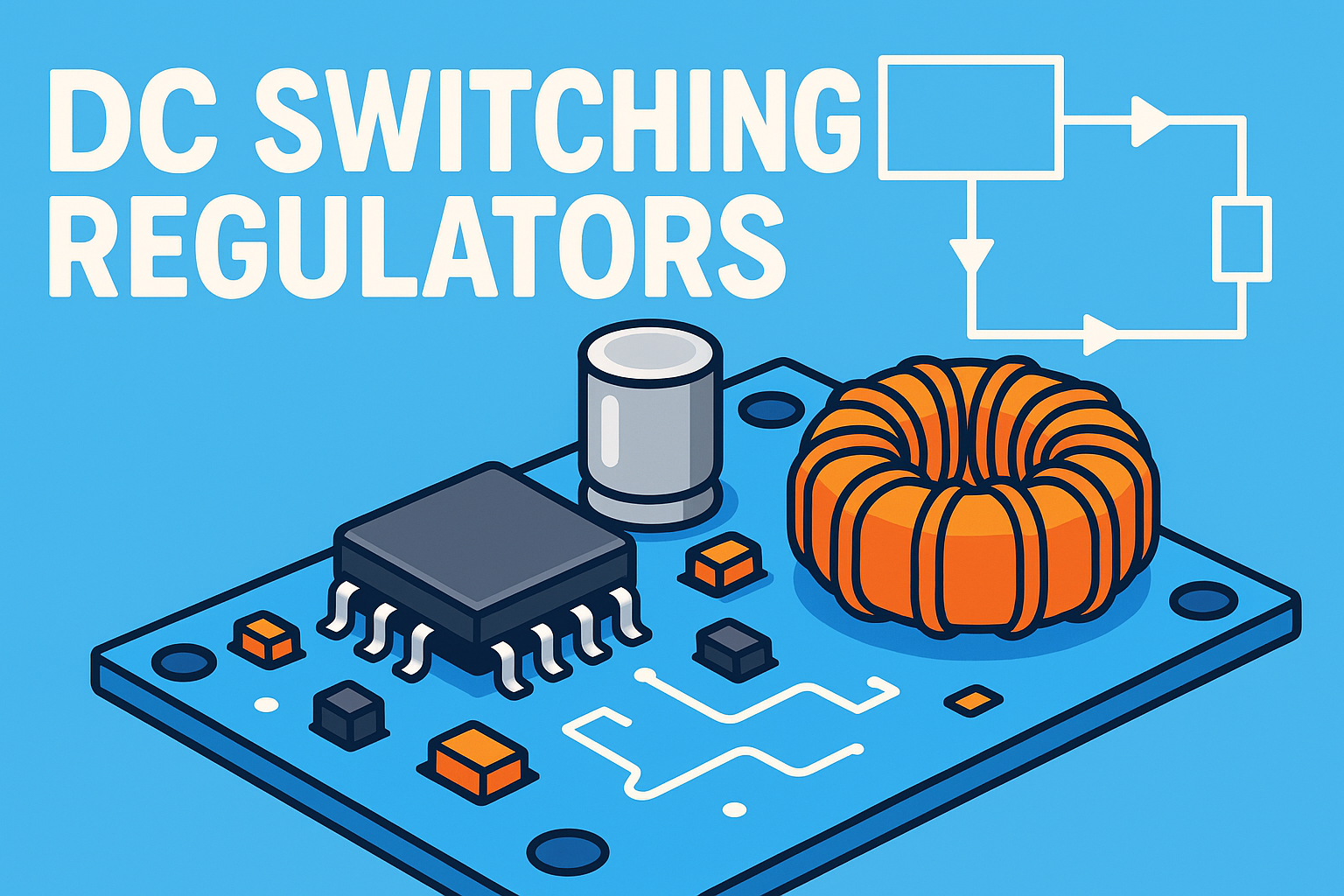
Let's talk about DC switching regulators - what they are, how they work, and how to choose them. Want to make your gadgets more powerful? Power efficiency is super important!Why Do We Need These "DC Switching Regulators" So Much?Hey, look at today's world - phones, computers, electric cars - which one can live without electricity? And they all need stable DC power. But here's the problem: battery voltage changes, and adapters don't output universal solutions. Using them directly will likely cause problems. That's when we need a "translator" to sort out the voltage properly - this "translator" is the voltage regulator.The old linear type was simple, but the efficiency was just terrible! Think about it - all that extra power just turned into heat and disappeared. What a waste! If phones used them, they'd probably be dead in half a day and burn your hands. So, DC switching regulators (DC-DC Switching Regulators) stepped up! These guys are famous for their high efficiency! They're practically the energy-saving champions of modern electronic devices.Have you ever encountered these annoying problems:Phone battery anxiety - charging several times a day?Laptop so hot you could fry an egg on it?Want to build something small, but the power section takes up more space than the core circuit?If so, you really need to read this article carefully. Today we're going to figure out these DC switching regulators once and for all!Figure 1: Look at this complex circuit board - power management is serious business!What's the Deal with This "Switching" Thing?DC switching regulators - you can tell from the name that "switching" is the key. Unlike the old-school linear regulators that stupidly "waste" excess voltage through resistance, these play the "switching" game.Simply put, they use a switching transistor (usually a MOSFET - pretty amazing stuff) to rapidly turn on and off, "chopping" the incoming power into pieces, then use inductors and capacitors as "storage warehouses" to store and smooth out these "power fragments," finally turning them into the stable DC power we want. It's kind of like a chef chopping vegetables and then plating them up!I tell you, when I first understood this principle, I was amazed! Just this simple and crude "on-off-on-off" could so efficiently convert energy - so clever! It's like using minimal effort to achieve maximum results.So its advantages are quite obvious:High! Efficiency! High! Important things said three times. The switching transistor is either fully on or fully off, doesn't consume much power itself, and energy whooshes right through. Good switching regulators can achieve efficiencies of over ninety percent!Flexible and adaptable - whether input voltage is high or low, it can handle it, and output stays stable.Many tricks - not only can it step voltage down (Buck), but also step it up (Boost), or even step up then down, or reverse the output polarity.Because of high efficiency, it doesn't generate much heat, so the whole power supply can be made very small, saving space!Of course, nothing's perfect. It also has some headaches:A bit more complex to design: External components like inductors and capacitors need to be chosen well, and the control part needs proper tuning.A bit "noisy": All that switching inevitably creates some voltage ripple and electromagnetic interference (EMI) that need to be "calmed down."Might cost a bit more: A few more components than linear regulators, and design takes more effort, so cost naturally goes up. But for high performance, this investment is worth it!"Honestly, efficiency is the lifeblood of DC switching regulators - it directly affects your precious gadget's battery life and heat generation."Common "Transformers": Main Topology StructuresThese switching regulators, depending on how they transfer energy and change voltage, are divided into several "schools," technically called "topology structures." The most common are these three:Step-Down Expert – Buck Converter (Buck, not Starbucks!)Buck means step-down. This one's used the most - powering CPUs on computer motherboards, powering various modules in phones - many use this. Its job is to convert high voltage (like 12V) into low, stable voltage (like 3.3V or 5V).Simply put, it first "stores" some power in an inductor, then slowly releases it to the load. Amazing when you think about it.Figure 2: Buck step-down circuit looks roughly like this (image from Wikipedia). Want to learn more? Check out Texas Instruments (TI)'s website - they have tons of material on this.Step-Up Champion – Boost ConverterBoost, as the name suggests, steps up voltage. For example, if you want to use one lithium battery (around 3.7V) to light up a string of LEDs that need 12V, you'd need this. It can "boost" low voltage up a level.I personally think Boost circuits are a bit more clever than Buck, because they first "hold" energy in the inductor, then in an instant "series-connect" the input voltage with the inductor voltage to boost the output. Pretty interesting!Figure 3: Boost step-up circuit schematic (image from Wikipedia). Analog Devices (ADI) also has good stuff in this area.Jack-of-All-Trades – Buck-Boost ConverterThis one's even more flexible - output voltage can be higher or lower than input. Especially suitable for situations where input voltage varies widely, like when a battery goes from full charge to nearly dead, but you still want stable output. However, the simplest Buck-Boost has inverted output voltage - meaning negative, which you need to watch out for.Now there are more advanced four-switch Buck-Boost converters that can achieve non-inverting step-up/step-down conversion. These are often used in USB PD fast charging - super convenient!Quick comparison of these three:FeatureStep-Down (Buck)Step-Up (Boost)Inverting Buck-BoostOutput VoltageLower than inputHigher than inputCan be higher or lower (but output is negative)Common ApplicationsCPU power, main system powerLED drivers, high voltage for displaysNegative voltage for displays, or where input varies but output must be stableOf course, there are more complex ones like SEPIC, Cuk, Flyback, but let's get these basics clear first!Overwhelmed by Choices? Picking the Right Switching Regulator - Look at These Points!Faced with all the different DC switching regulators on the market, picking a satisfactory one does take some thought. But don't panic - just focus on a few key points:Input voltage range VIN: This is super important! You need to ensure your power supply voltage, no matter how it fluctuates, stays within its acceptable range.Output voltage (VOUT​) and current (IOUT,max​): How many volts do you need? What's the maximum current it can handle? This depends on your "appliances," and you should leave some margin - don't cut it too close.Switching frequency (fSW): This parameter is quite tricky. High frequency means you can use smaller inductors and capacitors, saving space; but switching losses are also higher, and EMI problems might be more annoying. It's all about trade-offs!Efficiency (η): Especially for battery-powered devices, efficiency is the lifeline! Be sure to look at efficiency curves under different loads, not just the peak value.Quiescent current (IQ): This is the current the regulator "secretly consumes" when it's not working or working very lightly. For devices that need long standby times, the smaller this current, the better - otherwise the battery drains unknowingly.Package and thermal management: Is there enough space? How much heat does it generate? Choose the right package and consider thermal management well, or it'll burn out and that's no fun.Protection features: Things like overcurrent protection, overvoltage protection, thermal protection - like putting on "body armor," they can save the day when needed.Sometimes, for ultimate performance, you might use a switching regulator to roughly step down the voltage first, then use an LDO (a type of linear regulator) to provide cleaner, lower-noise voltage. Want to know what an LDO is? I remember reading an article about the physics behind Low Dropout Regulators (LDOs) that explained it pretty well - you can check it out.Selection is really a matter of experience. At first, you might feel overwhelmed by all the parameters and not know where to start. My advice is to focus on the most important ones first, like input/output voltage and current, then gradually refine. Read more datasheets, compare more options, and you'll get the feel for it with practice.Good Performance Depends on These "Behind-the-Scenes" DetailsBesides those basic parameters, some "invisible" performance and design details have huge impacts on DC switching regulator performance.Output ripple and noise: This is like ripples on water - switching regulators naturally create some. Our goal is to make these "ripples" as small as possible. Choosing good capacitors and inductors, and careful PCB layout can all help.Transient response: When load current suddenly increases or decreases, can the output voltage stay stable? It's like driving - when you suddenly accelerate or brake, the car shouldn't shake too much.Electromagnetic interference (EMI): Ugh, EMI is such a troublesome little devil! Switching regulators are major noise sources on circuit boards. PCB layout is especially important - that switching loop area must be small! Small! Small! Otherwise, radiation will mess up other circuits.Thermal management: No matter how high the efficiency, high power still generates heat. You need to let it dissipate heat comfortably, or thermal damage will be trouble.Component selection: How big should the inductor be? What material? Is saturation current enough? What about capacitors? What's the ESR (equivalent series resistance)? These all need careful consideration. MOSFET on-resistance, diode recovery time - these small details all affect efficiency.By the way, no matter how accurate a regulator's output voltage is, it can't work without a good "reference" - the reference voltage. For some particularly demanding applications, you need to think carefully about why precision reference ICs are so important - they have a big impact on the accuracy of the entire power system.Where Are These Used? They're Everywhere!Speaking of where DC switching regulators are used, there are just too many - they're truly the "cure-all" of the electronic world:Daily consumer electronics: Your phone, tablet, laptop, camera, gaming console... which one doesn't have several switching regulators working silently inside?Computers and servers: CPUs, graphics cards, memory modules - the power they consume is all "made" by switching regulators working hard.Inside cars: From navigation entertainment systems to control units, to cool LED headlights - they all need them.Industrial equipment: PLCs, sensors, motor drives... these industrial control devices have high requirements for power stability and efficiency.Communication networks: Base stations, routers, switches - these 24/7 non-stop devices especially need power efficiency.Plus medical devices, new energy vehicles, solar panels... really countless! See how important they are?Video 1: Find a DC-DC converter educational video to watch for a more intuitive understanding. (A real video link can go here)My Friend Mike's "Lifesaver" StoryI have a friend Mike who loves electronic DIY projects. Once he made a portable weather station powered by two dry batteries, wanting to power an ESP32 (which needs 3.3V). At first, he took the easy route and used an LDO, but what happened? When battery voltage dropped, the LDO gave up, and battery drain was super fast! He was so frustrated...Later I recommended he try a boost-type switching regulator to stably boost that pitiful battery voltage to 3.3V. Guess what? Hey, it worked! Not only did it solve the low voltage problem, but battery life tripled! Although the board had an extra small inductor and a few capacitors, it was worth it! He called that tiny switching regulator IC his "lifesaver"!After All This Talk, What Do You Think?We've talked so much about DC switching regulators - are you getting itchy hands too? Or do you have your own insights?Do you have any projects on hand that you think could be transformed with switching regulators?Besides the Buck, Boost, Buck-Boost we discussed today, do you know any more "advanced" techniques? Like Flyback or Forward? How are they different?When choosing switching regulators, which parameter do you value most? If several parameters "conflict" (like high frequency saves space but might consume more power), what do you do?For dealing with EMI, that little devil, besides PCB layout, do you have any secret weapons?Feel free to leave comments - let's exchange ideas!FAQ: Some Frequently Asked QuestionsQ1: What's the real difference between switching regulators and linear regulators (like LDOs)?A: Simply put, switching regulators are "tech-savvy" - they work through switching and energy storage elements, with high efficiency (usually 80%+), but circuits are a bit complex with some output ripple. Linear regulators are "honest workers" - they regulate through internal resistance, with simple circuits and clean output, but low efficiency. Especially when input-output voltage difference is large, they get hot enough to burn your hands!Q2: Can the "small ripple" (ripple) from switching regulator output be reduced?A: Absolutely! Methods include: 1. Use larger output capacitors; 2. Choose capacitors with low ESR (equivalent series resistance); 3. Add another stage of LC or RC filtering; 4. Be careful with PCB routing - keep high-frequency loops short and tight; 5. Some advanced techniques use multi-phase outputs. In short, there are always more solutions than problems!Q3: What is "synchronous rectification"? What are its benefits?A: Oh, "synchronous rectification" is mainly used in switching regulators (especially step-down types). It's using a MOSFET with very low on-resistance to replace the original freewheeling diode. The benefit is that when the MOSFET conducts, its voltage drop is much smaller than a diode's, so efficiency can improve significantly! This is especially noticeable with low output voltage and high current.Q4: Is higher switching frequency always better?A: Not necessarily! High frequency does allow smaller inductors and capacitors, making boards more compact. But! When frequency goes up, switching losses also rise proportionally (switching losses are proportional to frequency), efficiency might drop, and EMI problems might be more troublesome. So choosing frequency depends on what you prioritize - small size, high efficiency, or easy EMI compliance. You need to consider comprehensively, not be single-minded.Q5: Does PCB layout really affect switching regulators that much?A: It's huge! So huge you can't imagine! Poor layout makes even the best IC useless! Output ripple becomes frighteningly large, system instability, EMI failures that make you question life, even direct IC burnout is possible! The key is that high-current, fast-switching loop area - it must be small! Input/output capacitors must be placed right next to the IC pins! Ground planes need proper handling too! I strongly recommend: when you get a switching regulator IC, the first thing to do is carefully read the layout guidelines in its datasheet! That's blood and tears experience! Want to learn more? Search for EE Times articles about switching power supply layout - lots of good stuff there.So, About These Switching Regulators...After all this talk, do you have a new understanding of these little DC switching regulators? They might look insignificant, but they're really the pacemakers of modern electronic devices - high efficiency, versatile, absolutely essential!Understanding how they work, knowing how to choose the right one, and paying attention to design details (PCB layout! PCB layout! PCB layout! Important things said three times!), your circuits can reach the next level.And this technology is still developing - it'll definitely get better in the future: higher frequency, smaller size, more intelligent! Don't you think it's pretty interesting? Anyway, I think power management is a huge field of study, worth our careful exploration. When you have time, check out websites of major manufacturers like STMicroelectronics (ST) or Monolithic Power Systems (MPS) - they have lots of new stuff. h2, h3 { color: #1a73e8; } h2 { font-size: 24px; border-bottom: 2px solid #eee; padding-bottom: 10px; margin-top: 40px; margin-bottom: 20px;} h3 { font-size: 20px; margin-top: 30px; margin-bottom: 15px; color: #4a4a4a; } p { margin-bottom: 18px; text-align: left; } ul, ol { margin-bottom: 18px; padding-left: 25px; } li { margin-bottom: 10px; } strong { color: #e67e22; } em { color: #3498db; font-style: normal; font-weight: bold; } a { color: #1a73e8; text-decoration: none; } a:hover { text-decoration: underline; } .alt-text { text-align: center; font-size: 0.9em; color: #777; margin-top: -15px; margin-bottom: 25px; } blockquote { border-left: 4px solid #1a73e8; padding: 15px 25px; margin: 25px 0; background-color: #f0f8ff; font-style: italic; font-size: 1.05em; } table { width: 100%; border-collapse: collapse; margin: 25px 0; } th, td { border: 1px solid #ddd; padding: 12px; text-align: left; } th { background-color: #f2f2f2; color: #333; font-weight: bold;} .faq-question { font-weight: bold; color: #1a73e8; margin-top:15px;} .user-story { background-color: #eef7f2; padding: 20px; border-radius: 5px; margin-bottom: 25px; border-left: 5px solid #2ecc71; } .user-story h3 { color: #27ae60; margin-top: 0; } .conclusion { background-color: #f0f4f8; padding: 25px; border-radius: 5px; margin-top: 40px; } .conclusion h2 { border: none; } .highlight { background-color: #fff3cd; padding: 2px 5px; border-radius: 3px; } .my-thoughts { background-color: #fdf2e9; border: 1px dashed #e85d04; padding: 15px; margin: 20px 0; border-radius: 5px;} .my-thoughts p { margin-bottom: 10px;}
Kynix On 2025-05-30   208
IC Chips

STM32 Microcontrollers: Versatile Solutions for Modern Embedded Systems

STM microcontrollers have become a vital component in embedded systems due to their unmatched scalability, performance, and reliability. These microcontrollers simplify complex designs and accelerate development across industries.Luca Rodeschini, General Manager at STMicroelectronics, highlighted that Stellar microcontrollers with xMemory enhance car architectures, reducing costs and development time for manufacturers.The market reflects this success.Market size in 2023: USD 32.37 billion.Revenue forecast for 2030: USD 69.87 billion.Growth rate: 11.7% CAGR from 2024 to 2030.STM’s robust ecosystem ensures you can rely on it for diverse applications.Versatility of the STM32 SeriesImage Source: unsplashDiverse STM32 families for various applicationsThe STM32 series offers a wide range of microcontrollers and microprocessors, making it suitable for countless applications. Whether you are working on IoT devices, consumer electronics, or industrial automation, you can find an STM32 model that fits your needs. These microcontrollers come with integrated peripherals, which enhance connectivity and enable real-time processing. For example, you can use STM32 models with low-power modes for battery-operated devices like wearables or sensors. This flexibility allows you to design systems that balance performance and energy efficiency.Scalability from entry-level to high-performance needsSTM32 microcontrollers are designed to scale with your project requirements. You can start with entry-level models for simple tasks and move to high-performance variants for demanding applications. The STM32 family includes numerous options with varying processing power, memory sizes, and peripheral sets. This scalability ensures that you can upgrade or modify your design without switching to a completely different platform. For instance, if you are developing a prototype, you can begin with a basic STM32 model and later transition to a more advanced one as your project grows.Pin and software compatibility across the STM32 seriesOne of the standout features of the STM32 series is its pin and software compatibility. You can switch between different STM32 models without redesigning your hardware or rewriting your code. This compatibility saves time and reduces development costs. For example, if you need to upgrade your system’s performance, you can replace the microcontroller with a higher-end STM32 model while keeping the same PCB design. Additionally, the STM32 development ecosystem, including tools like STM32CubeMX, simplifies the process of adapting your software to new models.The versatility of the STM32 series empowers you to create innovative solutions across industries. Its diverse families, scalability, and compatibility make it a reliable choice for embedded systems.Performance and Features of STM32 MicrocontrollersHigh-performance ARM Cortex coresSTM32 microcontrollers deliver powerful performance thanks to their integration of ARM Cortex cores. These cores provide the computational power needed for demanding applications, from industrial automation to advanced robotics. You can rely on STM32 devices to handle complex tasks efficiently, ensuring smooth operation in real-time systems.To better understand the high performance of STM32 microcontrollers, consider the following benchmarks:STM32 SeriesCoreMark ScoreDMIPSOperating FrequencySTM32F4608225180 MHzSTM32F71082462216 MHzSTM32H732241327N/AThe STM32F4 series, for instance, achieved a CoreMark score of 469 at 168 MHz, showcasing its capabilities. When executing from RAM, the performance increased to 532 CoreMark, highlighting its efficiency. These metrics demonstrate why STM32 microcontrollers are trusted for applications requiring high performance and real-time capabilities.Energy efficiency and low-power modesEnergy efficiency is a critical factor in embedded systems, especially for battery-powered devices. STM32 microcontrollers excel in this area by offering advanced low-power modes. These modes allow you to optimize power consumption without sacrificing performance. For example, the STM32 Power Shield measures power consumption from as low as 180 nW to 165 mW. It also supports static current measurements ranging from 1 nA to 200 nA. This wide range ensures you can analyze power usage across various scenarios.The ULPMark benchmark further validates the energy efficiency of STM32 devices. By leveraging these low-power modes, you can extend battery life in applications like IoT sensors, wearables, and medical devices. This makes STM32 microcontrollers an excellent choice for energy-conscious designs.Integrated peripherals for real-time and connectivitySTM32 microcontrollers come equipped with a rich set of peripherals that enhance their real-time capabilities and connectivity options. These peripherals include timers, communication interfaces (like UART, SPI, and I2C), and advanced features like Ethernet and USB support. You can use these peripherals to build systems that require precise timing and seamless data exchange.For real-time applications, STM32 microcontrollers offer deterministic performance, ensuring tasks are executed within strict time constraints. This is crucial for systems like industrial automation and robotics, where delays can lead to failures. Additionally, the integrated connectivity options simplify the development of IoT devices, enabling secure and efficient communication with other systems.The combination of high-performance cores, energy efficiency, and integrated peripherals makes STM32 microcontrollers a versatile and reliable choice for embedded systems. Whether you're developing consumer electronics or industrial solutions, STM32 devices provide the tools you need to succeed.Developer Support and STM EcosystemDevelopment tools like STM32Cube and STM32CubeMXSTM32Cube and STM32CubeMX are essential tools in the STM32 development ecosystem. These tools simplify the process of learning embedded systems by offering developer-friendly features that enhance productivity and reduce errors. STM32CubeIDE, an all-in-one development tool, integrates multiple functionalities, so you don’t need separate tools for coding, debugging, or project management. This integration saves time and ensures a smoother workflow.STM32CubeMX, on the other hand, focuses on peripheral configuration and code generation. You can easily configure peripherals, which improves reliability during development. The automatic code generation feature minimizes human error and speeds up the process. Additionally, advanced debugging capabilities help you identify and resolve issues quickly, ensuring robust application support. The table below highlights the key features of these tools:FeatureDescriptionAll-in-one Development ToolSTM32CubeIDE integrates multiple functionalities, reducing the need for separate tools.Peripheral ConfigurationUsers can configure peripherals easily, enhancing reliability in development.Code GenerationAutomatic code generation minimizes human error and speeds up the development process.Debugging FeaturesAdvanced debugging tools help identify and resolve issues quickly, ensuring robust application support.Integration with STM32CubeMXSeamless integration allows for easy project setup and configuration, improving development efficiency.Build and Stack AnalyzersProvides insights into project status and memory requirements, aiding in resource management.These tools provide advanced programming capabilities that cater to both beginners and experienced developers. Whether you’re starting a new project or optimizing an existing one, STM32Cube and STM32CubeMX offer the comprehensive development ecosystem you need.Extensive documentation and learning resourcesSTM provides extensive support through its detailed documentation and learning resources. You can access user manuals, application notes, and reference guides that cover every aspect of STM32 microcontrollers. These resources make it easier to understand the hardware and software, even if you’re new to embedded systems.For those looking to deepen their knowledge, STM offers online courses, webinars, and tutorials. These materials help you master advanced programming capabilities and explore the full potential of STM32 devices. By leveraging these resources, you can accelerate your learning curve and build confidence in your skills.Active community and third-party supportThe STM developer ecosystem thrives on its active community and third-party support. You can connect with other developers through forums, social media groups, and dedicated platforms like the ST Community. These spaces allow you to share ideas, ask questions, and find solutions to common challenges.Third-party support further enriches the ecosystem. Many companies provide libraries, middleware, and tools compatible with STM32 microcontrollers. This collaboration ensures you have access to a wide range of resources, making it easier to integrate STM32 devices into your projects. The combination of community support and third-party contributions creates a robust ecosystem that fosters innovation and problem-solving.With STM’s support and ecosystem, you gain access to tools, resources, and a community that empowers you to succeed in your embedded system projects.Real-World Applications of STM MicrocontrollersImage Source: unsplashUse in consumer electronics and industrial automationSTM32 microcontrollers play a pivotal role in consumer electronics and industrial automation. Their robust architecture ensures reliable performance even in harsh environments. You can use them to power devices like smart home appliances, wearable gadgets, and advanced industrial machinery. The scalability of the STM32 series allows you to choose from entry-level to high-performance models, making it easier to balance cost and functionality.The rich peripheral set of STM32 microcontrollers simplifies the integration of sensors and communication interfaces. This feature is particularly useful in industrial automation, where real-time capabilities are critical. For instance, you can rely on STM32 devices to manage precise timing in robotic arms or conveyor systems. Their energy efficiency also makes them ideal for applications requiring low power consumption, such as portable consumer electronics.FeatureDescriptionRobust ArchitectureStrong and adaptable architecture ideal for harsh environments, prioritizing efficiency and reliability.ScalabilityWide range of options from high-performance to entry-level models, allowing cost-effective selections.Rich Peripheral SetExtensive peripherals for easy integration of sensors and communication interfaces.Real-Time CapabilitiesSuperior real-time performance critical for applications requiring timing accuracy.Energy EfficiencyEffective power management and low-power modes suitable for energy-conscious applications.Comprehensive Development EcosystemFeature-rich IDE and supportive community to accelerate development.Security FeaturesStrong security capabilities to protect industrial systems from potential attacks.Long-Term AvailabilityReliable long-term support and availability from STMicroelectronics for industrial applications.Applications in IoT, robotics, and medical devicesThe STM32 series excels in IoT, robotics, and medical devices. You can use STM32 microcontrollers to connect IoT devices seamlessly, thanks to their integrated connectivity options like Wi-Fi, Bluetooth, and Ethernet. These features enable secure and efficient communication between devices, making them perfect for smart cities and home automation systems.In robotics, STM32 microcontrollers provide the real-time performance needed for precise movements and decision-making. For example, you can use them in drones or robotic vacuum cleaners to ensure smooth operation. In medical devices, their energy efficiency and reliability are crucial. Devices like portable monitors and insulin pumps benefit from the low-power modes of STM32 chips, ensuring extended battery life and consistent performance.Reliability and certifications for critical systemsSTM32 microcontrollers meet stringent reliability and safety standards, making them suitable for critical systems. Certifications like TüV Rheinland and UL Class B validate their compliance with international safety regulations. These certifications ensure that STM32 devices can be trusted in applications like automotive systems, industrial control, and medical equipment.Image Source: statics.mylandingpages.coFor example, the TüV Rheinland certification for dual-core STM32 microcontrollers ensures their safety in automotive and industrial applications. Similarly, UL Class B certifications confirm their reliability in home appliances and medical devices. These certifications, combined with the long-term availability of STM32 chips, make them a dependable choice for critical systems.STM32 microcontrollers empower you to create innovative solutions across industries. Their versatility, reliability, and compliance with safety standards make them indispensable in modern technology.STM microcontrollers, especially the STM32 series, have set a benchmark in the embedded systems industry. Their scalability allows you to address both simple and complex applications without switching platforms. The powerful performance, combined with features like high-speed memory interfaces and on-chip power management, ensures seamless execution of demanding tasks. Additionally, the robust STM ecosystem, with tools like TouchGFX and extensive developer support, simplifies your development process.FeatureDescriptionBootflash MemoryEnsures easier and more secure startup, facilitating application development.Integrated NeoChrom GPUEnables rich graphical user interfaces with minimal CPU usage, enhancing user experience.On-chip Power ManagementReduces the need for external components, simplifying design and reducing costs.High-speed Memory InterfacesOperate at up to 200MHz, ensuring seamless application execution.Wide Range of Package OptionsOffers flexibility in design, accommodating various application needs with fewer PCB layers.Support for TouchGFX FrameworkContinuously updated to allow developers to create advanced graphics and animations.The STM32 series excels in versatility, offering a wide range of products tailored to diverse applications. Its developer-friendly tools and strong ecosystem make it a preferred choice for embedded projects. With a growing presence across industries, STM microcontrollers continue to shape the future of technology.FAQ1. What makes STM32 microcontrollers suitable for beginners?STM32 microcontrollers offer user-friendly tools like STM32CubeMX for peripheral configuration and code generation. These tools simplify development and reduce errors. Extensive documentation and tutorials help you learn quickly, even if you're new to embedded systems.2. Can STM32 microcontrollers handle real-time applications?Yes, STM32 microcontrollers excel in real-time systems. Their high-performance ARM Cortex cores and integrated peripherals ensure precise timing and reliable execution. You can use them for robotics, industrial automation, and other time-sensitive applications.3. How do STM32 microcontrollers support IoT projects?STM32 devices include connectivity options like Wi-Fi, Bluetooth, and Ethernet. These features enable secure communication between devices. You can build IoT systems for smart homes, cities, or industrial monitoring with ease.4. Are STM32 microcontrollers energy-efficient?STM32 microcontrollers offer advanced low-power modes, optimizing energy consumption. You can extend battery life in portable devices like wearables and IoT sensors. Their energy efficiency makes them ideal for applications requiring minimal power usage.5. What resources are available for STM32 developers?You can access STM32Cube tools, detailed documentation, and online tutorials. The active STM community provides support and solutions. Third-party libraries and middleware further enhance your development experience.
Kynix On 2025-05-24   89
IC Chips

Understanding Zero-Cross Detectors

Zero-cross detectors identify the moment when an alternating signal transitions through zero voltage. This technology plays a vital role in modern electronics by enabling precise control over electrical systems. Engineers use it to synchronize circuits, reduce energy waste, and improve automation processes. Signal processing applications also benefit from its ability to detect phase changes accurately. These capabilities make zero-cross detection indispensable in industries relying on efficiency and precision.Understanding Zero-Cross DetectorsWhat are zero-cross detectors?Zero-cross detectors are electronic circuits or devices designed to identify the precise moment when an alternating signal crosses the zero-voltage level. This crossing point, known as the zero crossing, occurs as the signal transitions from positive to negative or vice versa. These detectors play a critical role in applications requiring synchronization, timing, or phase detection.The basic operation of a zero-cross detector involves monitoring an input signal and generating an output pulse whenever the signal passes through zero. Engineers often use operational amplifiers or comparators to design these circuits. For example, a comparator compares the input signal with a reference voltage (usually zero) and triggers an output when the signal matches the reference. This simple yet effective mechanism forms the foundation of many advanced systems.Zero-cross detectors are essential in both analog and digital systems. In analog systems, they help in signal conditioning and waveform analysis. In digital systems, they assist in edge detection and timing control. Their versatility makes them a cornerstone of modern electronics.Importance of zero-cross detection in electronicsZero-cross detection is vital for ensuring precision and efficiency in electronic systems. It enables accurate timing and synchronization, which are crucial for various applications. For instance, in power electronics, zero-cross detectors help control the switching of devices like thyristors and triacs. This reduces power loss and enhances energy efficiency.In automation and industrial control systems, zero-cross detection ensures smooth operation by synchronizing processes with the AC power supply. This minimizes wear and tear on mechanical components and improves overall system reliability. Additionally, zero-cross detectors play a significant role in image processing. They assist in feature detection by identifying edges and transitions in visual data, enabling accurate analysis and interpretation.Another critical application lies in audio signal processing. Zero-cross detection helps reduce distortion by ensuring that signals are processed at the correct phase. This improves sound quality and enhances the listening experience. Furthermore, zero-cross detectors are integral to IoT devices and smart home technologies. They enable precise control of appliances, lighting, and other systems, contributing to energy savings and convenience.Note: The importance of zero-cross detection extends beyond traditional electronics. Its applications in emerging fields like artificial intelligence and machine learning highlight its potential for future innovation.Historical Background of Zero-Cross DetectionEarly methods and their limitationsThe early days of zero-cross detection relied on simple analog circuits. These circuits often used basic components like resistors, capacitors, and diodes to identify the zero-crossing point of an alternating signal. While these methods were innovative for their time, they faced significant challenges in accuracy and reliability.One major issue was the inability of these detectors to consistently capture every zero crossing. This led to erratic behavior in connected devices, especially in systems requiring precise timing. Another common problem occurred in pulse-width modulation (PWM) waveform generation. The detectors often produced inconsistent pulses, resulting in unreliable performance. Additionally, the trigger points in these systems frequently misaligned with the intended settings, causing limited power output and unpredictable operation. The table below summarizes these limitations:Example/IssueDescriptionZero Crossing DetectionThe detector fails to catch every zero crossing, leading to erratic behavior in connected devices.PWM Waveform GenerationThe expected PWM waveform is not produced correctly, with pulses being too short and inconsistent.Trigger Point VariabilityThe trigger point does not align with the PWM slider settings, resulting in limited power output and erratic performance.These limitations highlighted the need for more advanced solutions, paving the way for the development of integrated circuits.The emergence of integrated circuits for zero-cross detectionThe introduction of integrated circuits (ICs) revolutionized zero-cross detection technology. In the mid-1990s, optocoupled synchronous zero-voltage triacs emerged as a significant advancement. These devices offered improved performance and cost-effectiveness, particularly in driving high-power triacs. Earlier ICs, such as the CA3059 and TDA1024, also played a crucial role in advancing the field. They included features like AC-derived DC power supply circuitry and built-in zero-crossing detection, which enhanced their functionality.The new optocoupled ICs addressed many of the challenges faced by earlier methods. They provided greater accuracy, reliability, and efficiency, making them ideal for applications in power electronics and industrial systems. By integrating zero-cross detection into compact and efficient ICs, engineers could design more sophisticated and reliable electronic systems. This marked a pivotal moment in the history of zero-cross detection, setting the stage for further innovations.Evolution of Zero-Cross Detection TechnologyKey breakthroughs in design and functionalityZero-cross detection technology has undergone significant advancements since its inception. Early designs relied on basic analog circuits, but modern systems incorporate sophisticated components to enhance performance. One major breakthrough was the development of integrated circuits (ICs) with built-in zero-cross detection capabilities. These ICs improved accuracy and reliability, making them suitable for high-precision applications like power electronics and automation.Another milestone was the introduction of optocoupled zero-cross detectors. These devices provided electrical isolation, ensuring safer operation in high-voltage environments. Additionally, advancements in signal processing algorithms allowed detectors to handle noisy environments more effectively. This improved their ability to identify zero crossing points accurately, even in complex waveforms.Role of semiconductors in advancing zero-cross detectorsSemiconductors have played a pivotal role in the evolution of zero-cross detectors. Modern semiconductor-based ICs, such as ROHM's BM1ZxxxFJ series, have revolutionized the field. These ICs enhance reliability by accurately detecting the zero crossing of AC waveforms, which is essential for controlling motors and microcontroller units (MCUs). They also eliminate the need for photocouplers, reducing the risk of performance degradation over time.The table below highlights key features of semiconductor-based zero-cross detectors:Feature/AdvantageDescriptionImproved ReliabilityEnhances the performance of home appliances by ensuring precise detection.Elimination of PhotocouplersReduces operational inconsistencies across varying AC voltages.Voltage CompatibilitySupports input voltages up to 600V, ensuring safe operation in high-voltage systems.These advancements have made zero-cross detectors more efficient and versatile, enabling their use in a wide range of applications, from industrial automation to image processing.Integration with digital systems and edge detectionThe integration of zero-cross detectors with digital systems has opened new possibilities in computer vision and feature detection. By combining analog detection with digital processing, engineers have created systems capable of identifying edges and transitions in signals with remarkable precision. This is particularly useful in image processing, where zero-cross detectors assist in detecting edges and transitions in visual data.For example, the canny edge detector, a popular algorithm in computer vision, relies on zero-cross detection to identify edges in images. This integration has improved the accuracy of feature detection in applications like facial recognition and object tracking. Furthermore, digital systems enable real-time processing, making zero-cross detectors indispensable in modern automation and IoT devices.Tip: The combination of zero-cross detection and digital edge detection has significantly enhanced the capabilities of computer vision systems, paving the way for future innovations.Modern Applications of Zero-Cross DetectorsImage Source: pexelsPower electronics and energy efficiencyZero-cross detectors play a crucial role in power electronics by improving energy efficiency. They help control the switching of devices like thyristors and triacs. These components manage the flow of electricity in circuits, ensuring minimal energy loss. By detecting the zero crossing of an AC signal, these detectors allow devices to switch at the optimal moment. This reduces power surges and extends the lifespan of electrical components.In renewable energy systems, zero-cross detectors enhance the performance of inverters. Inverters convert DC power from solar panels or batteries into AC power for household use. Accurate zero crossing detection ensures smooth transitions, reducing energy waste. This technology also supports energy-efficient lighting systems. For example, LED dimmers use zero-cross detectors to adjust brightness levels without flickering.The ability to synchronize with AC signals makes zero-cross detectors essential in modern power grids. They enable precise timing, which improves the stability and efficiency of electricity distribution. This contributes to a more sustainable energy future.Automation and industrial control systemsAutomation systems rely on zero-cross detectors for precise timing and synchronization. In industrial settings, these detectors ensure that machinery operates in harmony with the AC power supply. This reduces mechanical stress and increases the reliability of equipment. For example, motor controllers use zero-cross detection to regulate speed and torque. This improves the efficiency of conveyor belts, robotic arms, and other automated systems.In manufacturing, zero-cross detectors assist in edge detection for quality control. They identify transitions in signals, which helps detect defects in materials or products. This ensures that only high-quality items reach the market. Additionally, these detectors support programmable logic controllers (PLCs). PLCs use zero-cross detection to coordinate complex processes, such as assembly lines and packaging systems.Zero-cross detectors also enhance safety in industrial environments. By detecting zero crossing points, they prevent sudden power surges that could damage equipment or cause accidents. This makes them a vital component in modern automation systems.IoT devices and smart home technologiesThe integration of zero-cross detectors into IoT devices has revolutionized smart home technologies. These detectors enable precise control of appliances, lighting, and HVAC systems. For instance, smart thermostats use zero-cross detection to optimize heating and cooling cycles. This reduces energy consumption and lowers utility bills.In smart lighting systems, zero-cross detectors ensure smooth dimming and switching. They detect the zero crossing of AC signals, which prevents flickering and extends the lifespan of bulbs. This technology also supports advanced features like motion-activated lighting and color temperature adjustments.Zero-cross detectors contribute to the functionality of smart plugs and energy monitors. These devices track power usage and provide real-time feedback to users. By detecting zero crossing points, they ensure accurate measurements and efficient operation. This makes them an integral part of energy-saving initiatives in smart homes.In addition, zero-cross detectors play a role in edge detection for IoT security cameras. They assist in image processing by identifying edges and transitions in visual data. This improves the accuracy of computer vision systems, enabling features like facial recognition and motion detection. The canny edge detector, a popular algorithm in computer vision, benefits from the precision of zero-cross detection. This combination enhances the performance of IoT devices in both residential and commercial settings.Note: The widespread adoption of zero-cross detectors in IoT and smart home technologies highlights their versatility and importance in modern electronics.Challenges and Future Trends in Zero-Cross DetectionCurrent challenges in zero-cross detection technologyZero-cross detection technology faces several challenges in modern applications. Sensitive electronics often malfunction due to electrical noise disturbances on AC mains supplies. These disturbances can cause issues such as false triggers, timing failures, and latchup conditions. Other problems include dielectric isolation failure, electromigration, and electrostatic discharge (ESD) injection. These challenges reduce the reliability of systems that rely on zero-cross detectors.To address these issues, zero-cross detectors monitor AC voltage and activate loads precisely at zero-crossing points. This reduces the impact of electrical noise and improves system stability. However, achieving consistent performance in noisy environments remains a significant hurdle. Engineers continue to explore ways to enhance the robustness of these detectors to meet the demands of modern electronics.Innovations in AI and machine learning for edge detectionArtificial intelligence and machine learning are transforming zero-cross detection and edge detection technologies. By integrating machine learning with real-time signal analysis, engineers have achieved remarkable improvements in detection accuracy. For example, experimental data shows a 93.8% event discovery rate and 99.8% classification accuracy when using machine learning for multiplexed detection.FeatureDescriptionMethodologyIntegration of machine learning with real-time signal analysis for multiplexed detectionPerformance93.8% event discovery rate and 99.8% classification accuracyApplicationUsed in an optofluidic MMI waveguide device for detecting biomoleculesTechnologyUtilizes a Google Coral Dev board for real-time processingThese advancements enhance the precision of edge detection in applications like computer vision. For instance, the canny edge detector benefits from AI-driven improvements, enabling more accurate identification of edges and transitions in visual data. This innovation supports applications in facial recognition, object tracking, and industrial automation.Future advancements in precision and integrationFuture developments in zero-cross detection technology will focus on improving precision and integration. Engineers aim to design detectors capable of operating in increasingly complex environments. Enhanced algorithms will allow detectors to process noisy signals with greater accuracy. This will benefit applications in power electronics, automation, and computer vision.Integration with digital systems will also advance. Compact, semiconductor-based detectors will combine analog and digital capabilities, enabling real-time processing. These systems will support emerging technologies like IoT and AI-driven automation. As zero-cross detectors become more precise and versatile, they will play a critical role in shaping the future of electronics.Zero-cross detectors have evolved from basic analog circuits to advanced semiconductor-based systems. Early designs faced challenges like inconsistent detection and limited reliability. The introduction of integrated circuits and optocoupled devices marked a turning point, enabling greater precision and efficiency.Key Takeaway: Zero-cross detectors are essential in modern electronics. They improve energy efficiency, enhance automation, and support IoT innovations.Future advancements in AI and integration promise even greater precision and versatility. These detectors will continue shaping industries, driving innovation, and contributing to a smarter, more efficient world.FAQWhat is the primary purpose of a zero-cross detector?A zero-cross detector identifies the exact moment when an alternating signal crosses the zero-voltage level. This helps synchronize electronic systems, improve timing accuracy, and reduce energy waste in applications like power electronics, automation, and signal processing.How does a zero-cross detector improve energy efficiency?Zero-cross detectors enable devices like thyristors and triacs to switch at the optimal moment. This minimizes power surges and reduces energy loss. In renewable energy systems, they ensure smooth transitions in inverters, enhancing overall efficiency.Can zero-cross detectors work in noisy environments?Yes, modern zero-cross detectors use advanced algorithms and semiconductor technology to filter out noise. This allows them to detect zero crossings accurately, even in environments with electrical disturbances or complex waveforms.Are zero-cross detectors used in smart home devices?Absolutely! Zero-cross detectors are integral to smart lighting, thermostats, and energy monitors. They ensure smooth dimming, optimize heating and cooling cycles, and provide accurate power usage data, making homes more energy-efficient and convenient.What industries benefit most from zero-cross detection?Industries like power electronics, automation, IoT, and renewable energy rely heavily on zero-cross detection. It enhances system reliability, improves energy efficiency, and supports advanced technologies like computer vision and AI-driven automation.Tip: Zero-cross detectors are versatile tools that continue to shape modern electronics and emerging technologies.
Kynix On 2025-05-24   169

Kynix

Kynix was founded in 2008, specializing in the electronic components distribution business. We adhere to honesty and ethics as our business philosophy and have gradually established an excellent reputation and credibility in our international business. With the accurate quotation, excellent credit, reasonable price, reliable quality, fast delivery, and authentic service, we have won the praise of the majority of customers.

Follow us

Join our mailing list!

Be the first to know about new products, special offers, and more.

Kynix

  • How to purchase

  • Order
  • Search & Inquiry
  • Shipping & Tracking
  • Payment Methods
  • Contact Us

  • Tel: 00852-6915 1330
  • Email: info@kynix.com
  • Follow Us

authentication

Kynix

© 2008-2026 kynix.com all rights reserved.