The Kynix Blog
Stay Ahead with Expert Electronics Insights,
Industry Trends, and Innovative Tips
- Electronic Components
- News Room
- General electronic semiconductor
- Components Guide
- Sort by
- Robots
- Transmitters
- Capacitors
- IC Chips
- PCBs
- Connectors
- Amplifiers
- Memory
- LED
- Diodes
- Transistors
- Battery
- Oscillators
- Resistors
- Transceiver
- RFID
- FPGA
- Mosfets
- Sensor
- Motors, Solenoids, Driver Boards/Modules
- Relays
- Optoelectronics
- Power
- Transformer
- Fuse
- Thyristor
- potentiometer
- Development Boards
- RF/IF
- Semiconductor Information
- PCB
- transistor
Have you heard of Silicon carbide power devices yet? Researchers are rolling out a new manufacturing process and chip design for silicon carbide (SiC) power devices, which can be used to more efficiently regulate power in technologies that use electronics. The process -- called PRESiCE -- was developed to make it easier for companies to enter the SiC marketplace and develop new products.(Silicon carbide power devices, like the one shown here, are more efficient than their silicon counterparts.)"PRESiCE will allow more companies to get into the SiC market, because they won't have to initially develop their own design and manufacturing process for power devices -- an expensive, time-consuming engineering effort," says Jay Baliga, Distinguished University Professor of Electrical and Computer Engineering at NC State and lead author of a paper on PRESiCE that will be presented later this month. "The companies can instead use the PRESiCE technology to develop their own products. That's good for the companies, good for consumers, and good for U.S. manufacturing." Power devices consist of a diode and transistor, and are used to regulate the flow of power in electrical devices. For decades, electronics have used silicon-based power devices. In recent years, however, some companies have begun using SiC power devices, which have two key advantages. First, SiC power devices are more efficient, because SiC transistors lose less power. Conventional silicon transistors lose 10 percent of their energy to waste heat. SiC transistors lose only 7 percent. This is not only more efficient, but means that product designers need to do less to address cooling for the devices. Second, SiC devices can also switch at a higher frequency. That means electronics incorporating SiC devices can have smaller capacitors and inductors -- allowing designers to create smaller, lighter electronic products. But there's a problem. Up to this point, companies that have developed manufacturing processes for creating SiC power devices have kept their processes proprietary -- making it difficult for other companies to get into the field. This has limited the participation of other companies and kept the cost of SiC devices high. The NC State researchers developed PRESiCE to address this bottleneck, with the goal of lowering the barrier of entry to the field for companies and increasing innovation. The PRESiCE team worked with a Texas-based foundry called X-Fab to implement the manufacturing process and have now qualified it -- showing that it has the high yield and tight statistical distribution of electrical properties for SiC power devices necessary to make them attractive to industry. "If more companies get involved in manufacturing SiC power devices, it will increase the volume of production at the foundry, significantly driving down costs," Baliga says. Right now, SiC devices cost about five times more than silicon power devices. "Our goal is to get it down to 1.5 times the cost of silicon devices," Baliga says. "Hopefully that will begin the 'virtuous cycle': lower cost will lead to higher use; higher use leads to greater production volume; greater production volume further reduces cost, and so on. And consumers are getting a better, more energy-efficient product." The researchers have already licensed the PRESiCE process and chip design to one company, and are in talks with several others. "I conceived the development of wide bandgap semiconductor (SiC) power devices in 1979 and have been promoting the technology for more than three decades," Baliga says. "Now, I feel privileged to have created PRESiCE as the nation's technology for manufacturing SiC power devices to generate high-paying jobs in the U.S. We're optimistic that our technology can expedite the commercialization of SiC devices and contribute to a competitive manufacturing sector here in the U.S.," Baliga says. The paper, "PRESiCE: PRocess Engineered for manufacturing SiC Electronic-devices," will be presented at the International Conference on Silicon Carbide and Related Materials, being held Sept. 17-22 in Washington, D.C. The paper is co-authored by W. Sung, now at State University of New York Polytechnic Institute; K. Han and J. Harmon, who are Ph.D. students at NC State; and A. Tucker and S. Syed, who are undergraduates at NC State. The work was supported by PowerAmerica, the Department of Energy-funded manufacturing innovation institute that focuses on boosting manufacturing of wide bandgap semiconductor-based power electronics. ref.KY56-PZTA06KY41-SL12T1G
kynix On 2017-10-09
A team of University of Wisconsin-Madison engineers has created the most functional flexible transistor in the world -- and with it, a fast, simple and inexpensive fabrication process that's easily scalable to the commercial level. It's an advance that could open the door to an increasingly interconnected world, enabling manufacturers to add "smart," wireless capabilities to any number of large or small products or objects -- like wearable sensors and computers for people and animals -- that curve, bend, stretch and move. Transistors are ubiquitous building blocks of modern electronics. The UW-Madison group's advance is a twist on a two-decade-old industry standard: a BiCMOS (bipolar complementary metal oxide semiconductor) thin-film transistor, which combines two very different technologies -- and speed, high current and low power dissipation in the form of heat and wasted energy -- all on one surface. As a result, these "mixed-signal" devices (with both analog and digital capabilities) deliver both brains and brawn and are the chip of choice for many of today's portable electronic devices, including cellphones. "The industry standard is very good," says Zhenqiang (Jack) Ma, the Lynn H. Matthias Professor and Vilas Distinguished Achievement Professor in electrical and computer engineering at UW-Madison. "Now we can do the same things with our transistor -- but it can bend." Ma is a world leader in high-frequency flexible electronics. He and his collaborators described their advance in the inaugural issue of the journal Flexible Electronics. Making traditional BiCMOS flexible electronics is difficult, in part because the process takes several months and requires a multitude of delicate, high-temperature steps. Even a minor variation in temperature at any point could ruin all of the previous steps. Ma and his collaborators fabricated their flexible electronics on a single-crystal silicon nanomembrane on a single bendable piece of plastic. The secret to their success is their unique process, which eliminates many steps and slashes both the time and cost of fabricating the transistors. "In industry, they need to finish these in three months," he says. "We finished it in a week." He says his group's much simpler high-temperature process can scale to industry-level production right away. "The key is that parameters are important," he says. "One high-temperature step fixes everything -- like glue. Now, we have more powerful mixed-signal tools. Basically, the idea is for flexible electronics to expand with this. The platform is getting bigger." Ref.KY56-2SA1860KY45-EKMC1601113
kynix On 2017-09-29
Today I want to share an LED strobe design project I found in electronic-lab, which you can do it by yourself. Strobe provides regular flashes of light. Usually Strobes are designed using Xenon Tubes. Here is LED based simple solution that can be used as strobe for entertainment and events and also as warning signals. Project is based on PIC16F1825 micro-controller with two digit frequency display. Project provides TTL output signal, frequency 1Hz-25Hz, Tact switches provided to set the frequency. This project works along with DC Output Solid State Relay Features 1.Supply 4.5 to 5V DC2.Frequency 1Hz To 25Hz3.Easy Interface with Relay Board4.Easy Interface with Solid State Relay5.On Board Power LEDOn Board Output LED6.Onboard Switch to set the frequency7.2X7 Segment 0.5 Inch Display Applications 1.Strobe for Entertainment2.Traffic Signal3.Warning Signal4.Ambulance Warning Signals Schematic Parts List Connections Photos Working Diagram Ref.PIC16F1825
kynix On 2017-09-28
A Tomsk Polytechnic University study reveals how topological vortices found in low-dimensional materials can be both displaced and erased and restored again by the electrical field within nanoparticles. This may open exciting opportunities for memory devices or quantum computers in which information will be encrypted in the characteristics of topological vortices.(Vortices in nanoparticles exposed by the electrical field. Credit: Tomsk Polytechnic University (TPU))Scientists from TPU and international collaborators have discovered unusual self-organization of atoms in the volume of nanoparticles and have learned to control it via an electric field. Such controlled nanoparticles can be used to generate capacious non-volatile random access memory (NRAM), quantum computers and other next-generation electronics. The main author is Dmitriy Karpov, engineer of the Department of General Physics, TPU, who explains that in modern materials science, the defects of matter are divided into two large groups. The first group includes classical, well-studied defects, when atoms in matter are mechanically disordered, i.e., atoms are either removed or inserted into the lattice. In the other group, the spatial organization of the lattice itself changes and such defects are called topological. Topological defects can strongly influence matter, making it superfluid or superconductive, and therefore, it is very important to study them. Topological defects can be found only in low-dimensional materials—two-dimensional nanorods and nanofilms (just several atoms thick) and one-dimensional nanodots or nanoparticles, which are spherical particles consisting of several tens or hundreds of identical atoms. "One of the important topological defects is a topological vortex which looks like a discernible twisting caused by a small displacement of all atoms. The vortex core is a nanostrand which can be both displaced by the field, and erased and restored again within nanoparticles," explains Edwin Fohtung, Professor of Los Alamos National Laboratory and New Mexico State University . The scientists studied barium titanate nanoparticles whose internal structure was visualized with the help of penetrating X-ray radiation from the synchrotron Advanced Photon Source (Chicago, USA). They obtained an image of the volume of nanoparticles with a resolution of 18 nanometers, which enabled them to analyze the slightest changes in the structure. As a result, the researchers showed that an external electric field can displace the core of the topological vortex inside the nanoparticle, and when the field is removed, it returns to its original position. Modern components of electronics are gradually becoming smaller. This can significantly influence the efficiency of devices, which will be significantly reduced due to quantum effects. One way to circumvent these limitations is to use topological vortices. Thus, they can be used to generate high density NRAM or quantum computers in which information will be encrypted in the characteristics of topological vortices. "All in all, the possibility to control and adjust topological vortices in nanoparticles is important for the creation of new electronics," concludes Dmitriy Karpov. Further reading>>>Topological defectA topological defect can be proven to exist[when?] because the boundary conditions entail the existence of homotopically distinct solutions. Typically, this occurs because the boundary on which the conditions are specified has a non-trivial homotopy group which is preserved in differential equations; the solutions to the differential equations are then topologically distinct, and are classified by their homotopy class. Topological defects are not only stable against small perturbations, but cannot decay or be undone or be de-tangled, precisely because there is no continuous transformation that will map them (homotopically) to a uniform or "trivial" solution. Reference>>>KY259-BB910KY259-CXA1512MKY32-K9T1G08U0M-YIBO
kynix On 2017-09-27
Every time you want to create a printed circuit board (PCB), you need to design holes, pads, and traces for your circuit. Then you send this design to a manufacturer or etch it yourself. What if you want to create a circuit board by yourself but it sounds hard? Don't worry, there are many free and affordable tools available that will help you do this. There are just a few steps you need to go through, and anyone can do it – even if you have no prior experience.I What is a PCB?According to Wikipedia, a printed circuit board (PCB) mechanically supports and electrically connects electronic components using conductive tracks, pads, and other features etched from copper sheets laminated onto a non-conductive substrate. Components (e.g., capacitors, resistors, or active devices) are generally soldered onto the PCB. Advanced PCBs may contain components embedded in the substrate, and modern designs can include multiple layers (from single-layer to 50+ layers for complex applications).Printed circuit boardWould you like to make your own smart device? Or IoT controller? Or robot? Or drone? Well, then you would want to make a printed circuit board. PCBs are the foundation of virtually all modern electronics!A printed circuit board is typically made from FR-4 (Flame Retardant 4), a composite material made of woven fiberglass cloth with an epoxy resin binder that is flame resistant. While green is the traditional and most common color due to the green solder mask, PCBs now come in various colors including blue, red, black, white, yellow, and even matte black for aesthetic purposes. The solder mask protects the copper traces from oxidation and prevents solder bridges during assembly.On the board, there are components. Initially, the PCB is bare, but you solder the components onto the board following your design. Modern PCBs can use through-hole technology (THT) or surface-mount technology (SMT), with SMT being more common in contemporary designs due to its compact size and automated assembly capabilities.II How to Make a Printed Circuit Board?To make a printed circuit board you need to:1. Design schematics2. Create the PCB layout3. Generate manufacturing files (Gerber files)4. Get the board manufactured and assembled2.1 Design SchematicsThe first and most important step in PCB design is to start with your schematics. This is the blueprint of your circuit that shows how all components connect electrically.Before you start drawing traces and placing components, you need to know what circuit you want to build. You need to find or design schematics for your circuit and choose appropriate PCB design software. Popular options in 2025 include:KiCad - Free, open-source, and very powerfulEasyEDA - Free, web-based with integrated manufacturingAltium Designer - Professional-grade (paid)Eagle (Autodesk) - Popular hobbyist choice with free tierFusion 360 Electronics - Integrated with 3D CAD (paid)CircuitMaker - Free community-driven platform2.2 Create the PCB LayoutStart by drawing your schematic diagram into the software you have chosen. You need to define the connections (nets) between different components.This process involves placing component symbols and connecting them with wires that represent electrical connections. Modern PCB software will check for electrical rule violations (ERC - Electrical Rule Check) to catch errors early.Schematic design exampleNext, you transfer your schematic into a physical PCB layout. This involves:Component placement - Arranging components efficiently on the boardRouting traces - Drawing copper connections between padsPower and ground planes - Creating solid copper areas for power distributionDesign rule checking (DRC) - Ensuring your design meets manufacturing constraintsDrawing PCBs is both technical and artistic. Take your time and follow PCB design best practices:Keep traces as short as possible, especially for high-frequency signalsMaintain proper trace width for current requirements (use trace width calculators)Provide adequate spacing between traces (typically 6-8 mils minimum)Use ground planes to reduce noise and improve signal integrityConsider thermal management for power componentsPlace decoupling capacitors close to IC power pinsPCB layout exampleWill you put the circuit board in an enclosure? Consider the mechanical constraints: tall components might need specific placement, mounting holes must align with your enclosure, and connectors should be accessible. Print out your board design at 1:1 scale to verify physical fit before manufacturing.2.3 Manufacturing Your PCBWhen you finish your layout, it's time to prepare your design for manufacturing. You'll need to generate Gerber files (the industry standard format) and a drill file. Most PCB software can export these automatically.Home Etching vs. Professional Manufacturing:Home Etching:Pros: Immediate results, good for learning, no minimum order quantityCons: Limited to single or double-layer boards, requires chemicals (ferric chloride or cupric chloride), lower precision, manual drilling required, no solder mask or silkscreen, time-consumingProfessional Manufacturing (Recommended for 2025):Pros: High quality, multi-layer capability, solder mask and silkscreen included, plated through-holes, very affordable (as low as $2-5 for small boards), quick turnaround (2-7 days)Cons: Requires waiting for shipping, minimum order quantities (though often just 5 pieces)Popular PCB Manufacturers in 2025:JLCPCB - Very affordable, fast turnaround, assembly services availablePCBWay - Good quality, competitive pricing, excellent customer serviceOSH Park - USA-based, high quality, purple PCBsALLPCB - Budget-friendly optionEurocircuits - European manufacturer, excellent qualitySeeed Studio - Fusion PCB service, good for prototypesMany manufacturers now offer PCB assembly services (PCBA), where they'll solder the components for you. This is increasingly affordable and saves significant time, especially for SMT components.Frequently Asked Questions (FAQ)1. How much does it cost to make your own circuit board?As of 2025, PCB manufacturing costs have decreased significantly. For prototypes, you can get simple PCBs manufactured for as little as $2-5 for 5 pieces (100mm x 100mm or smaller). More complex boards with multiple layers, special materials, or larger sizes will cost more. PCB assembly costs typically range from $0.50 to $5 per component placement, depending on component type and quantity. For a complete assembled board, expect to pay $20-100 for small quantities, with costs decreasing significantly for larger production runs (hundreds or thousands of units).2. How do you design and specify printed circuits?The PCB design process follows these steps:Schematic capture - Create the electrical circuit diagramSimulation - Verify circuit functionality (optional but recommended)Component selection - Choose specific parts with appropriate footprintsBoard setup - Define board dimensions, layers, and design rulesComponent placement - Position components strategicallyRouting - Connect components with copper tracesPower plane design - Create ground and power distribution layersDesign rule check (DRC) - Verify manufacturabilityGenerate manufacturing files - Export Gerber and drill filesCreate BOM - Bill of Materials for component procurementAssembly documentation - Create assembly drawings and pick-and-place files3. What does a printed circuit board do?A printed circuit board serves two primary functions: it provides mechanical support for electronic components and creates electrical connections between them using conductive copper pathways. The PCB eliminates the need for point-to-point wiring, making electronic devices more reliable, compact, and manufacturable at scale. Modern PCBs also provide electromagnetic shielding, heat dissipation, and can integrate additional features like impedance-controlled traces for high-speed signals, embedded components, and flexible or rigid-flex sections.4. What is a printed circuit board called?Printed circuit boards are known by several names:PCB - Most common abbreviationPrinted Wiring Board (PWB) - Emphasizes the wiring aspectPrinted Circuit Assembly (PCA) - When components are already mountedPrinted Circuit Board Assembly (PCBA) - Fully assembled boardCircuit Board - General termThe term "printed" refers to the manufacturing process where the circuit pattern is printed onto the board, though modern manufacturing uses photolithography rather than literal printing.5. What is the difference between PCB and PWB?The terms PCB (Printed Circuit Board) and PWB (Printed Wiring Board) are often used interchangeably, but there's a subtle distinction:PWB typically refers to the bare board with only copper traces, pads, and holes - no components mountedPCB can refer to either the bare board or the assembled board with componentsPCBA or PCA specifically refers to the assembled board with all components solderedIn practice, most people use "PCB" to refer to both bare and assembled boards, with context determining the meaning.6. What is a printed circuit board made of?PCBs consist of several layers:Substrate - Usually FR-4 (fiberglass-reinforced epoxy), but can be FR-1, FR-2, CEM-1, CEM-3, polyimide (for flexible PCBs), aluminum (for LED boards), or Rogers material (for high-frequency applications)Copper layers - Typically 1 oz/ft² (35 μm) or 2 oz/ft² (70 μm) thickness, laminated to the substrateSolder mask - Protective polymer layer (usually green, but available in other colors) that prevents solder bridges and protects copper from oxidationSilkscreen - White (or other color) ink layer showing component designators, logos, and other markingsSurface finish - Protects exposed copper pads; options include HASL (Hot Air Solder Leveling), ENIG (Electroless Nickel Immersion Gold), OSP (Organic Solderability Preservative), or immersion silver/tin7. What does PCB stand for?PCB stands for Printed Circuit Board. It's the foundation of modern electronics, providing both mechanical support and electrical connections for electronic components. PCBs replaced earlier point-to-point wiring and wire-wrap construction methods, enabling the mass production of reliable, compact electronic devices. The "printed" aspect refers to the manufacturing process where circuit patterns are created using photolithographic techniques, similar to how photographs are developed.8. Why are PCBs green?PCBs are traditionally green due to the color of the solder mask - a protective coating applied over the copper traces. The green color became standard for several reasons:Historical - Early solder mask materials naturally produced a green colorVisibility - Green provides good contrast for inspection, making it easier to see traces and identify defectsEye strain - Green is easier on the eyes during prolonged inspection and assembly workCost - Green solder mask is the most common and therefore least expensiveHowever, modern PCBs come in many colors: blue, red, black, white, yellow, purple, and even matte black. Color choice is now often aesthetic, though some colors (like black) can make inspection more difficult. High-end products often use black PCBs for a premium appearance, while purple has become popular in the maker community.9. How do you choose a PCB material?PCB material selection depends on your application requirements:By Application Type:Standard/General Purpose - FR-4 (most common, good for frequencies up to 1-2 GHz)High Frequency/High Speed (>2 GHz) - Rogers RO4003C, RO4350B, or Isola materials with controlled dielectric constantFlexible Circuits - Polyimide (Kapton) or polyesterRigid-Flex - Combination of FR-4 and polyimideLED/High Power - Aluminum or copper core for better heat dissipation (Metal Core PCB - MCPCB)High Temperature - Polyimide or high-Tg FR-4 (Tg > 170°C)Low Cost - FR-1, FR-2, or CEM-1 (phenolic paper-based)Key Material Properties to Consider:Dielectric constant (Dk) - Affects signal speed and impedanceLoss tangent (Df) - Signal loss at high frequenciesGlass transition temperature (Tg) - Maximum operating temperatureThermal conductivity - Heat dissipation capabilityCoefficient of thermal expansion (CTE) - Dimensional stability with temperature changesMoisture absorption - Affects reliability in humid environments10. Why do we use PCB instead of breadboard circuits?While breadboards are excellent for prototyping, PCBs offer significant advantages for final products:Advantages of PCBs over Breadboards:Reliability - Permanent solder connections vs. friction contacts that can loosenDurability - Resistant to vibration, shock, and environmental factorsCompactness - Much smaller footprint, especially with SMT componentsPerformance - Lower parasitic capacitance and inductance, better for high-frequency circuitsCurrent capacity - Wider traces can handle more current safelyReproducibility - Identical boards can be manufactured consistentlyProfessional appearance - Clean, polished look for commercial productsCost-effective at scale - Very cheap per unit in production quantitiesHeat management - Can integrate heat sinks, thermal vias, and metal coresEMI/EMC compliance - Better electromagnetic compatibility through proper grounding and shieldingWhen to Use Each:Breadboard - Initial prototyping, learning, testing concepts, temporary circuitsPCB - Final products, permanent installations, high-frequency circuits, production quantities, professional projectsConclusionCreating your own PCB has never been more accessible. With free or affordable design software, online tutorials, and inexpensive manufacturing services, anyone can bring their electronic projects to life. Whether you're a hobbyist building your first LED blinker or an engineer developing a complex IoT device, the PCB design and manufacturing process follows the same fundamental steps.Start with simple projects to learn the basics, and gradually tackle more complex designs as your skills improve. The maker community is vibrant and supportive, with countless resources, forums, and tutorials available online. Don't be intimidated - your first PCB might not be perfect, but each project will teach you valuable lessons.Remember: every expert PCB designer started exactly where you are now. The key is to start designing, learn from mistakes, and keep improving. Happy designing!
Kynix On 2017-09-26
Today I want to share a project of making a simple automatic street light controller using relay and LDR I found in circuitdigest with you. You have seen street light which automatically gets turned on in the night and gets turned off in the morning or day time, there are sensors who senses the light and control the light accordingly. These Street lights are an important project in smart cities. So here in this project, we are going to make a Simple Automatic Street Light Controller Using Relay and LDR. This circuit is very simple circuit and can be built with Transistors and LDR, you don’t need any op-amp or 555 IC to trigger the AC load. Here we have used an AC bulb as street light. Some applications of this circuit are street light controlling, home/office light controlling, day and night indicators, etc. Components Required: Transistor BC547 -2 LDR (Light Dependent Resistor) Relay Resistor 1k 100k Potentiometer Power Supply 12v -1 Connecting wires Jumper wires Screw terminal Block 2 pin or 3 pin Bread Board or Perf Board 1n4007 Diode AC supply AC Load or Bulb Here you may want to know: what is LDR? LDRs are made from semiconductor materials to enable them to have their light sensitive properties. There are many types but one material is popular and it is cadmium sulphide (CdS). These LDRs or PHOTO REISTORS works on the principle of “Photo Conductivity”. Now what this principle says is, whenever light falls on the surface of the LDR (in this case) the conductance of the element increases or in other words the resistance of the LDR falls when the light falls on the surface of the LDR. This property of the decrease in resistance for the LDR is achieved because it is a property of semiconductor material used on the surface. LDR (Light Dependent Resistor) Circuit Diagram and Explanation: Below is the circuit diagram of this Light sensing Street Light: In this project, we have used an LDR (Light Dependent Resistor) which is responsible for detecting light and darkness. The resistance of LDR increases in darkness and reduces in presence of light. This circuit is same as a Dark Detector or Light Detector Circuit, only here we have replaced simple LED with a AC load, using a Relay. Two BC547 NPN transistors are used to drive the relay. Automatic Street Light circuit using LDR and relay Whenever light falls over LDR its resistance get decreased and transistor Q1 turns ON and collector of this transistor goes LOW, and this makes the second transistor turns OFF due to getting a LOW signal at its base, so relay also remain turned OFF due to second transistor. Now whenever LDR senses Darkness, mean no light, then transistor Q1 turned ON due to increase in the resistance of LDR which is responsible for voltage drop at the base of Q1. Due to a LOW signal at the Q1 base, Q2 transistor gets a HIGH signal from the collector of Q1 and turns ON the relay. Relay turned ON the AC load that is connected to relay. A 10K pot is also used for setting up the sensitivity of the circuit. So this is how automatic Street Lights turns on in the night and turn off in the day, and below is the effect pictures. >>>>> > >>>> Ref. KY56-BC547A KY32-1N4007
kynix On 2017-09-22
Join our mailing list!
Be the first to know about new products, special offers, and more.
Feature Posts
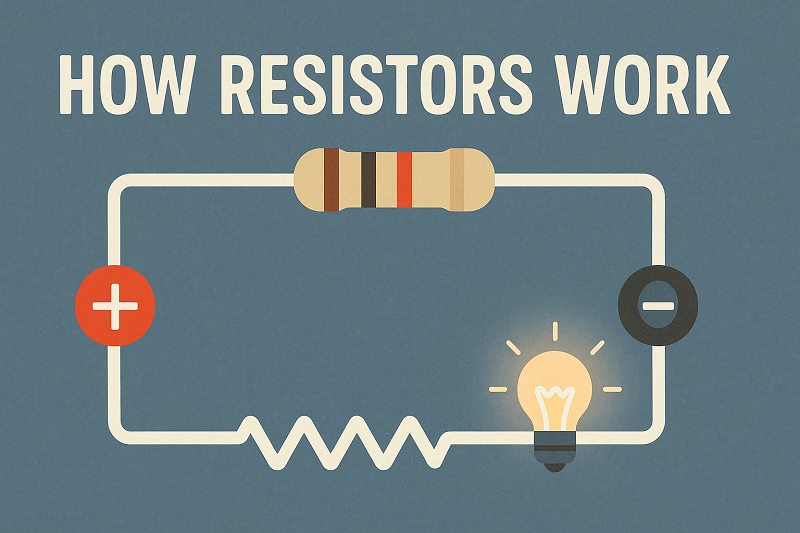
How Resistors Work: From Basic Principles to Advanced Applications2025-07-30
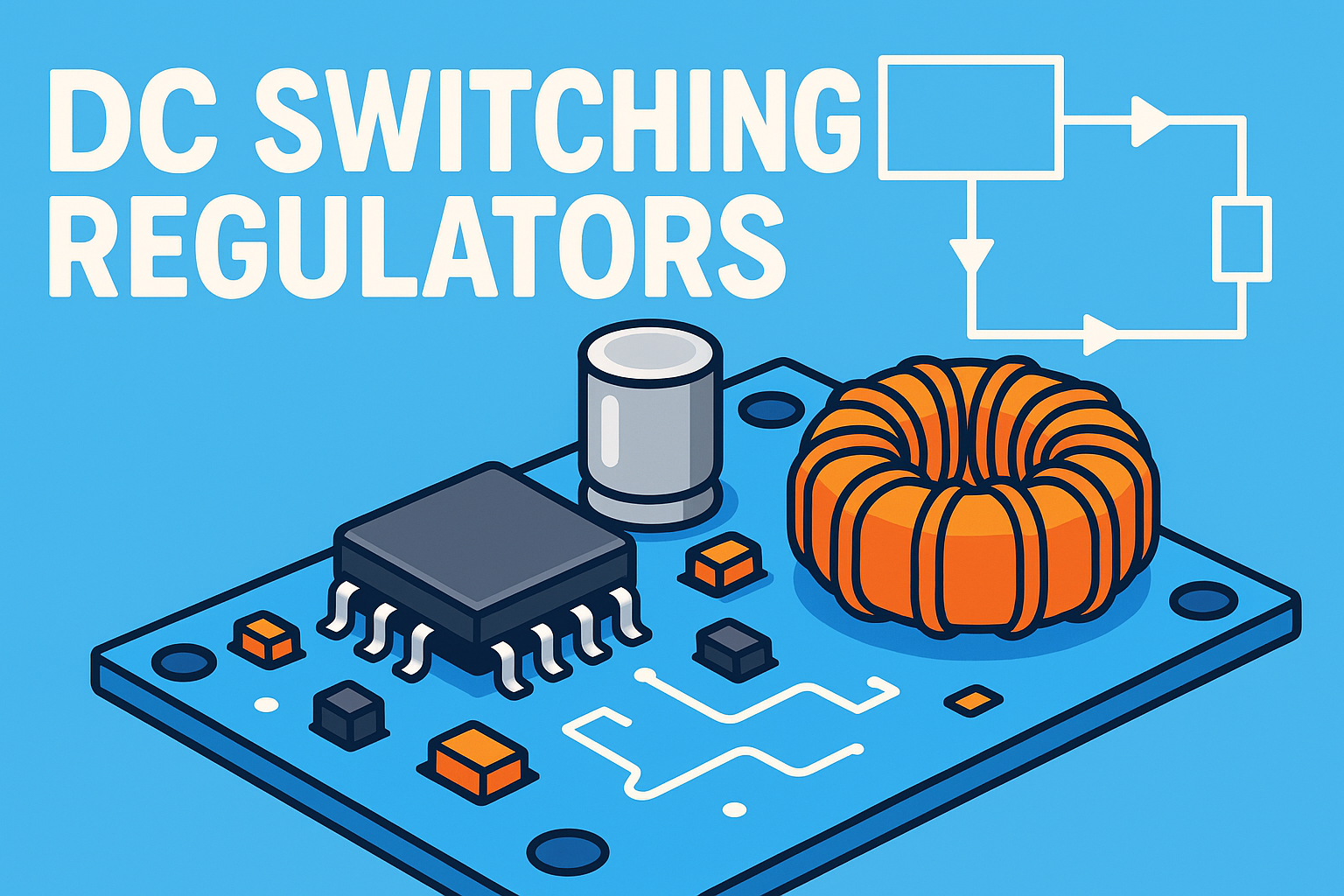
DC Switching Regulators: Principles, Selection, and Applications2025-05-30
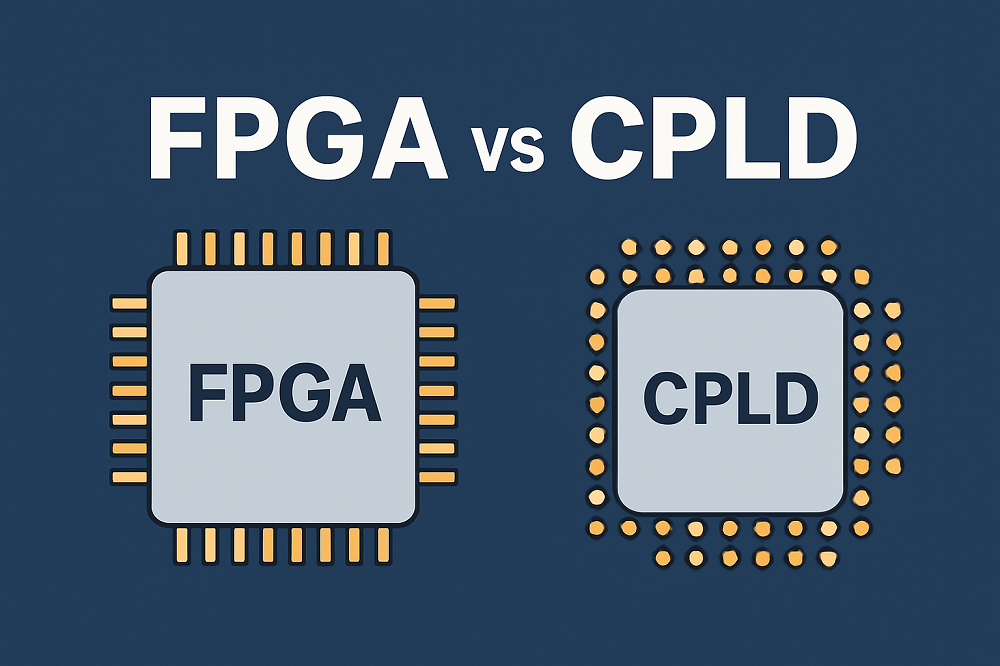
FPGA vs CPLD: In-depth Analysis of Architecture, Performance and Application2025-05-07
MOSFET Technology: Essential Guide to Working Principles & Applications2025-05-04
SMD Resistor: Types, Applications, and Selection Guide2025-04-30