The Kynix Blog
Stay Ahead with Expert Electronics Insights,
Industry Trends, and Innovative Tips
- Electronic Components
- News Room
- General electronic semiconductor
- Components Guide
- Sort by
- Robots
- Transmitters
- Capacitors
- IC Chips
- PCBs
- Connectors
- Amplifiers
- Memory
- LED
- Diodes
- Transistors
- Battery
- Oscillators
- Resistors
- Transceiver
- RFID
- FPGA
- Mosfets
- Sensor
- Motors, Solenoids, Driver Boards/Modules
- Relays
- Optoelectronics
- Power
- Transformer
- Fuse
- Thyristor
- potentiometer
- Development Boards
- RF/IF
- Semiconductor Information
- PCB
- transistor
Summary As the emergence of a range of electronic technologies appear,major changes in the design of real-time embedded systems like the internet of things,augmented reality,or artificial intelligence occurred. The unifying thread between all of them is a greater focus on the use of distributed systems coupled with a need for high performance to deal with the data they generate and consume. Different design direction There are tensions that pull the engineering of real-time devices employing such technologies in different directions. Edge devices such as IoT sensor nodes and gateways call for the lowest-power operation.However,It's not the only area that needs energy efficiency. Despite their reliance on high-performance graphics and responsiveness to movement, AR-enabled systems (such as head-up displays for machine operators) also have to preserve as much energy as possible, protecting battery life and preventing head-mounted displays from becoming uncomfortably warm. Similarly, versatile robots enabled by AI need to be able to operate away from mains power. Distributed processing allows intensive computational work to be moved to the cloud and so offload the embedded systems. However, the real-time nature of these applications calls for low latency. Applications such as motion control and AR suffer if the delay from input to response is too long. This issue is leading to the deployment of edge computing server or ‘cloudlets’ - efficient server blades located relatively close to the edge devices themselves. To support real-time applications such cloudlets are in a position to take advantage of changes in memory technology to better fit the real-time nature of the clients they serve than traditional server designs. Historically, engineers have been forced to choose between performance and persistence when designing bulk memories into real-time computer systems. DRAM is cost-effective for storing large amounts of data close to the processor but is volatile. To ensure data is not lost through power issues - which are more likely to occur in edge nodes - data often has to be copied to persistent storage, which have often much slower access times.The move from rotating disk drives to flash memory for larger applications has already helped significantly when it comes to read access times. But flash still has its drawbacks when it comes to write performance. The erasing and rewriting of data from/to flash memory takes multiple cycles during which high-voltage pulses are delivered to the target memory cells. That takes both time and energy that system designers do not want to waste. Next generation memory technologies Next generation memory technologies are now appearing that overcome the write delays and power demands of flash. These technologies include ferroelectric memory, phase-change memory (PCM), magnetic random-access memory (MRAM) and resistive random-access memory (ReRAM). As devices based on these concepts become available, engineers can consider using them in novel memory hierarchies that optimise cost, increase resilience and improve real-time responsiveness. Here we may mention that PCM,which was first put forward as a possible memory material as long ago as the 1970s,It is based on the same group of chalcogenide materials as those used in rewritable optical disks. A useful feature of the chalcogenides is the way they react to heat. High-current pulses will melt the material. If left to cool quickly it turns to a resistive amorphous state. But the amorphous state can be converted to a crystalline form with a much higher conductivity by applying a small amount of heat. Thanks to this change in properties, readout circuitry can interpret the difference in resistivity between cells as representing ones and zeros. Though similar in behaviour to PCM, with the same core approach of switching between high-resistance and low-resistance states, ReRAM uses different materials to chalcogenide. Typically, the movement of ions within the cell under the influence of pulses of current forms conductive filaments. Reset pulses disrupt these filaments, greatly increasing resistance. One potential advantage of ReRAM is that a large number of candidate materials could be chosen to implement them. This provides the scope for manufacturers to introduce memories with different levels of resilience and storage time. Although these memories use current pulses, the total charge required to program a cell is much lower than that required for flash. In the memories being developed today, ReRAM requires less write energy than PCM but the write times are similar. However, endurance is better in PCM than ReRAM and PCM currently lies further ahead on the development path. Experts believe both PCM and ReRAM will scale better than flash in the long term and so could ultimately supplant flash entirely. about Ferroelectric Memory Ferroelectric memory and MRAM use the spin properties of electrons for storage. The spin can be controlled with very little energy through a spin-valve structure similar to that used in high-density read heads for magnetic disks. In an MRAM, this spin valve is made from a sandwich of materials formed in a via that lies between two metal interconnect lines on the surface of an integrated circuit (IC). The valve alters the resistance of the via based on the spin states of different materials in the sandwich.Ferroelectric memory has been available for several decades but in comparatively low densities to those envisaged for the resistance-based memories. Ferroelectric memory requires both a capacitor and transistor to be formed on the base layer of the wafer. The other memories are all formed in the metal interconnect layers and, potentially, can be stacked for higher integration.What's more,a key advantage for ferroelectric memory is its use of materials that polarise in two different directions based on an applied electric field. This polarisation requires even less power than is needed for MRAM, which makes it suitable for systems that need to be highly energy efficient. The potential problem A potential problem for all the novel memories today is that they lack the cost-effectiveness and density of flash, which is now beginning to take advantage of 3D manufacturing techniques. In reality, for cloudlets and also edge devices themselves, the density is not a major issue as these memories can serve as the underpinning for persistent caches. The low-power and relatively fast write times of the novel memories provides applications with the ability to copy important data to the persistent cache. Data objects that need to be stored permanently can, from there, be copied to flash or disk storage. However, there is no longer any need to transfer data to flash or disk storage continually just to ensure that important but transient data is not lost. When the system restarts, it can recover its state from combining data in both the permanent and persistent arrays.As costs come down and performance improves, there is the potential for MRAM, PCM or ReRAM to begin to displace DRAM and so move the architecture to one in which only the caches on the processors themselves employ a volatile memory architecture (such as SRAM).Persistent memory technologies need not be isolated to cloudlets and high-performance systems. The use of ferroelectric memory by Texas Instruments in its MSP430 line of microcontrollers provides an example of the impact it can have in IoT edge nodes such as sensors. Many IoT applications will rely on energy harvesting to at least supplement a built-in battery. Some may dispense with the battery altogether. The problem with energy harvesting is one of reliability. There are situations, such as vibrational energy capture on heavily used industrial machinery, where the power source is predictable. But in many cases, even with the use of a supercapacitor for an energy reservoir, the system may run temporarily short of power and need to shut down. When enough external energy is supplied, it can resume normal duties.The use of ferroelectric technology provides the microcontroller with the ability to ensure data persists through unexpected power outages without incurring an energy penalty even when data is written to it frequently.
kynix On 2018-01-19
SummaryRecently engineers discover the two-dimensional atomic sheets for memory storage when they were developing alternative ways to provide greater memory storage capacity on thiner computer chips. Most of us are curious about how engineers discover them?DiscoverA team of electrical engineers at The University of Texas at Austin, in collaboration with Peking University scientists, has developed the thinnest memory storage device with dense memory capacity, paving the way for faster, smaller and smarter computer chips for everything from consumer electronics to big data to brain-inspired computing. Discussion"For a long time, the consensus was that it wasn't possible to make memory devices from materials that were only one atomic layer thick," said Deji Akinwande, associate professor in the Cockrell School of Engineering's Department of Electrical and Computer Engineering. "With our new 'atomristors,' we have shown it is indeed possible." Made from 2-D nanomaterials, the "atomristors"—a term Akinwande coined—improve upon memristors, an emerging memory storage technology with lower memory scalability. He and his team published their findings in the January issue of Nano Letters. "Atomristors will allow for the advancement of Moore's Law at the system level by enabling the 3-D integration of nanoscale memory with nanoscale transistors on the same chip for advanced computing systems," Akinwande said.Memory storage and transistors have, to date, always been separate components on a microchip, but atomristors combine both functions on a single, more efficient computer system. By using metallic atomic sheets (graphene) as electrodes and semiconducting atomic sheets (molybdenum sulfide) as the active layer, the entire memory cell is a sandwich about 1.5 nanometers thick, which makes it possible to densely pack atomristors layer by layer in a plane. This is a substantial advantage over conventional flash memory, which occupies far larger space. In addition, the thinness allows for faster and more efficient electric current flow.Given their size, capacity and integration flexibility, atomristors can be packed together to make advanced 3-D chips that are crucial to the successful development of brain-inspired computing. One of the greatest challenges in this burgeoning field of engineering is how to make a memory architecture with 3-D connections akin to those found in the human brain. "The sheer density of memory storage that can be made possible by layering these synthetic atomic sheets onto each other, coupled with integrated transistor design, means we can potentially make computers that learn and remember the same way our brains do," Akinwande said. The research team also discovered another unique application for the technology. In existing ubiquitous devices such as smartphones and tablets, radio frequency switches are used to connect incoming signals from the antenna to one of the many wireless communication bands in order for different parts of a device to communicate and cooperate with one another. This activity can significantly affect a smartphone's battery life. The atomristors are the smallest radio frequency memory switches to be demonstrated with no DC battery consumption, which can ultimately lead to longer battery life. All in all,this discovery has real commercialization value as it won't disrupt existing technologies. Rather, it has been designed to complement and integrate with the silicon chips already in use in modern tech devices.
kynix On 2018-01-18
SummaryA good news that transmitter industry have a futher development is that powercast,a leader in the field of permanent mold aluminium castings,announced its three-watt PowerSpot transmitter is now FCC-approved and ISED-approved for far field(up to 80 feet) over-the-air charging multiple consumer devices.This kind of transmitter doesn't require charging mats or direct line of sight.Product IntroductionCreating a coverage area like Wi-Fi, a Powercast transmitter automatically charges enabled devices when within range. The RF transmitter uses the 915-MHz ISM band to send RF energy to a tiny Powercast receiver chip embedded in a device, which converts it to direct current (DC) to directly power or recharge that device’s batteries.Powercast is to begin the production of its standalone PowerSpot charger and is also offering a PowerSpot subassembly that consumer goods manufacturers can integrate into their own products. The compay envisions that lamps, appliances, set-top boxes, gaming systems, computer monitors, furniture or vehicle dashboards that are readily wired to an electricity source could all become “PowerSpots” able to charge multiple enabled devices around them.“Consumer electronics manufacturers can now confidently build our FCC-approved technology into their wireless charging ecosystems, and offer their customers convenient far-field charging where devices charge over the air from a power source without needing direct contact, like inductive charging requires, or near direct contact, like magnetic resonance requires,” said Powercast’s COO/CTO Charles Greene, Ph.D. The PowerSpot creates an overnight charging zone of up to 80 feet free of wires or charging mats. Enabled devices charge when in range, but don’t need direct line of sight to the PowerSpot. Powercast expects up to 30 devices left in the zone on a countertop or desktop overnight can charge by morning, sharing the transmitter’s three-watt (EIRP) power output. Charging rates will vary with distance, type and power consumption of a device. Power-hungry, heavily used devices like game controllers, smart watches, fitness bands, hearing aids, ear buds, or headphones charge best up to two feet away; keyboards and mice up to six feet away; TV remotes and smart cards up to 10 feet away; and low-power devices like home automation sensors (window breakage, temperature) up to 80 feet away. An illuminated LED indicates devices are charging and it turns off when they’re done. Audible alerts indicate when devices move in and out of the charge zone. The PowerSpot transmitter uses Direct Sequence Spread Spectrum (DSSS) modulation for power and Amplitude Shift Keying (ASK) modulation for data, and includes an integrated 6dBi directional antenna with a 70-degree beam pattern. About PowerSpotEstablished in 2003,powerspot is the leading provider of RF-based wireless power technologies that provide power-over-distance,elimiate or reduce the need for batteries,and power or charge devices without wires and connectors.Powercast's IP portfolio includes 45 patents worldwide (21 in the US) and 30 patents pending.
kynix On 2018-01-17
SummarySeveral days ago, I was facing a challenge in my lab is--what is the perfect way to power breadboard projects?Situation and SolutionActually,I used breadboards to prototype almost all of my designs and I have always had less than ideal setups.Between my bench power supply, which has banana plugs, and the many wall transformer power supplies I have around the house with 2.1 mm plugs, I just do not have any options that are breadboard friendly.Here,just see the following photos,you will know that I end up with solutions in the past,well,it's not the easiest or prettiest of ways to connect to the breadboard.It does not take more than a casual glance at the pictures above to recognize that while functional, these are not ideal solutions. In both cases, the connections are too easy to accidentally dislodge and there is a risk of a short with the second one. There had to be a better way.Before a design could be had, it needed some requirements. As I pondered the requirements, I came up with the following technical specifications for this little device. I wanted to be able to optionally use my bench power supply or wall transformer and that each would have a secure connection to the breadboard. I also wanted the ability to switch it on or off and have the option to power either both rails or just one with the external supply.As I worked through the design, it became a simple but effective solution.( I am excited)At first,I created a project in Eagle CAD around the connectors I needede,and designed the board shape to match up to the standard 830 point breadboards that I use in my lab. There were a handful of other features I wanted to include such as an optional filter cap, an on/off switch, and a power status LED. As I got designing, I decided to refine a few of the features. Many of my projects have more than one input voltage. To facilitate this, I added a jumper block to connect or disconnect the second power rail for projects that need a dual voltage. Electronic partsHere just let me list the material we need in this project firstly: Deltron 571-0100 : Test Sockets SINGLE PCB SOCK BLKDeltron 571-0500 : Test Sockets SINGLE PCB SOCK REDKobiconn 163-7620E-E : DC Power Connectors PCB 2.1MMFCI / Amphenol 67997-472HLF : Headers & Wire Housings 72P HDRHarwin M7581-08 : Headers & Wire Housings JUMPER SOCKET OPEN TOP REDKOA Speer MF1/2DC1501F : Metal Film Resistors – Through Hole 1.5K 1% 100PPM Kingbright WP710A10SGD : Standard LEDs – Through Hole Grn 40mcd 568nm 40 deg DiffusedPanasonic ECA-1HM100I : Aluminum Electrolytic Capacitors – Leaded 10UF 50V ELECT M RADIAL If you would like to build one following me , these parts you can find from: https://www.kynix.com Schematic and ComponentsWith the basic design framework laid out, I started researching the components needed. I personally tend to use the online Mouser catalog to help me sort through the vast quantities of components available. I stuck with all through-hole components to make this project easier to assemble at home. With all the parts identified, I returned to my project in Eagle CAD and found each of the components in my component libraries. I connected them electrically as shown in the schematic below, and double-checked the design (an often under rated step in the design process). Board LayoutWith the schematic complete, it was time to move on to the board layout. Breadboards use a standard 0.1 inch pin spacing, but when I measured the spacing between the power busses, I noticed that they were slightly different. After some trial and error, I realized that the actual spacing between the power bus pins was 1.85 inches O.C. With the header pins placed at this location, the board outline was adjusted to create a proper fit. After arranging the components, I added a ground pour to the top layer to simplify routing. The Eagle autorouter made quick work of the rest of trace routing and the resulting board design looks like this:Board Assembly and TestingI ordered a batch of these boards from my favorite purple PCB vendor (OSHPark) online and assembled them. I couldn’t be happier with the finished product. The fit is perfect and they snap into the power bus tightly and stay put. This little device has gone through extensive testing as I have been using these on all of my breadboard projects ever since I got the first one assembled. They really work wonderfully! Article edited by: kynix
kynix On 2018-01-16
This article will be divided into three parts--individual transformer , parallel transformer and redundancy requirements for bulk power transformers. Catalog I. Individual Transformer II. Parallel Transformer III. Redundancy Requirements for Bulk Power Transformers FAQ I. Individual Transformer Just see the following picture, it includes the protection for banks where fuses are used on the primary. Overall differential protection may be applied by using CTs in the transformer primary bushings for larger or important banks. The common connection is shown with delta on the source (primary) side and wye-grounded on the secondary side. Other possible connections: delta–delta, wye–wye, or primary-wye– secondary-delta. Figure 1 – Transformer protection without primary-side circuit breaker About the analysis of power circuit, you can see the article: Analysis of Switching Power Supply Principle Note: Secondary circuits should have 51 and 51N relays. Therefore, transformer secondary breaker and relays may be omitted unless another source connects to the secondary bus. 51N relay can be omitted with 51G available. For transformer banks with primary breakers, the protection is summarized in Figure 2. Relay 51G provides backup protection for secondary bus and feeder faults and must be time-coordinated, with other ground relays protecting the various feeder circuits on the secondary bus. Similarly, phase relays 51 must be coordinated with the phase relays on the feeders. The common connection is shown with delta on the source (primary) side and wye-grounded on the secondary side. Other possible connections: delta–delta, wye–wye, primary-wye– secondary-delta, three-winding, or autotransformer. Figure 2 – Transformer protection with primary-side circuit breaker "52S may be omitted in some applications requiring 151G to coordinate with and trip the secondary circuit devices if used." II. Parallel Transformer The protection for transformer banks where the secondaries are connected together by a bus tie breaker is summarized in the following picture(a,b,c). The arrangement shown is typical for large- or critical-load substations, especially for industrial plants. The loads are supplied from separate buses that are connected together by a bus tiebreaker (52T) that may be operated either normally closed (NC) or normally open (NO). Figure 3a – Single line diagram of transformer and secondary bus protection for a typical double-source supply with secondary tie and breaker If you operated NO, the protection of the first picture and second is applicable. If operated with 52T NC, the protection of the first picture and second is applicable with the secondary side modified. Figure 3b – Secondary protection with high-side fuses With the bus tiebreaker closed, there is a possibility for the interchange of power between the two sources. Here, current flows from one source through its transformer, the secondary buses, and back through the other transformer to the second source. Generally, this is neither desirable nor permitted. "To prevent this operation, directional time–overcurrent relays (67, 67N) are applied to each transformer." Figure 3c – Secondary protection with high-side breaker The single-line connections are shown in Figure 3b and Figure 3c, with complete three-line connections in the following figure. Note: They operate only for fault current that flows into the transformer and trip the secondary breaker (52–1 or 52–2). This is also important in removing a secondary fault source for faults in the transformer bank. The phase relays (67) can be set on a low of the minimum tap. Load current certainly flows through the relay, but normally not in the operating direction. The low tap continuous rating must not be exceeded by increasing the maximum load current. The 67-time setting must coordinate with the protection on the transformer primary. When used, the ground relay can be set on minimum setting and time, because coordination is not necessary. Figure 4 – Three-line connections for reverse-phase and partial differential backup protection The inverse-time–overcurrent relays (51, 51N) provide bus protection and backup protection for the feeder circuits. These relays trip both 52–1 (or 52–2) and 52T. This is a partial differential connection and these units must be time-coordinated with the protection on the several feeders that are connected to the bus. "Only two-phase relays are required, but the third relay (shown optionally in Figure 4) provides additional redundancy. When a ground differential is used, as illustrated in Figure 3c, 67N and 51N are omitted." Ground-fault backup is provided by 51G, 151G, and 251G inverse-time overcurrent relays (Figure 3abc). Relay 251G provides bus ground-fault protection and backup for the feeder circuit ground relays. It must be time- coordinated with these. It trips the bus tie 52T, as the fault could be either on the bus or on the associated feeders. If the fault continues to exist with the bus tie open, relay 151G trips breaker 52–1 (or 52–2). Thus, 151G must coordinate with 251G. If the fault persists, it is between the secondary breaker, in the transformer winding, or in the grounding impedance. Relay 51G set to coordinate with 151G is the last resort. It trips the high-side or primary breaker to remove the transformer from the service. III. Redundancy Requirements for Bulk Power Transformers When transformers are connected to bulk power systems, redundancy requirements for related protection need to be addressed. To provide the required redundancy, two separate differential schemes may be applied. "Redundancy for transformer faults may also be obtained by a differential scheme and sudden pressure." In such an application, the sudden pressure protection needs to be supplied with additional protection for faults on the transformer bushings and leads, as sudden pressure devices will not respond to faults in these areas. Redundant schemes for disconnecting the transformer from the system when a high-side breaker is not applied can be obtained by using various combinations of the methods. Take an example, two separate transfer trip systems may be applied although they are expensive. A cheaper alternative is to combine a transfer trip scheme and a faulty switch. It may be possible to delay closing the fault switch for a few cycles to allow time for the transfer trip scheme, provided it is operational, to de-energize the failed transformer before the closing of the fault switch. This would spare the power system from being subject to a solid fault when the fault switch closes, whenever the transfer trip scheme works properly. When a high-side breaker is applied and it fails to operate, breaker failure protection is required to enable isolation of a faulted transformer. The breaker failure scheme may require the application of a fault switch, transfer trip scheme, or a second interrupting device if other local breakers are not available to isolate the transformer. FAQ 1. What is the use of transformer? Transformers are employed for widely varying purposes; e.g., to reduce the voltage of conventional power circuits to operate low-voltage devices, such as doorbells and toy electric trains, and to raise the voltage from electric generators so that electric power can be transmitted over long distances. 2. What are the 3 types of transformers? There are three primary types of voltage transformers (VT): electromagnetic, capacitor, and optical. 3. What is the basic principle of transformer? A transformer consists of two electrically isolated coils and operates on Faraday's principal of “mutual induction”, in which an EMF is induced in the transformers secondary coil by the magnetic flux generated by the voltages and currents flowing in the primary coil winding. 4. Does a transformer convert AC to DC? A transformer is built to transfer the energy from one circuit into another circuit by way of magnetic coupling. ... An alternating current creates a magnetic flux in the core on its way through the first winding, inducing the voltage in the others. It can convert high and low voltages, it cannot convert AC to DC. 5. What are the main parts of transformer? There are three basic parts of a transformer: a. an iron core which serves as a magnetic conductor, b. a primary winding or coil of wire and. c. a secondary winding or coil of wire. 6. What are the classification of transformer? Depending upon the type of construction used, the transformers are classified into two categories viz.: (i) Core type, and (ii) Shell type. Depending upon the type of service, in the field of power system, they are classified as: (i) Power transformers, and (ii) Distribution transformers. 7. Can a transformer work on DC? As mentioned before, transformers do not allow DC input to flow through. This is known as DC isolation. This is because a change in current cannot be generated by DC; meaning that there is no changing magnetic field to induce a voltage across the secondary component. 8. How do you convert a transformer? This conversion is made by winding two separate conductors around a common iron core. Applying an alternating voltage to the primary conductor produces current which sets up a magnetic field around itself. This is known as mutual inductance. 9. What are two components of no load current in transformer? The no-load current of a transformer consists of two components: The Magnetization Current iM is the current required to produce the flux in the transformer core. The Core-loss Current ih+e is the current required to make up for hysteresis and eddy current losses. 10. Which type of transformer core is most efficient? SHELL CORE. The most popular and efficient transformer core is the SHELL CORE, as illustrated in figure (4). As shown, each layer of the core consists of E- and I-shaped sections of metal. These sections are butted together to form the laminations. 11. What is the power factor of transformer? The power factor of a distribution transformer is between (0.75 to 0.80) when secondary is connected to u.p.f loads. 12. Why do we need Transformers? Transformers help improve safety and efficiency of power systems by raising and lowering voltage levels as and when needed. They are used in a wide range of residential and industrial applications, primarily and perhaps most importantly in the distribution and regulation of power across long distances. 13. What is the difference between a step up transformer and a step down transformer? A transformer that increases the voltage from primary to secondary (more secondary winding turns than primary winding turns) is called a step-up transformer. Conversely, a transformer designed to do just the opposite is called a step-down transformer. 14. Are transformers dangerous? There is no established evidence that the exposure to magnetic fields from powerlines, substations, transformers or other electrical sources, regardless of the proximity, causes any health effects. 15. Why transformer rating is in kVA not in kW? Copper losses (I²R) depends on current which passing through transformer winding while Iron losses or core losses or Insulation losses depends on Voltage. ... That's why the transformer rating may be expressed in VA or kVA, not in W or kW.
kynix On 2018-01-15
CCD image sensors still remain preferable in some specialised application.Today I would like to talk something about CMOS image sensor technology. As the development of image sensor,CMOS technology is widely used in most machine vision applications.What's excited,perhaps as the concepts behind industry 4.0 become adopted more broadly--the need for mre capable vision systems has grown sharply. This is a video of CCD vs CMOS sensors Catalog Historical and modern CMOS Improve productivity, support high bandwidth readout Inherent flexible available About the high resolution Design the right products Conclusion FAQ Machine vision systems use images to gather information on a system or process and to then make decisions based on the image captured.While such systems are dependent upon lighting and software,the camera-and the image sensor within it-is the key component in the overall operation of the system,as well as the ability to improve manufacturing quality and increase productivity.At a high-level,a typical machine vision application involves som combinaton of basic measurement,counting or inspection functions.Objects may be assessed to confirm the number of objects present,to determine the number and size of features or their quality level.So machine vision could be used to not only determine that the proper number of holes have been drilled into an item, but also to verify the spacing and shape of each hole. Similarly, the location of an object may be determined in order for it to be picked up by a robot arm or to determine whether a feature is in the correct place. Other functions include reading a barcode, performing character recognition or measuring the level of a fluid.So machine vision could be used to not only determine that the proper number of holes have been drilled into an item, but also to verify the spacing and shape of each hole. Similarly, the location of an object may be determined in order for it to be picked up by a robot arm or to determine whether a feature is in the correct place. Other functions include reading a barcode, performing character recognition or measuring the level of a fluid. Historical and modern CMOS Historically, machine vision systems have required CCD image sensors because of their high image quality and performance. Today, however, CMOS image sensors have jumped to the forefront for many machine vision applications. Advances in CMOS pixel design have made the imaging quality available from this platform sufficient for a variety of different end uses.Modern CMOS image sensor platforms, such as that used in ON Semiconductor’s PYTHON family, are based on a global shutter pixel design that enables the capture of moving objects without the introduction of motion artefacts. In-pixel correlated double sampling provides low readout noise, while on-chip fixed pattern noise correction helps preserve image quality. Combined with a 10bit A/D converter and a dynamic range of 60dB, these features allow machine vision systems to leverage the intrinsic advantages of a CMOS platform in their operation. Improve productivity, support high bandwidth readout With many machine vision applications looking to operate at ever higher speeds in order to increase productivity, image sensors must support high bandwidth readout. The output architecture of the CMOS platform enables this as additional digital outputs can be added to increase the available bandwidth. For example, the use of up to 32 separate LVDS outputs enables high resolution PYTHON devices to realise bandwidths that exceed those of modern computer interfaces, including 10Gbit Ethernet or USB 3.1. The ability to output at up to 80frame/s from a 25Mpixel device is well beyond the capabilities of standard CCD designs. Inherent flexible available The inherent flexibility available in CMOS output designs allows the frame rate to be further increased when operating in Region of Interest (ROI) mode, where only a portion of the image sensor array is read out. With proper design considerations, the speed increase when operating in this manner can scale by both the x and y dimensions of the ROI, enabling faster frame rates than can be realised when using a more standard CMOS output design, which only scales the x dimension. Consider the frame rates from the PYTHON 5000 image sensor compared to theoretical frame rates from a similar 5Mpixel sensor using a standard CMOS output. At full resolution, both designs would provide approximately 100frame/s, but when reading out a 1280 x 720 pixel ROI, the the PYTHON device’s frame rate increases to almost 600frame/s, while the standard output design would increase to only 300frame/s. This can be an important differentiator. About the high resolution While high resolution can provide finer detail, this must be balanced by making sure that too much information is not captured, which would slow data processing. In addition to having the right number of pixels, they need to be in the appropriate aspect ratio for the application. For example, an aspect ratios of 1:1 is often used in pick and place applications to maximise image capture across the full field of view. Different spectral sensitivities, such as colour, monochrome and extended near infrared (NIR), may also be required to optimise the imaging system for the application. In order to do this, a camera manufacturer will look for an integrated family of image sensor products that includes multiple resolution nodes and colour options to support a portfolio of products.The PYTHON family has more than 40 options, with resolutions ranging from VGA to more than 25Mpixel. These devices are available in multiple configurations, including monochrome, Bayer Color and extended NIR sensitivities. Selected devices are available in low-power configurations or with removable tape to protect the image sensor during the camera assembly process. Design the right products Avent Silica offers a range of evaluation kits to help designers understand the performance available from the PYTHON family of image sensors.These kits include an image sensor,the appropriate sensor headboard,FPGA evaluation board and software and accessories.The Flexible design also allows the evaluation hardware to be use with other PYTHON devices by purchasing additional image sensors.After identifying the most appropriate image sensor, designers then need to consider the remainder of the camera design. Complementary products from ON Semiconductor include embedded boards, power and signal chain components that allow engineers to choose between modular solutions and the flexibility of a discrete design. If a machine vision system needs to be brought to market quickly, it may not be possible to build it from the ground up. For those applications, Avnet Silica products such as the PYTHON-1300-C camera module. Based on the PYTHON 1300 colour image sensor and featuring a 0.5in SXGA CMOS image sensor with a resolution of 1280 x 1024 pixels, the module can be combined with Avnet Silica’s MicroZed Embedded Vision Carrier Card and the Smart Vision Development Kit to provide a complete hardware design, leaving the designer to only write the application software.\ Conclusion Because of the combination of image quality,bandwidth,image flexiblity and configuration flexiblity available from MOS image sensors has accelerated adoption of this technology in machine vision applications.What's celebrating,The imaging capabilities of such devices has ushered in a new level of performance and functionality for industrial imaging and CMOS sensor based imaging is now suitable for use in almost every type of design. FAQ 1. How does a CMOS image sensor work? Unlike CCD sensors that use high-voltage analog circuits, CMOS sensors employ a smaller digital circuitry that uses less power, and are in principle free from smear (vertical white streak in the image taken under bright light) and blooming (corruption of images such as white spots). 2. Which sensor is better CCD or CMOS? CMOS sensors have thousands. This means that CMOS cameras can read out incredibly fast, even 100X faster than a comparable CCD. For long-exposure applications that is not so important, but it is especially important for video cameras. 3. Is CMOS a full frame sensor? "Full frame" is a description of sensor size, sort of... "CMOS" is a name for semiconductor technology used to make sensors. So, they are definitely different, and not comparable. 4.What is CMOS sensor type? A CMOS sensor is an electronic chip that converts photons to electrons for digital processing. CMOS (complementary metal oxide semiconductor) sensors are used to create images in digital cameras, digital video cameras and digital CCTV cameras. 5. What is the function of image sensor? An image sensor is a device that allows the camera to convert photons – that is, light – into electrical signals that can be interpreted by the device. The first digital cameras used charge-coupled devices, facilitating movement of the electrical charge through the device so it could be modulated. 6. What is difference between CCD and CMOS? The biggest difference is that CCD sensors create high quality images with low noise (grain). CMOS images tend to be higher in noise. CCD sensors are more sensitive to light. CMOS sensors need more light to create a low noise image at proper exposure. 7. What CCD means? Charged Coupled Device. Stands for "Charged Coupled Device." CCDs are sensors used in digital cameras and video cameras to record still and moving images. The CCD captures light and converts it to digital data that is recorded by the camera. For this reason, a CCD is often considered the digital version of film. 8. What is CCD and CMOS? CCD (charge coupled device) and CMOS (complementary metal oxide semiconductor) image sensors are two different technologies for capturing images digitally. Each has unique strengths and weaknesses giving advantages in different applications. 9. Is CMOS sensor good? CMOS sensors traditionally have lower quality, lower resolution and lower sensitivity. CMOS sensors are just now improving to the point where they reach near parity with CCD devices in some applications. CMOS cameras are usually less expensive and have great battery life. 10. How does a CCD work? Fundamentally, a charge coupled device (CCD) is an integrated circuit etched onto a silicon surface forming light sensitive elements called pixels. Photons incident on this surface generate charge that can be read by electronics and turned into a digital copy of the light patterns falling on the device.
kynix On 2018-01-12
Join our mailing list!
Be the first to know about new products, special offers, and more.
Feature Posts
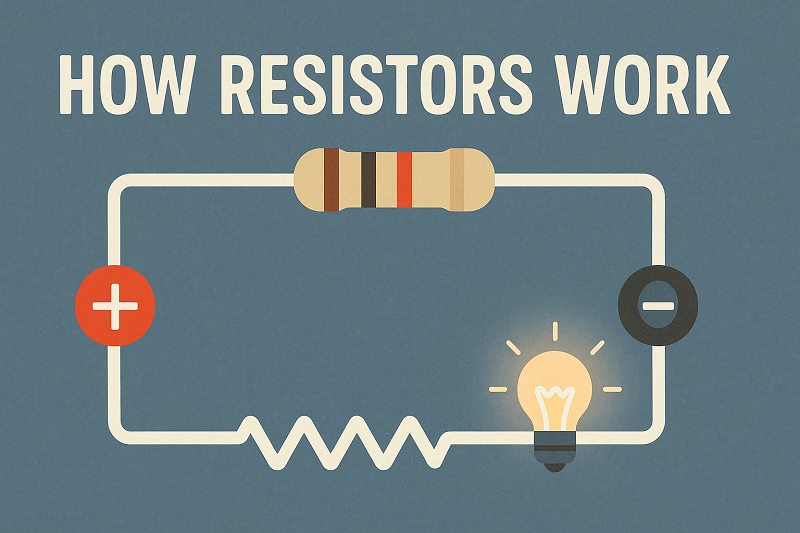
How Resistors Work: From Basic Principles to Advanced Applications2025-07-30
DC Switching Regulators: Principles, Selection, and Applications2025-05-30
FPGA vs CPLD: In-depth Analysis of Architecture, Performance and Application2025-05-07
MOSFET Technology: Essential Guide to Working Principles & Applications2025-05-04
SMD Resistor: Types, Applications, and Selection Guide2025-04-30