info@kynix.com
 00852-6915 1330


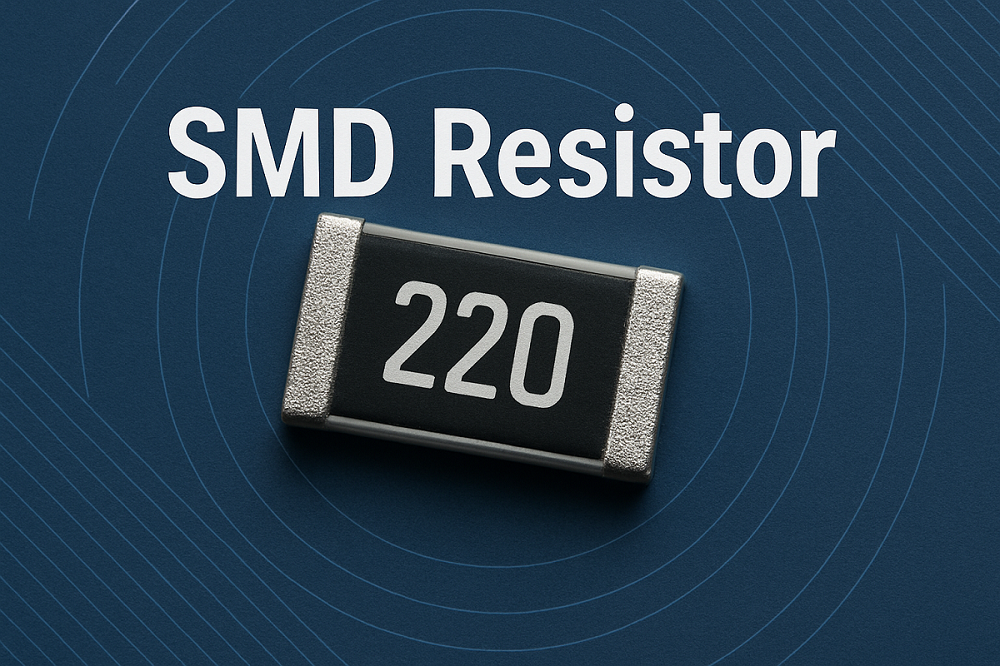
Executive Summary & The High-Speed Decision FrameworkIn high-speed printed circuit board (PCB) design, passive components, semiconductor packages, traces, and vias cease to function as ideal lumped circuit elements. At gigahertz frequencies and sub-nanosecond switching speeds, physical geometry dictates electrical behavior. Every discrete resistor, multi-layer ceramic capacitor (MLCC), filter choke, connector pin, and PCB via introduces parasitic inductance, capacitance, and resistance. These parasitics degrade characteristic impedance (Z0), create impedance discontinuities, induce ground bounce and Power Delivery Network (PDN) collapse, excite resonance spikes, and close receiver eye diagrams.+-------------------------------------------------------------------------------+| THE HIGH-SPEED REALITY CHECK || || Ideal Schematic Symbol Physical High-Speed Reality || || Capacitor: --||-- ===> --[ESL]--/\/\/--||--[ESR]-- || || Resistor: --/\/\/-- ===> --[L_lead]--/\/\/--[L_lead]-- || | || [C_shunt] || | || Trace: ---------- ===> Distributed Transmission Line || (Z0, Propagation Delay td, || Dielectric & Skin Losses) |+-------------------------------------------------------------------------------+The fundamental metric governing signal integrity is edge transition speed (rise and fall times, tr / tf), not fundamental clock frequency. A 10 MHz square wave with a 300 ps rise time exhibits spectral energy extending well into the multi-gigahertz range, behaving entirely as a distributed transmission line system. Conversely, a 100 MHz clock with a gradual 5 ns rise time can often be analyzed using simpler lumped-circuit assumptions.Furthermore, impedance is strictly a point concept. Characteristic impedance is determined by the instantaneous cross-sectional geometry and material properties of the interconnect. Any localized variation—whether caused by an oversized surface-mount device (SMD) land pad, a necked-down trace entering a ball grid array (BGA), an unterminated via stub, or a component mounting loop—creates immediate electromagnetic reflections and phase distortion. SIGNAL PATH INTEGRITY BUDGET Transmitter (Tx) Interconnect Discontinuities Receiver (Rx)+------------------+ +---------------+ +---------------+ +---------------+| Open Eye Diagram | ----> | Via Stubs | > | SMT Pad Drops | > | Eye Closure / || Clean Slew Rate | | Loop Parasitic| | Package Ind. | | Jitter & BER |+------------------+ +---------------+ +---------------+ +---------------+The Interconnect Boundary Framework: When Does a Trace Become a Transmission Line?Per IPC-2251[4] (Design Guide for the Packaging of High Speed Electronic Circuits), an interconnect must be modeled, analyzed, and routed as a distributed transmission line[1] whenever the one-way signal propagation delay (td) exceeds 10% to 20% of the signal's 10%–90% rise time (tr), or when the physical trace length (l) exceeds one-tenth to one-sixth of the signal's effective wavelength (λ) in the dielectric medium.Transmission Line Regime: td ≥ 0.20 × tr or l > λeffective10To evaluate interconnect boundaries during layout planning[3]:Calculate the Knee Frequency (fknee):fknee ≈ 0.35trwhere tr is the 10%–90% rise time. This frequency marks the boundary below which the majority of energy in the digital edge transition resides.Calculate Effective Propagation Velocity (vp) and Wavelength (λ):vp = c√(εr,eff), λ = vpfkneewhere c is the speed of light in vacuum and εr,eff is the effective relative permittivity (dielectric constant) of the substrate.Establish Routing Strategy: If physical trace length exceeds λ/10 or one-way delay td ≥ 0.20 × tr, standard copper connections cannot be treated as simple equipotential nodes. Controlled-impedance routing (50 Ω single-ended, 90 Ω to 100 Ω differential) and impedance matching topologies become mandatory.The Physics of Component Parasitics: Why Passives Stop Behaving IdeallyAt direct current (DC) and low frequencies, circuit components closely match their schematic representations. As frequency climbs into the gigahertz realm, the physical geometry of passive components transforms them into complex RLC circuits[6]. CAPACITOR EQUIVALENT CIRCUIT RESISTOR EQUIVALENT CIRCUIT +---[ L_ESL ]---+ +---[ L_lead ]---+ | | | | In >-----+ +-----> Out In >-----+----/\/\/------+-----> Out | | | R_nom | +--/\/\/--||---+ +------||--------+ R_ESR C C_shuntRLC Equivalent Models of Discrete PassivesDiscrete Resistors: A physical surface-mount resistor consists of a resistive element with series lead/metallization inductance (Llead) and parasitic shunt capacitance (Cshunt) formed across the component body and between its end-cap terminations. At multi-gigahertz frequencies, shunt capacitance bypasses the resistive element, degrading termination effectiveness and reducing effective impedance.Discrete Capacitors: A multi-layer ceramic capacitor (MLCC) comprises alternating layers of dielectric and metallic conductor plates. The physical component exhibits internal Equivalent Series Inductance (LESL), Equivalent Series Resistance (RESR), and bulk capacitance (C).The Self-Resonant Frequency (SRF) BoundaryThe impedance profile of any real capacitor follows a classic V-shaped curve across frequency, defined by the interaction of its capacitive reactance (XC) and inductive reactance (XL):Z(f) = √[RESR2 + (2πfLESL − 12πfC)2]The minimum impedance point corresponds to the Self-Resonant Frequency (f0 or SRF):f0 = 12π√(LESL · C)Capacitor Impedance vs. Frequency: SRF and Parasitic RegionsImpedance | |Z| \ / Inductive Zone (Slope: +20 dB/dec) \ / |Z| ~= 2*pi*f*L_ESL \ / \ Capacitive Zone / \ (Slope: -20 dB/dec) / \ |Z| ~= 1/(2*pi*f*C) / \ / \ / \ / \_______x_______/ <-- Minimum Impedance Floor = R_ESR | f0 (SRF) Frequency (Hz)Below f0 (Capacitive Region): Reactance is dominated by XC = 1 / (2πfC). Impedance decreases at −20 dB/decade.At f0 (Resonant Point): Inductive and capacitive reactances cancel (XL = XC). Total impedance drops to its lowest value, equal to RESR.Above f0 (Inductive Region): Reactance is dominated by XL = 2πfLESL. Impedance increases at +20 dB/decade.The Core High-Speed Consequence: Beyond its SRF, a capacitor ceases to function as a charge reservoir or bypass element; it behaves as an inductor. If high-speed transient current demand occurs at frequencies past the component's SRF, the capacitor opposes rapid current changes (V = L · di/dt), amplifying rail collapse and ground bounce instead of suppressing them.Skin Effect and Harmonic AttenuationAt high frequencies, changing internal magnetic flux forces alternating current to crowd within the outer perimeter of a conductor. The effective current-carrying depth is governed by skin depth (δ):δ = √(ρπf μ0 μr)where ρ is conductor resistivity, f is frequency, and μ is permeability.Because effective cross-sectional area decreases proportionally to √f, high-frequency AC resistance increases with frequency. This causes higher-order odd harmonics of a digital clock pulse to experience higher attenuation and phase velocity variations than lower harmonics, warping the pulse shape, rounding transition corners, and worsening data-dependent jitter.Understanding Signal IntegrityCore SI-Critical Components: Comparison, Specifications, and Failure ModesComponent selection in high-speed digital systems requires balancing functional electrical parameters against high-frequency physical parasitics. The following master selection matrix details the six primary component classes that directly dictate high-speed signal integrity.Component ClassPrimary SI FunctionCritical Parasitic ParametersHigh-Frequency Failure ModeLayout & Selection Mitigation StrategyDecoupling MLCCsProvide low-impedance transient current; stabilize PDN; suppress rail collapseLESL, RESR, Mounting Loop Inductance (Lloop)Inductive phase inversion past SRF; anti-resonance impedance peaks between parallel capsSelect ultra-small footprints (0402/0201) or reverse-geometry (0508); place vias immediately adjacent to pads or utilize Via-In-Pad (VIPPO).Termination ResistorsMatch source/load to line impedance (Z0); eliminate reflections and ringingShunt capacitance (Cshunt), Lead inductance (Llead), Physical stub lengthIncomplete reflection absorption; high-frequency capacitive roll-off; standing wave resonanceUse thin-film 0402/0201 packages; place strictly within electrical stub budget (lstub < (tr · vp) / 6); migrate to On-Die Termination (ODT).Common-Mode ChokesSuppress common-mode EMI radiation on high-speed differential pairsInter-winding capacitance (Cstray), Differential insertion loss (Sdd21)Premature differential signal attenuation; differential-to-common mode conversion (Scd21)Ensure differential cutoff frequency exceeds the link's 3rd harmonic; maintain tight symmetrical pad escape routing; verify impedance matching (90 Ω / 100 Ω).AC-Coupling CapacitorsDC blocking for SerDes links; level-shifting between transceiver domainsPad-to-ground capacitance (Cpad), Component ESLLocalized capacitive impedance dip (100 Ω → 78–80 Ω); increased return loss (S11); eye closureSelect 0201/0402 packages; implement reference plane voiding directly underneath SMT pads on Layer 2; match pad dimensions to trace width.ESD Protection DiodesClamp high-voltage electrostatic discharge transients on external I/ODiode junction capacitance (Cj), Dynamic clamping resistance (Rdyn)Excessive capacitive loading; slew rate degradation; inter-symbol interference (ISI)Select ultra-low capacitance arrays (Cj < 0.2 pF); route differential pairs straight through component pads without branching stubs.Controlled-Z ConnectorsPreserve transmission line geometry across board-to-board or cable interfacesContact pin inductance, Pin-to-pin mutual capacitance (Cm) and inductance (Lm)Impedance mismatch steps; pin stub resonance; high-frequency crosstalk; ground return bounceUse ground-shielded differential pairs; assign interleaved Ground-Signal-Signal-Ground (GSSG) pinouts; match breakout via fields.Decoupling Capacitors & Power Delivery: Defeating ESL and the Resonance TrapA robust Power Delivery Network (PDN) must deliver instantaneous current to switching logic while maintaining DC voltage within a strict tolerance window (typically ±3% to ±5%). THE DECOUPLING VIA GEOMETRY EFFECT POOR: Long Escape Traces (2.5 - 4.0 nH) OPTIMAL: Side-Placed Vias (< 0.8 nH) Via Pad Pad Via Pad Pad Via ( O )-------------| |=====| | ( O )-| |=====| |-( O ) === === === === Capacitor CapacitorThe PDN Target Impedance EquationTo prevent digital switching transients (ΔI) from inducing excessive supply rail voltage ripple (ΔV), the PDN impedance (ZPDN) must remain at or below the calculated Target Impedance (Ztarget) across the entire operational bandwidth of the circuit:Ztarget = Vrail × Allowed Ripple FractionΔItransientIllustrative example: For a typical 0.9 V core rail with a 5% maximum allowed ripple (ΔV = 45 mV) supporting a 15 A transient switching event:Ztarget = 0.045 V15 A = 0.003 Ω = 3 mΩMaintaining a flat 3 mΩ impedance profile up to hundreds of megahertz requires managing capacitor parasitics and layout geometry.The "SRF Trap" & Anti-Resonance SpikesA common industry design habit involves placing multi-decade parallel decoupling networks (e.g., 10 μF + 0.1 μF + 1 nF) on every power pin. While this approach attempts to broaden low-impedance coverage, it creates anti-resonance peaks.Impedance (Ohms) ^ | Capacitor 1 (10 uF) Capacitor 2 (0.1 uF) | \ / \ / | \ / \ / | \ / \ / | \ / ^ \ / | \ / / \ \ / | \ / / \ \ / | \______x______/ / \ \______x______/ | | / \ | | SRF1 / \ SRF2 | / | ANTI-RESONANCE PEAK (High Z) +--------------------------------------------------------------------> FrequencyAt frequencies between the SRF of the larger capacitor (SRF1) and the smaller capacitor (SRF2), the larger capacitor has turned inductive, while the smaller capacitor remains capacitive. This forms a high-Q parallel LC resonant tank:fanti ≈ 12π√(LESL1 · C2)At fanti, the parallel network's impedance spikes significantly above Ztarget. If a clock harmonic or core data pattern aligns with fanti, the PDN exhibits large voltage oscillations, resulting in timing jitter, false clock transitions, or logic resets.Mitigation:Avoid wide decade capacitance jumps.Select capacitors with moderate, controlled RESR to damp the anti-resonant Q-factor.Use multiple identical low-ESL capacitors placed in parallel, which lowers overall inductance[2] (Leff = LESL / N) without generating intermediate anti-resonance peaks.Mounting Loop Inductance vs. Internal Component ESLThe internal equivalent series inductance (LESL) of a discrete 0402 or 0201 MLCC is typically reported in the 0.5 nH to 0.6 nH range, though exact values are vendor- and part-dependent. However, in a fabricated PCB, mounting loop inductance (Lloop) often dominates total decoupling performance.Mounting loop inductance is the total magnetic flux area enclosed by the path from the capacitor pad, through the trace, down the via, across the power and ground planes, back up the second via, and into the opposing pad.Poor Layout (Distant Vias with Narrow Traces): Adding 3 mm of 0.2 mm trace between pads and vias introduces 2.5 nH to 4.0 nH of parasitic mounting inductance. This negates the benefit of choosing an ultra-low-ESL capacitor.Good Layout (End-Placed Vias): Positioning vias immediately off the end-caps with short, wide traces reduces mounting inductance to 0.8 nH to 1.2 nH.Optimal Layout (Side Vias / Via-In-Pad VIPPO): Placing double-vias along the long sides of the SMD pads or dropping vias directly inside the pads (VIPPO) minimizes current path length and loop area, lowering total mounting inductance below 0.4 nH.Package Geometry: Standard vs. Reverse-GeometryIn standard two-terminal SMD components (e.g., 0805 or 0603), current flows lengthwise through the long axis of the component. In reverse-geometry capacitors (e.g., 0508 or 0306), the terminations are located along the wide lateral sides. STANDARD 0805 MLCC REVERSE-GEOMETRY 0508 MLCC +-------------------+ +-------------------+ | T1 T2 | | T1 | | ===> Current ===> | +-------------------+ | Path (Long) | | | Current Path | | T1 T2 | | v (Wide & Short) | +-------------------+ +-------------------+ | T2 | +-------------------+This wider, shorter current path reduces internal loop area and magnetic flux buildup, cutting internal LESL from ≈ 0.8 nH down to ≤ 0.2 nH.Termination Resistors: Source, Parallel, and On-Die Schemes for Reflection ControlWhen a high-speed digital transition encounters an impedance discontinuity along a transmission line, a portion of the electromagnetic wave reflects back toward the source, while the remainder transmits forward. TRANSMISSION LINE REFLECTION PHYSICS Forward Wave (V_inc) --------> Discontinuity (Z1 -> Z2) ==========================================+ ============================== <-------- Reflected Wave (V_refl = Gamma * V_inc)The amplitude and polarity of the reflection are governed by the Reflection Coefficient (Γ):Γ = ZL − Z0ZL + Z0If the line is open-circuited (ZL = ∞), Γ = +1: the wave reflects with equal magnitude and identical polarity, doubling edge voltage.If the line is short-circuited (ZL = 0), Γ = −1: the wave reflects with equal magnitude and inverted polarity.If the line is perfectly matched (ZL = Z0), Γ = 0: all energy is absorbed, eliminating reflections.Comparative Breakdown of Termination SchemesTo eliminate reflection-induced ringing, overshoot, undershoot, and false switching thresholds, hardware designers implement specific termination resistor topologies[8].1. SERIES (SOURCE) TERMINATION 2. PARALLEL (LOAD) TERMINATION Driver Driver +----+ Rs Line (Z0) +----+ Line (Z0) Receiver |Tx |--/\/\/----------------+ |Tx |------------------------+---|Rx | +----+ | +----+ | +----+ +----+ |Rx | Rt / (Rt = Z0) +----+ | GND (or VTT)3. THEVENIN TERMINATION 4. ON-DIE TERMINATION (ODT) Driver Driver Receiver Silicon Die +----+ Line (Z0) +----+ Line (Z0) +---------+ |Tx |------------------------+ |Tx |-----------------------|--/\/- | +----+ | +----+ | R_ODT | \ | | | R1 / | GND | \ +---------+ +--- VDD (Zero board-level | stub length) R2 / | GND1. Series (Source) TerminationConfiguration: A resistor (Rs) is placed in series directly at the driver output pin such that the sum of the driver output impedance (Zdriver) and Rs equals the transmission line characteristic impedance:Rs + Zdriver = Z0Operation: The driver launches a half-amplitude wave (0.5 × VDD) down the line. At the high-impedance receiver (ZL ≈ ∞), Γ ≈ +1, reflecting the wave back at full amplitude (1.0 × VDD). When this reflection reaches the source, it is fully absorbed because Rs + Zdriver = Z0 (Γ = 0).Best Use Case: Point-to-point single-ended nets, clock lines, and low-power buses.Trade-offs: Zero static DC power consumption. However, full voltage amplitude is only present at the end of the line; intermediate taps along the net will observe a stepped edge profile.2. Parallel (Load) TerminationConfiguration: A resistor (Rt = Z0) is placed at the end of the line connected to ground or a termination rail (VTT = 0.5 × VDD).Operation: Absorbs the incident wave directly at the receiver on its first pass (Γ = 0), preventing any reflection back toward the driver.Best Use Case: High-speed multi-drop buses and distributed networks.Trade-offs: High continuous DC power dissipation when pulling to ground. Connecting to a dedicated VTT supply cuts dynamic power swing in half but requires an additional power rail.3. Thevenin (Split-Resistor) TerminationConfiguration: A dual-resistor voltage divider (R1 to VDD, R2 to GND) where the parallel equivalent resistance matches Z0:Reff = R1 · R2R1 + R2 = Z0Best Use Case: Logic families requiring an explicit DC bias point.Trade-offs: Continuous DC static current flows through the divider network, increasing standby power consumption.4. On-Die Termination (ODT)Configuration: Termination resistors are integrated directly onto the receiver/transmitter silicon die using internal MOSFET networks.Operation: Controlled dynamically by internal registers in protocols such as DDR4/5, LPDDR, PCIe, and high-speed SerDes.Engineering Advantage: Completely eliminates the physical trace stub, SMD pad capacitance, and via inductance between an external SMD resistor and the internal receiver gate.Physical Placement & Stub ConstraintsFor discrete termination resistors, physical placement distance is critical. The trace segment between the component pin and the discrete resistor acts as an unterminated transmission line stub.To prevent stub reflections from distorting the primary rising edge, the maximum allowable physical distance (lstub) must satisfy:lstub < tr · vp6Example: For a signal with rise time tr = 300 ps in an FR-4 stripline (vp ≈ 150 mm/ns = 0.15 mm/ps):lstub < 300 ps × 0.15 mm/ps6 = 45 mm6 = 7.5 mmPlacing the resistor further than 7.5 mm from the driver or receiver creates an uncontrolled resonant stub that degrades edge quality.In-Line Filters & AC Discontinuities: Common-Mode Chokes, Ferrites, and DC-Blocking CapsInserting in-line filtering or DC-blocking components into multi-gigabit data channels introduces geometric discontinuities that require precise physical layout compensation.AC-Coupling Capacitor Reference Plane Voiding Cross-Section AC-COUPLING CAPACITOR REFERENCE PLANE VOIDING SMT Component Pad (0402/0201) +-------------------------------+ | | <-- Excess Pad Capacitance (C_pad) =====+-------------------------------+===== Signal Trace (Top Layer) ------------------------------------------- Dielectric Layer 1 (h1) ===== ===== Layer 2 Reference Ground (CUTOUT VOID) <-- Intentional Ground Void ------------------------------------------- Dielectric Layer 2 (h2) =========================================== Layer 3 Reference Ground (Continuous Return) <-- Restores 50/100 Ohm Target Z0Common-Mode Chokes (CMCs): The EMI vs. Signal Fidelity CompromiseCommon-mode chokes are placed on external differential interfaces (e.g., USB 3.x, HDMI, Ethernet) to attenuate unwanted common-mode electromagnetic radiation while preserving the underlying differential data signal.Operating Principle: Differential currents flow in equal and opposite directions through the choke's windings, creating magnetic fields that cancel each other out (Sdd21 ≈ 0 dB). Common-mode noise currents flow in the same direction, creating additive magnetic flux that presents high inductive impedance (Scc21 ≪ 0 dB).The Differential Cutoff Pitfall: Every CMC possesses inter-winding stray capacitance and leakage inductance. If the choke's differential-mode cutoff frequency sits too close to the fundamental harmonic of the data signal, the choke will attenuate the differential signal, round digital edges, and close the receiver eye.Layout Rule: Select CMCs whose differential insertion loss (Sdd21) is rated flat (loss < 1 dB) beyond the channel's 3rd or 5th harmonic, and maintain symmetric routing across both pads to avoid differential-to-common mode conversion (Scd21).The Ferrite Bead WarningCore Rule: Never place ferrite beads in series with high-speed digital signal lines.Mechanism: Ferrite beads are lossy, non-linear, frequency-dependent inductors designed to dissipate high-frequency energy as heat. When inserted into a digital signal path, their non-linear impedance profiles and magnetic core saturation characteristics distort high-frequency harmonics, resulting in severe waveform distortion and inter-symbol interference.Proper Application: Ferrite beads belong exclusively on DC power distribution branches and isolated analog supply rails to filter out specific high-frequency ripple components.AC Coupling Capacitors & Reference Plane VoidingHigh-speed serial interfaces (PCIe, SATA, SerDes) require series AC coupling capacitors (0.1 μF or 0.22 μF) for DC common-mode voltage isolation.The Impedance Dip: A standard SMD component land pad (e.g., 0402 pad) is wider than a typical 50 Ω microstrip trace. This localized increase in copper area increases capacitance to the underlying reference plane:C = εAhThis localized excess capacitance (Cpad) causes a sharp drop in transmission line impedance—often plunging a nominal 100 Ω differential pair down to 78–80 Ω at the component pads.The Reference Plane Voiding Solution: To eliminate this capacitive discontinuity, designers implement reference plane voiding. Ground copper is intentionally cut away on the reference layer directly underneath the component pads (Layer 2). The signal trace then references the next ground plane below it (Layer 3).Physics of Recovery: Increasing the dielectric distance (h2 > h1) lowers pad-to-plane capacitance, balancing the excess pad area (A) and returning local characteristic impedance back to the target 100 Ω.Structural Interconnect Discontinuities: Vias, Connectors, and Board SubstratesIn high-speed multilayer boards, vertical interconnect transitions and substrate material physics often introduce greater signal degradation[7] than horizontal trace routing. THE VIA STUB RESONANCE NOTCH Layer 1 Trace (Tx) =======+ | Active | Via Barrel | Layer 4 Trace (Rx) =======+ | Unused | <--- Open-Ended Stub (Length = h_stub) Via Barrel| Resonates as a Quarter-Wave Notch Filter: | f_notch = c / (4 * h_stub * sqrt(Er)) XVia Parasitics & The Quarter-Wavelength Stub Resonance TrapA standard plated through-hole (PTH) via introduces parasitic barrel inductance (Lvia ≈ 0.3–0.5 nH/mm) and pad-to-plane anti-pad capacitance (Cvia ≈ 0.5–1.0 pF/mm).When a signal transitions between internal layers, the unused portion of the plated barrel constitutes an open-ended transmission line stub. This via stub behaves as a quarter-wavelength (λ/4) open-circuit resonator, generating a deep resonant notch filter (fnotch) in the channel's insertion loss (S21) spectrum:fnotch ≈ c4 · hstub · √(εr) (simplified; neglects via pad/anti-pad capacitance)Example: An un-backdrilled PTH via stub of length hstub = 0.5 mm (19.7 mils) in an FR-4 board (εr = 4.0):fnotch = 3 × 1011 mm/s4 × 0.5 mm × √4.0 = 3 × 10114 = 75 GHzHowever, for a thicker 12-layer backplane with a long stub of hstub = 2.5 mm (98.4 mils):fnotch = 3 × 1011 mm/s4 × 2.5 mm × √4.0 = 3 × 101120 = 15 GHzA deep attenuation notch at 15 GHz severely distorts a 25 Gbps or 32 Gbps SerDes channel operating with a Nyquist frequency near 12.5–16 GHz.Insertion Loss | S21 (dB) | 0 dB | \ / | \ / | \ / | \ / | \ /\ / | \ / \ / | \ / \ / |-20 dB --------\/------\/------- <-- Destructive Stub Notch Filters +-------------------------------------------------------------> Frequency (GHz) f_notch1Mitigation Strategies:Backdrilling (Controlled-Depth Counter-Boring): Mechanically drills out the unused copper via barrel, leaving a remaining stub length ≤ 0.2 mm (8 mils).Blind/Buried Microvias: Utilizes High-Density Interconnect (HDI) laser-drilled microvias spanning only the required layers, eliminating the creation of via stubs.High-Speed Substrate Laminate SelectionSubstrate dielectric properties govern signal propagation velocity, dielectric loss, and channel attenuation over distance. Total interconnect loss (αtotal) is the sum of conductor resistive loss (αc ∝ √f) and dielectric material loss (αd ∝ f · Df):αd = 27.3 · f · √(εr) · tanδc [dB/unit length]where tanδ (Df) is the dielectric dissipation factor.Laminate CategoryRepresentative MaterialDielectric Constant (Dk @ 10 GHz)Loss Tangent (Df @ 10 GHz)Usable Channel Reach & Speed BoundaryPrimary ArchitectureStandard FR-4Standard Difunctional Epoxy4.2–4.50.018–0.022< 2–5 Gbps over short traces (< 10 cm)Cost-sensitive low-speed embedded systems, legacy microcontrollers.Mid-Loss FR-4Isola FR408HR / Shengyi S1000-2M3.6–3.90.009–0.012Up to ∼ 10 Gbps (PCIe Gen 3/4, DDR4/5)Mid-range compute, networking switches, industrial PCs.Low-Loss High-SpeedPanasonic Megtron 6 (R-5775)3.34–3.610.003–0.004Up to 25–32 Gbps (PCIe Gen 5, 25G/50G SerDes)High-end servers, backplanes, telecom base stations.Ultra-Low Loss PTFE / HydrocarbonRogers RO4350B / Megtron 7/83.0–3.50.0015–0.002556–112+ Gbps PAM4 SerDes channels100G/400G/800G optical modules, radar, microwave RF front-ends.Debunking Outdated Rules of Thumb & Engineering MisconceptionsLegacy design heuristics from slower digital architectures often lead to signal failures when applied to sub-nanosecond designs.Myth 1: "Place a single 0.1 μF capacitor at every IC power pin."The Reality: A standard 0402 0.1 μF capacitor typically has an SRF in the 15 MHz to 30 MHz range, depending on the specific part and manufacturer. For modern transceivers with sub-nanosecond switching edges, current transients contain frequency content extending well past 1 GHz. At these frequencies, the 0.1 μF capacitor is purely inductive. Effective modern PDN design relies on quantitative target impedance calculations, low-ESL package geometries, and minimizing mounting via loop inductance rather than arbitrary single-value decoupling.Myth 2: "Standard FR-4 is strictly unusable above 5 Gbps."The Reality: High-speed channel feasibility is an insertion loss budget trade-off based on trace length, copper foil roughness, and transceiver equalization capabilities (Continuous Time Linear Equalization [CTLE] and Decision Feedback Equalization [DFE]). A short 4 cm PCIe Gen 4 (16 Gbps) trace on FR-4 can successfully meet eye mask specifications if total channel insertion loss remains within the protocol's loss budget (e.g., approximately < 28 dB for PCIe, per the relevant PCI-SIG specification). However, for backplanes and extended routing runs, migrating to low-loss laminates becomes necessary.Myth 3: "The 3W rule guarantees 100% crosstalk elimination."The Reality: The classic 3W rule (trace center-to-center spacing ≥ 3× trace width) reduces mutual capacitive and inductive coupling by approximately 70%, which is insufficient for fast edge rates (tr < 300 ps) or high-density parallel buses. Crosstalk is heavily dependent on the dielectric height (h) above the nearest reference plane. Decreasing dielectric height (h) tightens electromagnetic field lines to the reference ground, suppressing mutual coupling far more effectively than arbitrary lateral spacing. LATERAL SPACING (3W) vs. PLANE PROXIMITY (h) Trace 1 Trace 2 +-----+ +-----+ | | <---3W---> | | +-----+ +-----+ ---------------------------------- Dielectric Height (h) ================================== Reference Ground Plane (Tighter height 'h' reduces field spreading to adjacent traces)Myth 4: "Differential pairs must always be matched to exactly ±1 mil."The Reality: Intra-pair skew tolerances are governed by signal rise time (tr) and interface protocol specifications (PCI-SIG, IEEE 802.3, USB-IF). While multi-gigabit links require tight skew management to prevent differential-to-common mode conversion (Scd21), forcing unnecessary sub-mil length matching on lower-speed differential nets introduces excess serpentine routing. Serpentine bends create local impedance discontinuities and intra-trace coupling that degrade signal fidelity more than slight length mismatches.Industry Standards & Practical SI Verification WorkflowDesigning reliable high-speed boards requires adhering to established IPC/IEEE structural standards and executing a disciplined verification workflow.Governing Industry StandardsIPC-2251[5]: Design Guide for the Packaging of High Speed Electronic Circuits. Outlines core design formulas and guidelines for high-speed transmission lines, propagation delays, controlled impedance geometries, and crosstalk control.IPC-2141: Controlled Impedance Circuit Boards and High-Speed Logic Design. Provides mathematical models and test coupon structures for single-ended microstrips, striplines, and differential pairs.IEEE P370: Standard for Electrical Characterization of Printed Circuit Board Interconnects up to 50 GHz. Defines test fixture design, de-embedding algorithms, and high-frequency S-parameter measurement integrity.The 4-Stage Pre-Layout to Post-Routing SI Sign-off Workflow4-Stage High-Speed SI Verification and Sign-off Workflow+-------------------------------------------------------------------------------+| HIGH-SPEED SI VERIFICATION WORKFLOW || || [Phase 1: Architecture] [Phase 2: Schematic] [Phase 3: Physical] [Phase 4: Sign-off] || * Substrate Dk/Df * Decap ESL / SRF * Plane Continuity * 3D EM Extraction || * Stackup 2D Solver * ODT Configuration * SMT Pad Voiding * TDR Impedance Test || * Loss Budget (dB) * Low-Cj ESD Diodes * Via Backdrilling * VNA S-Parameters |+-------------------------------------------------------------------------------+The table below outlines the specific tasks, tools, and pass/fail criteria required at each stage of development.Design PhaseCore Engineering ActionsKey Tools & MethodsPass / Fail Sign-off CriteriaPhase 1: Architecture & Loss Budget Modeling• Select substrate laminates based on Dk, Df, and loss budgets.• Define stackup dielectric thicknesses (h) and copper weights.• Establish target single-ended (50 Ω) and differential (90/100 Ω) geometries.• 2D Field Solvers• Substrate Datasheet Audits• Analytical Channel Models• Characteristic impedance calculated within ±5%.• Total channel insertion loss within protocol loss budget (e.g., < 28 dB at Nyquist).Phase 2: Schematic & Component Audit• Verify passive component package sizes (0402/0201 preferred).• Calculate PDN target impedance (Ztarget) and model decap SRF curves.• Confirm transceiver On-Die Termination (ODT) capabilities.• Audit ESD protection diode junction capacitance (Cj < 0.2 pF).• SPICE PDN Simulators• Component S-Parameter Models• Datasheet Parasitic Audits• PDN impedance profile remains below Ztarget up to transient frequency cutoff.• In-line series components verified for adequate bandwidth.Phase 3: Placement & Physical Layout Routing• Ensure solid, unbroken reference ground return planes directly beneath all critical high-speed traces.• Apply reference plane voiding beneath AC coupling capacitor SMT pads.• Place termination resistors within electrical stub budgets.• Implement backdrilling on through-hole via transitions.• CAD Constraint Managers• 3D Layout Geometry Checkers• DRC Rule Automation• Zero signal crossings over split reference planes.• All unused via stubs backdrilled to < 0.2 mm remaining length.• High-speed SMD pad voiding implemented on Layer 2.Phase 4: Post-Routing Extraction & Lab Sign-off• Extract full 3D electromagnetic models of critical SerDes channels and via fields.• Run eye diagram simulations with jitter and noise injection.• Perform laboratory Time-Domain Reflectometry (TDR) and Vector Network Analyzer (VNA) S-parameter validation.• 3D Full-Wave EM Solvers• TDR Oscilloscopes• Multiport VNAs (IEEE P370 de-embedded)• TDR measured interconnect impedance within ±10% of nominal target.• Return loss S11 < −10 dB across operating band.• Zero eye mask margin violations at target Bit Error Rate (BER ≤ 10−12).Frequently Asked Questions (FAQ)Why are 0201 or 0402 package sizes preferred over 0805 for high-speed decoupling?Smaller component packages have shorter internal electrode lengths and lower loop areas, resulting in substantially lower internal Equivalent Series Inductance (LESL). A smaller LESL pushes the component's Self-Resonant Frequency (SRF) higher into the gigahertz range, allowing the capacitor to maintain low-impedance capacitive decoupling across faster digital switching transients.How do I determine if a PCB trace must be routed as a controlled-impedance transmission line?Calculate the one-way signal propagation delay along the trace (td). If td exceeds 10% to 20% of the signal's 10%–90% rise time (tr), or if the physical trace length exceeds λ/10 at the knee frequency (fknee ≈ 0.35 / tr), lumped-element circuit approximations break down. The trace must then be designed and routed as a controlled-impedance transmission line (50 Ω single-ended or 90 Ω–100 Ω differential).What is reference plane voiding beneath AC coupling capacitor pads?Reference plane voiding is the intentional removal of ground copper on the immediate reference layer (Layer 2) directly beneath surface-mount component pads. Because SMT pads are wider than the interconnect trace, they add excess parasitic capacitance to the reference plane, dropping local impedance (100 Ω → 78–80 Ω). Cutting a void beneath the pads forces the signal to reference a deeper layer (Layer 3), increasing the dielectric height (h), lowering capacitance, and restoring target impedance.When is backdrilling strictly necessary for PCB vias?Backdrilling is necessary when an unterminated via stub acts as a quarter-wavelength open-circuit resonator whose resonant notch frequency (fnotch ≈ c / (4 · hstub · √εr)) falls near or below the channel's fundamental or harmonic data frequencies. In practice, backdrilling is routinely evaluated whenever channel data rates exceed 5 to 10 Gbps or whenever via stub lengths exceed λ/10 of the highest operational frequency.Can active receiver equalization (CTLE/DFE) compensate for poor component selection?Receiver equalization techniques, such as Continuous Time Linear Equalization (CTLE) and Decision Feedback Equalization (DFE), effectively compensate for smooth, predictable high-frequency channel losses (such as dielectric absorption and skin effect attenuation). However, active equalization cannot fully correct non-linear phase distortions, sharp via stub anti-resonances, or large localized reflections caused by improper passive component parasitics, poorly matched terminations, or uncontrolled mounting loop inductances.Sources and references used for this guideSignal Integrity Design for High-speed Digital CircuitsSource type: research sourceUsed for: Foundational multi-conductor transmission line theory, lossy dielectric modeling, and reference return path physics.Caution: Academic research paper focusing on theoretical electromagnetic fundamentals rather than specific CAD tool workflows.DesignCon East 2005 Inductance of Bypass CapacitorsSource type: reputable professional sourceUsed for: Comprehensive characterization of bypass capacitor ESL, mounting loop inductance, via geometry parasitics, and PDN target impedance.Caution: Highly technical industry paper; guidelines must be translated into practical layout rules.Planning PCB Layouts for High-Speed Digital SignalsSource type: reputable professional sourceUsed for: Practical high-speed routing strategies, trace length thresholds, interconnect discontinuities, and component placement rules.Caution: Focuses on general high-speed digital guidelines; verify protocol-specific skew budgets separately.IPC-2251 - Design Guide for the Packaging of High Speed Electronic CircuitsSource type: standards bodyUsed for: Industry standard framework for high-speed circuit packaging, propagation delay calculations, crosstalk limits, and transmission line thresholds.Caution: Standard guide outlining baseline engineering principles; not a rigid regulatory pass/fail inspection document.IPC-2251, Packaging of High-Speed Electronic CircuitsSource type: standards bodyUsed for: Summary of high-speed transmission line criteria, noise budgeting, and EMI mitigation standards.Caution: Overview document covering standard scope and intent.Characterization of Passive SMD Components at Microwave FrequenciesSource type: research sourceUsed for: Experimental measurement and RLC equivalent circuit modeling of passive SMD component parasitics (ESL/ESR) above 1 GHz.Caution: University thesis data focusing on specific measured test fixtures; verify against broader industry components.A Comprehensive Study of Signal Integrity Challenges and SolutionsSource type: research sourceUsed for: Overview of signal integrity degradation mechanisms, interconnect impedance control, and dielectric material loss properties.Caution: Preprint publication; synthesized with peer-reviewed IEEE standards for engineering validation.Signal Integrity for High Speed PCB DesignSource type: vendor articleUsed for: Practical termination resistor schemes (Series, Parallel, Thevenin, ODT) and high-speed interface layout constraints.Caution: EDA vendor publication; proprietary software marketing and workflows omitted in favor of engineering principles.
Kynix On 2026-08-17