The Kynix Blog
Stay Ahead with Expert Electronics Insights,
Industry Trends, and Innovative Tips
- Electronic Components
- News Room
- General electronic semiconductor
- Components Guide
- Sort by
- Robots
- Transmitters
- Capacitors
- IC Chips
- PCBs
- Connectors
- Amplifiers
- Memory
- LED
- Diodes
- Transistors
- Battery
- Oscillators
- Resistors
- Transceiver
- RFID
- FPGA
- Mosfets
- Sensor
- Motors, Solenoids, Driver Boards/Modules
- Relays
- Optoelectronics
- Power
- Transformer
- Fuse
- Thyristor
- potentiometer
- Development Boards
- RF/IF
- Semiconductor Information
- PCB
- transistor
Ⅰ Introduction A flyback converter has the function of a simple switch-mode power supply, which is usually applied in either AC or DC applications. This low- to mid-power device with multiple outputs transfers power from the input to the output during off-time. It can be found in a television set, a plasma lamp, and a variety of other electronic devices that require high voltage. flyback transformers which I have met with." width="455" height="240" /> 6 different kinds of flyback transformers which I have met with Catalog Ⅰ Introduction Ⅱ Basics of Flyback Transformers 2.1 What are Flyback Transformers? 2.2 What is a flyback? Ⅲ How Does a Flyback Transformer Work? Ⅳ Design of Flyback Transformer 4.1 Key Components of Flyback Transformer 4.2 Design of Flyback Transformer Ⅴ Advantage and application of Flyback Transformers 5.1 Advantages of Using Flyback Transformers 5.2 What are typical flyback transformer applications? Ⅵ Practical Projects of Flyback Transformers Ⅶ FAQ Ⅱ Basics of Flyback Transformers 2.1 What are Flyback Transformers? A flyback transformer is a gapped-core coupled inductor. When the input voltage is applied to the primary winding during each cycle, energy is stored in the gap of the core. It is then transferred to the secondary winding, where it is used to power the load. Flyback transformers are used in flyback converters to provide voltage transformation and circuit isolation. Flyback transformers are the most common choice for low-cost, high-efficiency isolated power supply designs up to 120 Watts. They offer circuit isolation, the ability to have multiple outputs, and the ability to have positive or negative output voltages. They can also be controlled across a wide range of input voltage and load conditions. Because the energy is stored in the transformer, the flyback topology, unlike the other isolated topologies, does not require a separate output filter inductor. This reduces the number of components required and simplifies the circuit requirements. This article goes over flyback transformers and the applications that they are best suited for. What is a flybackTransformers ? 2.2 What is a flyback? In the condition of flyback topologies, energy is kept in the magnetic field of the transformer during the first half of the switching cycle, but in the second half of the cycle, it is released to the secondary winding(s) connected to the load. Flyback transformers have a gapped-core design that allows for high energy storage without oversaturating the core. This aspect of energy storage distinguishes flybacks from other topologies such as forward-mode, in which energy is transferred directly from primary to secondary. Flyback transformers are also known as coupled inductors as the gapped core and stored energy. The circuit of a flyback transformer? Ⅲ How Does a Flyback Transformer Work? A flyback transformer circuit resembles other isolated transformer circuits in appearance and has many of the same components, such as a switch, output rectifier or diode, and input and output capacitors. However, compared with other isolated transformers, flyback transformers store energy within the core and do not require a separate output inductor. By ensuring circuit isolation and allowing both positive and negative output voltage, this highly efficient construction facilitates cost-effective power usage. Switch The metal oxide semiconductor field-effect transistor (MOSFET) is the most common switch design for flyback converters, consisting of three terminals that modify the intensity of and redirect electronic signals. Flyback converter switches can also consist of bipolar transistors, gallium nitride (GaN), or silicon carbide (SiC). Current flows are stored in the core through the primary coil when the switch is closed (or in the on position). When the switch is turned off, current flows through the secondary coil and is transmitted to the output load. The output voltage is adjusted by varying the duty cycles and turn ratios of the primary and secondary coils. Coupled Inductor A coupled inductor is made up of the coils that transmit and store energy in a flyback transformer. Mutual electromagnetic inductance connects the two coils—when energy flows into the primary coil, it creates a magnetic link and generates a voltage in the second coil. The function of coupled inductors is to change the voltage. They can also be used to isolate circuit components to improve electrical flow efficiency. When the switch is turned on, energy enters the primary winding and is stored in the core. When the switch is in off status, the stored magnetic flux flows into the secondary winding, and the energy is distributed via a diode. Output Diode As current flows from the second coil, it can be increased, decreased, or modified. Diodes ensure that current flows unidirectionally toward the output and that the voltage remains constant to meet the application's requirements. Because the current from the transformer can fluctuate depending on the input voltage, the diode, and output capacitor help to maintain a constant outflow of current. Input and Output Capacitors In flyback transformers, capacitors can be installed on both the input and output ends of the current flow. They are used to reserve energy to release it in controlled amounts. Input capacitors manage the flow of energy into the primary coil, while output capacitors manage the flow of energy to ensure a smooth flow at the desired voltage and current. Fig. 2: Current when switching on and off Ⅳ Design of Flyback Transformer 4.1 Key Components of Flyback Transformer Primary switchMutually coupled inductorOutput rectifierInput capacitorOutput capacitor 4.2 Design of Flyback Transformer It is made up of a few electrical components. A switching device, consisting of transistors or MOSFETs, is present at the input to turn on and off the primary coil's input voltage. In reverse bias, the secondary coil contains a diode that restricts current flow. Fig 1. Construction of Flyback transformer A flyback transformer, unlike other types of transformers, is designed to be excited by direct current voltage. A switch powered by a DC supply drives the primary winding. The magnetic flux is transferred to the secondary coil when the primary coil is activated. Because the secondary coil is connected to a diode in reverse bias., the current is stored. However, As a result, the next incoming primary winding pulse adds to the stored current (i.e the energy stored in the previous pulse). The result of this subsequent addition is a very high pulse of electricity at the output. Ⅴ Advantage and application of Flyback Transformers 5.1 Advantages of Using Flyback Transformers Flyback transformers have several advantages over other types of converters, including: Circuit isolation. The circuit isolation provided by flyback transformers prevents electrical hazards and improves safety, especially for those working near high-energy electrical systems. Compact size. Flyback transformers are smaller, lighter, and easier to install than comparable transformers due to their simple design, making them a better fit within your overall electrical system. Cost-effectiveness. Flyback transformers typically cost the same as other transformers. However, because they contain fewer components, flyback converters – of which flyback transformers are an important component – are typically less expensive than comparable converters. This is important to remember when thinking about flyback transformers and their use in flyback converters. Convenience Flyback transformers can be used to isolate and manipulate multiple output voltages from a single control. 5.2 What are typical flyback transformer applications? Flyback transformers can be used in a variety of applications, including: DC-DC power suppliesTelecomLED LightingPower over Ethernet (PoE)Capacitor chargingBattery chargingSolar MicroinvertersAC-DC power supplies Flyback transformers are commonly used when the output current is less than 10 amps and the output power is less than 100 watts. Coilcraft sells standard, off-the-shelf flyback transformers ranging in power from a few Watts to around 120 Watts. Forward-mode, push-pull, and half-bridge / full-bridge topologies are more efficient when higher current and power are required. Ⅵ Practical Projects of Flyback Transformers The drivers used to drive flyback transformers in flyback mode, or push-pull topology, are featured in this project because they are not conventional transformers. Projects circuit These flyback transformers can be found in anything with a CRT, such as TVs or monitors, and are responsible for generating high voltage to create an electric field. In turn, electrons are accelerated toward the screen, where they excite phosphors and form images. Flyback transformers are made of coupled inductors that are driven differently than iron-cored main transformers because they use a ferrite core that requires different operating conditions. building drivers for flyback transformer To avoid finding the built-in primary, you may need to consider winding your primary during construction. The primary turns can be adjusted to achieve the desired output voltage or drive voltage. The 555 astable modes is used in one flyback driver design. Ⅶ FAQ 1. What is the function of flyback transformer? A flyback transformers, also known as a line output transformer, stores energy from input voltage in switched-mode power supplies. It is useful for multiple electrical applications. At one time, these transformers were used to meet high voltage needs at high frequencies. 2. Why is it called a flyback transformer? The reason it is called a flyback transformer is because the primary winding uses a relatively low-voltage saw-tooth wave. The wave gets strengthened first and then gets switched off abruptly; this causes the beam to fly back from right to left on the display. 3. What is a flyback transformer in CRT? A flyback transformer, sometimes called a line output transformer, is used in older CRT TV's and computer monitors to produce the high voltage required to drive the CRT and electron gun. They also have auxiliary low voltage windings which the TV designers use to power other parts of the TV. 4. What type of transformer do I have? In order to do this, simply look for the “W” on your device's label. This will help you determine which transformer you need. If the device is 300 watts, then you will need to buy a transformer that is also 300 watts. 5. Why flyback converter is used? Flyback converters are often used in power supplies requiring low to medium output power at several output voltages. With a flyback, multiple outputs incur little additional cost or complexity—each additional output requires only another transformer winding, rectifier and output filter capacitor. 6. How do I select a core for a flyback transformer? The ideal core material should have a maximum available ΔB and low core losses (proportional to the shaded area). Powder cores are made of tiny insulated particles, hence, the air gaps are distributed evenly through the core structure.
kynix On 2021-11-04
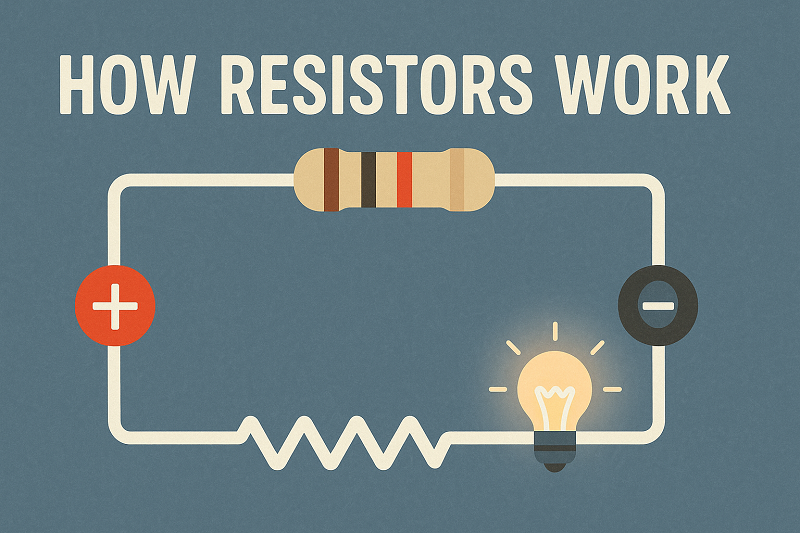
Introduction A resistor is a passive two-terminal electrical component. After it is connected to the circuit, the resistance is fixed, which can limit the current through the branch connected to it. On one hand, the resistance that cannot be changed is called a fixed resistor, on the other hand, the resistances of potentiometers or variable resistors are changeable. The main physical characteristic of a resistor is to transform electrical energy into thermal energy. It can also be said that it is an energy-consuming element, because internal energy is generated when current passes through it. Figure 1. Use Resistor in Circuit Catalog Introduction Ⅰ Functions of Resistor Ⅱ Three Basic Principles for Resistor Selection Ⅲ The Role of Resistors in Transistor Circuits 3.1 Why Should a Resistor Be Added to the Base of the Transistor? 3.2 Pull-down Resistor in Transistor Circuits Ⅳ FAQ Ⅰ Functions of Resistor In short, the function of resistance is to limit current, divide current, divide voltage, and convert electric energy into internal energy (heating) in the circuit. According to Ohm's law, through calculations, resistors in parallel and series connections can be used to achieve the desired current and voltage. Also there are different resistors and switches combined to produce voice-activated switches, photosensitive switches, infrared switches and so on. How to Use Resistors in circuits? 1) Limit CurrentIn order to prevent the components connected in series from being burnt out by the excessive current and to ensure the normal operation of the electrical appliances, a variable resistor can usually be connected in series in the circuit.2) Current DiversionThe resistor is connected in parallel to the component or circuit that needs to be shunted, and the voltage does not change. The function of this resistor is to divide current.3) Voltage DiversionGenerally, electrical appliances are marked with a rated voltage value. If the power supply is higher than it, the electrical appliance cannot be directly connected to the power supply for a normal operation. In this case, a resistor with suitable resistance can be connected in series in the circuit to share a part of the voltage, therefore the electrical appliance can work at the rated voltage. At this time, the role of the resistor is to divide the voltage.4) Provide Bias VoltageIn the transistor circuit, the resistor is connected between the base of it and the working voltage. At this time, the power supply provides a bias voltage to the base through the resistor, and the resistance can determine the bias voltage. The role of the resistor in the circuit at this time is to provide a bias voltage.5) Negative FeedbackUsed in the resistance between the base and collector of the transistor, then the feedback branch of the negative feedback circuit is formed in the circuit. At this time, the resistor plays a negative feedback role in the circuit.6) OscillationResistor and capacitor form an RC circuit, which can be combined in parallel and in series.7) Damping EffectConnecting a resistor in parallel in the LC resonant circuit can reduce the Q value, at this time, resistor plays a damping effect.8) DecouplingThe use of resistors in multi-stage amplifier circuits can prevent harmful low-frequency interference, which play a decoupling effect.9) Convert Electrical Energy into Internal Energy (Heating)When the current passes through the resistor, it will convert all (or part) of the electrical energy into internal energy, which will generate heat. This principle is often used in electric stoves and heaters in our lives.10) Convert Current into VoltageWhen current flows through the resistor, a voltage will be generated across the resistor. As shown in the figure below, the collector load resistor R2 plays this role, converting the current flowing through the resistor R2 into a voltage and outputting it from U0. Figure 2. Resistor Circuit Ⅱ Three Basic Principles for Resistor Selection 1) Choose resistors that are manufactured by a certification body that implement high-level standards.2) Choose resistors produced by manufacturers with functional advantages, quality advantages, efficiency advantages, price advantages, and service advantages.3) Choose a manufacturer that can meet the above-mentioned requirements in the model catalog. Ⅲ The Role of Resistors in Transistor Circuits 3.1 Why Should a Resistor Be Added to the Base of the Transistor? First of all, we must understand the basic principle of the transistor. It is a current-controlled element, which is different from the MOFET, a voltage-controlled element. The transistor has three working areas: cut-off area, amplification area and saturation area. Take NPN transistor as an example, the voltage difference(UBE)of BE is about 0.6V (the actual size depends on the model of the component). When UBE<0.6V , the transistor is off; when UBE=0.6V, the transistor is in the amplification or saturation region. Figure 3. Schematic Diagram of the NPN Transistor Current When the transistor is in the amplification area, the added resistance between the base and VCC is a bias resistance. The following explains why the base should be added when the transistor is used as a switch. What is the difference between transistor and MOSFET circuits when adding a resistor.The following figure is the most commonly used circuit diagram of NPN transistors. The common input terminal is the I/O port of the microprocessor (microcontroller, DSP, ARM, etc.). Figure 4. NPN Transistor Take the microcontroller I/O port with 0/5V input as an example. Why must a resistor be connected in series with the base? Can it work without a resistor? Here the resistor is a current control element. When the transistor is in an amplified or saturated state, the voltage of the UBE is 0.6V, and the base current can be calculated according to the input voltage U. The calculation formula is Ib=(U-0.6 )/R1. It can also be seen from the formula that if the current limiting resistor R1 is not connected, when the input voltage is greater than 0.6V, the base current will be very large to burn the tube.Moreover, the resistor cannot be used casually. It needs to be calculated according to the input voltage and the characteristics of the tube. For example, the amplification factor β of the transistor is 50, the maximum current of the collector is 500mA, and the input voltage is 5V. If the design requires the transistor to be in a saturated state, then Ic=500mA, Ib=Ic/β=10M=mA, where the current-limiting resistance R1=(5V-0.6V)/Ib=430Ω. If it is required to input 5V, the collector current is about 200mA, then Ib=Ic/β=200mA/50=4mA can be calculated, finally the current-limiting resistance R1=(5V-0.6V)/Ib=1075Ω (1K can be selected Standard resistance). Note: The above figure is used to explain the example, but it is not very reliable. A more reliable connection method should be to connect a large resistor (such as 10K, or 20K) between the base and the ground. When there is no input, pull the base down quickly to ensure that the tube is in a stable cut-off state.If the NPN transistor in the figure above is replaced with an N-channel MOS tube, the principle is the same. When a high level is input, the tube is turned on, and when a low level is input, the tube is turned off. Figure 5. MOSFET Circuit Since the MOSFET is a voltage-controlled device, the current of the gate (G) is very small and can be ignored, so it can work normally without connecting the resistor R1.The figure after remove the resistor is shown in the below: Figure 6. MOSFET Circuit without Resistor Note: In actual applications, a resistor is generally connected in series to improve reliability. The product reliability is very important. Without current-limiting resistor, when the MOS is damaged by voltage breakdown, the components on the control terminal will be affected easily, especially the processor, is easily damaged by high current. 3.2 Pull-down Resistor in Transistor Circuits 🔺For TransistorsThe transistor is a current-type driving component, so a current-limiting resistor is connected to the base, generally less than 10K, and the typical values are 3.3K, 4.7K, 5.1K, 6.8K, etc. What is the function of this pull-down resistor?The following figure shows the transistor 8050 switching circuit. The transistor will be turned on when the I/O port outputs a high level, and the transistor will not be turned on. If the I/O port does not output a high level, the base will always be pulled low without a 68K pull-down resistor, that is to say it is in the cut-off state. The circuit may be in an unstable state, especially when it is initialized at the moment of power-on. It is easy to generate noise and easily cause the transistor to malfunction, especially for some general input/output ports. Therefore, this resistor is actually a bias resistor, which makes the base to be pulled down when there is no driving signal, making the circuit more reliable. Figure 7. Pull-down Resistor in Transistor Circuit Although the pull-down resistor can make the circuit more reliable, tit cannot be too large or too small. If the resistance too large, the base current will not be enough to drive the transistor. On the contrary, if it is too small, the bias voltage will be less than the transistor conduction voltage. In general, this resistance is not more than 100K.Sometimes we see that a capacitor is connected in parallel with this resistor. In fact, this is generally designed in high-speed signal switching circuits. Adding a capacitor can improve performance, as shown below: Figure 8. RC Circuit 🔺For MOSFETUnlike transistors, MOS transistors are voltage-controlled components, which are driven by voltage. We all know that there is parasitic capacitance between the two pins of MOS transistors. In fact, the key of MOS transistors’ conduction is the charging and discharging of capacitors. Therefore, for the N-type MOS, it will be turned on when Vgs is greater than a certain value, but for the P-type MOS, it will be turned on when the value of Vgs is less than a certain value.Therefore, due to the capacitive effect between the three pins, when the MOS is constantly turned off, the parasitic capacitance voltage can be properly discharged, which is similar to the role of a bleeder resistor and is a kind of protection for the MOS. Figure 9. MOSFET Circuit Ⅳ FAQ 1. What is the function of the resistor?A resistor has the ability to reduce voltage and current when used in a circuit. The main function of a resistor is to limit current flow. Ohm's law tells us that an increase in a resistors value will see a decrease in current. 2. How do resistors work?A conductor has low resistance, while an insulator has much higher resistance. Devices called resistors let us introduce precisely controlled amounts of resistance into electrical circuits. ... A resistor works by converting electrical energy into heat, which is dissipated into the air. 3. Why do you need resistors?A resistor controls the flow of the electrical current within a circuit. ... Resistors are essential to many electoral circuits, and they can be applied to a myriad of different applications. Protect against voltage spikes. Resistors also protect components against voltage spikes. 4. What role do resistors play in electronic devices?A resistor is a passive two-terminal electrical device that resists the flow of current. It is probably the simplest element in an electronic circuit. It is also one of the most common components as resistance is an inherent element of nearly all electronic circuits. They are usually color-coded. 5. What is a good example of a resistor?A few examples include limiting electric current, voltage division, heat generation, matching and loading circuits, gain control, and setting time constants. They are commercially available with resistance values over a range of more than nine orders of magnitude. 6. What happens if I use a higher ohm resistor?The cases where using a higher value resistor will damage a circuit exist, but are a bit less usual than the cases where it may simply produce a weaker result than desired, or a different frequency response than desired. 7. What is a resistor simple explanation?A resistor is an electrical component that limits or regulates the flow of electrical current in an electronic circuit. Resistors can also be used to provide a specific voltage for an active device such as a transistor. ... The most common type in electronic devices and systems is the carbon-composition resistor. 8. What happens when a resistor blows?Blowing Up a Resistor. By applying too high a voltage to a resistor, the resistor will draw too much current. This causes excessive power to be dissipated in the resistor which makes it go up in flames and a cloud of smoke as this video shows. 9. How is a resistor connected in a circuit?Resistors are said to be connected in “Series”, when they are daisy chained together in a single line. Since all the current flowing through the first resistor has no other way to go it must also pass through the second resistor and the third and so on. 10. Do resistors change voltage?The larger the resistor, the more energy used by that resistor, and the bigger the voltage drop across that resistor. Ohm's Law can be used to verify voltage drop. In a DC circuit, voltage equals current multiplied by resistance. V = I R.
kynix On 2021-09-24
A printed circuit board, also known as PCB, is the electrical connection provider of electronic components. It has been developed for more than 100 years; its key point is about layout design. The main advantage of using circuit board is to greatly reduce wiring and assembly errors, improve the level of automation and productivity. In today's blog, we are going to introduce PCB systematically to show you what is PCB, what's its features, and its manufacturing method and wiring technique and so many more. Catalog PCB Introduction PCB Form PCB Features PCB Advantages PCB Basic Manufacturing How to Designing Your Own PCBs PCB Function Testing PCB Design PCB Wiring How Does PCB Works PCB Recycle FAQ PCB Introduction A printed circuit board, also known as PCB, is the electrical connection provider of electronic components. It has been developed for more than 100 years; its key point is about layout design. The main advantage of using circuit board is to greatly reduce wiring and assembly errors, improve the level of automation and productivity. Since printed circuit boards are not general end products, there is a slight confusion in the definition of it. For example, the motherboard for personal computers is called the motherboard and cannot be called the circuit board directly, although there is a circuit board in the motherboard. They are not the same, so the relationship between the two cannot be said to be the same when evaluating the industry. Another example: because integrated circuit parts are mounted on a circuit board, the news media call it IC board, but in essence, it is not equal to a printed circuit board. We commonly refer to PCB as a bare board which components are not on it. The number of PCB layers can be divided into a single panel, double panel, four-layer board, six-layer board and multilayer board. PCB Material Common materials of PCB boards are electric boards, glass fiberboards, and various types of plastic boards. PCB manufacturers generally use an insulating portion consists of glass fibre, non-fabric, and resin, then pressed with epoxy resin and copper foil to form a prepreg. PCB Metallic Coating The metal coating is where the substrate line meets the electronic component. Furthermore, metal solderability, contact, resistance, and so on will have a direct impact on the component's effectiveness. And different metals have a direct impact on production costs. Copper, tin (the thickness is usually 5 to 15 m), lead-tin alloy (or tin-copper alloy, that is solder, the thickness is 5 to 25 m, about 63 percent is tin), gold (usually plated on the interface), and silver are the most commonly used metallic coatings (usually plated on the interface, or as a whole is silver alloy). PCB Line Design Software Simple layout design can be completed by hand, but complex circuit design is usually realized through computer-aided design (CAD), and well-known design software includes CAD, Pads (that is PowerPCB), Altium designer (that is Protel), FreePCB, CAM350, and others. PCB Form The current circuit boards are primarily made up of the following components: The Line and Pattern: A line is a tool used to connect the original parts. The large copper surface will be designed as the grounding and power supply layer in the design. The wiring route is created concurrently with the pattern. Dielectric is used to keep lines and layers insulated. Through-hole / via: it can switch the lines above the two layers on and off, larger ones are used to set components, and non-through holes (nPTH) are typically used as surface mounting positioning and fixing screws for assembly. Solder resistant / Solder Mask: not all copper surfaces needed solder parts with sin, so the non-tin soldering area will print something to separate tin (usually epoxy resin), to avoid a short circuit. According to different processes, this can be divided into green oil, red oil and blue oil to distinguish different functional areas. Legend / Marking/ Silk screen: it is not necessary. Its main function is to mark the name and position of each part on the circuit board for easy maintenance and identification after assembly. Surface Finish: because the copper surface is easy to oxidize in the general environment, leading to failure to solder tin ( or solder poor), therefore, it will make the copper surface protection which needing to solder sin. The methods of protection include HASL, ENIG, Immersion Silver, tin, Immersion Tin, and OSP, which are generally called surface treatment, having their own advantages and disadvantages. PCB Features Bare panels (no parts on them) are also known as "Printed Wiring Board (PWB)". The board itself is made of insulating, non-bending material. The thin wire material that can be seen on the surface is copper foil, which is originally covered on the whole board but is etched away in the manufacturing process, and the remaining part becomes a small net line. These lines are called conductor pattern or wiring and are used to provide electrical connections to parts on the PCB. The colour of PCB is usually green or brown, which is the colour of the solder mask. It is an insulating protective layer that protects copper wire, prevents short circuit caused by wave welding, and saves solder consumption. Also, a silkscreen will be printed on the solder mask layer. Text and symbols (most are white) are usually printed on them to indicate the location of each part on the board. Silkscreen is also called a legend. Integrated circuits, transistors, diodes, passive components (such as resistors, capacitors, connectors, etc.) and a variety of other electronic components are installed when the final product made. By connecting wires, electronic signals can be connected and their functions can be work. PCB Advantages (1) Because of the reproducibility and consistency of the graphics, the errors in wiring and assembly are reduced, and the maintenance, debugging and checking the time of the equipment are saved; (2) The design can be standardized and interchangeable; (3) High density of wiring, small size, lightweight, which is beneficial to the miniaturization of electronic equipment; (4) It is beneficial to mechanization and automatic production, increasing labour productivity and reducing the cost of electronic equipment PCB Basic Manufacturing PCB manufacturing methods are classified into two types: subtractive and additive. At the moment, the subtractive etching copper foil method is primarily used in mass industrial production. Basic Manufacturing Procedure: First, we’ll need a blank circuit board (a circuit board with complete metal foil), and the rest are required circuit boards. Screen printing: a screen mask is made from a pre-designed circuit diagram. The screen's unnecessary circuit is covered with wax or waterproof material. Following that, the screen mask is placed on a blank circuit board, with a protective agent applied to the screen to prevent corrosion. Finally, immerse the circuit board in the corrosion solution; the part not covered by the protective agent will be corroded away, leaving only the rest to be cleaned away. Photosensitive board: a pre-designed circuit diagram is printed on a transparent film mask (the simplest method is to print the film with a printer), and the required part is printed in an opaque color in the same way. Then, apply photosensitive pigment to the blank circuit board, place the prepared film mask on the board while it is blazing for a few minutes, remove the mask, and use a developer to display the pattern on the board. Engraving: use a milling machine or laser engraving machine to remove unnecessary parts of a blank line directly. Other Manufacture Procedure: (1)Additive The additive, is a pre-coated copper substrate coated with a photoresistor (D/F), exposed to ultraviolet light and exposed where it is needed. Then using electroplating to thicken the copper of the formal circuit line to the required specification, and plating a layer of anti-corrosion thin tin, and finally remove the photoresist (this process is called film removal), and then etch the copper foil layer under the photoresist. (2)Layer Method The lamination method is one of the methods of making multilayer printed circuit board. The outer layer is made after the inner layer is wrapped, and the outer layer is treated by the subtractive or additive method. The sequential layer method can be used to get the multi-layer printed circuit board with multiple layers by repeating the action of the stacking method. 1. Making inner layer 2. Laminated formation( bonding different layers) 3. Layer completion ( Outer metal-containing foil film by subtractive method, mixing with the additive method) 4. Drilling (3)Panel Method 1. Whole PCB electroplating 2. Add a barrier layer where the surface is to be retained 3. Etching4. Removal of barrier layer (4)Pattern Method 1. Add a barrier layer to the area where the surface is not required 2. Electroplating requires with thickness 3. Removal of barrier layer4. Etching into unnecessary foil film to disappear (5)Complete Addition Method 1. Add a barrier layer where there is no conductor 2. Circuit consisting of no electrolytic copper (6)Partial Addition Method 1. Covered with electrolytic copper PCB 2. Add a barrier layer where there is no conductor 3. Electrolytic copper plating 4. Removal of barrier layer 5. No electrolytic copper disappeared until etched under the original barrier layer. (7)ALIVH ALIVH (Any Layer Interstitial Via Hole,Any Layer IVA), this is using aramid fiber fabric as the substrate. 1. Prepreg: dip the fabric in an epoxy resin to form a “Adhesive sheet”. 2. Laser drilling. 3. Filling the hole with conductive paste. 4. Attaching copper foil to the outer layer. 5. Making Circuit pattern by etching on copper foi. 6. Gluing the copper foil on the semi-finished product after the second step. 7. Laminated formation 8. Repeating steps 5 to 7 until completed. (8)B2it (Buried Bump Interconnection Technology) 1. First make a double panel or multilayer board. 2. Printing silver paste as cone on copper foil. 3. To place the adhesive on a silver paste, making silver cone to penetrate the adhesive. 4. Attaching the previous adhesive to the board of the first step. 5. Etching the copper foil of the adhesive into a circuit pattern. 6. Repeat the second to fourth steps until it completed. How to Designing Your Own PCBs How do you go about designing your own PCB? The ins and outs of PCB design are way too in-depth to get into here, but if you really want to get started, here are some pointers: 1. Find a CAD package: there are a lot of low-cost or free options out there on the market for PCB design. Things to consider when choosing a package: Community support: are there a lot of people using the package? The more people using it, the more likely you are to find ready-made libraries with the parts you need. Ease-of-use: if it's painful to use it, you won't. Capability: some programs place limitations on your design- number of layers, number of components, size of the board, etc. Most of them allow you to pay for a license to upgrade their capability. Portability: some free programs do not allow you to export or convert your designs, locking you into one supplier only. Maybe that’s a fair price to pay for convenience and price, maybe not. 2. Look at other people’s layouts to see what they have done. Open Source Hardware makes this easier than ever. 3. More practice. 4. Maintain low expectations. Your first board design will have lots of problems. Your 20th board design will have fewer, but will still have some. You’ll never get rid of them all. 5. Schematics are important. Trying to design a board without a good schematic in place first is an exercise in futility. Finally, a few words on the utility of designing your own circuit boards. If you plan on making more than one or two of a given project, the payback on designing a board is pretty good- point-to-point wiring circuits on a protoboard is a hassle, and they tend to be less robust than purpose-designed boards. PCB Function Testing More intensive PCB, with the higher bus speed and analog RF circuits, pose unprecedented challenges to the testing, where efficient testing requires careful design, thoughtful testing methods and appropriate tools which can provide credible test results. In high-density UUT, if calibration or diagnosis is required, manual work is likely to be required. This is because the machine is limited and the test requires faster (the UUT can collect data quickly with a probe instead of feedback the information to the edge connector), in this case, that the operator is required to probe the test points on the UUT to make sure the test points are clearly marked. Testing Issues include: (1) Is the probe bigger than the test point? (2)Is the probe in danger of shorting several test points and damaging UUT? (3) Is there a shock hazard to the operator? (4)Can each operator find out the test point quickly and check it out? (5)Are test points large and easy to identify? (6)How long does it take the operator to press the probe on the test point to get an accurate reading? (7)If the time is too long, there will be some trouble in the small test area, for example, the operator's hand will slide, so it is recommended to expand the test area to avoid this problem. After considering the above problems, the test engineer should re-evaluate the type of the test probe, modify the test file to better identify the location of the test point or even change the requirements for the operator. PCB Automatic Exploration In some cases, the use of automated probes may be required, such as when PCB is difficult to detect manually, or when the test speed is significantly reduced due to the technical limitations of the operator, under this case which an automated approach should be considered. The automatic probe can eliminate human error, reduce the possibility of short circuit at several test points, and speed up test operation. However, it should be noted that there may be some limitations to automated probes, depending on the vendor's design, including: (1)A size of UUT (2)Number of synchronous probes (3)How close are the two test points? (4)Positioning accuracy of the testing probe (5)Can the system detect UUT on both sides? (6)How fast does the probe move to the next test point? (7)What is the actual interval required for the probe system? (it is generally larger than an offline functional test system.) Automatic detection usually does not touch test points with probe and is generally slower than the production line, so two steps may be required: if the detector is used only for diagnosis, the traditional function test system can be used in the production line, and the detector should be put on the side of the production line as the diagnostic system. If the purpose of the detector is using the UUT to calibrate, it is necessary to use multiple systems, which is still much faster than manual operation. Another key issue is how to integrate the test system into the production line. Is there still room on the production line? Can the system be connected to the conveyor belt? Fortunately, many new detection systems are compatible with the SMEMA standard, so they work in an online environment. PCB Boundary Scan Because it requires specialized components to perform the task, this technology should have been discussed prior to the product design phase. Devices with IEEE1194 (boundary-scan) support can be purchased in UUT with a digital circuit, allowing most diagnostic problems to be solved with little or no detection. However, because it expands the area of each compatible device, boundary scanning reduces the overall functionality of the UUT (4 to 5 pins per chip and some wires). When selecting this technology, the goal is to improve diagnosis. Furthermore, it is emphasized that boundary scans can be used to program Flash memory and PLD devices on UUT, which strengthens the case for selecting the test method. PCB Design In the design of a printed circuit board, the layout of components and wiring of circuit connection are two key aspects. PCB Layout The layout is to put the circuit device in the printed circuit board wiring area. The layout not only affects the wiring work behind it, but it also has a significant impact on the overall performance of the circuit board. To meet the requirements of process, detection, and maintenance, the components should be uniform, neat, and compactly placed on the PCB to minimize the lead and connection between the components, resulting in uniform assembly density. PCB Functional Differentiation Components should be arranged in groups based on their power-supply voltage, digital and analog circuits, speed, current, and so on, to avoid interference with one another. When installing the digital circuit and analog circuit on the circuit board, the ground wire and power supply system of the two circuits should be completely separated, and the digital circuit and analog circuit should be arranged in different layers if the conditions allow. When arranging the fast, medium, and low-speed logic circuits on the circuit board, they should be close to the connector, while the memory should be far away from the connector. This reduces common impedance coupling, radiation, and crosstalk. The clock and high-frequency circuits, which are the primary sources of disturbance emitter, must be arranged separately and away from the sensitive circuit. PCB Thermal Magnetic Balance The heating parts and the heat-sensitive parts are as far away as possible, the influence of electromagnetic compatibility should be considered. Manufacturability: (1) Surface The mounting parts are installed on one side as far as possible and simplify the assembly process. (2) Spacing The minimum distance between components is determined according to the shape of components and other related properties. At present, the distance between components is generally not less than 0.2mm~0.3mm, the distance between components and PCB edge should be more than 2mm. (3) Direction The direction and density of the elements should be favourable to the convection of the air. Considering the assembly process, the component direction is as consistent as possible. PCB Wiring 1. Wires (1) Width The minimum width of the printed wire is determined by the adhesive strength between the conductor and the insulating substrate and the current value flowing through them. Printed wire can be as wide as possible, especially power lines and ground wires, as wide as possible under the condition of the plate surface, even if the area is tight, generally not less than 1mm. In particular, ground wires, even if they are not allowed to be widened locally, it is necessary to widen somewhere permitted to reduce the resistance of the whole ground wire system. For example, the conductors longer than 80mm, even if the current is small, should be widened to reduce the influence of conductor voltage drop on the circuit. (2) Length To minimize the length of the wiring, the shorter the wiring, the less interference and crosstalk, and the lower the parasitic reactance and the less radiation. Especially the FET gate, transistor base and high-frequency circuit should pay more attention to short wiring. (3) Gap The distance between adjacent conductors should meet electrical safety standards. The main electrical issues affecting wiring spacing are crosstalk and voltage breakdown. The spacing should be as wide as possible for ease of operation and production, and the minimum spacing should be appropriate to the applied voltage. This voltage includes the operating voltage, the additional fluctuation voltage, the overvoltage, and the peak voltage for other reasons. For safety reasons, the spacing should be wider when there is a current-voltage in the circuit. (4) Path The signal path from driver to load should be constant in width. The path impedance (resistance, inductance, and capacitance) changes as the path width changes, resulting in reflection and line impedance imbalance. As a result, it is best to keep the path width constant. Furthermore, it is best to avoid right and sharp angles for the wiring corner, which should generally be greater than 90 °. The inner edge of the right path can generate a concentrated electric field, which produces noise coupled to the adjacent path, and the 45 °path outperforms the right angle and acute angle paths. When two conductors come together at an acute angle, the acute angle should be turned into a circle. 2. Aperture and Pad The aperture of components should be better matched with the diameter of the lead; in other words, the diameter of the installation hole should be slightly larger 0.150.3mm than the component's lead diameter. DIL packaging pins and most small components have an aperture of 0.8mm and a pad diameter of about 2mm. For large pad aperture, in order to get better adhesion ability, the ratio of the aperture and the diameter of the pad is about 2 for epoxy glass plate and 2.5~3 for phenol cardboard. Perforation, which is commonly used in multilayer PCBs, has a minimum available diameter that is related to plate thickness, and the plate thickness to aperture ratio is usually 6:1. A high-speed signal generates 14nH inductance and 0.38pF capacitance when perforated. As a result, when laying high-speed signal channels, the number of holes should be kept to a bare minimum. If layer changes are unavoidable for high-speed parallel lines (such as address and data lines), it is necessary to ensure that the number of holes in each signal line is the same, and that the number of holes is minimized. When necessary, a printed conductor protection ring or protective line should be installed to prevent oscillations and improve circuit performance. 3. Grounding Design Unreasonable grounding design will affect the printed circuit board, fail to reach the design target, and even can not work. The ground wire is the reference of the potential in the circuit and the common current channel. The ground potential value is zero theoretically, but in fact, because of the existence of conductor impedance, the potential everywhere of the ground wire is not all zero. As long as the ground wire has a certain length, it's potential may not in zero everywhere. The ground wire is not only a necessary common circuit channel, it also a channel for interference. One point grounding is the basic principle of eliminating grounding interference. The ground wire of all circuits and devices must be connected to a unified grounding point, which is used as the circuit and the zero potential reference point of the equipment. One point grounding is divided into common ground wire series grounding and independent wires parallel grounding. The common ground-wire series grounding is simple. The grounding lead of each circuit is relatively short, and its resistance is relatively small. This kind of grounding method is often used in the earthing of the equipment cabinet. The independent wires parallel grounding has one ground point which is defined as the ground reference point. The other points that need to be grounded are directly connected to this point, and the earth potential of each circuit is related only to the ground current base impedance of the circuit, which will not be affected by other circuits. The Following Points Should Be Noted in Specific Wiring: (1)The line length is as short as possible in order to minimize the lead inductance. In low-frequency circuits, multipoint grounding is avoided because the ground current of all circuits flows through a common grounding impedance or grounding plane. (2)Common ground wires should be arranged as far as possible on the edge of the printed circuit board. As much copper foil as possible should be retained on the circuit board as the ground wire, which can enhance shielding ability. (3)The double-layer plate can use the ground surface, the purpose of which is to provide a low-impedance ground wire. (4)In a multi-layer printed circuit board, a grounding layer can be set, and it is designed as a mesh. The spacing of the earth grid can not be too large because one of the main functions of the earth wire is to provide the signal return path. If the spacing of the grid is large signal-loop area will be formed, which will cause radiation and sensitivity problems. In addition, if the signal reflux path is a small loop area, other ground lines will not take into effect. (5)The earth surface can minimize the radiation loop. How Does PCB Works PCB Recycle PCB manufacturing technology is a very complex, comprehensive processing technology. Especially in the process of wet processing, a large amount of water is needed, so there are many kinds of heavy metal wastewater and organic wastewater discharged. The composition is complex, and the treatment is difficult. If the copper foil utilization ratio of the printed circuit board is 30% and 40%, most of the copper content is in wastewater. If the thickness of each copper foil is 35 microns based on 10, 000 square meters of double panels, the wastewater contains about 4500 kilograms of copper, and there are many other heavy metals and precious metals. These are found in waste liquid and wastewater, if the metal is discharged without treatment, it is not only a big waste but also pollutes the environment. Therefore, the treatment of wastewater and the recycling of copper and other metals in the process of PCB production are of great significance and are indispensable parts in PCB production. It is well known that the wastewater in the production of the printed circuit board is a large amount of copper, and a very small amount of lead, tin, gold, silver, fluorine, ammonia, organic compounds and organic complexes, etc. As for the production of copper wastewater, the main processes are: copper sink, copper plating, copper electroplating, etching and various PCB pretreatment processes (chemical pretreatment, brush plate pretreatment, pozzolanic ash grinding plate pretreatment, etc.). The copper-containing wastewater produced by the above processes can be divided into complex wastewater and non-complex wastewater according to its composition. In order to make the wastewater treatment meet the environment-protection standard, and the maximum allowable compound concentration of copper is 1mg/l (according to copper), but different wastewater treatment methods must be adopted for different copper-containing wastewater. FAQ 1. What is PCB? A printed circuit board, or PCB, is used to mechanically support and electrically connect electronic components using conductive pathways, tracks or signal traces etched from copper sheets laminated onto a non-conductive substrate. 2. What is PCB and types of PCB? A printed circuit board (PCB) is a thin board made from fiberglass, composite epoxy, or other laminate materials. PCBs are found in various electrical and electronic components such as beepers, radios, radars, computer systems, etc. Different types of PCBs are used based on the applications. 3. What can a PCB be used for? Printed circuit boards (PCBs) are used to mechanically support and electrically connect electronic components using conductive pathways, tracks or signal traces etched from copper sheets laminated onto a non-conductive substrate, employed in the manufacturing of business machines and computers, as well as communication ... 4. Why are PCB green? It is due to the solder mask, which protects the copper circuits printed on the fibre glass core to prevent short circuits, soldering errors, etc. ... The colour of the solder mask gives the board its appearance. 5. What is PCB and its advantages? Compact Size and Saving of Wire. A characteristic PCB includes a large number of electronic components. On a Printed circuit board, the interconnection between the components is made through copper tracks instead of using a number of current carrying wires. It makes the interconnections less bulky. 6. How long does it take for PCBs to break down? 3.5 to 83 days. The time it takes for half of the amount of PCBs (initially) present to be broken down ranges from 3.5 to 83 days for molecules with 1 to 5 chlorine atoms. In water, PCBs are essentially broken down by the effect of sunlight (photolysis). 7. What is the disadvantage of PCB? Disadvantages: Easy to Cause Handling Damage. Process Uses a Carcinogen (Thiourea) Exposed Tin on Final Assembly can Corrode. 8. Which PCB design software is the best for beginners? Top Best PCB Design Software of 2021 a. PROTEL (Altium Designer) b.PADS (PowerPCB) c. ORCAD. d. Allegro. e. Eagle(Easily Applicable Graphical Layout Editor) f. Kicad. g. EasyEda. h. Fritzing. 9. What are the advantage of flexible PCB? The flexible circuit board are designed for saving room and improving the flexibility to meet a smaller and higher density mounting design, it also helps to reduce the assembly process and enhance reliability. 10. Why do we use PCB instead of breadboard circuit? The advantages of a printed circuit board: the board is permanent to have an electronic device worked. PCB has a better current carrying capacity comparing to a breadboard, you can make your traces wider to take more current so that work well. ... You can mount heat-sinks to the board so that have them rigid.
kynix On 2018-11-30
Executive Summary: Transistors in 2026The semiconductor transistor remains the fundamental building block of modern electronics. As of January 2026, the industry has shifted toward Gate-All-Around (GAAFET) architectures at the 2nm process node, enabling AI chips like NVIDIA's Blackwell B200 to pack over 208 billion transistors. This guide updates legacy concepts with 2026 standards, covering operation modes, NPN/PNP switching circuits, and the latest market statistics approaching a $1 Trillion valuation.What is a Semiconductor Transistor in 2026?A semiconductor transistor is an active semiconductor device used to amplify, control, and generate electrical signals and power. It functions as a variable current switch capable of controlling output current based on input voltage. Unlike ordinary mechanical switches (such as relays), transistors use electrical signals to control their own opening and closing, allowing for switching speeds in the gigahertz (GHz) range—critical for modern 5G and AI applications.Key 2026 Insight: While traditional Bipolar Junction Transistors (BJTs) are still used in analog circuits, modern high-speed computing relies on GAAFET (Gate-All-Around Field Effect Transistor) technology, which has replaced FinFET at the 3nm and 2nm nodes to minimize power leakage.Video: Transistors Basics Explained Ⅰ How do Electrons and Holes Function in a Transistor?The transistor is a current-controlled device (BJT) or voltage-controlled device (FET) that facilitates signal amplification, oscillation, and modulation. Its operation relies on the movement of charge carriers: electrons (negative charge) and holes (positive charge carriers).A standard BJT has three terminals (Emitter, Base, Collector), three regions, and two PN junctions. Understanding the internal structure is key to grasping how 2026 hardware manages billions of switching operations per second.Figure 1. Transistor Structure (NPN Configuration)Movement of Charge Carriers:Figure 2. Movement of Charge CarriersHoles vs. Electrons: The hollow circles in Figure 2 represent positively charged holes, while solid dots are negatively charged electrons. "Hole movement" is effectively the macroscopic result of electrons filling vacancies.Emitter (E): Heavily doped to emit a large number of electrons. When forward-biased, it injects carriers into the base.Base (B): Very thin and lightly doped. In an NPN transistor, the P-type base allows most electrons from the emitter to diffuse directly to the collector, with very few recombining with holes (creating the small base current, IB).Collector (C): Large surface area designed to collect electrons drifting through the base. It dissipates the most heat, especially in power transistors used in 2026 EV inverters.Current Equation: IE (Emitter Current) = IC (Collector Current) + IB (Base Current).Ⅱ What are the Key Characteristics of Transistors?Transistors define the logic of all digital circuits. Their behavior is governed by the following core principles:1) Current Control (BJT): The small base current (IB) controls the large collector current (IC).NPN Current Direction: Base → Emitter.PNP Current Direction: Emitter → Base.2) Amplification Factor (β): Transistors amplify signals by a factor of β (Beta). If IB = 1mA and β = 100, then IC = 100mA. This principle amplifies weak sensor signals in IoT devices.3) Saturation (Switch ON): When IB is sufficient (e.g., ≥1mA for small signal transistors), the voltage drop Vce ≈ 0.3V. The transistor acts as a closed switch.4) Cutoff (Switch OFF): When Vbe < 0.7V (for Silicon), the transistor is fully off. Vce is high (equal to supply voltage), acting as an open switch.Design Tip for 2026: For NPN switching circuits, connect the load to the Collector and the Emitter to Ground (GND). For PNP, connect the Emitter to Power (VCC) and the load to the Collector. NPN is generally preferred in modern logic due to higher electron mobility compared to hole mobility. Ⅲ What are the Three Operational Regions of a Transistor?To effectively use a transistor in AI hardware or power regulators, one must understand its three operational states: Cut-off, Active, and Saturation.Figure 3. Transistor Circuit And Operational Regions(1) Cut-off Region (Digital "0"): The transistor is OFF. Ube < Threshold (0.7V). IB = 0, IC ≈ 0. The switch is open.(2) Active Region (Amplification): Used for analog signal processing (audio, radio). The Emitter junction is forward-biased, and the Collector junction is reverse-biased. IC = β * IB.(3) Saturation Region (Digital "1"): The transistor is fully ON. Both junctions are forward-biased. IC cannot increase further even if IB increases. Uce is minimal (~0.2V).In embedded systems and logic gates (like those in the newest 2nm chips), transistors toggle rapidly between Cut-off and Saturation, avoiding the Active region to minimize power loss.Figure 4. Voltage CharacteristicⅣ How to Analyze Input and Output Characteristics?4.1 Input CharacteristicsThe input characteristic curve relates the base current (IB) to the base-emitter voltage (VBE). It resembles the curve of a standard diode.Figure 5. Input CharacteristicWhen VCE increases, the collector's ability to "sweep" electrons improves, slightly reducing the recombination in the base. This shifts the curve to the right, meaning less IB flows for the same VBE.4.2 Output CharacteristicsThe output characteristic relates the collector current (IC) to the collector-emitter voltage (VCE) for various fixed values of IB.Figure 6. Output CharacteristicUnderstanding the Graph: The horizontal axis is VCE. The initial steep rise is the Saturation Region (switch closed). The flat horizontal lines represent the Active/Amplification Region, where IC is constant regardless of VCE (acting as a constant current source controlled by IB). Ⅴ What Causes Saturation and Cutoff Distortion?Signal distortion occurs when a transistor amplifier is improperly biased, causing the output waveform to be "clipped" at the top or bottom.5.1 Waveform Analysis of Basic Common Emitter Amplifier CircuitFigure 7. Waveform Analysis of Common-emitter Amplifier CircuitSaturation Distortion (Bottom Clipping): Occurs when the static operating point (Q-point) is too high. IB is too large, causing UCE to drop near 0V during the positive half-cycle of the input.Cutoff Distortion (Top Clipping): Occurs when the Q-point is too low. IB is too small, causing the transistor to turn OFF during the negative half-cycle of the input.5.2 Why use Transistors as Switches?Feasibility: The distinct "ON" (Saturation) and "OFF" (Cutoff) states allow transistors to replace mechanical switches. Modern SiC (Silicon Carbide) transistors can switch high voltages in EVs with minimal efficiency loss.Necessity: Microcontrollers (CPUs/MCUs) operate at low voltages (3.3V or 5V) and cannot directly drive high-power loads like motors or LED arrays. A transistor acts as the bridge, allowing a weak software signal to control massive power. Ⅵ How to Design Transistor Switching Circuits?6.1 Basic Switching Circuit of NPN TransistorsFigure 8. NPN Transistor Switch CircuitLow-Side Switching: In an NPN circuit, the Load (R1) is connected between VCC and the Collector. The Emitter connects to Ground. When the Base receives a High signal (e.g., 3.3V from a GPIO pin), current flows from C to E, turning the load ON.6.2 Basic Switching Circuit of PNP TransistorsFigure 9. Basic Switching Circuit of PNP TransistorHigh-Side Switching: Common PNP models like the 8550 are used here. The Emitter connects to VCC. The Load connects between the Collector and Ground. Logic: A LOW signal (0V) at the Base turns the PNP transistor ON. A HIGH signal turns it OFF. This is often used for driving buzzers or indicators where the ground path must remain common. Ⅶ Frequently Asked Questions About Transistors (2026 Update)1. How does a semiconductor transistor work?A transistor works by using a small control current at the Base (or voltage at the Gate) to regulate a much larger current flowing between the Collector and Emitter (or Source and Drain). This allows it to act as an amplifier or a high-speed electronic switch.2. How is a transistor used as a switch?The transistor operates as a solid-state switch by toggling between the Cutoff region (Open circuit, OFF) and the Saturation region (Short circuit, ON). It eliminates moving parts, allowing for billions of operations per second in modern CPUs.3. What is the PN junction of a transistor?A BJT contains two PN junctions. The Emitter-Base junction is forward-biased to inject carriers, while the Collector-Base junction is typically reverse-biased to collect them. These junctions form the potential barriers that control current flow.4. How many PN junctions are there in a transistor?2 PN JunctionsA Bipolar Junction Transistor (BJT) has two PN junctions (Base-Emitter and Base-Collector). Field Effect Transistors (FETs) rely on channel conductivity rather than junction injection.5. What are the two basic types of transistors?The two primary categories are Bipolar Junction Transistors (BJT) (current-controlled) and Field Effect Transistors (FET) (voltage-controlled). As of 2026, FETs (specifically MOSFETs and GAAFETs) dominate digital electronics.6. What are the terminals of a transistor called?For BJTs: Emitter, Base, and Collector. For FETs/MOSFETs: Source, Gate, and Drain.7. What is the difference between NPN and PNP?An NPN transistor turns ON with a positive current to the Base (High-Side control usually requires voltage > Emitter). A PNP transistor turns ON when the Base is pulled Low (voltage < Emitter). NPN is more common in switching applications due to better electron mobility.8. What is the most popular transistor in 2026?The MOSFET remains the most widely used transistor globally, accounting for 99.9% of all transistors. However, for cutting-edge AI chips (like NVIDIA Blackwell), GAAFET (Gate-All-Around) is the new standard, while SiC and GaN dominate power electronics in electric vehicles.{ "@context": "https://schema.org", "@type": "Article", "headline": "What is a Semiconductor Transistor? 2026 Comprehensive Guide", "datePublished": "2019-01-01", "dateModified": "2026-01-05", "description": "A deep dive into semiconductor transistors, covering electrons/holes, NPN/PNP characteristics, and 2026 industry standards like GAAFET and AI chip architectures.", "author": { "@type": "Organization", "name": "Kynix Semiconductor" }, "mainEntity": { "@type": "FAQPage", "mainEntity": [ { "@type": "Question", "name": "How does a semiconductor transistor work?", "acceptedAnswer": { "@type": "Answer", "text": "A transistor works by using a small control current at the Base (or voltage at the Gate) to regulate a much larger current flowing between the Collector and Emitter, effectively acting as an amplifier or switch." } }, { "@type": "Question", "name": "What are the two basic types of transistors?", "acceptedAnswer": { "@type": "Answer", "text": "The two main types are Bipolar Junction Transistors (BJT) and Field Effect Transistors (FET). In 2026, FETs (specifically MOSFETs and GAAFETs) are the dominant technology for digital processors." } }, { "@type": "Question", "name": "How acts a transistor as a switch?", "acceptedAnswer": { "@type": "Answer", "text": "It acts as a switch by driving the transistor into saturation (fully ON) or cutoff (fully OFF), thereby completing or breaking the circuit path for the load." } }, { "@type": "Question", "name": "What is the difference between NPN and PNP transistors?", "acceptedAnswer": { "@type": "Answer", "text": "NPN transistors are 'active high' switches that turn on when current enters the base. PNP transistors are 'active low' switches that turn on when the base is pulled to ground." } } ] }}
Kynix On 2022-03-10
CatalogInstructionRelated VideoHow to Use SD Card ReaderSD Card Reader Not WorkingExampleFAQInstructionAs a base device, the SD card reader is lightweight and compact. You only need to insert the SD card into the SD card reader in the correct direction to connect successfully and start using it. For some SD card readers, you need to insert the SD card upside down. After that,the device is connected to another electronic terminal (such as a laptop) where the files in the SD card can be viewed. The card reader is similar to a USB floppy drive for a computer; the only difference is that the card reader reads a variety of flash memory cards, whereas the USB floppy drive only reads floppy disk. Related VideoVideo: How to Use an SD Card ReaderVideo Description:If you need to get files off your camera and onto your computer, you might need to know how to use an SD card reader. How to Use SD Card Reader1: Insert the card into the reader. Insert the SD card into the reader.2: Insert the card into the USB drive. Connect the card reader to any USB drive on your computer.3: Choose View in New Window. When prompted by the computer, select View in New Window.4: Choose DCIM DCIM should be double-clicked.5: Emphasize files Select all of the files you want to copy to your computer.6: Transfer files Move your files wherever you want by right-clicking and selecting Move To.7: Disconnect the card reader. Remove the card reader by clicking the Safely Remove Hardware icon in the bottom right corner of the screen. SD Card Reader Not WorkingHere are the steps for resolving the SD card reader not working problem. If your SD card reader isn't working on Windows, try these fixes:Clean the slot on the SD card reader.In Device Manager, look at the SD card reader's hardware information.In Device Manager, update the SD card reader driver. If your SD card reader isn't working on Mac OS, try these solutions:Check to see if the SD card reader has any limitations.In System information, look for SD card reader.In System Preferences, look for software updates. ExampleUSB 3.0 SuperSpeed Multi-Drive Memory Card ReaderSystem RequirementsTablet, laptop, Ultrabook,Chromebook or computer withUSB port (USB 3.0 port requiredfor USB 3.0 speeds) FeaturesHigh-Speed Data TransferIdeal for transferring photos, documents, hi-def audio and video, and other files between a memory card and your tablet, laptop, Ultrabook, Chromebook or computerBuilt-in 6 in. USB cable connects to device’s USB portSupports USB 3.0 data transfer rates up to 5 GbpsBackward compatible with previous USB generations Plug-and-Play ConvenienceNo software, drivers or external power supply requiredCompact case made from lightweight aluminumFits easily into your pocket, backpack, briefcase or laptop bagCompatible with all USB-enabled operating systems Compatible with Wide Range of Memory CardsSD Cards: Secure Digital (SD), Elite Pro SD, Extreme III SD, Gaming Edition SD, Platinum II SD, SD Pro, SDHC, SDXC, SD-Max, SD-Pleomax, SD-Pro C, Super SD, Turbo SD, Ultima I SD, Ultima II SD, Ultimate SD, Ultra High Speed SD, Ultra II SD, Ultra II SD Plus, Ultra SD, Ultra-X SD, DV-RS MMC, High Speed MMC/RS-MMC, MCCmobile, MMC Pro, MMCplus, MMCplus Turbo, RS-MMC Micro SD Cards: MicroSD (TransFlash), microSDHCCF Cards: CompactFlash Type I/II, CF Elite Pro, CF PRO I, CF PRO II, CF Turbo, CF Ultima I, CF Ultima II, Extreme CF, Extreme III CF, HS CF, Ultra II CF FAQ1. Why do you need a card reader?A card reader is a security device that all customers who want to use Online Banking must have. It works in conjunction with your Online Banking service to provide an additional layer of security against online fraud. 2. Are all SD card readers the same?Card readers come in a variety of shapes and sizes, with various connectors. They can read more than just SD cards; some can also read microSD cards, CompactFlash (CF) cards, and Sony's Memory Stick Pro Duo. We tested SD readers that connect via USB or USB Type-C to find the best one for your machine. 3. Does SD card reader matter?In summary, transfer speed does matter. To professional users, both write and read speed matter. To consumers, read speed is generally the most important measure of performance. For all users, a fast memory card reader is essential to ensure that the least amount of time is required during the post-capture workflow. 4. How do I use my SD card reader on my laptop?Insert your SD card into the card reader and connect it to the appropriate port on your laptop. Then, using the Windows key + E, open File Explorer and navigate to This PC. Your SD card should be listed in the right pane. To browse or access the content on your SD card, double-click it. 5. How do I use SD card reader on Android?Head to Settings > Storage & USB, and you'll be able to see the microSD cards you've installed. If your microSD card is configured as portable storage and you want to switch to internal storage, select the drive and then tap the menu button in the top right corner of the screen. Then, go to Settings and select Format as Internal. 6. Can you read an SD card on an iPhone?You can use the Files app and other supported apps to access files stored on external devices connected to your iPhone, such as USB drives and SD cards. 7. Do Macs have SD card readers?The MacBook Pro comes with a built-in SD card reader, so you can insert compatible SD cards and view their contents using the Media Reader. The cards must conform to SD 1. x, 2. x, and 3. 8. How do I get drivers for my SD card reader?You can use the Files app and other supported apps to access files stored on external devices connected to your iPhone, such as USB drives and SD cards. 9. What does a USB SD card reader do?A memory card reader is a device used to read data from a memory card such as a CompactFlash (CF), Secure Digital (SD), or MultiMediaCard (MMC). Most card readers have write capability, and when combined with a card, this can function as a pen drive. 10. Why do I need an SD card reader?SD card readers enable you to view and transfer files from the card. If your computer lacks one, you may be able to connect an external SD card reader. It is simple to transfer these files to your computer. First, remove the card from the device where it was collecting data.
kynix On 2022-05-18
RFID is the abbreviation of Radio Frequency Identification.Its principle is the contactless data communication between the reader and the tag to achieve the purpose of identifying the target. RFID has a wide range of applications, typical applications include animal chip, car chip immobilizer, access control, parking control, production line automation, and material management.What is RFID? How RFID works? RFID Explained in DetailCatalogI Overview of RFIDII Working principle of RFIDIII How RFID system is composed?3.1 About the reader3.2 About electronic tagsIV Features4.1 Applicability4.2 High efficiency4.3 Uniqueness4.4 SimplicityFAQI Overview of RFIDRadio frequency identification, or radio frequency identification technology, is a type of automatic identification technology that uses wireless radio frequency for non-contact two-way data communication. It uses radio frequency to read and write recording media (electronic tags or radio frequency cards) to achieve the purpose of identification and data exchange. It is considered to be one of the most promising information technologies in the 21st century.Radio frequency identification technology uses radio waves without contact with fast information exchange and storage technology, combines wireless communication with data access technology, and then connects to the database system to achieve non-contact two-way communication. In this way, the purpose of identification is achieved, and it can be used for data exchange, connecting an extremely complex system in series.In the identification system, the reading and writing and communication of electronic tags are realized through electromagnetic waves. According to the communication distance, it can be divided into near-field and far-field. For this reason, the data exchange mode between the read/write device and the electronic tag is correspondingly divided into load modulation and backscatter modulation. II Working principle of RFIDThe basic working principle of RFID technology is not complicated: After the tag enters the reader, it receives the radio frequency signal from the reader, and uses the energy obtained by the induced current to send out the product information stored in the chip (Passive Tag, passive tag or passive tag). ), or the tag actively sends a signal of a certain frequency (Active Tag, active tag or active tag). After the reader reads and decodes the information, it is sent to the central information system for relevant data processing.A complete RFID system is composed of three parts: a reader, an electronic tag, a so-called transponder, and an application software system. Its working principle is that the reader emits radio wave energy of a specific frequency to drive the circuit to send out the internal data. At this time, the Reader receives the interpretation data in order and sends it to the application program for corresponding processing.From the perspective of the communication and energy sensing methods between the RFID card reader and the electronic tag, it can be roughly divided into two types: inductive coupling and backscatter coupling. Generally, low-frequency RFID mostly adopts the first method, and high-frequency RFID mostly adopts the second method.The reader can be a read or read/write device depending on the structure and technology used, and it is the information control and processing center of the RFID system. The reader usually consists of a coupling module, a transceiver module, a control module and an interface unit.The reader and the tag generally adopt a half-duplex communication mode for information exchange, and the reader provides energy and timing to the passive tag through coupling. In practical applications, management functions such as the collection, processing and remote transmission of object identification information can be further realized through Ethernet or WLAN. III How RFID system is composed?The complete RFID system consists of three parts: Reader, Tag and data management system. 3.1 About the readerThe reader is a device that reads the information in the tag or writes the information that the tag needs to store into the tag. Depending on the structure and technology used, the reader can be a read/write device, which is the information control and processing center of the RFID system. When the RFID system is working, the reader sends radio frequency energy in an area to form an electromagnetic field, and the size of the area depends on the transmit power.The tag in the coverage area of the reader is triggered to send the data stored in it, or modify the data stored in it according to the instructions of the reader, and can communicate with the computer network through the interface. The basic composition of the reader usually includes: transceiver antenna, frequency generator, phase-locked loop, modulation circuit, microprocessor, memory, demodulation circuit and peripheral interface composition.(1) Transceiver antenna: Send radio frequency signals to the tag, and receive the response signal and tag information returned by the tag.(2) Frequency generator: Generates the operating frequency of the system.(3) Phase-locked loop: Generate the required carrier signal.(4) Modulation circuit: Load the signal sent to the tag to the carrier wave and send it out by the radio frequency circuit.(5) Microprocessor: Generates the signal to be sent to the label, decodes the signal returned by the label, and sends the decoded data back to the application program. If it is an encrypted system, a decryption operation is also required.(6) Memory: store user programs and data.(7) Demodulation circuit: demodulate the signal returned by the tag and deliver it to the microprocessor for processing.(8) Peripheral interface: to communicate with the computer.3.2 About electronic tagsThe electronic tag consists of a transceiver antenna, AC/DC circuit, demodulation circuit, logic control circuit, memory and modulation circuit.(1) Transceiver antenna: Receive the signal from the reader and send the required data back to the reader.(2) AC/DC circuit: Utilize the electromagnetic field energy emitted by the reader, output by the voltage regulator circuit to provide a stable power supply for other circuits.(3) Demodulation circuit: Remove the carrier from the received signal and demodulate the original signal.(4) Logic control circuit: decode the signal from the reader, and send back the signal according to the requirements of the reader.(5) Memory: As a location for system operation and storage of identification data.(6) Modulation circuit: The data sent by the logic control circuit is loaded to the antenna and sent to the reader after the modulation circuit.IV FeaturesGenerally speaking, the radio frequency identification technology has the following characteristics. 4.1 ApplicabilityRFID technology relies on electromagnetic waves and does not require physical contact between the connecting parties. This makes it possible to establish connections without regard to dust, fog, plastic, paper, wood and various obstacles, and to complete communications directly. 4.2 High efficiencyRFID system read and write speed is extremely fast, a typical RFID transmission process is usually less than 100 milliseconds. RFID readers in the high frequency band can even identify and read the contents of multiple tags simultaneously, greatly improving the efficiency of information transmission. 4.3 Uniquenesseach RFID tag is unique, through the RFID tag and product one-to-one correspondence, you can clearly track the subsequent circulation of each product. 4.4 SimplicityRFID tag structure is simple, high recognition rate, the required reading equipment is simple. Especially with the gradual popularization of NFC technology on smart phones, each user's cell phone will become the simplest RFID reader.FAQ 1. What is RFID used for?Radio Frequency Identification (RFID) is the wireless non-contact use of radio frequency waves to transfer data. Tagging items with RFID tags allows users to automatically and uniquely identify and track inventory and assets.2. What is RFID and how it works?RFID is a method of data collection that involves automatically identifying objects through low-power radio waves. Data is sent and received with a system consisting of RFID tags, an antenna, an RFID reader, and a transceiver.3. What RFID means?Radio Frequency Identification (RFID) refers to a wireless system comprised of two components: tags and readers. The reader is a device that has one or more antennas that emit radio waves and receive signals back from the RFID tag.4. Is RFID harmful to human?It is a non-ionizing type of radiation, but some researches show that it could have a negative impact on the human body in a long-term period [11, 12]. So, for the safety reasons, manufacturers of the RFID systems have limited the range of the RFID antennas used in their systems.5. Is RFID tag and FASTag same?FASTag is a device that employs Radio Frequency Identification (RFID) technology for making toll payments directly while the vehicle is in motion. FASTag (RFID Tag) is affixed on the windscreen of the vehicle and enables a customer to make the toll payments directly from the account which is linked to FASTag.6.What is RFID and its advantages?RFID technology automates data collection and vastly reduces human effort and error. RFID supports tag reading with no line-of-sight or item-by-item scans required. RFID readers can read multiple RFID tags simultaneously, offering increases in efficiency.7. Why is RFID bad?Some negative effects are that its deadly, if RFID tags combine with static electricity you can die. Another negative effect is that the government is slowly taking away surviving resources and giving ultimatums, such as if you don't get the RFID tracking chip your public assistance will be terminated.8.What are the disadvantages of RFID?a. Materials like metal & liquid can impact signal.b. Sometimes not as accurate or reliable as barcode scanners.c. Cost – RFID readers can be 10x more expensive than barcode readers.d. Implementation can be difficult & time consuming.9.How do I charge my RFID FASTag?In order to recharge your FASTag sticker, just hit the Add Money option in your Paytm app. FASTag will automatically reserve some amount from your wallet, which can be used at toll plazas later. Do note that FASTag can be used only after 20 mins of adding money to the Paytm Wallet.10. Can I use existing RFID for FASTag?If a vehicle already has an RFID tag, it might already be activated. When you buy the vehicle, RFID tag payment was also done. It might also have a minimum balance of INR 100 or 200 as is required by the bank. You can recharge it with your Customer ID or Wallet ID of FASTag.11. How does RFID work without power?Passive RFID tags have no power of their own and are powered by the radio frequency energy transmitted from RFID readers/antennas. The signal sent by the reader and antenna is used to power on the tag and reflect the energy back to the reader.12. What are the types of RFID tags?RFID tags can be grouped into three categories based on the range of frequencies they use to communicate data: low frequency (LF), high frequency (HF) and ultra-high frequency (UHF). Generally speaking, the lower the frequency of the RFID system, the shorter the read range and slower the data read rate.13.How do I know if I have an RFID chip?The best way to check for an implant would be to have an X-ray performed. RFID transponders have metal antennas that would show up in an X-ray. You could also look for a scar on the skin. Because the needle used to inject the transponder under the skin would be quite large, it would leave a small but noticeable scar.14. Does RFID require power?Active RFID tags possess their own power source – an internal battery that enables them to have extremely long read ranges as well as large memory banks. Typically, active RFID tags are powered by a battery that will last between 3 - 5 years, but when the battery fails, the active tag will need to be replaced.15. What is the difference between a QR code and RFID?QR codes must always be “read-only”, whereas RFID tags can be “read-write”, depending on the radio frequency that's being used. ... So, not only are RFID tags futuristic and have more uses than QR tags, they also have many more applications. The read range is far superior for an RFID tag.
Kynix On 2025-04-29
Join our mailing list!
Be the first to know about new products, special offers, and more.
Feature Posts
How Resistors Work: From Basic Principles to Advanced Applications2025-07-30
DC Switching Regulators: Principles, Selection, and Applications2025-05-30
FPGA vs CPLD: In-depth Analysis of Architecture, Performance and Application2025-05-07
MOSFET Technology: Essential Guide to Working Principles & Applications2025-05-04
SMD Resistor: Types, Applications, and Selection Guide2025-04-30