Phone

    00852-6915 1330

The Kynix Blog

Stay Ahead with Expert Electronics Insights,
Industry Trends, and Innovative Tips

IC Chips

Digital vs Analog ICs: Key Differences Every Engineer Should Know

Advanced Technical Guide: This definitive guide covers digital vs analog IC design for modern hardware engineers navigating the transition to Mixed-Signal architecture.The debate between digital and analog design is no longer a binary choice between continuous waves and discrete 1s and 0s. Digital logic scales workflow control, while analog physics, such as those discussed in an analog to digital converters overview, solve the massive power constraints of modern Edge AI. This analysis breaks down the physical realities of layout parasitics, the financial stakes of modern tape-outs, and the multi-billion dollar analog hardware revival, providing a clear framework for engineers deciding where to specialize in 2026.The Illusion of Binary: Why the digital vs analog IC Debate is OutdatedThe digital vs analog IC debate is outdated because digital circuits are fundamentally analog at the physics level, battling the exact same parasitic capacitance and resistance during physical layout.The engineering industry suffers from a persistent "Grass is Greener" syndrome. Digital engineers frequently report burnout from highly stressful, code-heavy verification workflows and tight production cycles. Conversely, analog engineers often feel gatekept by the immense physics and math learning curve, alongside the exorbitant cost of Electronic Design Automation (EDA) software like Cadence. Knowing How to Learn Analog Circuit Design is crucial for bridging this gap.However, the necessity of integrated circuits unites both disciplines. According to a U-Today Special Edition interview with UT Professor Bram Nauta, if an iPhone 5S were built using 1970s discrete components instead of integrated microchips, visual stress tests and 3D animations demonstrate it would be larger than the Eiffel Tower and require a nuclear power plant to run. Integration is mandatory, and at the microscopic level, the line between digital and analog disappears.While a digital schematic appears clean and logical, the physical reality is chaotic. In visual observations of Cadence software, the physical layout resembles a dense, multi-layered, colorful neon cityscape. The physical proximity of these microscopic wires introduces massive parasitic capacitance and resistance not seen in schematics. Consequently, digital designers spend the majority of their time mitigating analog problems—such as clock skew and supply noise—simply to ensure a clean "1" or "0" registers correctly.Pro Tip: "Digital is just an abstraction." Every digital gate is built from analog transistors. When operating at high frequencies, digital signals degrade into analog waveforms, requiring deep analog knowledge to troubleshoot signal integrity failures.The Core Engineering Trade-Offs: Workflows and RealitiesThe High Cost and Long Lead Times of Semiconductor Tape-outsIC design is unforgiving because physical fabrication requires months of lead time, making layout verification far more critical than standard software compilation.Unlike software engineering, where code is recompiled in seconds, or PCB design, which allows for rapid prototyping, Integrated Circuit design carries a massive penalty for errors. For advanced nodes, the tape-out to first silicon fabrication process takes 4 to 6 months at the foundry. Furthermore, the financial stakes are astronomical; mask set costs range from $47 million for 5nm nodes to over $100 million for 3nm nodes, according to 2025/2026 semiconductor manufacturing data from ALLPCB and SemiAnalysis. A single mistake in layout simulation means losing half a year of development time and millions of dollars.{{Integrated Circuit Design – EE Master SpecialisationThis extreme risk highlights the danger of relying solely on EDA tools. Professor Bram Nauta explicitly warns against blind trust in simulators: "You can put them in the computer simulator, and yeah, you always get an answer from the computer... but it's determined by what you put into the computer, so that's never complete."Because simulators cannot account for every physical variable, physical fabrication remains the ultimate source of truth. In laboratory environments, engineers use fine-tipped tweezers to carefully pick up a bare, manufactured silicon chip—no larger than a speck of coarse pepper—and place it into a custom green PCB testing rig surrounded by heavy SMA connectors to verify if the simulated layout matches physical reality.The "Nauta Circuit" Hack: Blurring the Lines Between DomainsThe Nauta Circuit is architecturally significant because it uses standard digital building blocks to solve high-frequency analog problems, proving the viability of Mixed-Signal convergence.Historically, analog and digital components were strictly segregated on the die. However, modern constraints require innovative crossovers. The "Nauta Circuit," invented by Professor Bram Nauta, perfectly illustrates this convergence.Traditional analog high-frequency filters require bulky inductors that consume excessive die area. Instead of using these legacy components, the Nauta Circuit uses standard CMOS digital inverters—which lack speed-limiting internal nodes—wired into a specific analog configuration. This arrangement creates an inductor effect with negative resistance, effectively canceling out its own parasitic output resistance. Documented by the Netherlands Organisation for Scientific Research (NWO) and IEEE Xplore, this hack achieves high speeds with minimal energy, demonstrating how digital building blocks elegantly solve analog high-frequency problems.Why is Analog Hardware Making a Massive Comeback in AI?Analog Compute-In-Memory vs Digital Memory WallAnalog hardware is experiencing a revival because Compute-In-Memory bypasses the digital memory wall, performing AI matrix math instantly using physical voltage.For decades, the industry standard dictated that analog computing was a legacy technology, permanently replaced by scalable, noise-immune digital microcontrollers. Digital processors remain the industry standard for scalable logic and workflow control, and they are an excellent choice for users who need deterministic, easily programmable environments.However, digital processing has hit a massive physical "memory wall." Moving digital data (1s and 0s) back and forth between memory and processors consumes too much power for modern Edge AI workloads. For engineers who prioritize ultra-low-power neural computation, analog architecture offers a vastly superior path.Analog Compute-In-Memory (CIM) performs Multiply-Accumulate (MAC) operations—the core math of AI—instantly at the hardware level by storing neural weights natively as analog conductance values. The performance gains are measurable. According to a January 2026 report in Modern Mechanics 24, researchers at Peking University successfully turbocharged a next-generation analog AI chip that handles real-world AI inference workloads 12 times faster and with over 200 times the energy efficiency of state-of-the-art digital processors.The commercial sector is actively adopting this architecture. In February 2026, Honda and AI hardware startup Mythic announced a joint development agreement to build a 100x more energy-efficient analog AI chip for next-generation software-defined vehicles. When evaluating edge AI accelerators, a component like nan is often the clearest example of how analog conductance values natively store neural weights without digital memory bottlenecks.Can You Shift from Digital to Analog IC Design?Transitioning to analog IC design is challenging because it requires mastering physical layout parasitics, but Mixed-Signal architecture offers a highly lucrative middle ground.A common consensus among enthusiasts on community forums like r/chipdesign is that moving from digital to analog is nearly impossible mid-career due to the physics barrier. While a purely digital IC design engineer relies heavily on Verilog/VHDL and automated place-and-route tools, an analog designer must manually battle layout effects, thermal noise, and device mismatch.However, the future does not require choosing a strict binary. The most future-proof career path in 2026 is mastering Mixed-Signal IC design. Modern System-on-Chips (SoCs) require engineers who understand how to interface digital control logic with temperature sensors analog digital output and CIM cores. For engineers transitioning, studying the architecture of nan provides a practical baseline for understanding how digital control logic interfaces with analog compute cores.Comparison Table: Digital vs Analog IC WorkflowsDigital IC workflows are verification-heavy because they scale massively, whereas analog workflows are physics-heavy because they deal with continuous real-world signals.Feature/AttributeDigital IC DesignAnalog IC DesignMixed-Signal (The Convergence)Primary ChallengeLogic verification, timing closure, clock skew.Parasitics, thermal noise, layout effects.Interfacing domains, signal integrity across boundaries.Core WorkflowCode-heavy (Verilog/VHDL), automated routing.Math/Physics-heavy, manual layout tweaking.Co-simulation, balancing automated and manual routing.Tape-Out RiskHigh (Logic bugs require full respins).Extreme (Parasitics often ruin first silicon).Extreme (Requires perfect isolation between domains).AI ApplicationControl logic, data routing, standard processors.Compute-In-Memory (CIM), ultra-low-power MACs.Complete Edge AI SoCs (e.g., Honda/Mythic 2026 chip).EDA Tool FocusSynthesis, Static Timing Analysis (STA).SPICE simulation, custom layout editors.Mixed-signal co-simulation environments.Frequently Asked Questions (FAQ)The FAQ section is essential because it clarifies complex semiconductor terminology and addresses common career concerns for hardware engineers.What is Compute-In-Memory (CIM) in IC design?Compute-In-Memory is an architecture that performs calculations directly within the memory cells where data is stored. In analog CIM, it uses physical voltage and conductance to execute Multiply-Accumulate (MAC) operations instantly, bypassing the power-hungry process of moving data between memory and a separate processor.Why do IC layouts look different from circuit schematics?A schematic is a logical representation showing ideal connections. The physical layout must account for the actual microscopic wires, transistors, and spacing on the silicon die. Physical proximity introduces parasitic capacitance and resistance, transforming a simple diagram into a highly complex, multi-layered geometric maze.What does "tape-out" mean in semiconductor manufacturing?Tape-out is the final step of the IC design process where the completed physical layout is sent to the foundry for fabrication. In 2026, advanced node tape-outs (like 3nm) take 4 to 6 months to manufacture and cost upwards of $100 million for the mask sets.Why is analog IC design considered harder than digital?Digital design relies on abstraction, using automated tools to place millions of standard logic gates. Analog design requires manual, transistor-level layout to manage continuous physical variables like voltage fluctuations, temperature changes, and manufacturing variations that automated tools cannot perfectly predict.ConclusionMixed-Signal design is the definitive future of hardware because it marries the scalability of digital logic with the ultra-low-power physics of analog computation.The narrative that analog computing is a dead, legacy technology is factually incorrect in 2026. As digital processors hit the memory wall, analog Compute-In-Memory architectures are providing the 200x energy efficiency required for the next generation of Edge AI and software-defined vehicles. Digital masters will continue to scale complex workflows, while analog masters will dictate ultra-low-power physics. Ultimately, the engineers who understand the physical realities of both domains—and the heavy penalties of the 6-month tape-out cycle—will hold the most strategic advantage in the semiconductor industry.
Kynix On 2026-05-16   23

IC Chips

Sourcing Automotive-Grade Components: Navigating Structural Shortages and AEC-Q Standards

Procurement managers and automotive engineers face a critical bottleneck in 2026: securing reliable, automotive-grade electronic components amidst a structural supply chain shortage. Electric vehicles require up to 2.5 times the semiconductor value of internal combustion engine vehicles, just as global foundries are reallocating massive capacity away from automotive legacy nodes to feed AI data centers. Building a resilient automotive supply chain requires aligning procurement strategies with strict engineering standards. Success depends on understanding AEC-Q qualifications, facility-level IATF 16949 certifications, and shifting to strategic diversification models like direct-to-foundry sourcing.The Shift from Cyclical to Structural Shortages in Automotive SemiconductorsWhy Legacy Nodes are Starved by AI DemandThe 2026 automotive chip shortage is structural, driven by foundries reallocating capital expenditure toward advanced nodes for AI data centers, leaving mature automotive nodes (28nm–180nm) with a critical investment deficit.AI Data Centers Projected Memory Chip ConsumptionAccording to the SupplyICs Q2 2026 Market Intelligence Report and EnkiAI data, AI data centers are projected to consume up to 70% of all memory chips produced by 2026. Foundries are overwhelmingly directing capital expenditure toward advanced nodes and packaging technologies, such as CoWoS (Chip-on-Wafer-on-Substrate). Consequently, the legacy nodes that automakers rely on for microcontrollers and power management are permanently deprioritized. Procurement teams waiting for the market to "normalize" are facing a permanent structural shift, not a temporary cyclical delay.The Exponential Impact of EV ElectronicsElectric vehicles demand significantly higher semiconductor density than legacy vehicles, requiring extensive passive components across the drivetrain, charging systems, and infotainment units.Industry reports from S&P Global Mobility and EE Times indicate that the semiconductor value in an EV is approximately 2 to 2.5 times higher than in an internal combustion engine (ICE) vehicle. ICE vehicles average $500–$750 in semiconductor content, whereas EVs range from $1,300 to $2,000 per vehicle, with forecasts projecting the average to firmly hit $2,000 by 2030.In visual stress tests of an exposed EV "skateboard" chassis, we observed the sheer density of wiring, battery modules, and the central drivetrain. This physical architecture demonstrates why EVs require vastly more passive components—such as power magnetics, EMC components, RF inductors, and ferrites—than traditional vehicles. Every additional subsystem multiplies the supply chain vulnerability.Decoding Automotive-Grade Standards: AEC-Q and Beyond📺 AEC-Q200 Qualified Automotive ComponentsAEC-Q100, AEC-Q101, and AEC-Q200 ExplainedThe Automotive Electronics Council (AEC) defines strict reliability standards: AEC-Q100 for integrated circuits, AEC-Q101 for discrete semiconductors, and AEC-Q200 for passive components.AEC-Q100 Grade 0 certification requires components to operate in ambient temperatures ranging from -40°C to +150°C, with thermal cycling stress tests extending from -55°C to +150°C. Furthermore, automotive-grade components are engineered for a 10- to 15-year operational lifespan with a zero-defect tolerance, according to AEC specifications and KOMEG environmental stress testing guidelines.AEC-Q100 Thermal Stress Testing RangeExperts point out that these temperature specifications map directly to physical stress points. Visual analysis of a CCS charging port during high-voltage fast charging reveals immense heat generation right at the point of power transfer. Components situated near these junctions must not degrade under continuous thermal stress, translating the abstract -55°C to +150°C benchmark into a mandatory operational reality.Facility-Level Certification: IATF 16949 and AIAGComponent qualification is insufficient without facility-level certification; manufacturing sites must hold IATF 16949:2016 certification and utilize highly automated, AIAG-referenced assembly lines to eliminate manual variability.While many guides suggest verifying the AEC-Q status of a part, professional workflows actually require auditing the production facility itself. Visual documentation of manufacturing processes confirms that even basic passive components, such as SMT (Surface Mount Technology) spacers, must be manufactured in an IATF 16949:2016 certified production site. Furthermore, automated manufacturing must follow AIAG (Automotive Industry Action Group) references. Manual assembly of micro-components introduces unacceptable variability, making highly automated lines a prerequisite for zero-defect targets.The Danger of Substituting Industrial or Commercial GradesSubstituting industrial-grade components for automotive-grade parts introduces severe liability and catastrophic failure risks, as commercial parts lack the thermal resilience and zero-defect tolerances required for ISO 26262 compliance.For stationary consumer electronics operating in climate-controlled environments, industrial-grade components adhering to the JESD47 standard (tolerating 0°C to 70°C/85°C) remain the most cost-effective choice. However, for automotive engineers designing safety-critical EV powertrains, AEC-Q qualification is a hard constraint. Attempting to substitute non-automotive grade commercial components to bypass supply chain bottlenecks compromises the vehicle's mission profile. A commercial-grade capacitor failing in an infotainment screen is an inconvenience; the same failure in an advanced driver-assistance system (ADAS) results in catastrophic liability.Current Lead Times and Sourcing Realities for EV ElectronicsAutomotive-Grade MOSFETs and SiC ComponentsLead times for power MOSFETs, including Silicon Carbide (SiC) variants critical for EV power efficiency, are currently stabilizing between 16 to 25 weeks in 2026.According to Baird Semiconductor Reports and SupplyICs Q2 2026 data, Power MOSFETs are currently averaging 16 to 25 weeks. SiC MOSFETs are particularly critical because they handle higher voltages and temperatures more efficiently than traditional silicon, directly extending an EV's driving range. With a 25-week lead time, procurement teams must forecast their high-voltage inverter production nearly two quarters in advance. This requires calculating precise inventory buffers to prevent assembly line halts without tying up excessive capital in warehousing.General-Purpose MCUs and Passive ComponentsGeneral-purpose and automotive microcontrollers face severe bottlenecks, with lead times extending up to 32 weeks due to the structural deficit in legacy node manufacturing.Extended Lead Times for MicrocontrollersAs of Q1/Q2 2026, general-purpose and automotive MCUs (especially 32-bit architectures on 28nm-40nm nodes) face extended lead times of 18 to 32 weeks, with some high-demand families stretching to 40 weeks. Because these mature nodes are starved of foundry investment, the supply of MCUs used for seat controls, window regulators, and battery management systems remains highly constrained.Strategic Diversification in Semiconductor ProcurementThe Rise of Direct-to-Foundry Sourcing ModelsAutomotive OEMs are increasingly bypassing traditional Tier 1 suppliers to establish direct-to-foundry relationships, securing dedicated capacity allocations for critical legacy node components.Historically, automakers relied entirely on Tier 1 suppliers to manage the semiconductor pipeline. The 2026 structural shortage has forced a paradigm shift. OEMs are now forming direct dual-sourcing agreements with semiconductor foundries. This strategy guarantees a specific volume of wafer production on 40nm and 65nm nodes, insulating the automaker from sudden allocations to the consumer electronics or AI sectors.Dual-Sourcing and Early Alternative QualificationIntegrating procurement with engineering during the initial design phase allows teams to qualify alternative memory types and components before shortages impact production.If you prioritize rapid prototyping for non-critical systems, relying on a single franchised distributor is sufficient. However, if you prioritize long-term production stability for an EV platform, early qualification of secondary suppliers is the strategic winner. Engineers must design printed circuit boards (PCBs) to accept pin-compatible alternatives. Qualifying a secondary MCU or alternative memory type takes months of testing to ensure ISO 26262 compliance; doing this proactively prevents production stoppages when the primary component lead time jumps to 40 weeks.Mitigating Risks with Independent DistributorsIndependent distributors provide access to open-market inventory, but require strict counterfeit detection, traceability, and authenticity verification protocols to ensure AEC-Q compliance.Users on procurement community forums often report that while independent brokers can successfully bypass 30-week lead times, the open market carries inherent risks. Sourcing outside franchised channels necessitates rigorous vetting. Procurement teams must utilize third-party testing facilities for decapsulation, X-ray inspection, and electrical testing to verify that a batch of chips is genuinely AEC-Q100 qualified and not relabeled commercial-grade inventory.Supplier Qualification and Risk Management MatrixTo navigate the complexities of automotive sourcing, procurement teams should utilize a structured vetting framework before onboarding new vendors.Automotive Supplier Vetting ChecklistComponent Level: Is the specific part AEC-Q100 (ICs), AEC-Q101 (Discrete), or AEC-Q200 (Passive) qualified?Facility Level: Is the manufacturing site actively IATF 16949:2016 certified?Process Level: Does the assembly line utilize AIAG-referenced automated manufacturing to ensure zero-defect tolerances?Safety Level: Does the component meet ISO 26262 functional safety requirements for its specific ASIL (Automotive Safety Integrity Level) rating?Supply Level: Does the supplier offer dual-fab sourcing to mitigate risks associated with legacy node capacity constraints?Closing SectionSurviving the 2026 structural semiconductor shortage requires a dual focus: uncompromising adherence to AEC-Q and IATF standards, paired with agile, diversified procurement strategies. As foundries continue to prioritize AI data centers, automotive manufacturers must bridge the gap between engineering requirements and supply chain realities through direct-to-foundry sourcing and early alternative qualification.Next Step: Download our Comprehensive Automotive Supplier Auditing Checklist to ensure your next vendor meets all IATF 16949 and AEC-Q standards before you sign a procurement contract.Frequently Asked QuestionsHow do AEC-Q100 standards differ from standard industrial certifications?AEC-Q100 standards require components to withstand extreme thermal cycling (-55°C to +150°C) and guarantee a 10- to 15-year operational lifespan with zero defects. Industrial standards like JESD47 typically only require tolerance up to 70°C or 85°C and do not mandate the same rigorous failure-rate testing.What are the risks of using commercial-grade chips in automotive applications?Commercial-grade chips lack the thermal resilience and vibration tolerance required for automotive environments. Using them in safety-critical systems violates ISO 26262 compliance, leading to catastrophic system failures, vehicle recalls, and severe legal liability.Why are structural shortages still affecting legacy automotive chip nodes?Foundries are directing up to 70% of their capital expenditure and production capacity toward advanced nodes required for AI data centers. This leaves mature nodes (28nm-180nm), which automakers rely on for MCUs and power management, with a permanent investment deficit.How can procurement teams verify the authenticity of automotive-grade semiconductors?When buying from independent distributors, teams must require full traceability documentation and utilize third-party testing. This includes X-ray inspection, decapsulation, and electrical testing to ensure the chips are not relabeled commercial-grade components.What role do independent distributors play in mitigating automotive supply chain disruptions?Independent distributors provide access to open-market inventory, allowing automakers to bypass extended 30-to-40-week lead times from franchised channels. However, utilizing them requires robust internal quality control and counterfeit detection protocols.
Allen On 2026-05-15   33
IC Chips

What Is a MOSFET? How It Works and Where It's Used

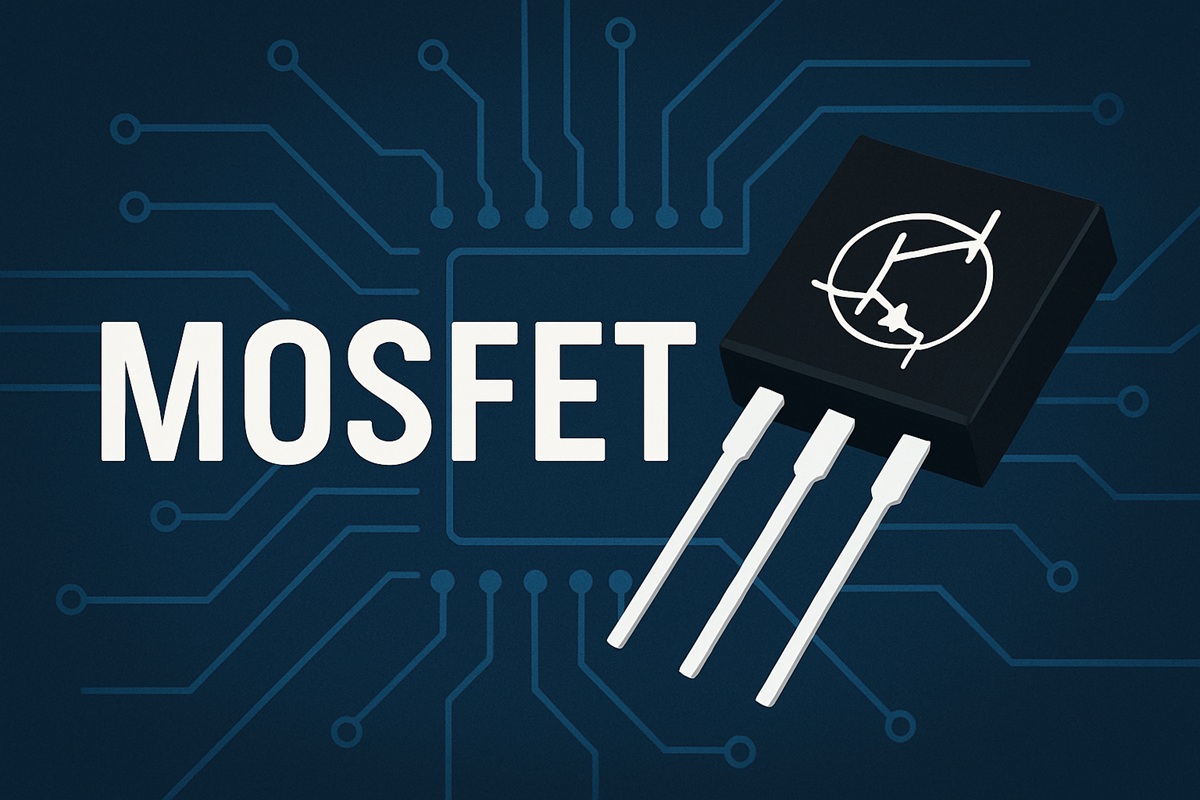
Guide: This practical guide covers what is a MOSFET for makers, engineering students, and hardware designers who need to drive heavy loads without destroying their microcontrollers. You followed the schematic perfectly, sent 5V from your ESP32 to the gate, and the component instantly got red hot, letting the "magic smoke" out. Or worse, the circuit randomly switches on when you physically walk past your breadboard. A MOSFET is not just a stronger transistor; it is a digitally controllable switch functioning as a voltage-controlled capacitor. Apply a voltage to the gate, and current flows; remove it (and drain the residual charge), and current stops. We are skipping the textbook P-N junction physics. This analysis details exactly how to wire the Gate, Drain, and Source, why "Logic-Level" components are mandatory for microcontrollers, how to navigate datasheet specifications, and how to prevent thermal runaway.What is a MOSFET (In Practical Terms, Not Textbook Physics)?A MOSFET is a voltage-controlled capacitor because it relies on an electrostatic field to open a conductive channel, unlike current-driven bipolar junction transistors. Understanding this Electronics Tutorial MOSFET Basics is essential for moving beyond simple transistor circuits.The Voltage-Controlled Capacitor vs. BJTWhile many guides suggest a MOSFET is simply a modern Bipolar Junction Transistor (BJT), professional workflows require understanding the fundamental difference. BJTs are current-controlled devices. For audio engineers who need to amplify analog signals, a BJT remains the stronger choice because of its linear current response. However, for digital hardware designers who prioritize switching high-power loads with minimal control current, the MOSFET offers a more efficient path. A MOSFET acts as a voltage-controlled capacitor. You do not push continuous current into the gate to keep it open; you charge the gate with voltage. Once charged, it stays open until discharged.The "Switch" Analogy in ActionAn n channel vs p channel mosfet comparison often highlights that the N-channel variant bridges the gap between low-voltage digital brains (like an Arduino) and high-voltage physical brawn (like motors). In visual stress tests, experts point out that the mechanism is binary but highly scalable. As noted in recent video intelligence: "If we apply a voltage to the gate pin, we allow current to flow between the source and the drain pins. We apply no voltage, and we don't allow any current to flow. And this is how we can use it as a digitally controllable switch."Pro Tip: Because the gate acts as a capacitor, failing to manage gate capacitance in half-bridge configurations leads to shoot-through—a catastrophic short circuit when two MOSFETs turn on simultaneously.The Core Anatomy: How the Hell Do I Actually Wire the Legs?The MOSFET anatomy is a three-pin system because it requires a control signal at the Gate, a power inlet at the Drain, and a return path at the Source.MOSFET Pinout and Wiring DiagramThe E-Glass Whiteboard BreakdownIn visual stress tests utilizing an E-Glass whiteboard diagram, the physical wiring path for an N-Channel MOSFET dictates a strict configuration:Gate: Connects directly to the microcontroller signal pin.Drain: Connects to the negative terminal of your external load.Source: Connects to Ground.The "Common Ground" Warning (Don't Fry Your PC)The most common catastrophic failure occurs when combining a 3.3V or 5V microcontroller (powered via USB) with an external high-voltage power supply (e.g., a 12V battery). These two isolated systems must share a common ground line. If they do not, the digital signal lacks a reference point. Video intelligence demonstrations issue a severe warning here: failing to link the grounds when using an external high-voltage power supply alongside a USB-connected microcontroller will not just destroy the $4 board—it can send high voltage back through the USB cable and permanently damage the connected computer.The "Tiny to Massive" Test: Seeing a MOSFET in ActionA MOSFET is a highly scalable switch because it allows low-voltage microcontrollers to drive high-amperage loads without altering the underlying control logic.Swapping an LED for a 60W Car HeadlightTo validate the scalability of a MOSFET, visual evidence demonstrates a "tiny to massive" load swap. A standard Python "blink" script running on a breadboard easily flashes a 5mm LED. By disconnecting the LED, introducing a 12V external power supply, and wiring a massive 60W car headlight to the exact same MOSFET circuit, the same code flashes the headlight. The microcontroller does no extra work; the MOSFET handles the heavy current draw.PWM Motor Control (Beyond Binary On/Off)MOSFETs process switching at frequencies far exceeding mechanical relays. By utilizing Pulse Width Modulation (PWM), the microcontroller rapidly toggles the gate on and off thousands of times per second. Video demonstrations show this visually ramping the RPMs of a DC motor up and down smoothly, proving the component functions as a variable power delivery system, not just a static binary switch.Why Did My Component Melt? (The Datasheet Deception)The datasheet rating is a theoretical maximum because it assumes impossible lab conditions, specifically an infinite heatsink keeping the silicon die at exactly 25°C.Thermal Performance vs. Datasheet SpecsThe "Max Continuous Drain Current" LieHardware designers often purchase a component, read the "Max Continuous Drain Current" on the first page of the datasheet, and assume it can handle that load on a breadboard. This is the datasheet deception. According to 2026 technical specs from Texas Instruments, a 49A rating for an IRFZ44N assumes the component's case is held at exactly 25°C using an infinite heatsink. In real-world ambient conditions without active cooling, pushing even a fraction of that rated current through a bare TO-220 package will cause it to melt.$R_{DS(on)}$ and Thermal Runaway$R_{DS(on)}$ is the internal resistance between the drain and source when the MOSFET is fully open. Heat increases $R_{DS(on)}$, which in turn generates more heat—a cycle known as Thermal Runaway. According to 2026 benchmarks, the typical Junction-to-Ambient thermal resistance ($R_{\theta JA}$) for a bare TO-220 package suspended in free air is 62 °C/W. Dissipating just 2 Watts of heat causes the internal junction temperature to spike by 124°C above room temperature. FLIR thermal camera footage confirms this, showing a MOSFET controlling a high-power Peltier module rapidly spiking past 60°C within seconds.Essential Survival Rules: Logic-Level, Floating Gates, & Inductive LoadsA logic-level MOSFET is mandatory for microcontrollers because standard MOSFETs require higher voltages to fully open, preventing catastrophic overheating from partial conduction. Learning how to select right mosfet drivers can help mitigate these switching issues in more complex designs.Why You MUST Buy a "Logic-Level" MOSFETFor industrial engineers driving 24V PLCs, a standard MOSFET remains the stronger choice because of its high voltage tolerance. However, for makers who prioritize 3.3V/5V microcontroller integration, a Logic-Level MOSFET offers a more cost-effective path. According to the Quantum Archive, a standard IRFZ44N requires a 10V gate drive to fully open (achieving ~0.028 Ω resistance). If driven by a 5V Arduino, it only partially conducts (~0.080 Ω), acting like a resistor and generating massive heat. Conversely, a logic-level IRLZ44N has a threshold voltage ($V_{GS(th)}$) of 1-2V and fully opens at 4-5V logic levels. When evaluating logic-level components, nan is often cited as a clear example of a device that successfully bridges 3.3V logic with high-current demands.The Pulldown Resistor Trick (Fixing "Floating Gates")Users on community forums often report their MOSFET staying ON after the microcontroller stops sending a signal, or triggering when they move their hand near the circuit. Because the gate is a capacitor, it holds its charge. A Floating Gate picks up ambient static or body capacitance. Video intelligence highlights the pulldown resistor trick: connecting a 10k Pull-down Resistor between the Gate and Ground forcefully pulls the voltage to absolute zero when the signal drops, draining the capacitance.Flywheel Diodes for Inductive LoadsWhen controlling inductive loads (motors, solenoids, electromagnets), the magnetic field collapses when the MOSFET turns off, sending a massive reverse voltage spike back through the circuit. Experts point out the necessity of adding a "flywheel diode" across the load to absorb this spike and protect the MOSFET from immediate destruction.The Future of Power Electronics (2026 Trends)Silicon is becoming obsolete in heavy industry because Wide Bandgap semiconductors offer superior thermal efficiency and lower switching losses for high-voltage applications.Why Silicon is Dying in Heavy IndustryFor hobbyists building 12V LED arrays, traditional Silicon MOSFETs remain the most cost-effective choice. However, for engineers designing 800V EV powertrains or 500kW AI data center racks, Silicon is reaching its physical limits. According to 2026 market data from Mordor Intelligence and Fortune Business Insights, the Silicon Carbide (SiC) power semiconductor market is valued at $3.41 billion (projected to hit $10.26 billion by 2031), while the Gallium Nitride (GaN) market reached $3.32 billion. These Wide Bandgap (WBG) materials offer substantially lower switching losses and survive extreme thermal demands that would instantly destroy standard Silicon.Entity Comparison: Standard vs. Logic-Level MOSFETsAttribute EntityStandard MOSFET (e.g., IRFZ44N)Logic-Level MOSFET (e.g., IRLZ44N)Gate Drive Requirement10V to fully open4-5V to fully openThreshold Voltage ($V_{GS(th)}$)2V - 4V1V - 2VResistance at 5V Drive~0.080 Ω (High Heat)~0.022 Ω (Low Heat)Primary Use Case12V/24V Industrial Systems3.3V/5V Microcontrollers (Arduino/ESP32)Community Consensus: What Users SayReal-world testing suggests that theoretical knowledge often fails upon first implementation. A common consensus among enthusiasts is that the datasheet is the biggest hurdle."I burned through three standard MOSFETs before realizing my ESP32's 3.3V pin was barely opening the gate. Switching to a logic-level component dropped the temperature from burning hot to room temperature.""Adding a 10k pull-down resistor instantly fixed my 'ghost switching' issue. My body capacitance was literally turning the motor on every time I reached for my coffee."Conclusion & Next StepsA MOSFET is a critical hardware tool because it bridges the gap between digital logic and physical power when wired with proper thermal management.If you prioritize basic 5V switching, nan is the strategic winner for breadboard prototyping. However, regardless of the component you choose, you must respect $R_{DS(on)}$, use logic-level components for microcontrollers, and tie your grounds together. As noted in recent hardware analysis: "You are now equipped with the ability to use an N-type MOSFET to control a load with a microcontroller—an incredibly powerful tool to have as a maker."Frequently Asked Questions (FAQ)Why does my MOSFET stay ON when I remove the voltage?The gate acts as a capacitor and holds its charge. Without a path to ground, it becomes a "floating gate" and stays open. You must use a pull-down resistor to drain the charge.Do I need a pull-down resistor for a MOSFET?Yes. A 10k pull-down resistor connected between the Gate and Ground ensures the voltage drops to absolute zero when the microcontroller stops sending a signal, preventing unpredictable behavior.What is the difference between a logic-level and standard MOSFET?A logic-level MOSFET fully opens its gate at 3.3V or 5V, making it safe for microcontrollers. A standard MOSFET requires 10V or more to fully open, otherwise it partially conducts and overheats.Why is my MOSFET getting so hot?It is likely experiencing thermal runaway due to high $R_{DS(on)}$. This happens if you are not supplying enough gate voltage (using a standard MOSFET with a 5V board) or pushing too much current without a heatsink.What happens if you don't share a common ground with a MOSFET?The digital control signal will lack a reference point, preventing the switch from triggering. Worse, if using high-voltage external power, it can send voltage back through the USB connection and destroy your computer.
Kynix On 2026-05-15   4
IC Chips

Active vs Passive Electronic Components: A Complete Overview

Active vs Passive Electronic Components: A Complete OverviewOverview of Active and Passive ComponentsGuide: This technical guide covers active and passive components differences overview for PCB designers and system architects navigating high-frequency 2026 circuit constraints.You have spent hours designing a switching power supply, but there is unexplained electromagnetic interference (EMI) and signal degradation on the board. The culprit is rarely a failed processor. It is usually an "ideal" passive component that is not acting passively at all. At a fundamental level, active components control the flow of electricity by injecting power, while passive components merely react to a signal by storing or dissipating energy. However, in modern engineering, the line between them blurs under high-frequency loads.This analysis covers the ultimate test to separate active from passive parts, catalogs the core examples, settles the diode classification debate, and reveals why passive parts destroy high-speed signals with parasitic noise.The Fundamental Rule: Action vs. ReactionComponent classification is binary because active parts require external VCC to control signals, whereas passive parts only react to existing current.In visual stress tests and board teardowns, we observed a stark dichotomy in how these components are deployed. Active components act as the "brains," typically clustered on dense, green printed circuit boards (PCBs) populated with surface-mount technology. Conversely, passive components act as the muscle and filtration, prominently visible on older, yellowish power supply boards using bulkier through-hole parts.The simplest heuristic to determine a component's classification is the "External Power" rule: Does the component need an external power source to operate? If yes, it is active. If no, it is passive.Physical complexity does not dictate classification. A simple two-lead diode is active, while a complex, multi-pin transparent-cased relay is entirely passive. Experts point out the fundamental behavioral difference: "Active components are devices that can control the flow of electricity. They have the ability to amplify signals, produce energy, or control the direction of current." In contrast, "Passive components cannot amplify or generate electrical signals; instead, they store or dissipate energy."Pro Tip: While many guides suggest visual identification is sufficient, professional workflows actually require checking the datasheet for VCC (power input) pins, because modern integrated passives can mimic the physical footprint of active logic gates.Active Components: The Signal ControllersActive components are signal controllers because they utilize external power to amplify, switch, and process electrical currents within a circuit, much like the Introduction to the Core Electronic Components in a Drone outlines for flight stability controllers.These devices rely on an external power source to inject net energy into a system. Visual board inspections routinely highlight the modern List of Basic Electronic Components arsenal: TO-220 packaged Transistors, DIP-packaged Integrated Circuits (ICs), and metal-can Photodiodes. These components form the logic and amplification stages of any hardware design.Are Diodes Active or Passive?This remains a massive point of online debate. Standard axial diodes (like the 1N400x series observed in visual component catalogs) lack power gain. They do not amplify signals. However, under 2026 engineering standards, they are technically classified as active components. Their non-linear semiconductor junctions allow them to control the direction of current, fulfilling the requirement of signal control.Counter-Intuitive Fact: While most people think a component must amplify a signal to be active, for power rectification, the mere ability to block reverse current makes a diode an active participant in circuit behavior.Passive Components: Energy Storage & DissipationPassive Component Density in Modern EVsPassive components are energy managers because they store or dissipate electrical energy without introducing net power into the circuit.These are the inert building blocks of electronics. They cannot introduce net energy into a circuit. Standard examples include color-banded axial Resistors, radial electrolytic Capacitors, toroidal wire-wound Inductors, and electro-mechanical Relays.While basic tutorials treat these as simple workbench parts, their deployment scale in 2026 is staggering. According to the Samsung Electro-Mechanics & Mordor Intelligence 2026 EV MLCC Market Report, a modern electric vehicle requires between 10,000 and 30,000 Multilayer Ceramic Capacitors (MLCCs) depending on the level of ADAS and electrification, compared to just ~3,000 in a traditional internal combustion engine vehicle.Pro Tip: If you prioritize absolute signal purity in low-frequency audio circuits, through-hole film capacitors remain the industry standard. However, if you prioritize spatial efficiency in dense digital logic, surface-mount MLCCs offer a more practical path.The Information Gap: The Active Threat of Passive ComponentsMicro-miniaturization of Passive ComponentsPassive components are unpredictable at high frequencies because inherent parasitic elements like ESR and ESL alter their intended impedance.The textbook fallacy states that passive components are perfectly inert. In reality, there is no such thing as a purely passive component. Every physical passive component inherently contains "parasitic" elements. A capacitor has parasitic Equivalent Series Resistance (ESR) and Equivalent Series Inductance (ESL). A resistor has parasitic capacitance.To meet the dense circuitry demands of IoT and AI hardware, passive components are shrinking to microscopic extremes. Per Murata Manufacturing and Core-EMT SMT Specifications, the ultra-microscopic 008004 imperial (0201 metric) SMT component measures exactly 0.25 mm × 0.125 mm, making it thinner than a human hair and reducing the required board placement area by 50% compared to the older 01005 size. This extreme micro-miniaturization forces engineers to deal with heightened thermal management and closer parasitic interference.For engineers modeling these parasitic effects, a simulation environment like nan remains the stronger choice because it natively calculates thermal drift in microscopic 008004 packages. However, for designers who prioritize open-source data sovereignty and zero recurring fees, traditional SPICE offers a more cost-effective path.Counter-Intuitive Fact: While many guides suggest upgrading to a faster active processor to fix timing errors, professional workflows actually require auditing the passive decoupling capacitors first, because parasitic inductance often starves the processor of instantaneous current.Why Are My Passive Components Introducing High-Frequency Noise?High-frequency noise is destructive because parasitic inductance and capacitance within passive components create unwanted oscillation during rapid switching cycles.At high switching frequencies, passive components act out. According to Cadence PCB Design & Analysis, Vincotech, and IEEE Xplore, modern AI hardware Voltage Regulator Modules (VRMs) operate at switching frequencies up to 1.8 MHz, while next-generation 2025/2026 EV Silicon Carbide (SiC) inverters are pushing switching frequencies beyond 100 kHz (up to 135 kHz in some PFC converters). {{ ?? Introduction to Active and Passive Components in Electronics }} At 1.8 MHz, an "ideal" passive capacitor acts as an inductor. This causes severe "ringing" (unwanted voltage spikes) and electromagnetic interference. Furthermore, engineers must account for Johnson/Nyquist thermal noise generated intrinsically by resistors, and the Skin Effect, where high-frequency AC currents run only on the outer layer of wires, altering impedance.When analyzing ringing in these high-frequency VRMs, nan is an excellent example of a diagnostic framework for identifying parasitic capacitance, though hardware oscilloscopes remain the ultimate ground truth for physical validation. To mitigate these issues, engineers utilize Snubber Circuits—networks of resistors and capacitors designed specifically to absorb excess energy and stop oscillation.Entity Comparison: Active vs. Passive AttributesComponent selection is highly contextual because active and passive parts serve fundamentally opposing roles in power management and signal integrity.Attribute EntityActive ComponentsPassive ComponentsPower InjectionRequires external VCC to operate.Operates entirely on the input signal.Signal ControlAmplifies, switches, or dictates direction.Stores, filters, or dissipates energy.Parasitic RiskThermal runaway, gate capacitance.ESR, ESL, Johnson Noise, Ringing.Common ExamplesTransistors, ICs, Diodes, Photodiodes.Resistors, MLCCs, Inductors, Relays.Primary 2026 ConstraintHeat dissipation in dense logic gates.Micro-miniaturization (008004 size limits).Community Consensus: What Users SayReal-world engineering consensus is shifting because high-frequency designs force developers to treat passive components with the same scrutiny as active processors.Users on community forums often report that swapping generic capacitors for low-ESR variants resolves up to 80% of unexplained microcontroller resets in custom PCB designs.A common consensus among enthusiasts is that the physical layout of passive components matters just as much as the component values. Placing a de-coupling capacitor even 2mm too far from an active IC renders it useless at high frequencies.Real-world testing suggests that relying purely on textbook definitions of "ideal" components leads to immediate failure when designing switching power supplies above 100 kHz.Conclusion & FAQModern circuit design is complex because the theoretical divide between active and passive components blurs under high-frequency operational stress.Understanding the distinction between active and passive components requires moving beyond basic definitions. While the "external power" rule remains the best heuristic for identification, successful 2026 hardware design requires acknowledging the active-like threats posed by parasitic elements in passive components.Frequently Asked QuestionsWhat is the easiest way to tell an active from a passive component? Determine if the component requires an external power source (VCC) to perform its function. If it requires external power to control a signal, it is active. If it only reacts to the signal passing through it, it is passive.Is a transformer active or passive? A transformer is passive. While it can step up voltage, it does so by stepping down current proportionally. It transfers energy without amplification and provides no net power gain.Why are MLCCs so important in modern electronics? Multilayer Ceramic Capacitors provide high capacitance in microscopic footprints. They are critical for filtering noise and stabilizing power in dense circuits, which is why a single modern EV requires up to 30,000 of them.Can a passive component amplify a voltage? Yes, but only via resonant step-up or transformer action. A passive component can never amplify total power (voltage × current). Any increase in voltage results in a proportional decrease in current.Are diodes considered active or passive components? Under modern engineering standards, diodes are classified as active components. Although they do not provide power gain or amplification, their non-linear semiconductor junction allows them to actively control the direction of current flow.
Kynix On 2026-05-13   13
IC Chips

How Does a Chip Actually Work? Inside the Semiconductor

Educational Article: This technical guide covers how does a chip work for the general tech audience and students, bridging the gap between microscopic switches and modern computing.A microchip is a highly synchronized 3D metropolis of microscopic switches. By routing electrical signals through specific pathways, these transistors perform mathematical operations that translate into rendered pixels or AI-generated text. This guide bypasses outdated chemistry lessons to explain the 2026 reality of semiconductor architecture, detailing how physical gates turn into data, how internal clocks synchronize operations, and why modern computing relies on specialized chiplets rather than monolithic dies.We literally tricked rocks into thinking by pumping them full of lightning. If you look up semiconductor architecture, most guides read like a 1990s chemistry textbook. They explain what a transistor is in agonizing detail, and then immediately jump to the conclusion that this is how a computer runs software. They leave out the entire middle step.Here is the modern, 2026 reality of how physical gates turn into data, how the internal clock synchronizes the chaos, and why modern computing relies on advanced packaging.The "Goldilocks" Material: Tricking Rocks into Processing DataSilicon is the foundational semiconductor material because its slight electrical resistance allows engineers to strictly control electron flow, creating physical binary switches.Experts point out that silicon is a semiconductor—meaning it conducts electricity, but not as freely as a highly conductive metal like copper. This slight resistance is exactly what makes it perfect for strictly controlling and manipulating electrical signals. If we used pure copper, the electricity would flow uncontrollably; if we used rubber, it would not flow at all. Silicon sits in the "Goldilocks" zone.In visual stress tests and architectural breakdowns, we observed the physical manifestation of binary. When a microscopic transistor switch is physically "off" (blocking electricity), it represents a 0. When it is "on" (allowing electricity to flow), it represents a 1. This process is effectively an extremely miniaturized version of creating physical binary switches.Furthermore, experts warn against the "thinking" fallacy. Even though the chip does not "think" like a human, it knows how to work through problems just by flipping billions of microscopic switches at the right time. It relies entirely on pre-programmed machine code.Counter-Intuitive Fact: A microchip contains zero inherent logic. It is purely a mechanical labyrinth where electricity is forced down specific paths to trigger a physical state change.The "Rest of the Owl": How Does a Chip Work to Run Software?A chip works to run software because microscopic switches are wired together into logic gates that perform basic math, which scales into complex rendering and AI calculations.Wiring a few transistors together creates basic "Logic Gates" (such as AND, OR, NOT). These gates take multiple electrical inputs and produce a single output based on strict rules. By chaining thousands of these gates together, the chip can add numbers. Consequently, adding numbers incredibly fast translates to rendering a 3D polygon in a video game or calculating a probability in a Generative AI model.Experts point out the secret of synchronization: the internal clock. All the disparate parts of a chip (memory, calculators, communicators) are kept perfectly in rhythm and synchronized by this tiny, lightning-fast metronome. Without this clock cycle, the data packets would collide, resulting in a system crash.Pro Tip: While marketing materials heavily promote Gigahertz (GHz), professional workflows actually require high IPC (Instructions Per Clock). A 3GHz chip with high IPC will easily outperform a 5GHz chip with low IPC because it executes more physical work per tick of the metronome.How Are Chips Made? (The Nanometer Layer Cake)Modern chips are manufactured because extreme ultraviolet lithography 3D-prints billions of microscopic circuit pathways onto ultra-pure silicon wafers.In visual stress tests of fabrication environments, experts highlight the "speck of dust" vulnerability. Because the architecture is built at the nanometer scale, the fabrication process is incredibly fragile. Even a speck of dust could ruin everything on a wafer, requiring extremely expensive and tightly controlled cleanrooms.Comparing a modern transistor node to a human hairTo understand the scale of miniaturization: according to the National Nanotechnology Initiative (NNI), a human hair is approximately 80,000 to 100,000 nanometers wide [1, 2]. Modern transistors, conversely, are a mere 3 nanometers across.The Tape-Out and EUV Lithography PhaseThe final phase of design before manufacturing is called the tape-out. Once taped out, the design meets EUV (Extreme Ultraviolet) lithography. According to ASML Financial Reporting, their latest High-NA EUV lithography machines (Twinscan EXE) cost approximately $380 million to $400 million each, weigh 150,000 kilograms, and are the size of a double-decker bus [3, 4, 5].These machines essentially 3D-print the circuit pathways in a "layer cake" process. They use light to etch patterns, followed by stacking chemicals, ion beams, and vaporized metals layer upon layer to build the complex 3D network of circuits.📺 How Microchips Work and Why They Power Everything TodayWhat Does “2nm” Actually Mean in Modern Tech?The "2nm" label is a marketing term because it denotes generational power efficiency and architectural design, not literal physical transistor dimensions.Historically, progress meant shrinking transistors smaller and smaller on a single flat piece of silicon. Today, the nanometer label is pure marketing to denote a generational die shrink. According to the TSMC 2026 Technology Symposium and Wedbush Securities, TSMC's 2nm (N2) process, which reached high-volume mass production in early 2026, does not use literal 2nm gates. Instead, it marks a generational shift to "Nanosheet Gate-All-Around" (GAAFET) architecture to reduce power consumption by 25–30% compared to 3nm[6, 7].Making chips smaller isn't just about speed; it is about power efficiency. If chips draw too much power, they suffer from thermal throttling (intentionally slowing down to prevent melting). Experts point out the massive flaws of the microchip's predecessor, the vacuum tube, which was bulky, fragile, and got hot easily, limiting the power and scaling of early room-sized computers. Modern GAAFET architectures solve this thermal bottleneck.The 2026 Reality: Chiplets, AI, and Specialized SiliconThe 2026 hardware landscape is fragmented because monolithic dies have been replaced by specialized chiplets to maximize manufacturing yields and AI performance.The old way of building a giant, all-in-one monolithic die is dying. The industry standard has shifted to Chiplets (or Tiles)—stitching smaller, specialized chips together using advanced packaging. Monolithic designs remain an excellent choice for low-power mobile devices where space is at an absolute premium. However, for high-performance computing, chiplets offer a more cost-effective path by combating shrinking manufacturing yields.Microscopic manufacturing imperfections lead to the "Silicon Lottery" (Binning). Manufacturers grade chips based on these microscopic flaws. The perfect silicon becomes a high-end processor, while the slightly flawed silicon gets locked down (cores disabled) and sold as a budget model.Market projection visualization for specialized AI chipsAccording to the Deloitte "2026 Global Semiconductor Industry Outlook", high-value AI chips are projected to drive roughly 50% of total semiconductor industry revenue, despite accounting for less than 0.2% of total unit volume (under 20 million chips) [8]. This massive market distortion dictates why specialized silicon dominates the modern motherboard.Entity Comparison: Modern Processing UnitsProcessing UnitPrimary FunctionArchitectural StrengthIdeal WorkloadCPU (Central Processing Unit)General-purpose logic and system management.Low latency, high clock speeds for sequential tasks.Operating systems, database management, web browsing.GPU (Graphics Processing Unit)Parallel processing for rendering and math.Thousands of smaller cores designed to execute multiple tasks simultaneously.3D rendering, video encoding, basic machine learning.NPU (Neural Processing Unit)Matrix multiplication for AI models.Highly optimized for tensor operations and low-precision math.Generative AI, local LLMs, real-time voice transcription.ASIC (Application-Specific IC)Single-task execution.Hard-coded logic that cannot be repurposed, offering maximum efficiency.Cryptocurrency mining, specific network routing.Conclusion & Next StepsUnderstanding semiconductor architecture reveals that modern computing relies on extreme miniaturization, specialized chiplets, and precise synchronization rather than raw clock speed.As experts frequently note, it is not just that chips are fast or small. It is that they have become cheap and efficient enough to fit into nearly anything. That is why the modern world is so tightly intertwined with microchip technology. The evolution from bulky vacuum tubes to 3D-stacked GAAFET architectures proves that Moore's Law did not die; it simply moved vertically.For readers looking to deepen their understanding of hardware architecture, the next step is to analyze how these specialized units communicate. Reviewing the differences between PCIe lanes, memory bandwidth, and advanced packaging techniques (like hybrid bonding) will provide a complete picture of modern system-level performance.Frequently Asked QuestionsWhat is the difference between a CPU, GPU, and NPU?A CPU acts as the general-purpose brain for sequential tasks. A GPU handles parallel processing for graphics and video. An NPU is built specifically for matrix multiplication, which is required for AI workloads.Is Moore’s Law actually dead?No, but it has evolved. Instead of simply shrinking transistors on a flat 2D plane, the industry has shifted to 3D stacking and advanced packaging (chiplets) to continue scaling performance.What does "tape-out" mean in chip manufacturing?Tape-out is the final phase of the chip design process. It marks the moment the digital circuit design is finalized and sent to the fabrication plant to be physically manufactured using EUV lithography.Why are microchips made of silicon instead of highly conductive copper?Silicon is a semiconductor, meaning it offers slight electrical resistance. This resistance allows engineers to strictly control the flow of electrons to create binary on/off switches. Copper conducts electricity too freely to be used as a switch.What is the "silicon lottery"?The silicon lottery refers to the microscopic manufacturing imperfections inherent in chip fabrication. Manufacturers test and grade (bin) chips based on these flaws, selling the perfect ones as high-end models and the slightly flawed ones as budget models. {"@context":"https://schema.org","@type":"FAQPage","mainEntity":[{"@type":"Question","name":"What is the difference between a CPU, GPU, and NPU?","acceptedAnswer":{"@type":"Answer","text":"A CPU acts as the general-purpose brain for sequential tasks. A GPU handles parallel processing for graphics and video. An NPU is built specifically for matrix multiplication, which is required for AI workloads."}},{"@type":"Question","name":"Is Moore’s Law actually dead?","acceptedAnswer":{"@type":"Answer","text":"No, but it has evolved. Instead of simply shrinking transistors on a flat 2D plane, the industry has shifted to 3D stacking and advanced packaging (chiplets) to continue scaling performance."}},{"@type":"Question","name":"What does \"tape-out\" mean in chip manufacturing?","acceptedAnswer":{"@type":"Answer","text":"Tape-out is the final phase of the chip design process. It marks the moment the digital circuit design is finalized and sent to the fabrication plant to be physically manufactured using EUV lithography."}},{"@type":"Question","name":"Why are microchips made of silicon instead of highly conductive copper?","acceptedAnswer":{"@type":"Answer","text":"Silicon is a semiconductor, meaning it offers slight electrical resistance. This resistance allows engineers to strictly control the flow of electrons to create binary on/off switches. Copper conducts electricity too freely to be used as a switch."}},{"@type":"Question","name":"What is the \"silicon lottery\"?","acceptedAnswer":{"@type":"Answer","text":"The silicon lottery refers to the microscopic manufacturing imperfections inherent in chip fabrication. Manufacturers test and grade (bin) chips based on these flaws, selling the perfect ones as high-end models and the slightly flawed ones as budget models."}}]}
Kynix On 2026-04-29   39
IC Chips

March 2026 PMIC Market Analysis - Kynix Supply Chain Report

The "wait and see" period is officially over. In January, we warned of potential volatility. Now, as we enter March 2026, the first major domino has fallen. Powerchip Semiconductor Manufacturing Corp (PSMC) has reportedly initiated a price hike for its 8-inch foundry services starting this month, a move expected to trigger a chain reaction across Tier-2 foundries globally.This isn't just about inflation; it's about a physical lack of manufacturing slots. According to the latest data from TrendForce and industry checks, global 8-inch wafer capacity is projected to contract by 2.4% year-over-year in 2026. This structural decline, colliding with the explosive demand from AI servers, has created a "Perfect Storm" for the analog supply chain.The Capacity Crunch Chart🚨 Critical Market Bulletin (March 2026):Foundry Action: PSMC and VIS (Vanguard) are raising quotes by 10-15% for spot orders.Capacity Utilization: Average 8-inch utilization has climbed to 90%, with BCD (Bipolar-CMOS-DMOS) processes fully allocated.Rumor Mill: Uncertainty surrounds Samsung's Giheung S7 fab, with reports of further capacity reductions intensifying supply fears.The "BCD" Bottleneck: Why AI is Starving Your PMIC SupplyWhy is a data center boom hurting the supply of industrial voltage regulators? The answer lies in the BCD process technology. This specialized 8-inch process is essential for manufacturing high-voltage Power Management ICs (PMICs).AI Servers (powering models like GPT-5) require complex, multi-phase power modules that consume up to 5x the silicon area of standard server PMICs. Tier-1 fabless design houses have booked out the vast majority of BCD capacity at TSMC and UMC to serve this high-margin AI market. This has effectively "crowded out" production slots for standard consumer and industrial PMICs, pushing lead times from 16 weeks to 26+ weeks.The BCD Process SqueezeCategory Watch: March 2026 Price & Lead Time DataProcurement teams must update their ERP lead time offsets immediately. The following data reflects the current situation on the Kynix platform and global spot market:Component FamilyMarch StatusPrice Trend (MoM)Lead TimeHigh-Voltage PMICAllocation▲ +18%26 - 30 WeeksAutomotive MOSFETsCritical Shortage▲ +15%35+ WeeksIndustrial MCUs (32-bit)Tightening▲ +8%20 - 24 WeeksStandard Logic (Little impact)Stable► 0%10 - 12 WeeksThe "Samsung Factor" and Structural DeclineAdding to the anxiety is the structural shift at major IDMs. Reports indicate that Samsung is continuing to scale back its 8-inch operations (specifically rumored around the Giheung S7 line) to focus resources on 12-inch and advanced memory.Unlike 2021, where the shortage was caused by a temporary demand spike, the 2026 challenge is supply-side atrophy. The machines are being turned off or converted, meaning this capacity is likely gone forever. This supports the forecast that the 2.4% capacity drop is just the beginning of a long-term trend.Kynix Strategy: Surviving Q2 and Q3With PSMC's price hike official, the window for "cheap inventory" has closed. Your strategy must shift from cost-saving to assurance of supply.1. Lock in Q3 Stock NowWait-and-see is a losing strategy. With lead times extending past 26 weeks, orders placed today will land in September. You must cover your Q3 production needs immediately.2. Validate Alternatives (Second Sources)If your BOM relies on a single Tier-1 brand for MOSFETs, you are at risk. Kynix can help you identify pin-to-pin compatible replacements from manufacturers who still have 8-inch capacity available, particularly in the Asian market.Conclusion: Resilience in a Shrinking MarketThe March 2026 data confirms that the era of abundant legacy node capacity is ending. The combination of PSMC's price moves and the AI sector's appetite for power silicon means buyers must be agile.Don't let a missing $0.20 regulator stop your production line.Secure Your Critical PMICs & MOSFETs TodaySearch Kynix's global inventory for real-time stock and alternative solutions.Search Components on Kynix.com
Kynix On 2026-03-04   325

Kynix

Kynix was founded in 2008, specializing in the electronic components distribution business. We adhere to honesty and ethics as our business philosophy and have gradually established an excellent reputation and credibility in our international business. With the accurate quotation, excellent credit, reasonable price, reliable quality, fast delivery, and authentic service, we have won the praise of the majority of customers.

Follow us

Join our mailing list!

Be the first to know about new products, special offers, and more.

Kynix

  • How to purchase

  • Order
  • Search & Inquiry
  • Shipping & Tracking
  • Payment Methods
  • Contact Us

  • Tel: 00852-6915 1330
  • Email: info@kynix.com
  • Follow Us

authentication

Kynix

© 2008-2026 kynix.com all rights reserved.