The Kynix Blog
Stay Ahead with Expert Electronics Insights,
Industry Trends, and Innovative Tips
- Electronic Components
- News Room
- General electronic semiconductor
- Components Guide
- Sort by
- Robots
- Transmitters
- Capacitors
- IC Chips
- PCBs
- Connectors
- Amplifiers
- Memory
- LED
- Diodes
- Transistors
- Battery
- Oscillators
- Resistors
- Transceiver
- RFID
- FPGA
- Mosfets
- Sensor
- Motors, Solenoids, Driver Boards/Modules
- Relays
- Optoelectronics
- Power
- Transformer
- Fuse
- Thyristor
- potentiometer
- Development Boards
- RF/IF
- Semiconductor Information
- PCB
- transistor
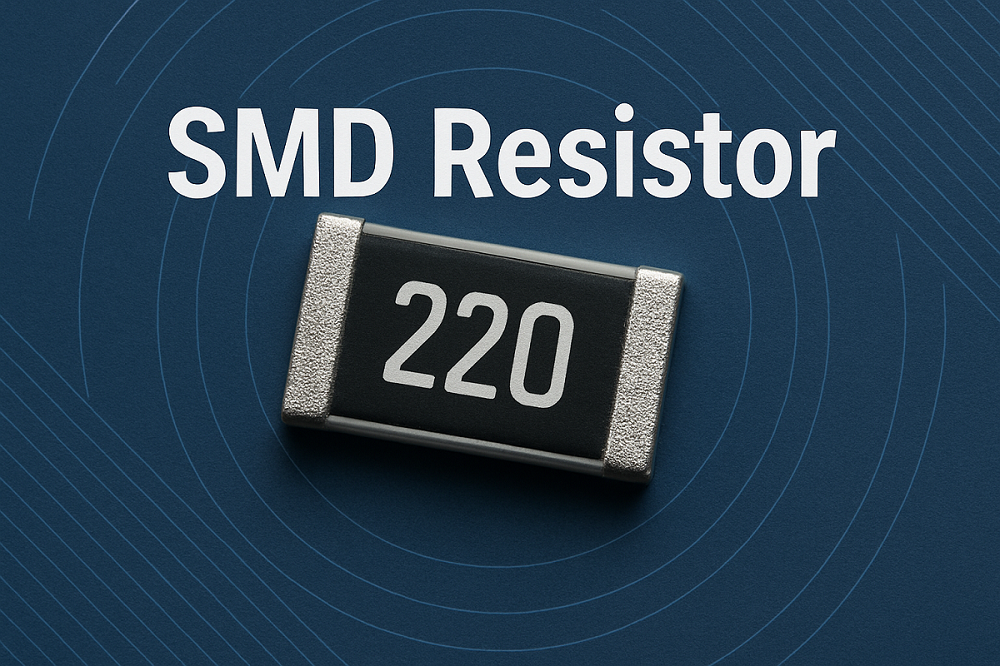
2026 Executive Summary: Reading SMD Resistor CodesHow do you read SMD resistor codes? For standard 3-digit codes, the first two numbers are significant digits, and the third is the multiplier (10^x). For 4-digit codes (precision), the first three are significant. The EIA-96 system uses a two-digit code and a letter multiplier. This authoritative guide covers all calculation methods, updated for 2026 industry standards.What are SMD Resistors? (2026 Overview)SMD Resistor, also known as a Chip Resistor, is a surface-mount passive component essential for modern high-density electronics. Manufactured by sintering metal powder and glass glaze on a ceramic substrate, these components offer superior resistance to humidity, high temperatures, and vibration compared to legacy through-hole parts. As of 2026, they are the industry standard for everything from AI hardware to smartphones. While different resistors feature varied specifications, the critical question remains: how are these microscopic resistance values marked and decoded? Figure 1. Structure of SMD ResistorsⅠ How to Read Resistor Markings: 4 Key MethodsTo master resistor identification, one must understand the four global standards used to denote resistance values. These methods are governed by IEC 60062 standards:1. Direct Marking MethodThis method prints the actual numbers and unit symbols directly on the resistor surface. The allowable error (tolerance) is expressed as a percentage. If no deviation is marked, the standard tolerance is typically ±20%.2. Text Symbol MethodThis approach uses a combination of Arabic numerals and text symbols to indicate the nominal resistance and tolerance. The number preceding the symbol represents the integer value, while the number following represents the decimal. Tolerance characters are standardized: D (±0.5%), F (±1%), G (±2%), J (±5%), K (±10%), M (±20%).3. Digital Method (Most Common for SMD)This method uses a 3-digit or 4-digit code. Read from left to right, the initial digits represent the significant figures (effective values), and the final digit is the exponent (multiplier), indicating the number of zeros to add. The unit is always Ohms (Ω).4. Color Code Marking MethodWhile rare on modern SMDs (except MELF packages), color bands are the standard for through-hole resistors. The bands represent values and multipliers:Black (0), Brown (1), Red (2), Orange (3), Yellow (4)Green (5), Blue (6), Violet (7), Gray (8), White (9)Tolerance: Gold (±5%), Silver (±10%), Colorless (±20%)Figure 2. Universal Resistor Color Code DiagramReading Tip: For a four-band resistor, the last band (usually gold/silver) is the tolerance. The first two bands are digits, and the third is the multiplier. For five-band precision resistors, the first three are digits, the fourth is the multiplier, and the fifth is the tolerance. Ⅱ Calculating SMD Resistor Values (Step-by-Step)2.1 Understanding Character Code MarkingsVideo: SMD Resistor Coding ExplainedMarking chip resistors requires a compact system due to the component's microscopic size. While large packages may use full numbers, 0603, 0805, and 1206 packages use coded systems. Here is the 2026 standard breakdown for decoding these values:The 3-Digit System (Standard Tolerance ±5%):1. The first and second digits represent the significant resistance figures.2. The third digit is the multiplier (10^x).Decoding Guide by Third Digit:• Ends in 0: No extra zeros. Example: 100 = 10 Ω.• Ends in 1: Add one zero (x10). Example: 101 = 100 Ω.• Ends in 2: Add two zeros (x100). Example: 102 = 1,000 Ω (1 kΩ).• Ends in 3: Add three zeros (x1,000). Example: 103 = 10,000 Ω (10 kΩ).• Ends in 4: Add four zeros. Example: 104 = 100 kΩ.• Ends in 5: Add five zeros. Example: 105 = 1 MΩ.• Ends in 6: Add six zeros. Example: 106 = 10 MΩ.The 4-Digit System (Precision Tolerance ±1%):For higher precision, three significant digits are used. Example: 1001 means 100 + one zero = 1000 Ω (1 kΩ).Note: Ultra-small packages like 01005, 0201, and 0402 are physically too small for markings. These must be measured with a multimeter or tracked via reel tape labeling.2.2 Real-World Calculation ExamplesCase 1: 3-Digit Code (±5% Tolerance)This uses two significant digits followed by a multiplier.Calculation: 153 → 15 followed by 3 zeros → 15,000 Ω = 15 kΩDecimal Values: "R" represents the decimal point. Code 6R8 → 6.8 ΩCase 2: 4-Digit Code (±1% Tolerance)Common on packages like 0805, 1206, and 2512. The first three digits are significant.Calculation: 2372 → 237 followed by 2 zeros → 23,700 Ω = 23.7 kΩDecimal Values: 3R24 → 3.24 ΩCase 3: EIA-96 System (The "Cryptic" Code)Used for 1% tolerance resistors on small 0603 packages where 4 digits won't fit. This system uses a two-digit code (referencing a lookup table) and a letter multiplier.Format: [Code] [Letter]Example Multipliers: Y=0.01, X=0.1, A=1, B=10, C=100, D=1000, E=10000.E-96 Series Standard Resistance Lookup Table (Partial)ValueCodeValueCodeValueCode100011471721533102021501822134105031541922635107041582023236110051622123737113061652224338115071692324939118081742425540121091782526141124101822626742127111872727443130121912828044133131962928745137142003029446140152053130147143162103230948 ValueCodeValueCodeValueCode316494646568181324504756669882332514876771583340524996873284348535116975085357545237076886365555367178787374565497280688383575627382589392585767484590402595907586681412606047688792422616197790993432626347893194442636497995395453646658097696EIA-96 Calculation Examples:Code 29B: Lookup "29" in table → Value 196.Multiplier "B" → x10.Result: 196 × 10 = 1.96 kΩCode 10X: Lookup "10" in table → Value 124.Multiplier "X" → x0.1.Result: 124 × 0.1 = 12.4 ΩCase 4: The Underlined Code (Special 0603 Case)Sometimes you see a standard 3-digit code with a line under it on an 0603 package. This usually indicates the manufacturer uses the E-24 series values (loose tolerance) rather than E-96, but the calculation is standard.122 = 12 × 100 = 1.2 kΩ680 = 68 × 1 = 68 Ω (Note: 680 does not mean 680 ohms here, it means 68 and zero extra zeros). Ⅲ How to Identify Damaged SMD Resistor Values?When a resistor is burned or the marking is unreadable, use these four forensic engineering methods to deduce the value:1. Parallel Circuit ComparisonPCB designs, especially in power supplies and audio amplifiers, often use symmetrical channels. • Example: In an LCD backlight driver, if the resistor in Channel A is burnt, check the corresponding position in Channel B. Often R17 = R51, or R23 = R48. Measure the intact sibling component to find the value.2. Circuit Context Analysis (Pull-Up/Pull-Down)For Microcontroller (MCU) circuits, resistors connected to GPIO pins are typically "pull-up" or "pull-down" resistors used to stabilize logic levels.• Common Values: 3.3kΩ, 4.7kΩ, 10kΩ.• Deduction: If the resistor connects a data line to VCC or GND, replacing it with a 10kΩ resistor is a safe starting point for testing.3. Reference Similar SchematicsIf the exact schematic is unavailable, search for schematics of devices using the same main IC. Manufacturers often use the "Reference Design" provided by the chipmaker, meaning the peripheral resistor values will be identical across different brands.4. The Potentiometer Test (Advanced)If all else fails, trace the circuit diagram. Temporarily solder a high-value potentiometer (variable resistor) in place of the damaged part. Power on the device and slowly adjust the resistance while monitoring voltage levels until the circuit functions correctly. Remove the potentiometer, measure its set resistance, and replace it with the closest standard fixed resistor. Ⅳ Top SMD Resistor Manufacturers (2026 Updated)Reliability is paramount in 2026 electronics. The following brands are currently recognized as Tier-1 manufacturers for automotive, industrial, and consumer electronics:YAGEO: Global leader in chip resistors (acquired KEMET).Vishay: Known for high-precision, military-grade foil resistors.Panasonic: Industry standard for high-reliability automotive parts.KOA Speer: Major supplier for automotive and industrial markets.Bourns: Famous for circuit protection and resistors.TE Connectivity: Specialist in harsh environment resistors.Other Notable Brands: ROHM, Ohmite, Welwyn, TT Electronics, UNI-ROYAL (Uniohm). ⅴ Frequently Asked Questions (FAQ)1. What is an SMD resistor used for?SMD (Surface Mount Device) resistors limit current, divide voltage, and stabilize signal lines in compact electronic circuits. They are essential for miniaturizing devices like smartphones, wearables, and IoT sensors where traditional through-hole components would be too bulky. 2. How do I calculate the value of a 3-digit SMD resistor?Use the formula: [1st Digit][2nd Digit] x 10^[3rd Digit]. For example, "103" means 10 x 10^3 (1000) = 10,000 Ohms or 10kΩ. 3. What does "R" mean in a resistor code like 4R7?The letter "R" represents the decimal point. It is used when the resistance value is too small to use a multiplier code. Therefore, 4R7 equals 4.7 Ohms. 4. What is the difference between 103 and 1002 markings?Both equal 10kΩ, but the marking indicates tolerance. "103" (3-digit) typically indicates ±5% tolerance. "1002" (4-digit) indicates higher precision, typically ±1% tolerance. 5. How do I read the cryptic "01A" or "29B" codes?These are EIA-96 codes for 1% precision resistors on small 0603 parts. You cannot read them directly; you must use an EIA-96 lookup table. The number refers to a value code, and the letter is the multiplier. 6. Why do some SMD resistors have no markings?Resistors in package sizes 0402, 0201, and 01005 are physically too small to print legible text. To identify these, you must measure them with a multimeter or refer to the manufacturer's reel tape packaging. 7. What does SMD stand for?SMD stands for Surface Mounted Device. It refers to the component itself. SMT (Surface Mount Technology) refers to the manufacturing process of placing these components onto a PCB. 8. What materials are SMD resistors made of?Most SMD resistors are "Thick Film" or "Thin Film" types. They consist of a ceramic substrate (alumina) coated with a resistive paste (metal oxides and glass). This is fired in a kiln, laser-trimmed to the exact value, and then coated with a protective layer.{ "@context": "https://schema.org", "@type": "Article", "mainEntityOfPage": { "@type": "WebPage", "@id": "https://www.kynix.com/Blog/How-to-Read-the-Value-of-SMD-Resistor-Example-Explained.html" }, "headline": "How to Read SMD Resistor Codes: The 2026 Guide to 3-Digit, 4-Digit & EIA-96 Markings", "image": "https://www.kynix.com/editor_u/image/20211027/2021102711243403.jpg", "author": { "@type": "Organization", "name": "Kynix Electronics" }, "publisher": { "@type": "Organization", "name": "Kynix Electronics", "logo": { "@type": "ImageObject", "url": "https://www.kynix.com/logo.png" } }, "datePublished": "2021-10-27", "dateModified": "2026-01-08", "description": "Learn how to calculate SMD resistor values using 3-digit, 4-digit, and EIA-96 codes. Includes updated 2026 lookup tables and troubleshooting steps for damaged components.", "articleBody": "SMD Resistor, called Chip Resistor, is one type of resistors..."}{ "@context": "https://schema.org", "@type": "FAQPage", "mainEntity": [{ "@type": "Question", "name": "What is an SMD resistor used for?", "acceptedAnswer": { "@type": "Answer", "text": "SMD (Surface Mount Device) resistors limit current, divide voltage, and stabilize signal lines in compact electronic circuits like smartphones and IoT devices." } }, { "@type": "Question", "name": "How do I calculate the value of a 3-digit SMD resistor?", "acceptedAnswer": { "@type": "Answer", "text": "Use the formula: [1st Digit][2nd Digit] x 10^[3rd Digit]. For example, 103 means 10 x 1000 = 10,000 Ohms (10kΩ)." } }, { "@type": "Question", "name": "What does 'R' mean in a resistor code like 4R7?", "acceptedAnswer": { "@type": "Answer", "text": "The letter 'R' acts as a decimal point. 4R7 represents 4.7 Ohms." } }, { "@type": "Question", "name": "How do I read EIA-96 codes like 01A?", "acceptedAnswer": { "@type": "Answer", "text": "EIA-96 codes require a lookup table. The number represents a significant value, and the letter represents a multiplier. For '01A', 01 is 100 and A is x1, resulting in 100 Ohms." } }]}{ "@context": "https://schema.org", "@type": "HowTo", "name": "How to Read a 3-Digit SMD Resistor Code", "description": "Step-by-step guide to calculating resistance from standard 3-digit markings found on most chip resistors.", "step": [{ "@type": "HowToStep", "name": "Identify the Significant Digits", "text": "Read the first two numbers on the resistor. These are your significant digits (e.g., in '103', the significant digits are '10')." }, { "@type": "HowToStep", "name": "Identify the Multiplier", "text": "Read the third number. This indicates the power of 10 to multiply by (or how many zeros to add). In '103', the multiplier is 3 (10^3 or 1000)." }, { "@type": "HowToStep", "name": "Calculate the Result", "text": "Multiply the significant digits by the multiplier. 10 x 1000 = 10,000 Ohms (10kΩ)." }]}
Karty On 2021-10-27

Ⅰ IntroductionOscillators are the heartbeat of modern electronics. From the quartz watch on your wrist to the 5G smartphone in your pocket, these components play a critical role in generating timekeeping signals and carrier waves. While early applications included simple AM radios and metal detectors, today's oscillators are foundational to IoT devices, advanced computing, and high-speed data transmission.To understand how electronic oscillators function in 2025, it helps to look at physical analogies and fundamental circuit designs. This guide covers the core concepts, modern classifications, and practical examples of oscillators in electronics.Ⅱ What is an Oscillator?An oscillator is an electronic circuit that converts direct current (DC) from a power supply into an alternating current (AC) signal—typically a sine wave, square wave, or triangle wave. They are ubiquitous in technology, found in everything from microcontrollers and music synthesizers to GPS receivers.Every oscillator contains at least one active device (such as a transistor or Op-Amp) that acts as an amplifier. The core operating principle relies on a feedback loop: an oscillator employs a sensitive amplifier where a portion of the output signal is fed back into the input in phase. This process, known as positive feedback, allows the signal to regenerate and sustain itself indefinitely, provided there is a power source.Ⅲ The Working Principle of an OscillatorFor an oscillator to sustain a frequency, energy must oscillate between two forms. The simplest way to visualize this is through a Tank Circuit, created by connecting a capacitor and an inductor in parallel.The Energy Cycle:Storage: Capacitors store energy in an electrostatic field, while inductors store energy in a magnetic field.Discharge: When a charged capacitor discharges through an inductor, the current creates a magnetic field around the inductor coil.Collapse & Recharge: As the capacitor fully discharges, the inductor's magnetic field collapses, inducing a current that recharges the capacitor (with opposite polarity).Oscillation: This back-and-forth transfer of energy creates an oscillation. In a perfect world, this would continue forever. In reality, internal resistance dissipates energy (damping), so an active component (amplifier) is required to inject energy and keep the oscillation going.Ⅳ Types of Oscillators4.1 General ClassificationWhile there are countless variations, oscillators generally fall into two primary categories:Harmonic (Linear) Oscillators: Energy flows from active to passive components to generate a purely sinusoidal waveform. The frequency is determined by a feedback path. These are crucial for radio frequencies (RF) and audio applications.Relaxation Oscillators: These operate by exchanging energy between active and passive components through charging and discharging phases. They produce non-sinusoidal shapes like square, saw-tooth, or triangular waves, commonly used in digital timing and signal processing.4.2 The 5 Basic TypesRC and LC Oscillators: Basic circuits using resistors/capacitors or inductors/capacitors to determine frequency.Crystal Oscillators: Use vibrating quartz crystals (and increasingly MEMS technology) for high-precision stability.Sinewave Oscillators: Circuits optimized to produce low-distortion sine outputs (e.g., Wien Bridge).Square Wave Oscillators: Circuits like the Multivibrator or 555 Timer used for clock pulses.Voltage Controlled Oscillators (VCO): The frequency output can be tuned by varying the input voltage.Ⅴ Details and Circuit Examples5.1 LC OscillatorsLC oscillators combine inductors and capacitors (a tank circuit) to generate high-frequency sine waves. They are preferred in Radio Frequency (RF) applications because they offer good phase noise performance and are easy to tune. In 2025, advanced LC tank circuits are still relevant in communication hardware, though they are often integrated into silicon chips.Figure 1: Basic LC Oscillator ConfigurationExample: Gated LC Phase Shift OscillatorThis circuit allows the oscillation to be turned on or off via a logic input. When the input is high (e.g., 5V), the oscillator runs; when grounded, it stops. This "burst" mode capability is useful in digital communication protocols.Figure 2: Gated LC Phase Shift Oscillator5.2 RC (or CR) OscillatorsAt low frequencies (like the audio range of 20Hz - 20kHz), inductors become large and impractical. Engineers solve this by using Resistors and Capacitors (RC) to set the frequency. While creating a pure sine wave with RC circuits is challenging, they are cost-effective and compact for audio signal generation.Figure 3: Basic RC OscillatorExample: CMOS 555 Timer & Schmitt TriggerEven decades after its invention, the 555 timer remains a staple in electronics. The modern CMOS versions consume less power and offer cleaner switching, making them ideal for battery-operated IoT sensor polling.Figure 4: 555 Timer based RC Oscillator5.3 Crystal OscillatorsCrystal oscillators utilize the piezoelectric effect of quartz to generate a frequency with immense stability. They act as the "heartbeat" for microprocessors. In recent years, MEMS (Micro-Electro-Mechanical Systems) oscillators have begun to replace quartz in some high-vibration environments, but quartz remains the standard for precision.Figure 5: Crystal Oscillator SchematicFor High-Frequency (HF) applications, a transistor like the 2N2222A (or modern surface-mount equivalents) is typically used. The tuned circuit matches the impedance, often loading at nominally 50 ohms. Modern designs frequently include a buffer amplifier stage to prevent the load from pulling the crystal off-frequency.5.4 Sinewave OscillatorsThe Wien Bridge Oscillator is a specific type of RC oscillator capable of generating very low-distortion sine waves. It is famous for being the first product designed by Hewlett-Packard (HP).Figure 6: Practical Wien Bridge Oscillator using a light bulb for stabilizationHistorical Note: The schematic above uses an incandescent light bulb for gain stabilization. As the bulb heats up, its resistance increases, stabilizing the feedback loop. In modern 2025 circuitry, this bulb is typically replaced by JFETs or automatic gain control (AGC) ICs for higher reliability and lower power consumption, though the bulb method remains an excellent educational example of negative feedback.5.5 Square Wave OscillatorsAlso known as Astable Multivibrators, these generate a digital on/off signal without external input. They are fundamental to digital logic clocks and PWM (Pulse Width Modulation) controllers.Figure 7: Multi-frequency Square Wave Generator using 555 Timer5.6 Voltage Controlled Oscillator (VCO)A VCO allows the frequency to be tuned dynamically by changing a control voltage. This is the core component of Phase Locked Loops (PLLs) used in Wi-Fi, Bluetooth, and cellular radios to lock onto specific frequencies.In the circuit below, a Varactor Diode is used. When reverse-biased, a diode acts like a capacitor; varying the voltage changes the capacitance, thus tuning the oscillator circuit without moving parts.Figure 8: Hartley Oscillator configuration for VCO applicationsⅥ Frequently Asked Questions (FAQ)1. What is the primary function of an oscillator?Oscillators convert a steady DC supply into a periodic AC signal. They provide the timing signals (clock) for computers, generate carrier waves for wireless transmission, and produce audio signals for synthesizers and alarms.2. How do you calculate oscillation frequency?For a simple pendulum or mechanical system, the formula is T = 2π√(m/k). In electronics (LC circuit), the resonant frequency is calculated as f = 1 / (2π√(LC)), where L is inductance and C is capacitance.3. What are the core components of an oscillator circuit?Most oscillators require three elements: 1. Tank Circuit/Network: Passive components (Inductors/Capacitors or Crystals) to set the frequency. 2. Amplifier: An active device (Transistor, Op-Amp) to gain power. 3. Feedback Loop: A positive feedback path to sustain the oscillation.4. What is the difference between an oscillator and an alternator?While both generate AC, an alternator is a mechanical device that converts mechanical energy into electrical energy (usually at low frequencies like 50/60Hz). An electronic oscillator is a solid-state circuit that converts DC electrical energy into high-frequency AC signals without moving parts.
Kynix On 2021-10-26
Introduction If you've heard much about furnaces and their components, you've almost certainly heard the term "blower." Because the blower is an important component of the furnace, we'll explain what it is, how it works, and what to expect if it develops problems. The blower is one of your furnace's most aptly named components: its sole purpose is to blow hot air through the ducts and into your home. There is an important distinction to be made between a blower motor and a blower fan. Although they are frequently referred to as the "blower," the majority of problems you will encounter will be with the blower motor itself. After all, the blower fan is merely an accessory to the motor. Figure1: Blower motors are able to move large volumes of air since they use fan cages in enclosed spaces. Catolog Introduction Ⅰ What Is a Blower Motor? Ⅱ How does a Blower Motor Works? Ⅲ Why Blower Motor need Maintenance? Ⅳ Types of Blower Motors Ⅴ What is the Components of a Blower Motor? Ⅵ Where is a Blower Motor Located? Ⅶ How to test the blower motor? Ⅷ What are Some Of The Symptoms of a Failing Blower Motor? Ⅸ Can I Change Out The Blower Motor Myself? Ⅹ What Steps DO I need to take for this DIY Blower Motor Replacement? Ⅺ FAQ Ⅰ What Is a Blower Motor? A blower motor is a motor that drives the fan in a car's heating and air conditioning system. A blower motor is a part of a home's HVAC system. When the heating system is operated, the motor blows heated air through vents. When the air conditioning system is on, some blower motors blow cold air. Blower motors are classified into two types: single-speed motors and variable-speed motors. Single-speed blower motors only produce one speed of airflow. Variable-speed motors change their speed to blow air at different levels. A properly functioning blower motor is still a significant part of your home's HVAC system. The blower motor is critical in keeping your home at a comfortable temperature. Understand Blower Motor Circuits to Better Diagnose Problems (Season 5/E12) Ⅱ How does a Blower Motor Works? ostats cooperated with the home's heating and cooling systems to monitor the temperature. When the temperature falls below the thermostat setting, the furnace activates. The furnace generates hot (or cold) air, which must then circulate throughout your home. This is when the blower motor kicks in. A blower motor circulates the heated or cooled air produced by the furnace throughout the home to ensure the temperature meets the temperature set on the thermostat. It accomplishes this by spinning a fan, which blows air through your home's ventilation system. Even a small blower motor can move a significant amount of air. Figure2: motor circuit When in use, single-speed motors operate at one speed and full energy capacity. The thermostat controls the operation of your blower motor by telling it when to turn on and off. Single-speed motors can cause cold spots because they only run when the thermostat signals them to. Variable-speed motors, on the other hand, blow air at higher and lower speeds as needed. As a result, this motor contributes to a more evenly distributed temperature throughout your home. Furthermore, variable-speed motors are typically more energy-efficient than single-speed motors, allowing you to save money on your monthly energy bills. Ⅲ Why Blower Motor need Maintenance? One of the most obvious signs that your blower motor has failed is that your furnace is persistently working while the house remains cool. You can ensure your family's year-round comfort by properly maintaining your furnace's blower motor. When each heating season is coming, clean the fan blades, inspect the motor belt for wear and tear, and lubricate the motor adequately. Even with proper maintenance, some problems can cause your blower motor to stop working. Common problems, for example, involve the resistor, fan relay, and climate control switches. An experienced HVAC professional, on the other hand, evaluates and repairs any problems with these components. Figure3: blower motor in HVAC Blower motor failure can also be caused by a worn-out bearing, a broken or worn-out motor, or an obstructed fan cage. However, routine maintenance, such as regular cleaning, keeps the motor clean. Furnaces are frequently found in basements and laundry rooms. As a result, dirt and even small lint particles frequently find their way into the engine, causing burnouts. In addition, dirt or debris falling down the ventilation system frequently obstructs the blower motor fan cage. Ⅳ Types of Blower Motors There are two types of blower motors. The first option is a single-speed transmission. When the thermostat indicates that the temperature in your home has dropped or increased beyond the desired setting, single-speed blower motors will activate. The variable-speed blower motor is the second type of blower motor. Variable-speed blower motors are distinguished from single-speed blower motors by their ability to move at different speeds, allowing them to better command the flow of air in your home. Variable-speed blower motors use less energy. They consume 2-4 amps, whereas older-style motors consume 12 amps. The amount of electricity consumed by the motor is measured in amps. The slower speed also contributes to efficiency. Variable motors also circulate the air in your home more frequently, preventing cold spots. Finally, variable speed blower motors are quieter than single-speed blower motors. Ⅴ What is the Components of a Blower Motor? The components of a blower motor can vary depending on the application, but they typically include: a direct current motora fan housing that can be bolted down (also known as a wheel or cage)Some blower motors are wired differently than others, but the majority of systems use a few other components to control their operation, such as:a fan relay and a blower motor resistor Figure4: components of a blower motor Ⅵ Where is a Blower Motor Located? A blower motor is typically found in the heater box, though each vehicle is slightly different. Some blower motors are easily accessible, while others are hidden beneath the dash. Blower motors are commonly found inside the passenger compartment for most passenger cars and trucks, but in some cases, the heater box, blower motor, or both are located in and accessed from, the engine compartment. Figure5: Mazada3 Large vehicles, such as large SUVs and vans, may have multiple blower motors. In those cases, one blower motor is typically located in the front heater box and another somewhere in the rear of the vehicle. These vehicles may also have an additional heater core located in the passenger compartment's back end. Ⅶ How to test the blower motor? If the blower motor does not function properly, the blower motor has to be diagnosed preferentially. When the blower motor is on, the voltage at the blower motor connector is typically measured. If there is a voltage at the motor (at least 4-6 Volts at low speed and 12 Volts at high speed), but the motor does not run, the motor is defective or jammed. Voltage testing of the blower motor The voltage at the blower motor is being tested. If there is a voltage at the motor (at least 4-6 Volts at low speed and 12 Volts at high speed), but the motor does not run, the motor is defective. Leaves, twigs, nuts, and pieces of a ripped cabin filter can all jam the blower motor's blade. This is a common occurrence in many automobiles. If there is no voltage at the motor, the entire blower motor circuit, beginning with a fuse, has to be tested. See also: how to test a fuse in a car. Figure6 : Testing the voltage at the blower motor. If there is a voltage at the motor (at least 4-6 Volt at low speed and 12 Volt at high speed), but the motor doesn't run, the motor is bad. Ⅷ What are Some Of The Symptoms of a Failing Blower Motor? When the blower motor is faulty , it will come out some of the symptoms of a bad or a failing blower motor. Low Or Inadequate Airflow From the Vents Low or shaky airflow from the vents is one of the most noticeable signs of a faulty blower motor. When you turn on the A/C or heat, the vents will blow out air, but it will be much lower or fainter than you're used to. This is a good indication that your blower motor is either broken or starting to wear out. A faulty blower motor will not properly cool or heat a vehicle. The temperature in the car's cabin will also be uncontrollable. The Fan Will Only Blow At Specific Speeds Another sign of a faulty blower motor is a motor that only operates at certain speeds. Many blower motors are designed and built to operate at different speeds. Their design allows for the control of various cabin temperatures. You have a faulty blower motor if it does not push air at any of its specific settings. There is No Air Coming From The Vents When there is no air flow from your vehicle's vents when the A/C or heat is turned on, this indicates that you have a faulty blower motor. If your blower motor fails or short circuits, there will be no airflow produced for the system. This type of situation necessitates a complete replacement of the blower motor in order to restore proper system operation. Figure67: No Air Coming From The Vents Smoke Is Being Blown At You Have you noticed a burning odor while driving your car? Then you should pull over as soon as possible. You could have a blown-out blower motor. Your blower motor may also have bad wiring or a short circuit. That burned or short-circuited blower motor could be emitting burning odors and smoke that you should not inhale or endure. If you inspect your blower motor and discover a blown fuse in the blower motor circuit, you have proof that the circuit was overloaded. Ⅸ Can I Change Out The Blower Motor Myself? You certainly can. You can successfully replace the blower motor if you have the patience, the right tools, and the energy. What tools are required for a blow motor replacement? The following tools are required for a successful blow motor change out: Set of Rachet and SocketService manual for a small flat heat screwdriverNew cabin air filter and blower motorCleaning cloths and flashlights Ⅹ What Steps DO I need to take for this DIY Blower Motor Replacement? Check that you're parked on a level surface and that your parking brake is engaged. Remove your car's hood and disconnect the battery. Step1: Find the blower-motor service manual. Important Note: If your vehicle was built prior to the mid-late 1990s, your blower motor may be located inside the engine bay, on the firewall on the passenger side. It should be easy to find. Step2: Remove the lower trim from your glove box. This may necessitate the removal of a few bolts.Examine your supplies for clips and plastic connectors. Please be gentle and mild with them if you do. You want them to fit back together properly. Step3: Take a look in your glove box. Then take it out. This usually only necessitates a push of the retaining clips to the side, allowing you to unlatch the glovebox from its housing. With your flashlight, enter the footwell. Step4: Then, raise your eyes to the ceiling until you see the blower motor. Look for three or six bolts that keep it together. Step5: Use your sockets and ratchet kit to remove the bolts. These bolts are almost certainly metric-sized bolts.The motor assembly for your blower should easily slide out. This should also allow you to disconnect the HVAC vent connections. It is now time to disconnect the electrical power connector. You can dislodge the clips by hand or by using a small flathead screwdriver. Step6: Use your old blower as a template for installing the new blower. Allow plenty of time to install the new blower. You may also need to replace a gasket.You can now connect the vehicle's power supply. After that, it's time to reinstall the HVAC vents. Then, carefully slide the blower motor into the bracket. You can now secure your new blower. Step7: The next step is to replace your glovebox and lower trim panel. After that, you can reconnect the battery in your vehicle. You are now ready to start your engine and test the blower motor's operation. You can accomplish this by selecting a few different levels of A/C and heat. Step8: Check to see if there is a strong blow coming from the vents and if there are any unusual noises. Ⅺ FAQ 1. How Does A Blower Motor Work in a Vehicle? Once you turn on the vehicle’s heater, the blower motor will blow that heat across the core. Then it will send that heat through the vents, so that you stay warm as you drive your vehicle. The same is true once you turn on your vehicle’s air conditioning. The same process will happen, except the cold air will blow through the vents, to keep you cool as you drive your vehicle. 2. What is The Average Blower Motor Replacement Cost? The average cost of a blower motor replacement can fall between $340 and $400. Labor alone for a blower motor replacement can cost up to $300. Of course, these figures are approximate. You will have to visit a mechanic so that he or she can look at your vehicle and give you an exact value. 3. What causes blower motor failure? Like other components in your HVAC system, the blower motor can wear down over time. Some of the reasons a blower motor might fail are overheating, and excessive moisture. ... Blower motors that are clogged with debris, or that become saturated with moisture can fail due to overworking or electrical shorts. 4. What does a bad blower motor sound like? A defective blower motor will make a continuous sound noticeable by the passengers in the vehicle. It can manifest as a knocking, whirring, clunking, vibrating, squealing, or whining noise that persists until the blower motor is replaced. 5. How long do blower motors last? 10 to 20 years The blower motor in your home or office should last anywhere from 10 to 20 years. Modern sealed bearings and sealed bushings can push the lifespan to its maximum of 20 years. 6. How long does it take to replace a blower motor? DIY or Pro Installation: It's going to take a furnace repair technician between 45 minutes and 90 minutes to replace the motor, clean the fan, adjust the motor, test it and put the furnace back together. The biggest factor is how easy it is to get the assembly out. 7. Can you drive a car with a bad blower motor? A bad heater blower motor will not affect the safety of your car, with the possible exception of you not being able to clear the windshield of snow, ice, or condensation if the defrosters don't work. But you won't be comfortable inside your car, especially during the cold of winter and the heat of summer.
kynix On 2021-10-22
Introduction The rectifier diode is a semiconductor device that converts AC into DC. Usually it contains a PN junction with two terminals, a positive electrode and a negative electrode. The most important characteristic is unidirectional conductivity. In electronic circuits, its breakdown voltage is high, the reverse leakage current is small, and the high temperature performance is good. Generally, it can be made of materials such as semiconductor germanium or silicon. In addition, high-voltage and high-power rectifier diodes are made of high-purity single crystal silicon (it is easy to reverse breakdown when there is more doping). This kind of device has a large junction area and can pass a large current (up to thousands of amperes), but the operating frequency is not high, generally below tens of KHz. Rectifier diodes are mainly used in various low-frequency half-wave rectifier circuits. If require full-wave rectification, several diodes need to be connected to form a rectifier bridge. What is a Rectifier? (AC to DC) Catalog Introduction Ⅰ Common Parameters Ⅱ Rectifier Diodes Selection Ⅲ Rectifier Common Failures Ⅳ Rectifier Diodes Detection Ⅴ Rectifier Diode Replacement 5.1 Replacing Rules 5.2 Commonly Used Rectifier Models List Ⅵ Rectifier Diode Circuit Types 6.1 Half-Wave Rectifier Circuit 6.2 Full-Wave Rectifier Circuit 6.3 Bridge Rectifier Circuit Ⅶ High-frequency Rectifier Diodes Ⅷ FAQ Ⅰ Common Parameters The rectifier diode uses the unidirectional conductivity of the PN junction to convert alternating current into pulsating direct current. Rectifier diodes have a large leakage current, and most of them are diodes packaged with surface mount materials. The parameters of the rectifier diode include the maximum rectifier current, which refers to the maximum current value allowed by the rectifier diode for long-term operation. It is the main parameter of the rectifier diode and the main basis for the option of the rectifier diode. Except it, other important parameters are introduced here.(1) Maximum average rectified current IF: It refers to the maximum forward average current allowed to pass through the diode during long-term operation. The current is determined by the PN junction area and the heat dissipation conditions. It should be noted that the average current passing through the diode cannot be greater than this value, and has heat dissipation.(2) Maximum reverse working voltage VR: It refers to the maximum reverse voltage allowed to be applied across the diode. If it is greater than this value, the reverse current (IR) will increase sharply, and the unidirectional conductivity of the diode will be destroyed, causing reverse breakdown. Usually take half of the reverse breakdown voltage VB as VR.(3) Maximum reverse current IR: It is the reverse current allowed to flow through the diode under the highest reverse working voltage. This parameter reflects the quality of the unidirectional conductivity of the diode. Therefore, the smaller the current value, the better the diode quality.(4) Breakdown voltage VB: It refers to the voltage value at the sharp bend point of the reverse volt-ampere characteristic curve of the diode. When the reverse is a soft characteristic, it refers to the voltage value under a given reverse leakage current condition.(5) The highest operating frequency fm: It is the highest operating frequency of the diode under normal conditions. It is mainly determined by the junction capacitance and diffusion capacitance of the PN junction. If the operating frequency exceeds fm, the unidirectional conductivity of the diode will not be well reflected.(6) Reverse recovery time trr: It refers to the reverse recovery time under the specified load, forward current and maximum reverse transient voltage.(7) Zero-bias capacitor CO: It refers to the sum of the capacitance of the diffusion capacitance and the junction capacitance when the voltage across the diode is zero. It is worth noting that, due to the limitation of the manufacturing process, even the same type of diode has a large dispersion of its parameters. The parameters given in the manual are often within a range. If the test conditions change, the corresponding parameters will also change. For example, the IR of the 1N5200 series silicon plastic rectifier diode measured at 25°C is less than 10uA, and at 100°C IR becomes less than 500uA. Ⅱ Rectifier Diodes Selection Rectifier diodes are generally planar silicon diodes, which are used in various power rectifier circuits. When selecting a rectifier diode, the parameters such as its maximum rectifier current, maximum reverse working current, cut-off frequency and reverse recovery time should be mainly considered.The rectifier diode used in the ordinary series stabilized power supply circuit does not require high reverse recovery time of the cut-off frequency. The rectifier diode with the maximum rectified current and maximum reverse working current should meet the requirements of the circuit.The rectifier diode used in the rectifier circuit of the switching regulated power supply and the pulse rectifier circuit should be a rectifier diode with a higher operating frequency and shorter reverse recovery time (such as RU series, EU series, V series, 1SR series, etc.) or select fast recovery diodes, or Schottky rectifier diode. Ⅲ Rectifier Common Failures (1) Inadequate lightning protection and poor overvoltage protection. The rectifier device is not equipped with lightning protection and overvoltage protection devices. Or insufficient routine maintenance of the equipment.(2) Poor operating conditions. In the indirect drive generator set, because the calculation of the speed ratio is incorrect or the ratio of the diameters of the two belt pulleys does not meet the requirements of the speed ratio, the generator runs at a high speed for a long time, so the rectifier is at a higher voltage for a long time. It accelerates the rectifier aging, and was damaged by premature breakdown.(3) Poor operation management. The load failure or diode breakdown doesn’t fixed in time.(4) Poor equipment installation or manufacturing process. The generator set has been operating under large vibration for a long time, which affects the rectifier tube operation. At the same time, because the generator set speed is unstable, the working voltage of the rectifier tube also fluctuates, which greatly accelerate the aging and damage of the rectifier tube.(5) The specifications and models of the rectifier tube do not match. When replacing a new rectifier tube, wrongly replace the tube whose working parameters do not meet the requirements or the wiring is wrong, causing the rectifier tube to breakdown and damage.(6) The safety margin of the rectifier tube is too small. The overvoltage and overcurrent safety margin of the rectifier tube is too small, so that the rectifier tube cannot withstand the overvoltage or the peak value of the overcurrent transient process that occurs in the generator excitation circuit and is damaged. Figure 1. Diode as Rectifier Symbol Ⅳ Rectifier Diodes Detection Here is a more general and simple method. Remove all the rectifier diodes in circuit, use the 100×R or 1000×R ohm range of a multimeter to measure the two lead wires of the rectifier diode (adjust and test twice). If the resistance values measured twice are very different, for example, the resistance value is as high as a few hundred kΩ to infinity, or the resistance value is only a few hundred Ω or less, indicating that the diode is good (except under special circumstances). If the resistance value measured twice is almost the same and the resistance value is very small, it means that the diode has been broken down and cannot be used. In addition, if the resistance values measured twice are both infinite, it means that the diode has been internally disconnected and cannot be used. Ⅴ Rectifier Diode Replacement 5.1 Replacing Rules After the rectifier diode is damaged, you should replace with the same model or another model with the same parameters.Generally, rectifier diodes with high withstand voltage (reverse voltage) can be substituted for rectifier diodes with low withstand voltage, while rectifier diodes with low withstand voltage cannot be replaced with rectifier diodes with high withstand voltage. A diode with a high rectification current value can be substituted for a diode with a low rectification current value, while a diode with a low rectification current value cannot be substituted for a diode with a high rectification current value. 5.2 Commonly Used Rectifier Models List Material Model Reverse Voltage Operation (peak) Average Rectified Current Silicon Rectifier Diode 1N4001 50V 1A (Ir=5uA,Vf=1V,Ifs=50A) 1N4002 100V 1A 1N4003 200V 1A 1N4004 400V 1A 1N4005 600V 1A 1N4006 800V 1A 1N4007 1000V 1A 1N4148 75V 4PF, Ir=25nA,Vf=1V 1N5391 50V 1.5A (Ir=10uA,Vf=1.4V,Ifs=50A) 1N5392 100V 1.5A 1N5393 200V 1.5A 1N5394 300V 1.5A 1N5395 400V 1.5A 1N5396 500V 1.5A 1N5397 600V 1.5A 1N5398 800V 1.5A 1N5399 1000V 1.5A 1N5400 50V 3A (Ir=5uA,Vf=1V,Ifs=150A) 1N5401 100V 3A 1N5402 200V 3A 1N5403 300V 3A 1N5404 400V 3A 1N5405 500V 3A 1N5406 600V 3A 1N5407 800V 1A (Ir=5uA,Vf=1V,Ifs=50A) 1N5408 1000V 1A Ⅵ Rectifier Diode Circuit Types The power grid supplies users with alternating current, and various electrical devices require direct current. Rectification is the process of converting AC into DC. Utilizing the device with unidirectional conductivity, the current of alternating direction and magnitude can be converted into direct current. The following introduces three main rectifier circuits composed of crystal diodes. 6.1 Half-Wave Rectifier Circuit Figure 2. Half-Wave Rectifier Circuit The figure shows the simplest rectifier circuit. It is composed of power transformer B, rectifier diode D and load resistor Rfz. The transformer transforms the voltage into the required alternating voltage e2, and then D transforms the AC into pulsating DC.The transformer threshold voltage e2 is a sine wave voltage whose direction and magnitude change with time, and its waveform is shown in Figure (a). In the 0~K time, e2 is a positive half cycle, that is, the upper end of the transformer is positive and the lower end is negative. At this time, the diode is in forward conductive conduction, and e2 is added to the load resistor Rfz through it. Within π~2π, e2 is in negative half cycle, the lower end of the transformer secondary is positive, and the upper end is negative. At this time, D bears the reverse voltage and does not conduct, and there is no voltage on Rfz. In the time of π~2π, the process of 0~π time is repeated, and in the time of 3π~4π, the process of π~2π time... half-cycle through Rfz, a single right direction voltage is obtained on Rfz (up positive and lower negative), as shown in Figure (b), which achieves the purpose of rectification. But the load voltage Usc, and the load current also changes with time, so it is usually called pulsating DC. Figure 3. Half-Wave Rectifier Wave This rectification method of removing the first half week and leaving half a week is called half wave rectification. It is not difficult to note that the half-wave rectification is at the expense of consuming half of the AC in circuit, and the current utilization rate is very low. According to it, half-wave rectifier diode is commonly used in high voltage and small current occasions, and is rarely used in general radio devices. 6.2 Full-Wave Rectifier Circuit Figure 4. Full-Wave Rectifier Circuit If some adjustments are made to the structure of the rectifier circuit, a full-wave rectifier circuit that can be obtained. The figure above is the electrical schematic diagram of the full-wave rectifier circuit.The full-wave rectifier circuit can be regarded as a combination of two half-wave rectifier circuits. A tap needs to be drawn in the middle of the secondary coil of the transformer to divide the secondary coil into two symmetrical windings, so as to get two voltages e2a and e2b of equal size but opposite polarity to form two energized circuits.The working principle of the full-wave rectifier circuit can be illustrated by the waveform diagram. Between 0 and π, e2a is a positive voltage to Dl, D1 is turned on, and a up positive and down negative voltage is obtained on Rfz. e2b is a reverse voltage to D2, and D2 is not conductive (see Figure(b) ). In the time of π-2π, e2b is a positive voltage to D2, D2 is turned on, and the voltage obtained on Rfz is still up positive and down negative voltage, therefore e2a is a reverse voltage to D1, and D1 is not conductive (see figure (c). Figure 5. Full-Wave Rectifier Circuit Wave Repeated this way, because the two rectifier elements D1 and D2 conduct electricity in turn, the result is that the load resistor Rfz has the same direction of current at the positive and negative half cycles, as shown in Figure(b). This is full-wave rectification, which not only uses the positive half-cycle, but also cleverly uses the negative half-cycle. Full-wave rectifier greatly improves the rectification efficiency. Figure 6. Full-Wave Rectifier Circuits This circuit requires the transformer to have a secondary center tap that makes the two ends symmetrical, which brings a lot of trouble to the production. In addition, in this circuit, the maximum reverse voltage that each rectifier diode can withstand is twice the maximum value of the transformer secondary voltage, so diodes should withstand higher voltages. 6.3 Bridge Rectifier Circuit Figure 7. Bridge Rectifier Circuit The bridge rectifier circuit is the most used rectification circuit. It has the advantages of a full-wave rectifier circuit as long as two diode ports are connected to form a bridge structure, so its shortcomings are overcome to a certain extent.The bridge rectifier circuit is as follows: Figure 8. Bridge Rectifier Circuit (a) When e2 is a positive half cycle, D1, D3 and the direction voltage, D1, D3 are turned on; D2, D4 are applied with reverse voltage, they are turned off. E2, Dl, Rfz, and D3 are energized a loop in the circuit. On Rfz, a positive and negative half-wave washing voltage is formed. When e2 is a negative half cycle, a positive voltage is applied to D2 and D4, and they are turned on; Apply reverse voltage to D1 and D3, they are cut off. E2, D2Rfz, and D4 are energized a loop in the circuit, and the other half-wave rectified voltage is also formed on Rfz. Figure 9. Bridge Rectifier Circuit (b) If repeated, a full-wave rectified voltage at Rfz is made. The waveform diagram is the same as the full-wave rectifier. It is not difficult to see from the figure that the reverse voltage of each diode in the bridge circuit is equal to the maximum value of the secondary voltage of the transformer, which is half smaller than the full-wave cleaning circuit. Ⅶ High-frequency Rectifier Diodes The rectifier diode in the switching power supply must have the characteristics of low forward voltage reduction and fast recovery, and should also have sufficient output power. The following three types of high-frequency diodes can be used: fast recovery rectifier, ultra-fast recovery rectifier, and Schottky diode rectifier.Fast recovery and ultra-fast recovery rectifier diodes have moderate and high forward voltage drop, and the range is from 0.8 to 1.2V. These two types of rectifier diodes also have higher cut-off voltage parameters. Therefore, they are particularly suitable for use in low-power auxiliary power circuits with output voltages around 12V.Compared with general rectifier diodes, the reverse recovery time difference between fast recovery rectifier diodes and ultra-fast recovery rectifier diodes is reduced to the nanosecond level, thus greatly improving the efficiency of the power supply. According to experience, when choosing a fast recovery rectifier diode, its reverse recovery time should be at least 1/3 of the rise time of the switching transistor. These two kinds of rectifier diodes also reduce the switching voltage spike, because it will affect the ripple of the output DC voltage.Whether fast recovery rectifier diodes and ultra-fast recovery rectifier diodes used in switching power supplies need a heat sink, which depends on the maximum power of the circuit. Under normal circumstances, the allowable junction temperature is 175°C during manufacture. The manufacturer has a technical parameters provided for the designer to calculate the maximum output operating current, voltage, and case temperature. Even under the action of a large forward current, the forward voltage drop of Schottky rectifier diodes is very low, only about 0.4V. Moreover, as the junction temperature increases, its forward voltage drop decreases. Therefore, Schottky rectifier diodes are particularly suitable for low-voltage output circuits around 5V. Its reverse recovery time is negligible, because this device is a semiconductor device with majority carrier. During the switching process of the device, there is no need to remove the stored charge of the minority carrier.Schottky rectifier diodes have two major shortcomings: First, the reverse cut-off voltage tolerance is low, about 100V; second, the reverse leakage current is large, making the device more susceptible to have heat breakdown than other types of rectifier devices. Of course, these shortcomings can also be overcome by adding a transient overvoltage protection circuit and appropriately controlling the junction temperature. Ⅷ FAQ 1. How does a rectifier diode work?A rectifier is a device that converts an Alternating Current (AC) into a Direct Current (DC) by using one or more contact diodes. ... In simple words, a diode allows current in just one direction. This unique property of the diode allows it to act sort of a rectifier by converting an alternating current to a DC source. 2. What is a function of rectifier diode?A rectifier diode is an electrical device that converts alternating current (AC), which periodically reverses direction, to direct current (DC). 3. What is the function of diode in rectifier circuit?A characteristic of diodes is that current flows (forward direction) or current does not flow (reverse direction) depending on the direction of applied voltage. This works to convert alternating current (AC) voltage to direct current (DC). 4. Which is used as rectifier?We know that the core use of rectifier is to convert AC current into DC current. The rectifier consists of semiconductor diodes to do this function. 5. What is the limitation of a diode rectifier?Disadvantages of Full Wave Bridge RectifierIt needs four diodes. The circuit is not suitable when a small voltage is required to be rectified. It is because, in this case, the two diodes are connected in series and offer double voltage drop due to their internal resistance. 6. What is the ideal rectifier diode efficiency?It is the ratio of DC output power to the AC input power. The rectifier efficiency of a full-wave rectifier is 81.2%. 7. What is a fast recovery rectifier?Definition: Fast Recovery Diode is a semiconductor device which possesses short reverse recovery time for rectification purpose at high frequency. A quick recovery time is crucial for rectification of high-frequency AC signal. Diodes are mostly used in rectifiers because they possess ultra-high switching speed. 8. Which diode is fast recovery diode?FRD stands for fast recovery diodes. They offer high-speed support and generally have a trr of approximately 50 to 100 ns. With a VF of approximately 1.5V, it is rather large when compared to general rectifying diodes. Another generic term for the FRD type would be a “High-speed Diode.” 9. What is ultra fast recovery diode?A fast diode is a faster-than-standard current rectifier. ... A fast rectifier typically recovers ten times faster than a standard rectifier, and an ultrafast designation is usually applied to rectifiers designed to beat the standard rectifier recovery by being more than fifty times faster. 10. What is the difference between a Schottky diode and a rectifier diode?Schottky diode, also known as barrier diode is mainly used in low voltage circuits because the forward voltage drop of Schottky diode(Vf) is less than a rectifier diode. The forward voltage drop of a Schottky diode is typically in the range of . 25 to 0.5 V whereas the Vf of a rectifier diode is around 0.7 volts. 11. What is Schottky barrier rectifier?The Schottky diode or Schottky Barrier Rectifier is named after the German physicist Walter H. Schottky, is a semiconductor diode designed with a metal by the semiconductor junction. It has a low-forward voltage drop and a very rapid switching act. ... Actually, it is one of the oldest semiconductor devices in reality.
kynix On 2021-10-22
Ⅰ Introduction One type of primary capacitor is the variable capacitor. Capacitors are classified into two types based on their capacitance. These are known as 'Fixed Capacitors' and 'Variable Capacitors.' Capacitors with a fixed capacitance value are referred to as 'Fixed Capacitors.' Similarly, capacitors with varying capacitance are referred to as Variable Capacitors. What is a variable capacitor diode – how does it work? | Intermediate Electronics This type of capacitor has the competence to change the capacitance values "Electrically" or "Mechanically." Variable Capacitors, unlike Fixed Capacitors, provide specific ranges of values rather than deciding the values during manufacturing. These capacitors are chosen based on the required values. This type of capacitor is preferred in the majority of Tuning Circuits. Catalog Ⅰ Introduction Ⅱ What is a Variable Capacitor? Ⅲ Construction of Variable Capacitor 3.1 Summery Ⅳ Types of Variable Capacitors 4.1 Tuning Capacitors 4.2 Common problems in turning circuits 4.3 Trimmer Capacitors 4.4 Mechanical Capacitors 4.5 Electronic Capacitors Ⅴ Working principle of Variable Capacitors 5.1 Turning types 5.2 Ceramic trimmers 5.3 Plastic foil types Ⅵ Variable Capacitor Applications Ⅶ FAQ Ⅱ What is a Variable Capacitor? Figure1:Variable Capacitor Symbol Ⅲ Construction of Variable Capacitor The variable capacitor's construction is shown below. As their simple construction, these capacitors are commonly used in a variety of applications. These capacitors are typically constructed with two sets of hemispherical metal plates separated by air gaps. One set of metal plates is fixed, while the other is connected to a shaft, allowing the user to turn the assembly and change the capacitance as needed. As a result, the construction of each type of capacitor differs. Figure2: construction-of-variable-capacitor The working principle of a basic capacitor can be applied to design this capacitor. The conductive plates of this capacitor are arranged in parallel and separated by dielectric coatings made of various materials such as reinforced paper, mica, or certain types of ceramics. These capacitors, unlike traditional fixed capacitors, are designed to change capacitance levels. In most cases, we can gain variable capacitance by varying the distance between parallel plates within a capacitor. 3.1 Summery This capacitor is built by inserting metal plates into it.Some of them are 'Fixed Plates,' while the rest are 'Movable Plates.'The area between the Fixed and the movable plates changes as a consequence of the rotation of the movable plates.Each type of capacitor in this category is built uniquely. Ⅳ Types of Variable Capacitors In the market, there are two types of variable capacitors, which are as follows. The capacitance of the following capacitors can be changed manually with screwdrivers; otherwise, any device can be used. Tuning CapacitorsTrimmer CapacitorsMechanical CapacitorsElectronic Capacitors 4.1 Tuning Capacitors Tuning capacitors can be designed with the help of a frame. This frame has both a stator and a rotor. The frame of the capacitor can support both the mica material and the stator. When the stator is turned off, the rotors begin to rotate with the assistance of a shaft. When the movable rotor plates enter the immobile stator, the capacitance value is maximum; otherwise, it is minimum. These capacitors can provide capacitance values ranging from picofarads to tens of picofarads. Figure3:Tuning Capacitors These capacitors are used in radio receivers with LC circuits. Tuning condensers is another name for these capacitors. 4.2 Common problems in turning circuits Variable capacitors used in tuning circuits can cause several issues. The main issue with the older types is a bend in the plates, which causes the component to short and thus become inoperative. As shown in Figure 1, this short can be detected. Figure 4 - Testing a variable capacitor with a multimeter. There must be no indication of low resistances around the entire turn of the variable capacitor. In good condition, the meter's needle should remain on infinite to a variable. If a short is discovered between the plates, the first step should be to attempt to correct the alignment of these plates using the screw that exists in the mobile variable axis. It is possible to adjust the plates if they are bent by pressing and releasing this screw. If the plates are bent, the technician can attempt to correct the defect very carefully, always performing a continuity test to detect the moment when the component is recovered. The insulating sheets inside them may have a small variable short problem. By carefully dismantling the component, you can obtain the defective sheets and attempt to correct the defect, or with insulating use of other variables abandoned by the same problem, or even with the improvisation of insulating sheets. Figure 5 depicts how the metal plates are arranged, with an insulating foil sandwiched between them to prevent contact between the mobile and fixed assemblies. Figure 5 - Construction of a variable with plastic insulation. After reassembly, an isolation test should be carried out to ensure that the short between the plates was indeed removed. If the problem is moisture or dirt, the variable can be disassembled for cleaning, but be careful not to bend plates and remember to reassemble any insulating sheet. 4.3 Trimmer Capacitors Trimmer capacitors are used to provide basic calibration of equipment during manufacturing or servicing. These capacitors are frequently arranged on the printed circuit board in such a way that the user does not have access to change them. As a result, these capacitors are inexpensive. These capacitors are used in circuits to set the oscillator frequency, rise, latencies, and fall times. These capacitors enable servicemen to adjust devices as needed. These capacitors are classified into two types: air trimmer and ceramic trimmer. There are three leads in this capacitor. The first lead is connected to the immobile part, the second to the rotary, and the third to the common. The purpose of a semi-circle-shaped movable disc is to observe the movement of this capacitor. This capacitor has two plates that are separated by a dielectric material and are arranged in parallel to each other. Figure6:Trimmer Capacitors These capacitors can be classified based on the dielectric material used, such as air trimmer or ceramic trimmer. 4.4 Mechanical Capacitors These capacitors are made up of a series of curved plates that are connected to a knob. The main advantage of this is that the capacitance of the capacitor can be easily changed if necessary. Mechanically, these are dependable because they are not overly complicated. 4.5 Electronic Capacitors By applying a DC voltage to these capacitors, you can change their capacitance. These capacitors' main applications are multimeters, resistance, and amperage. The DC (direct current) here refers to the type of current supplied by a battery. Ⅴ Working principle of Variable Capacitors The capacitance can be varied between a minimum and a maximum value using an electrode system composed of one fixed and one movable part – stator and rotor. The temperature coefficient (TC) for the various dielectrics has a great difference from the corresponding values for fixed capacitors. Except for the best precision components, the variations are significantly larger, which has to do with the mechanical conditions as well as the entire construction. Trimmer capacitors are primarily used on printed circuit boards (PCBs), but surface mount designs are becoming increasingly popular. Trimmers frequently have friction, which increases the turning moment and, as a result, locks the capacitor in its adjusted position. 5.1 Turning types Air dielectric As shown in Figure 7, the classic variable capacitor is be composed of semicircular electrodes that can be turned into each other. The styles are designed for either PCB or panel mounting. They are mainly used for tuning resonance circuits. Figure7: A variable air-insulated capacitor schematic and an example of Tronser's design. Mechanical precision is required due to the air-insulated electrodes. The plate distance is usually between 0.2 and 1 mm. The cost is fairly high. 5.2 Ceramic trimmers We can make a ceramic trimmer capacitor by reducing the plates in Figure 7 to just one silver-plated ceramic rotor that is turned in over the stator electrode. Figure C5-2 depicts an example of this design. There are also multilayer designs. The capacitors are available in both hole mount and surface mount configurations.Because Type 1 ceramics are used, losses will be minimal. Figure 8: Explanatory sketch of a cross-cut using a ceramic trimmer. 5.3 Plastic foil types If we replace the air insulation in Figure 7 with some plastic foil, the electrode distance can be reduced while the r – and thus the capacitance – increases, albeit at the expense of a slightly lower Q value. Low loss plastics such as Teflon (PTFE), polypropylene (PP), and polycarbonate (PC) are common, but polyester (PETP) is also available. Ⅵ Variable Capacitor Applications Ⅶ FAQ 1). What is the main function of the variable capacitor? It is used to fix the resonant frequency in the LC circuit. 2). How these capacitors are made? These are made with two sets of curved metal plates and they are divided by air gaps 3). What is a ganged capacitor? The combination of two capacitors that are connected together is known as a ganged capacitor. 4). What are the two types of variable capacitors? They are tuning capacitors and trimming capacitors. 5). What is the capacitance values of a variable capacitor? Typically ranges from 100pF to 500pF Thus, this is all about variable capacitors and the characteristics of the variable capacitor mainly include accuracy, tolerance, polarity, voltage rating, and capacitance range. Here is a question for you, what are the advantages of a variable capacitor?
kynix On 2021-10-20
Introduction The operational amplifier has a non-inverting input terminal and an inverting input terminal in the electronic circuit. The polarity of the input terminal and the output terminal are the same is a non-inverting amplifier, and the polarity of the input terminal and the output terminal are opposite called inverting amplifier. The inverting amplifier circuit has the function of amplifying the input signal as inverting output. Inverting Op Amp and The Concept of Virtual Ground in Op Amp Catalog Introduction Ⅰ Inverting Amplifier Basics Overview 1.1 Working Principle 1.2 Inverting Amplifier Gain Calculator 1.3 Inverting Amplifier Features 1.4 Inverting Amplifier Functions Ⅱ Inverting Amplifier Applications Ⅲ Inverting Amplifier Explain with Diagrams: NE5532 Ⅳ Inverting Amplifier Circuit Design Steps Ⅴ FAQ Ⅰ Inverting Amplifier Basics Overview 1.1 Working Principle As shown in Figure 1, the inverting amplifier circuit has the function of amplifying the input signal as inverting output. "Inverting" means that the positive and negative signs are reversed. This amplifier uses negative feedback technology, which used to return a part of the output signal to the input. In Figure, the wiring method of connecting the output Vout to the inverting input terminal (-) via R2 is negative feedback. Figure 1. Inverting Amplifier Circuit Operational amplifiers have such characteristics. When the power supply voltage is not applied to the output terminal, the non-inverting input terminal (+) and the inverting input terminal (-) are considered to have the same voltage, that is to say, it can be regarded as a virtual short circuit. Therefore, when the positive input terminal (+) is 0V, the voltage at output is also 0V.The input impedance of the operational amplifier is extremely high, and there is basically no current in the inverting input terminal (-). Therefore, when the current flows to R2, the I1 and I2 are basically equal. Based on the above conditions, using Ohm's Law for R2, we get Vout=-I1xR2. I1 is negative because I2 flows from point A where the voltage is 0V. From another point of view, when the input voltage of the inverting input terminal (-) rises, the output will be inverted and amplified greatly in the negative direction. Since the output voltage in the negative direction is connected to the inverting input terminal via R2, the voltage rise of the inverting input terminal (-) will be blocked. Both the inverting input terminal and the non-inverting input terminal voltage become 0V, and the output voltage is stable. 1.2 Inverting Amplifier Gain Calculator Calculate the gain through the relationship between the input and output in this amplifier circuit. The gain of an inverting op amp is the ratio of the feedback resistance to the input resistance, that is, the ratio of Vout to Vin, and the formula is Vout/Vin= (-I1xR2) /(I1xR1)=-R2/R1. The resulting gain is negative, indicating that the waveform is inverting.The current flowing through R1: I1=(Vi-V-)/R1...aThe current flowing through R2: I2=(V--Vout)/R2……bV-=V+=0………………cI1=I2……………………dSolve the above algebraic equations to get Vout=(-R2/R1)*Vi.This is the input and output relationship of the inverting amplifier circuit. 1.3 Inverting Amplifier Features It can reduce the input impedance or keep a certain value.It can be used as a current input type.Virtual short-circuit point is generated at a certain potential.Its positive input port is free.If the signal source impedance is low, it is easier to obtain a required S/N.The magnification is -Rf/R. 1.4 Inverting Amplifier Functions The inverting amplifier is the basic gain stage in the CMOS circuit. It adopts a common source structure, and the load can be an active load or a current source.Advantages: The potential of the two input terminals is always approximately zero (the non-inverting terminal is grounded, and the inverting terminal is virtual ground). With only differential mode signals,it has strong anti-interference ability.Disadvantages: The input impedance is very small, equal to the resistance of the series resistance from the signal to the input. Ⅱ Inverting Amplifier Applications Figure 2. Basic Inverting Amplifier Circuit 1) As a IntegratorThe original resistor R2 of the inverting amplifier is replaced by a capacitor C2. At this time, the relationship between the input signal Vi and the output signal Vo forms an integral relationship.2) As a DifferentiatorReplace the original resistor R1 of the inverting amplifier with an electric capacitor C. At this time, the relationship between the input signal Vi and the output signal Vo is differential.3) As a AdderIf the inverting amplifier is slightly changed, the relationship between the input signal and the output signal Vo at this time, if R1 = R2 = R3 =...= Rn = Rf, it can be simplified to Vo = -(V1+V2+V3+.. .+Vn), is additive. Ⅲ Inverting Amplifier Explain with Diagrams: NE5532 The equivalent resistance seen between the input terminal and the ground of the inverting amplifier circuit is equal to the equivalent resistance between the input terminal and the virtual ground, so the input resistance of the circuit is Ri=R. It can be seen that although the input resistance of the ideal operational amplifier is infinite, the input resistance of the inverting proportional arithmetic circuit is not large because of the parallel negative feedback introduced by the circuit. Figure 3. NE5532 Audio Amplfier Circuit In order to increase the input resistance, R must be increased. For example, when the scale factor is -50, if Ri=10kΩ, R should be 10kΩ and Rf should be 500kΩ. If Ri=100kΩ, R should be 100kΩ and Rf should be 5MΩ. In fact, when the resistance in the circuit is too large, on the one hand, due to the process, the stability of the resistance is poor and the noise is large, on the other hand, when the resistance is of the same order of magnitude as the input resistance of the integrated op amp, the proportional coefficient -Rf/R of the circuit will change greatly, and its value will not only be determined by the feedback network. Therefore, it is necessary for practical applications to use a resistor with a smaller resistance value to get a larger scale factor and a larger input resistance.Look at the following two simulations: Figure 4. Current and Voltage Measuring From above, it doesn't matter without R0, take a look at this below. Figure 5. Current and Voltage Measuring Their output is different, if the expected result is -4V. The reading value -3.608V obviously does not meet the design requirements. We now know that the resistance value of Rs in Figure 5 is orders of magnitude greater than the input resistance of the integrated operational amplifier. Next, if have R0, look at the picture below. Figure 6. Current and Voltage Measuring It can be seen from Figure 6 that after adding R0, the output of the op amp is normal. Why is this?In a TTL circuit, the transistor has a bias current, which will produce a DC voltage drop on the feedback resistor of the e pole. Although it is small, the amplifier has a high amplification factor, which affects the output accuracy greatly. A resistor in the same value as the negative terminal is connected to the positive terminal to cancel the effect of the bias current.R0 is a compensation resistor, which minimizes the bias current error to ensure the symmetry of the differential amplifier circuit of the input stage. When its value is u=0 (that is, the input terminal is grounded), the inverting input terminal is always the equivalent resistance, that is, the parallel connection of the resistance of each branch, so R0=Rs/Rf, through Rf in the circuit, induce negative feedback. According to practical experience, it is best to add a compensation resistor to improve the stability of the circuit. Of course, it can be omitted under normal circumstances. Ⅳ Inverting Amplifier Circuit Design Steps Inverting amplifiers are several commonly used amplifier types. How to use operational amplifiers design inverting amplifier circuit? The following sharing is the detailed steps.Step 1: Determine the magnification.As shown in the figure below, the amplification factor of the inverting amplifier is (-R2/R1). Figure 7. Determine the Magnification Step 2: Determine the supply voltage.Ensure that the output voltage after the input voltage Vin is multiplied by the amplification factor (-R2/R1) will not exceed the power supply voltage. If it is not the rail-to-rail operational amplifier used, it is better to have a margin of 1~2V. Figure 8. Determine the Supply Voltage Step 3: Determine the gain bandwidth product (GBW).If you are amplifying an AC signal, you need to consider the gain bandwidth product. The calculation formula is: bandwidth of input signal × design gain, select an operational amplifier whose GBW is greater than the required one. Step 4: Check the bandwidth with the slew rate (SR).If the amplifying is a large AC signal, there may be insufficient bandwidth, and it may not be accurate enough to calculate based on the gain-bandwidth product.SR = 2*pi*f*Vp -> f = SR/(2*pi*Vp), where Vp: peak output voltage.If the calculated value f is less than the input voltage frequency, the operational amplifier is not suitable and needs to be replaced. The actual bandwidth should be the smaller of the gain bandwidth product and the slew rate. Step 5: Determine the input offset voltage.Since the offset voltage is also a DC signal, if it is to amplify the DC signal, it should be noted that the offset voltage will also be amplified by the corresponding multiple. If the accuracy is high, try to choose an operational amplifier with a small offset voltage. Step 6: Determine the resistance value.In step 1, the ratio of R1 and R2 has been determined. R1 is generally 1k~10k. A small value is prone to cause gain errors, and a larger value will increase noise (resistor thermal noise). R2 takes the resistance value corresponding to the multiple of R1.It is better to choose the chip resistor, because the parasitic parameters are small.R3=R1/R2, if R1 and R2 are connected in parallel, which are not required. Ⅴ FAQ 1. What is the inverting amplifier?An inverting op amp is an operational amplifier circuit with an output voltage that changes in the opposite direction as the input voltage. In other words, it is out of phase by 180o。 2. What is inverting amplifier and its application?The inverting amplifier is an important circuit configuration using op-amps and it uses a negative feedback connection. An inverting amplifier, like the name suggests, inverts the input signal as wells as amplifies it. 3. How does an inverting amplifier circuit work?In an inverting amplifier circuit, the operational amplifier inverting input receives feedback from the output of the amplifier. Assuming the op-amp is ideal and applying the concept of virtual short at the input terminals of op-amp, the voltage at the inverting terminal is equal to non-inverting terminal. 4. What are the applications of inverting amplifier?op-amp inverting amplifier. Op amp summing amplifier: Based around the inverting amplifier circuit with its virtual earth summing point, this circuit is ideal for summing audio inputs. It is widely used in audio mixer and many other applications where voltages need to be summed. 5. Why is it called inverting amplifier?It is called Inverting Amplifier because the op-amp changes the phase angle of the output signal exactly 180 degrees out of phase with respect to input signal. Same as like before, we use two external resistors to create feedback circuit and make a closed loop circuit across the amplifier. 6. What are the characteristics of inverting amplifier?1) No Current Flows into the Input Terminals.2) The Differential Input Voltage is Zero as V1 = V2 = 0 (Virtual Earth) 7. What is the formula of inverting amplifier?One final point to note about the Inverting Amplifier configuration for an operational amplifier, if the two resistors are of equal value, Rin = Rƒ then the gain of the amplifier will be -1 producing a complementary form of the input voltage at its output as Vout = -Vin. 8. What are advantages and disadvantages of inverting amplifier?Advantages and Disadvantages of Inverting AmplifierIt follows the negative feedback. The gain factor of these amplifiers is very high. The output generated will be out of phase with the applied input signal. The potential values at both the inverting and the non-inverting terminals maintained at zero. 9. What are the advantages of inverting amplifier?The op amp circuit for the inverting amplifier offers many advantages including relatively low input impedance, a low output impedance and the level of gain that is required (within the limits of the op amp and the gain required from the overall circuit. 10. What is the use of inverting amplifier?The inverting amplifier is an important circuit configuration using op-amps and it uses a negative feedback connection. An inverting amplifier, like the name suggests, inverts the input signal as wells as amplifies it. 11. What is mean by inverting amplifier?An inverting amplifier takes an input signal and turns it upside down at the op amp output. When the value of the input signal is positive, the output of the inverting amplifier is negative, and vice versa. ... The amount of amplification depends on the ratio between the feedback and input resistor values. 12. How an opamp is used as inverting amplifier?Theory: An inverting amplifier using opamp is a type of amplifier using opamp where the output waveform will be phase opposite to the input waveform. The input waveform will be amplifier by the factor Av (voltage gain of the amplifier) in magnitude and its phase will be inverted. 13. What is an inverting amplifier used for?op-amp inverting amplifier. Op amp summing amplifier: Based around the inverting amplifier circuit with its virtual earth summing point, this circuit is ideal for summing audio inputs. It is widely used in audio mixer and many other applications where voltages need to be summed. 14. How does an inverting amplifier work?An inverting amplifier takes an input signal and turns it upside down at the op amp output. When the value of the input signal is positive, the output of the inverting amplifier is negative, and vice versa. 15. What is the gain of an inverting amplifier?The gain of inverting amplifier is Av= – Rf/Ri.
kynix On 2021-10-20
Join our mailing list!
Be the first to know about new products, special offers, and more.
Feature Posts
How Resistors Work: From Basic Principles to Advanced Applications2025-07-30
DC Switching Regulators: Principles, Selection, and Applications2025-05-30
FPGA vs CPLD: In-depth Analysis of Architecture, Performance and Application2025-05-07
MOSFET Technology: Essential Guide to Working Principles & Applications2025-05-04
SMD Resistor: Types, Applications, and Selection Guide2025-04-30