Phone

    00852-6915 1330

The Kynix Blog

Stay Ahead with Expert Electronics Insights,
Industry Trends, and Innovative Tips

Resistors

What is a Comparator in Electronics?

IntroductionIn electronics, a comparator is an electronic circuit that compares two voltages (or currents) and outputs a digital signal indicating which is larger. Comparing two or more data to determine the number size and arrangement order between them. In addition, it is a circuit that compares an analog voltage signal with a reference voltage. The two inputs of the comparator are analog signals, and the output is a binary signal 0 or 1, and the output is ideally. When the difference of the input voltage changes and the positive and negative sign remains constant, the output remains unchanged. Comparators play an essential role in designing electrical and electronic projects.What is A Comparator?CatalogIntroductionⅠ Working PrincipleⅡ Main Parameters2.1 Hysteresis Voltage2.2 Bias Current2.3 Super Power Swing2.4 Drain-source Voltage2.5 Output Delay TimeⅢ Comparator Classification3.1 Voltage Comparator3.2 Window Comparator3.3 Hysteresis ComparatorⅣ Comparator ICsⅤ How Do You Select a Comparator?Ⅵ Comparator Applications6.1 Zero-crossing Comparator 6.2 Relaxation Oscillator (ROSC)6.3 A/D Converter6.4 Voltage ComparatorⅦ Op Amp ComparatorⅠ Working PrincipleGenerally, in electronics, the comparator is used to compare two voltages or currents which are given at the two inputs of the comparator. A comparator circuit compares two voltages and outputs either a 1 (the voltage at the plus side; VDD in the illustration) or a 0 (the voltage at the negative side) to indicate which is larger. The operational amplifier can be used as a comparator theoretically without negative feedback. However, the open-loop gain of the operational amplifier is very high, so it can only process signals with a very small input differential voltage. Moreover, in general, the delay time of the op amp is long, which cannot meet the actual requirements. The comparator can be adjusted to provide a very small time delay, but its frequency response characteristics will be limited. To avoid output oscillation, many comparators also have internal hysteresis circuits. The threshold of the comparator is fixed, some have only one threshold, and some have two thresholds.Comparator SymbolⅡ Main Parameters2.1 Hysteresis VoltageThe voltage between the two input terminals of the comparator will change the output state when it crosses zero. Because the input terminal is often superimposed with a small voltage fluctuation, the differential mode voltage generated by it will cause the comparator output to change frequently.  In order to avoid output oscillation, the new comparator usually has a hysteresis voltage of several mV. The existence of it requires two switching points of the comparator: one is used to detect the rising voltage, the other is used to detect the falling voltage. The difference of the voltage threshold (VTRIP) is equal to the voltage hysteresis (VHYST). The offset voltage of hysteresis comparator is the average of TRIP and VTRIP-. The input voltage switching point of the comparator without hysteresis is the input offset voltage, not the zero of the ideal comparator. In addition, the offset voltage generally varies with temperature and power supply voltage. And the power supply rejection ratio is usually employed to express the influence of power supply voltage changes on the offset voltage.2.2 Bias CurrentThe input impedance of an ideal comparator is infinite. Therefore, there is no effect on the input signal theoretically. However, the actual input impedance of the comparator cannot be infinite. There is a current at the input end that flows through the internal resistance of the signal source and flows into the comparator, thereby generating an additional voltage difference. The bias current (Ibias) is defined as the median of the input currents of the two comparators and is used to measure the effect of input impedance.2.3 Super Power SwingTo further optimize the operating voltage range of the comparator, Maxim uses the parallel structure of the NPN tube and the PNP tube as the input stage of the comparator. Thus the input voltage of the comparator can be expanded. In this case, the lower limit can be lower to the lowest level, and the upper limit is 250mV higher than the power supply voltage to reach the Beyond-the-Rail standard. The input of this comparator allows a larger common-mode voltage.2.4 Drain-source VoltageThe comparator has only two different output states (zero level or power supply voltage). Its output stage of the comparator with full power swing characteristics is an emitter follower, which makes its voltage difference smaller between input and output signals. The voltage difference depends on the emitter junction voltage under the saturation state of the internal transistor of the comparator, which is equal to the drain-source voltage of the MOSFFET.2.5 Output Delay TimeIt includes the transmission delay of the signal through the components and the rise time and fall time of the signal. For high-speed comparators, such as MAX961, the typical value of the delay time can reach 4.5ns and the rise time is 2.3ns. Pay attention to the influence of different factors on the delay time when designing, including the influence of temperature, capacitive load, input overdrive and so on.Although the comparator has different types. The design and construction of each should take care of ordinary uses without affecting its measuring accuracy. The instrument should be very sensitive and withstand a reasonable ill usage without permanent harm.Ⅲ Comparator ClassificationComparators are classified into various kinds, such as electronic, electrical, mechanical, optical, sigma, digital and pneumatic comparators. These are used in various applications. Here we are talking about electronic comparator.3.1 Voltage ComparatorA voltage comparator is a circuit that discriminates and compares input signals, and is a basic unit that forms a non-sine wave generating circuit. Voltage comparators are commonly used including single-limit comparators, hysteresis comparators, window comparators, and three-state voltage comparators. Voltage comparator can be used as an interface between analog circuits and digital circuits, as well as waveform generation and conversion circuits.3.2 Window ComparatorCombine two comparators to form a "window comparator", which is widely used. The window comparator can set the upper limit voltage and lower limit voltage of the input at the same time, within limited voltage range, or outside the range, which we need. When the potential level of the high-level signal is higher than a certain specified value VH, it is equivalent to the positive saturation output of the comparator circuit. When the potential level of the low-level signal is lower than a certain specified value VL, it is equivalent to the negative saturation output of the comparator circuit. The comparator has two thresholds, and the transmission characteristic curve is window-shaped, so it is called a window comparator.3.3 Hysteresis ComparatorIt is a comparator with hysteresis loop transmission characteristics, and can be understood as a single-limit comparator with positive feedback. When the input voltage vI gradually increases from zero and VI is less than VT, the comparator output is a positive saturation voltage, and VT is called the upper threshold (trigger) level. When the input voltage VI>VT, the comparator output is a negative saturation voltage, and VT is called the lower threshold (trigger) level.Ⅳ Comparator ICsCommon chips are LM324, LM358, uA741, TL081\2\3\4, OP07, OP27, which can all be made into voltage comparators (without negative feedback). LM339 and LM393 are professional voltage comparators with fast switching speed and small delay time, which can be used in special voltage comparison occasions. Ⅴ How Do You Select a Comparator?The working principle of a comparator is simple and straightforward. It has a positive pin and a negative pin. When the voltage on the positive pin is high, the output drives a signal. When using open-collector output, the output pin of the comparator is the collector of a transistor or the drain of a FET. When using push-pull output, the comparator has a complementary NPN/PNP stage, like in an operational amplifier. The open-collector output is used when the load and the comparator use different power supplies. This kind of scheme can realize the solenoid of 12V, although the comparator may only work at 3.3V. Another function of the open-collector output is to minimize the quiescent current when the output is turned off. Among them, no base current flows in the N-type output transistor, and some base current always flows through one of the two output transistors.However, open-collector output also has some disadvantages. For example, they require external pull-up resistors. These resistors must complete the pull-up task during the high-impedance period, so that when the output is lower than turn-off, the comparator can switch faster, and the pull-up resistor makes the output high. Therefore, when you need a symmetrical waveform, it is not suitable to use an open collector output, such as a clock recovery circuit. If your circuit does not require level conversion, you should choose push-pull output, such as ALD2321APC, it can provide 24mA output drive capacity, quiescent current is 90μA.The high-speed comparator may also have a latched output, so that the output can be kept in a known state to meet the set-up and hold time requirements of the digital input behind it. Once the digital part has read the output of the comparator, the latch pin can be released and the output can track the input.High-speed comparators may also use ECL (emitter coupled logic) levels from -5V to 0V. PECL (positive emitter coupled logic) outputs have the same voltage swing, from 0V to 5V. There is also RSPECL (reduced amplitude PECL) output. The two output pins of some high-speed comparators use LVDS (low-voltage differential signaling) output, which converts 300mV around a 1.2V common-mode voltage in a complementary manner. You can send these outputs directly to the LVDS input pins of FPGA (field programmable gate array) and other digital circuits.In production, CMOS technology is generally used to build low-power devices, while bipolar devices are used to build high-speed devices. This represents a basic compromise: high-power high-speed, accurate devices, and low-power, low-speed devices. Another compromise is gain and high speed. The low-power comparator may take 70µs conversion time and consume less power. The response time of the high-speed comparator is 150ps. Some devices can overcome the trade-off between speed and power consumption. When converting at the highest rate, the power consumed by the comparator is much higher than its static power consumption. In the static state, the current is low. When the comparator is operated at a higher speed, it must be able to charge the capacitor. In dynamic mode, the current increases as the working speed increases. Another factor in power consumption is the load on the chip. For a switching current, the capacitance will also become a load, and the capacitive and resistive components in the load must be considered. Many devices are related to broken pins, which can reduce the power consumption to less than 1µA.As with all simulation, the declared propagation delay is meaningful only under strictly defined conditions, because the degree to which the input pin is driven directly affects the propagation delay. The greater the overdrive, the faster the device. Dispersion is the range of propagation delay values of a device under various overdrive levels. The relationship between overdrive and speed is one reason why some engineers are reluctant to consider comparator speed as a function of slew rate. It necessary to define the output level that is quantized as a valid transition, usually the maximum output level is 10% to 90%. The slew rate also represents a requirement for overdrive, that is, to keep the propagation delay as short as possible.Another parameter to consider when choosing a comparator is noise. However, manufacturers often omit noise specifications of the comparators and instead use random jitter to measure noise. In addition to the noise signal passing through the device gain, the input aperture error and the output rise and fall time can also affect jitter. A clock-driven device is nothing but a lower gain comparator optimized for noise. Designers can use larger input transistors in a CMOS device to reduce flicker noise, but this method increases the input capacitance.The next consideration should be the rated voltage of the comparator. One factor related to the power supply interval is the allowable common-mode voltage at the input pins of the comparator. Some devices allow you to pull the output to a voltage range higher or lower than the power supply. For other devices, when you pull the input pin below the negative power rail, the output will be inverted. Comparator with rail-to-rail input stage expands the range of input common-mode mode. These devices have a dual-input stage, using N-type transistors or FETs in parallel with the P-type input stage. The input voltage of the P-type input stage operates at near the ground or the negative voltage rail, and the N-type input stage works when the input swings to the positive voltage rail. IC designers generally make the device switch between level 1 or 2V below the positive voltage rail. When sweeping over the rail-to-rail devices, some structures can minimize the offset voltage.Another important specification of the comparator is the input offset current, that is, the amount of current flowing into or out of the input pin when the device is working. CMOS products have a low offset current, which represents a mismatch in the leakage of the input pin ESD (electrostatic discharge) structure. For every 10°C increase in temperature, the input offset current doubles. The offset current of high-speed comparators can be obvious, but it is not a problem because low-impedance circuits are generally used to drive these high-speed comparators. The input offset current of a bipolar device depends on the relationship between the two inputs. In a comparator, a 60mV difference in the base voltage of a differential input pair will get a 10 times higher difference between the pair's collector current and the input offset current. Therefore, one pin can pull or sink twice the rated input offset current, while the other pins have almost no input offset current, depending on which pin has a higher voltage.Ⅵ Comparator Applications6.1 Zero-crossing Comparator The zero-crossing comparator is used to detect whether an input value is zero. The principle is using a comparator to compare two input voltages. One of the two input voltages is the reference voltage Vr and the other is the voltage to be measured Vu. Generally, Vr is connected from the non-inverting input terminal, and Vu is connected from the inverting input terminal. According to the result of comparing the input voltage, the forward or reverse saturation voltage is output. When the reference voltage is known, the measured result of the voltage can be obtained. When the reference voltage is zero, it is a zero-crossing comparator.The zero-crossing comparator has a small measurement error. When the product of the voltage difference between the two input terminals and the open-loop magnification is less than the output threshold, the detector will give a zero value. For example, when the open-loop magnification is 106 and the output threshold is 6v, if the voltage difference between the two input stages is less than 6 microvolts, the detector outputs zero. This can also be considered the uncertainty of measurement.6.2 Relaxation Oscillator (ROSC)Comparators can construct relaxation oscillators by using positive feedback and negative feedback. Positive feedback is a Schmitt trigger, which forms a multivibrator. The RC circuit adds negative feedback to it, which causes the circuit to start to oscillate spontaneously, making the entire circuit from a latch to a relaxation oscillator.Level shifting uses open-drain comparators (such as LM393, TLV3011, and MAX9028) to construct a level shifter to change the signal voltage. Choosing an appropriate pull-up voltage can flexibly get the converted voltage value. For example, use the MAX972 comparator to convert ±5V signals into 3V signals.6.3 A/D ConverterThe function of the comparator is to compare whether an input signal is higher than a given value. So it can convert the input analog signal into a binary digital signal. Almost all digital-to-analog converters (including delta-sigma modulation) contain comparators circuit to quantize the input analog signal.6.4 Voltage ComparatorThe voltage comparator can be regarded as an operational amplifier with an infinite amplification factor. The function of the voltage comparator: compare the magnitude of two voltages (using the high or low level of the output voltage to indicate the magnitude relationship between the two input voltages): When the voltage at the "+" input terminal is higher than the "-" input terminal, the voltage comparator output is high level; when the "+" input terminal voltage is lower than the "-" input terminal, the voltage comparator output is low level.It can be used as an interface between analog circuits and digital circuits, and can also be used as a waveform generation and conversion circuit. A simple voltage comparator can change the sine wave into a square wave or rectangular wave with the same frequency. The simple voltage comparator has a simple structure and high sensitivity, but its anti-interference ability is poor, so people have to improve it. The improved voltage comparators include: hysteresis comparator and window comparator. Operational amplifiers are used to determine "operational parameters" through feedback loops and input loops, such as magnification. The feedback amount can be part or all of the output current or voltage. The comparator does not need feedback and directly compares the quantity of the two input terminals. If the non-inverting input is greater than the inverted phase, the output is high, otherwise it outputs low. The input of the voltage comparator is a linear quantity, and the output is a switch (high and low level). In typical applications, a linear op amp can sometimes be used to form a voltage comparator without negative feedback. Ⅶ Op Amp ComparatorIn principle, operational amplifier can be used as comparator without negative feedback. However, because of its high open-loop gain, it can only process signals with very small input differential voltage. Moreover, in this case, the response time of the operational amplifier is much slower than that of the comparator, and it also lacks some special functions, such as hysteresis, internal reference and so on. Comparator usually can not be used as an operational amplifier. Comparator can provide minimal time delay after adjustment, but its frequency response characteristics are limited to some extent. Operational amplifier makes use of the advantage of frequency response correction to become a flexible and versatile device. In addition, many comparators also have internal hysteresis circuit, which can avoid output oscillation, but it can not be used as an op amp. Frequently Asked Questions about Comparator Electronics1. What is a comparator and its application?A comparator is an electronic component that compares two input voltages. Comparators are closely related to operational amplifiers, but a comparator is designed to operate with positive feedback and with its output saturated at one power rail or the other. 2. How does a comparator circuit work?The comparator circuit work by simply taking two analog input signals, comparing them and then produce the logical output high “1” or low “0“. ... When the analog input on non-inverting is less than the analog input on inverting input, then the comparator output will swing to the logical low. 3. What is the purpose of a comparator in op amp?Op-amp window comparators are a type of voltage comparator circuit which uses two op-amp comparators to produce a two-state output that indicates whether or not the input voltage is within a particular range or window of values by using two reference voltages. An upper reference voltage and a lower reference voltage. 4. How do you use comparator electronics?A comparator circuit compares two voltages and outputs either a 1 (the voltage at the plus side; VDD in the illustration) or a 0 (the voltage at the negative side) to indicate which is larger. Comparators are often used, for example, to check whether an input has reached some predetermined value. 5. What is comparator and its types?Comparators are classified into various kinds, such as electronic, electrical, mechanical, optical, sigma, digital and pneumatic comparators, these are used in various applications. Comparators play an essential role in designing electrical and electronic projects.
kynix On 2021-03-09   12042
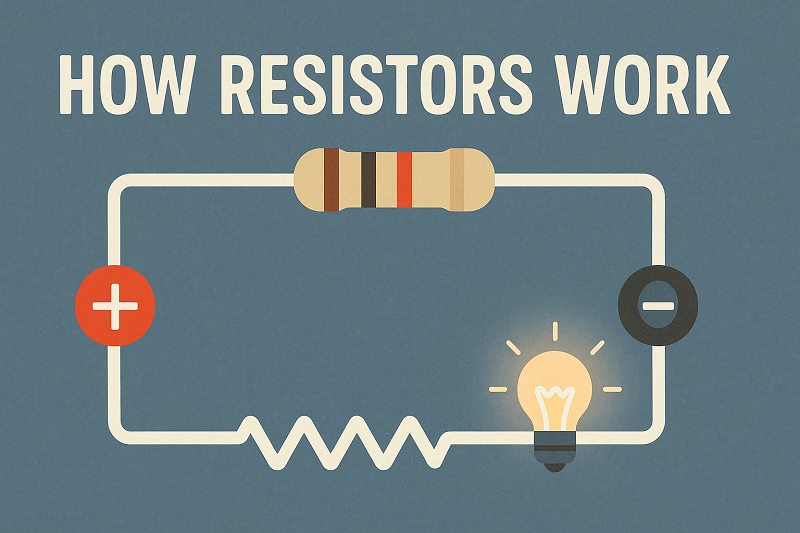
Resistors

What Is a Thermal Fuse and How Does It Work?

CatalogⅠ What is a Thermal Fuse?Ⅱ What is the structure of Fuse?Ⅲ How can Thermal Fuses be classified?Ⅳ What are the characteristics of the Thermal Fuse?Ⅴ What are the types of Thermal Fuse?Ⅵ How does a Thermal Fuse work?Ⅶ Precautions for Thermal FuseⅧ Some Frequently Asked Questions about Thermal Fuse Ⅰ What is a Thermal Fuse?A thermal fuse is a new type of electrical overheating protection element. This kind of element is usually installed in heat-prone electrical appliances. Once the electrical appliance fails and generates heat, when the temperature exceeds the abnormal temperature, the thermal fuse will automatically fuse to cut off the power supply to prevent the electrical appliance from causing a fire. The thermal fuse is the same as the fuse we are familiar with. It usually only serves as a powerful path in the circuit. If it does not exceed its rated value during use, it will not fuse and will not have any effect on the circuit. It will fuse and cut off the power circuit only when the electrical appliance fails to produce abnormal temperatures. This is different from a fused fuse, which is blown by the heat generated when the current exceeds the rated current in the circuit.Ⅱ What is the structure of Fuse?Generally, a fuse is composed of three parts: one is the melted part, which is the core of the fuse, which cuts off the current when it is blown. The melt of the same type and specification of the fuse must have the same material, the same geometric size, and the resistance value. It should be as small as possible and consistent. The most important thing is to have the same fusing characteristics. Household fuses are usually made of lead-antimony alloys.  The second is the electrode part, usually two. It is an important part of the connection between the melt and the circuit. It must have good electrical conductivity, should not produce obvious installation contact resistance; third is the bracket part, the melt of the fuse is generally slender and soft, the function of the bracket is to fix the melt and make the three parts a rigid whole for easy installation and use, It must have good mechanical strength, insulation, heat resistance, and flame resistance, and should not be broken, deformed, burned, or short-circuited during use.Ⅲ How can Thermal Fuses be classified?The thermal fuse can be divided into:According to the material: it can be divided into the metal shell, plastic shell, oxide film shellAccording to temperature: it can be divided into 73 degrees 99 degrees 77 degrees 94 degrees 113 degrees 121 degrees 133 degrees 142 degrees 157 degrees 172 degrees 192 degrees... • Commonly used fuse specifications Ⅳ What are the characteristics of the Thermal Fuse?Thermal fuse has the characteristics of accurate melting temperature, high withstand voltage, small size and low cost. The thermal fuse shell is marked with the rated temperature value and the rated current value, it is not difficult to identify, and it is very convenient to use. It can be widely used in electrical equipment, electric heating equipment and practical electrical appliances for overheating protection. Thermal fuse mainly has the following parameters: ①Rated temperature: Sometimes called the operating temperature or fusing temperature, it refers to the temperature at which the temperature rises to the fusing temperature at a rate of 1°C per minute under no-load conditions. ②Fusing accuracy: refers to the difference between the actual fusing temperature of the thermal fuse and the rated temperature. ③Rated current and rated voltage: Generally, the nominal current and voltage of thermal fuse have a certain margin, usually 5A and 250V. Thermal fuse is a one-time-use protection element. Its use affects not only depends on the performance of the element itself but more importantly, on how to select and install the thermal fuse correctly. The thermal fuse is generally connected in series in the circuit when it is used. Therefore, when choosing a thermal fuse, its rated current must be greater than the current used in the circuit. Never allow the current through the thermal fuse to exceed the specified rated current. Before selecting the rated temperature of the thermal fuse, you must understand and measure the temperature difference between the temperature to be protected and the location where the planting fuse is installed.  In addition, the length of the fusing time and the availability of ventilation are also closely related to the selection of the rated temperature of the thermal fuse. Ⅴ What are the types of Thermal Fuse?There are many ways to form a thermal fuse. The following are three common ones:• The first type: Organic Thermal FuseIt is composed of a movable contact (sliding contact), a spring (spring), and a fusible body (electrically nonconductive thermal pellet). Before the thermal fuse is activated, the current flows from the left lead to the sliding contact and flows through the metal shell to the right lead. When the external temperature reaches a predetermined temperature, the organic melt melts and the compression spring becomes loose. That is, the spring expands, and the sliding contact is separated from the left lead. The circuit is opened, and the current between the sliding contact and the left lead is cut off.  • The second type: Porcelain Tube Type Thermal FuseIt is composed of an axisymmetric lead, a fusible alloy that can be melted at a specified temperature, a special compound to prevent its melting and oxidation, and a ceramic insulator. When the ambient temperature rises, the specific resin mixture begins to liquefy. When it reaches the melting point, with the help of the resin mixture (increasing the surface tension of the melted alloy), the molten alloy quickly shrinks into a shape centered on the leads at both ends under the action of the surface tension. Ball shape, thereby permanently cutting off the circuit. • The third type: Square Shell-type Thermal FuseA piece of fusible alloy wire is connected between the two pins of the thermal fuse. The fusible alloy wire is covered with a special resin. Current can flow from one pin to the other. When the temperature around the thermal fuse rises to its operating temperature, The fusible alloy melts and shrinks into a spherical shape and attaches to the ends of the two pins under the action of surface tension and the help of special resin. In this way, the circuit is permanently cut off. Ⅵ How does a Thermal Fuse work?When the current flows through the conductor, the conductor will generate heat because of the resistance of the conductor. And the calorific value follows this formula: Q=0.24I2RT; where Q is the calorific value, 0.24 is a constant, I is the current flowing through the conductor, R is the resistance of the conductor, and T is the time for the current to flow through the conductor. According to this formula, it is not difficult to see the simple working principle of the fuse. When the material and shape of the fuse are determined, its resistance R is relatively determined (if the temperature coefficient of resistance is not considered). When current flows through it, it will generate heat, and its calorific value will increase with the increase of time. The current and resistance determine the speed of heat generation. The structure of the fuse and its installation status determines the speed of heat dissipation. If the rate of heat generation is less than the rate of heat dissipation, the fuse will not blow. If the rate of heat generation is equal to the rate of heat dissipation, it will not fuse for a long time. If the rate of heat generation is greater than the rate of heat dissipation, then more and more heat will be generated.And because it has a certain specific heat and quality, the increase in heat is manifested in the increase in temperature. When the temperature rises above the melting point of the fuse, the fuse blows. This is how the fuse works. We should know from this principle that you must carefully study the physical properties of the materials you choose when designing and manufacturing fuses, and ensure that they have consistent geometric dimensions. Because these factors play a crucial role in the normal operation of the fuse. Similarly, when you use it, you must install it correctly. Ⅶ Precautions for Thermal FuseThe following items must be observed to ensure the normal operation of the fuse:1 Each thermal fuse has rated current and voltage, melting temperature (Tf), operating temperature (Th), and maximum temperature (Tm), which must be used under specified parameters. 2 When selecting the fuse installation location, be careful not to shift the stress to the fuse due to the vibration in the finished product and the displacement of other accessories. 3 It must be installed in a place where the temperature will not rise above the maximum operating temperature after the thermal fuse is blown. 4 Can not be used in liquids or in machines where the humidity is maintained above 95%. 5 The thermal fuse should be installed in a place that can only sense the heat source of the thermal fuse. When it is unavoidable in the structure, a thermal barrier should be installed. For example, when installing on a heater, be careful not to connect directly to prevent the hot wire from heating to the thermal fuse 6 To increase the current flow of the thermal fuse, if it is connected in parallel or continues to pass overcurrent and overvoltage, the internal contact of the thermal fuse will be damaged, which will affect its normal operation. Therefore, it cannot be used under the above conditions. Although the thermal fuse has high reliability in design, the abnormal situation that a single thermal fuse can deal with is limited after all. Coupled with man-made or unpredictable force majeure, the thermal fuse is damaged and cannot function normally, and the circuit cannot be cut off in time when the machine is abnormal. Therefore, when the machine is overheated, when the wrong action directly affects the human body, when there is no circuit cut-off device other than the fuse, and when a high degree of safety is required, two or more thermal fuses with different fusing temperatures should be used. Ⅷ Some Frequently Asked Questions about Thermal Fuse1. How is a thermal fuse different from an electric fuse?An electric fuse is a common name of a thermal fuse. The thermal fuse is of two types.The one which melts at a certain high temperatureThe one which disconnects due to sub-zero temperature as required.Hypo thermal fuse is made of Biometal but a simple electric thermal fuse can be of any metal or alloy.There is another fuse that does not blow but disconnects the electric circuit. This is called a magnetic fuse. This used in circuit breaker. 2. Are thermal fuses universal?If by “universal” you mean “one size fits all”, then no. Thermal fuses come in a range of temperatures. The only ones I’ve bought are to replace failed ones in coffee makers, and I picked ones rated at around 110*C with an appropriate current capacity. Did not search for anything else, but higher current capacity units must exist.For those who have not run into these devices, they operate like any other fuse in that they are installed in series with the power source, but are designed to be relatively insensitive to current and to open when their temperature exceeds the design point. A valuable safety device in heated appliances. 3. How do I test a dryer thermal fuse?First of all, understand that once a certain amount of current goes through any kind of fuse, the fuse blows and can only be replaced, not repaired. So then, the only test you really want to do is to see if the fuse can still conduct electricity. Unplug the power cable and disconnect either end of the thermal fuse. Connect any cheap ohm meter to the loose end and the other end. If you get a reading, you may consider the fuse to be good. Don’t have a meter? In that case, you can use an old flashlight bulb (not LED), along with a battery and a piece of wire to test the fuse. Press the base of the bulb against one node of the battery while pressing the opposite end of the battery to one of the 2 fuse connections. At the same time, hold a test wire between the side of the bulb and the other fuse wire. If the fuse is good, the light will turn on. 4. How do I know if my thermal fuse is blown?Using a digital or analog multimeter, or other resistance-measuring instruments, check the resistance across the thermal fuse (preferably when it’s out of the circuit, which can affect the reading), If you read continuity (in the range of several ohms or less, depending on its rating), the fuse is still functional. If you read an open circuit, the fuse is blown, and has to be replaced. 5. How do you test a fuse using a multimeter?Testing connectivity is the best way of testing a fuse. A fuse works as long as its two terminals are connected by wire i.e. the two terminals of the fuse are shorted. If the connectivity test fails then it is sure that the fuse isn’t working. However, there might arise a case if the fuse isn’t using proper material. There might not be any connectivity, however, testing the resistance between the two terminals would give a small non-zero value. Even in such cases, we say that the fuse is working. However, such cases rarely exist and if they do we don’t consider as a good fuse (at least for the small power applications like a household) 6. What is the function of the thermal fuse of an electric fan?When the oil in the cheap sleeve bearings in the cheap shaded pole motor gets gummy, the motor will start drawing more current and run hotter. If the motor is not re-lubricated in a timely manner, eventually the sleeve bearings will get stuck and the rotor will fail to turn. This results in a locked-rotor condition and the windings draw more current and produce more heat than they can dissipate with no airflow over them to provide cooling. Eventually, the enamel insulation degrades and gets hot enough to smoke, possibly producing shorted turns that draw even more current.  The thermal fuse is a safety device to prevent the cheap motor from actually catching on fire. Sometimes the fuse can be replaced and the bearings can be relubricated to get another year or two of service if the windings haven’t discolored from overheating, but you can be sure that the end is near. You are better off getting a fan motor with sealed ball bearings. They cost more but last much longer, and usually give you a warning by making a rattling noise when the bearings start to wear out rather than seizing silently. 7. What material is used for making electrical fuses and why?Electrical fuses are generally made from materials having low melting. It acts as a low resistance path when the current flowing through it exceeds its rating by even a small amount. This is done to protect an electrical device from getting damaged. Thus, it acts as an overcurrent protection device. During faults, especially short circuit faults, when heavy currents suddenly flow, the fuse wire gets heated up and melts down, thereby preventing damage and fires from occurring. The fuse wires in general are made of nichrome, etc. 8. What is a fuse?It’s a safety device used to provide overcurrent protection of a circuit. Its main component is a metal wire/strip that melts when there’s too much current flowing through it and thus interrupts the current. This element can be made of zinc, copper, silver, aluminum, or some alloys. Fuse body is made of ceramic, glass, fiberglass, molded mica laminates or molded compressed fiber. 9. What is the difference between fuse and circuit breaker?Fuse-it is such a type of device which breaks the circuit one time when overcurrent in the circuit. you cannot break the circuit or open-close according to your choice.Breaker-it is such type of electrical equipment which breaks when overcurrent, other faulty conditions in the circuit. you can easily control the breaker for opening and closing the circuit ut is such a type of automatic switch. Mainly the big breakers are mainly run with the help of a relay. 10. What causes fuses to blow?A fuse is a safety device that should protect the rest of the circuit from (more) damage when there is a FAULT in the circuit. This can be caused by:component failurewiring failureplacing a load in the circuit that exceeds the Circuits safe level.Note that some circuits (example: motors) can have a very large starting current and special (slow blow) fuses are designed for this type of load.
kynix On 2021-03-06   36626
Resistors

How to Design and Calculate High Frequency Transformer?

IntroductionA transformer is a passive electrical device that transfers electrical energy from one electrical circuit to another, or multiple circuits. Its transmission current is AC. Transformer is commonly used to increase or decrease the supply. As one of the types, high-frequency transformers use frequencies from 20 KHz to over 1MHz. This paper tells the design process of high-frequency transformers (HFTs), that is, how to calculate high frequency transformer?How to Make High Frequency Transformer?CatalogIntroductionⅠ Transformer Core1.1 Magnetic Core Material1.2 Core Structure1.3 Core Parameters1.4 Coil Parameters1.5 Coil Turns1.6 Assembly Structure1.7 Temperature Rise CheckⅡ Types of High Frequency Transformer2.1 Transformer Classifications2.2 Design RulesⅢ Transformer Core Selection CaresⅣ Main Transformer ParametersⅤ How to Calculate High Frequency Transformer?5.1 Design Principles and Methods of Transformers5.2 AP Method Analysis5.3 Parameters of Power Supply5.4 Transformer Turns CalculationⅠ Transformer CoreIn real transformers, the two coils are wound onto the same iron core. The transformer core provides a magnetic path to channel flux. The use of highly permeable material (which describes the material's ability to carry flux), as well as better core construction techniques, helps provide a desirable, low reluctance flux path and confine lines of flux to the core. The following introduces some important aspect of the transformer core.1.1 Magnetic Core MaterialWhich material is best for high frequency transformer core? Soft ferrite is widely used in switching power supply due to its own characteristics. Its advantages are high resistivity, low AC eddy current loss, low price, and easy processing into various shapes. It also has disadvantages, including low working magnetic flux density, low permeability, large magnetostriction, and relatively sensitive to temperature changes. Choosing suitable materials can fully meet the design requirements of high-frequency transformers, and they have ideal performance and price advantage.1.2 Core StructureTransformer core as a main part, the factors to be considered when selecting the magnetic core structure are: reducing magnetic leakage and leakage inductance, increasing the heat dissipation spacing of the coil, which is beneficial to shielding, easy coil winding, and convenient assembly and wiring. Magnetic leakage and leakage inductance are directly related to the core structure. If the magnetic core does not require an air gap, a closed ring-shaped or square-shaped magnetic core is better.1.3 Core ParametersIn the design of the magnetic core parameters, special attention should be paid to the magnetic flux density on working not only limited by the magnetization curve, but also by the loss, and the working mode of power transmission. When the magnetic flux changes in one direction: ΔB=Bs-Br, which is not merely limited by the saturation magnetic flux density, but also mainly by the loss, (the loss causes a temperature rise to affect the magnetic flux density). Working magnetic flux density Bm=0.6~0.7ΔB.Opening the air gap can reduce Br to increase the magnetic flux density change value ΔB. After then, the excitation current increases, but the magnetic core volume can be reduced. For magnetic flux work in two-way: ΔB=2Bm. In this case, it is also necessary to pay attention to the fact that the volt-second area of the positive and negative changes of the excitation is not equal due to various reasons, and the DC bias problem occurs. Therefore, a small air gap can be added to the magnetic core, or a DC blocking capacitor can be added in the circuit design.1.4 Coil ParametersCoil parameters include the number of turns, wire section (diameter), wire form, winding arrangement and insulation arrangement.The wire diameter is determined by the current density of the winding. Usually J is 2.5~4A/mm2. The choice of wire diameter should consider the skin effect. If necessary, make adjustments after checking the temperature rise of the transformer.1.5 Coil TurnsGenerally used winding arrangement: The primary winding is close to the magnetic core, and the secondary winding feedback winding is gradually arranged outward. Two winding arrangements are recommended as following:1) If the voltage of the primary winding is high, and the secondary winding voltage is low, the secondary winding can be used close to the magnetic core, and next is the feedback winding, and the primary winding is in the outermost, which is beneficial to the primary winding to the magnetic core. Insulation arrangement.2) To increase the coupling between the primary and secondary windings, half of the primary windings can be close to the core, then the feedback winding and secondary windings, and another half primary windings in the outermost layer, which will reduce leakage inductance helpfully.1.6 Assembly StructureThe assembly structure of a high-frequency power transformer is divided into two types: horizontal and vertical. If using plane magnetic cores, chip magnetic cores and thin film magnetic cores, they all adopt a horizontal assembly structure.1.7 Temperature Rise CheckThe temperature rise check can be carried out by calculation and sample testing. The experimental temperature rise is lower than the allowable temperature rise by more than 15 degrees, increasing the current density and reducing the wire section appropriately. If it exceeds the allowable temperature rise, appropriately reduce the current density and increase the wire section. For example, increase the heat dissipation area of the magnetic core and wire diameter.Transformer SymbolⅡ Types of High Frequency Transformer2.1 Transformer ClassificationsPower transformers are divided into three categories according to the topology:(1) Flyback transformer(2) Forward transformer(3) Push-pull transformer (in full-bridge/half-bridge)The suitable topological structure of the magnetic core structure is shown in the table on the following:Core StructureTransformer Circuit TypeFlyback TypeForward TypePush-pull TypeE cores++0Planar E Cores-+0EFD Cores-++ETD Cores0++ER Cores0++U Cores+00RM Cores0+0EP Cores-+0P Cores-+0Ring Cores-++Remarks: "+"=Appropriate   "0"=Normal   "-"=None2.2 Design Rules1) If the DC filter inductor, and the inductor core only works in one quadrant, the inductors belonging to this type include Boost inductors, Buck inductors, Buck/boost inductors, forward and push-pull transformer filtering inductors, and single-ended transformers.2) The magnetic core of the forward transformer only works in one quadrant, so the transformer needs to be magnetically reset.3) The magnetic core of the push-pull transformer is bidirectional alternating magnetization. Converters belonging to this category include push-pull converters, half-bridge and full-bridge converters, and AC filter inductors. Ⅲ Transformer Core Selection Cares1) Soft ferrite is widely used in switching power supply due to its low price, good adaptability and high frequency performance.2) Soft ferrites are common in two series: manganese-zinc ferrite and nickel-zinc ferrite. The components of manganese-zinc ferrite are Fe2O3, MnCO3, and ZnO. It is mainly used in various filters below 1MHz, inductors, transformers, etc., with a wide range of applications. The components of nickel-zinc ferrite are Fe2O3, NiO, ZnO, etc., which are mainly used for various induction windings above 1MHz, anti-interference magnetic beads, and sharing antenna matching devices.3) Manganese-zinc ferrite cores are the most widely used in switching power supplies. Depending on their use, the choice of materials is also different. The cores used in the power input filter part are mostly high-permeability, and their material grades are mostly R4K~R10K, that is, ferrite cores with a relative permeability of 4000~10000. For main transformers and output filters, most of them have high saturation magnetic flux density, and their Bs is about 0.5T (ie 5000GS). Ⅳ Main Transformer Parametersa.Transformer TopologyWith a higher saturation magnetic flux density Bs and a lower residual magnetic flux density Br,  Bs has a certain impact on the transformer and winding results. Theoretically, if Bs is high, the number of winding turns will decrease, and the copper loss will also decrease. In practical applications, there are many circuit forms of switching power supply high-frequency converters. For transformers, their working forms can be divided into two categories:BipolarThe circuit is half-bridge, full-bridge, push-pull, etc. The positive and negative half-cycle excitation currents in the transformer primary winding are identical in magnitude and opposite in direction. Therefore, the magnetic flux changes in the transformer core also move symmetrically up and down. Maximum change range of B is △B=2Bm, and the DC component in the core basically cancels out.UnipolarThe circuit is single-ended forward, single-ended flyback, etc. The primary winding of the transformer adds a unidirectional square wave pulse voltage in one cycle (single-ended flyback is the case). The transformer core is unidirectionally excited, and the magnetic flux density varies from the maximum value Bm to the residual magnetic flux density Br. At this time, △B=Bm-Br. If Br is reduced and the saturation magnetic flux density Bs is increased, △B can be increased. It can reduce the number of turns and the copper loss. b. Low Power Loss at High FrequenciesThe power loss of ferrite not only affects the output efficiency of the power supply, but also causes the core heating, waveform distortion and other undesirable consequences. The heating problem of the transformer is extremely common in practical applications. It is mainly caused by the copper loss and core loss. If Bm is selected too low when designing the transformer, and more winding turns will cause the winding to heat up, and at the same time transfer heat to the magnetic core. Conversely, if the core is the main heating body, it will also cause the winding to heat up.When selecting ferrite materials, the power loss is required to have a negative temperature coefficient relationship. If the core loss is the main body of heat, the temperature of the transformer will rise, which will cause the core loss to increase further, eventually burn out the power tube, transformer and other components. Therefore, when developing power ferrites at home and abroad, it is necessary to solve the problem of the negative temperature coefficient of the magnetic material itself. This is also a significant feature of the magnetic material for power supply. c. PermeabilityHow much is the appropriate permeability? This should be determined according to the switching frequency of the actual circuit. Generally, materials with a relative permeability of 2000 have an applicable frequency below 300kHz, and sometimes it can be higher, less than 500kHz. For materials higher than this value, a lower magnetic permeability should be selected, generally around 1300. d. Higher Curie TemperatureThe Curie temperature is the temperature at which the magnetic material loses its magnetic properties, general above 200℃. However, the actual working temperature of the transformer should not be higher than 80℃. This is because when the temperature is above 100℃, its saturation magnetic flux density Bs has dropped to 70% of that at room temperature. Therefore, an excessively high operating temperature will cause the saturation flux density of the magnetic core to drop more severely. Furthermore, when it is higher than 100°C, its power consumption has a positive temperature coefficient, which will lead to a vicious circle. For the R2KB2 material, the temperature corresponding to its allowable power consumption has reached 110°C, and the Curie temperature is as high as 240°C, which meets the requirements for high-temperature use. Ⅴ How to Calculate High Frequency Transformer?5.1 Design Principles and Methods of TransformersThere are two principle methods for designing transformers: area product AP method. AP is the product of the core cross-sectional area Ae and the coil effective window area Aw.PT-power of transformerAe- effective cross-sectional areaAw- core window areaKo-core window utilization factor, typical value is 0.4.Kf-form factor, square wave is 4, and sine wave is 4.44.Bw-the working magnetic intensity of the magnetic coreFs-switch operating frequencyKj-current density coefficient, take 395A/cm2X-core structure coefficient5.2 AP Method AnalysisAccording to the design method of power transformer, the general steps of designing transformer with area product AP method:1. Select the core material and calculate the apparent power of the transformer.2. Determine the core cross-sectional size AP, and then select the core size according to it.3. Calculate the inductance and number of turns of the primary and secondary sides.4. Calculate the length of the air gap.5. Find the wire diameter according to the current density and the effective value current of the primary and secondary sides.6. Determine whether the copper loss and iron loss meet the requirements (allowable loss and temperature rise).5.3 Parameters of Power SupplyInput voltage: 175-264VACOutput voltage: 21VOutput power: 3AThe frequency is set at 60KHz, and the duty cycle is initially set at 0.45. Using a flyback topology, choose the core material and determine the apparent power PT of the transformer.Consider the cost, choose PC40 material here:Check the PC40 data and get Bs=0.39T, Br=0.06TBm= ΔBmax*0.6=0.198T, round it to 0.2TIn order to prevent the magnetic core from being saturated momentarily, reserve a certain margin and take Bm= ΔBmax*0.6=0.198T, take 0.2T.Transformer apparent power PT, for the flyback transformer:Calculate AP:Where:J is the current density, usually taking 395A/cm2.Ku is the effective use coefficient of the copper window, which is determined according to the safety requirements and the number of output channels, generally 0.2 to 0.4. Take 0.4 here to adapt to the sudden load current. The power supply is designed in critical mode, and the critical current I0B=0.8×I0=2.4A5.4 Transformer Turns Calculation1) Minimum input voltage: Vimin=ViACmin*1.2=210V2) Turns Ration=[Vimin/(Vo+Vf)]*[Dmax/(1-Dmax)]n=[210V/(21V+1V)]*[0.45/(1-0.45)]=7.83) Secondary Side Peak Current^IsB=2*IoB/(1-Dmax)^IsB=2*2.4A/(1-0.45)=8.72A4) Secondary Side InductanceLs=(Vo+Vf)*(1-Dmax)*[1/(Fs*1000)]/^IsB*1000000Ls=(21V+1V)*(1-0.45)*[1/(60KHz*1000)]/^8.72A*1000000=23.58uH5) Primary Side InductanceLp=n*n*LsLp=7.8*7.8*23.58uH=1434uH6) Secondary Side Peak Current (continuous mode)^IsB=Io/(1-Dmax)+(^IsB/2)^IsB=3A/(1-0.45)+(8.72A/2)=9.81A7) Primary Side Peak Current (continuous mode)^Ipp=^Isp/n^Ipp=9.81A/7.8=1.257APrimary Winding and Secondary Winding Turns1) Primary Winding TurnsNp=Lp*^Ipp(^B*Ae)Np=1434uH*1.257A/(0.2*84.8)=106.28T,round it to 106T2) Secondary Winding TurnsNs=Np/nNs=106T/7.8=13.58T,round it to Ns=14T3) Feedback TurnsNv=(Vcc+Vf)/[(Vo+Vf)/Ns]Nv=(14.5V+1V)/[(21V+1V)/14T]=9.87T, round it to Nv=10TIn order to avoid saturation of the magnetic core, an appropriate air gap is added to the magnetic circuit, and the calculation is as follows:It may be necessary to correct the number of turns based on the edge effect of the air gap flux.There are two methods for the wire diameter of the primary, secondary and auxiliary windings:Bare wire areaPrimary Winding diameter: effective currentIprms=Po/^n/ViminIprms=63W/0.8/210V=0.375AWire diameter (J current density is 4A/mm2)Use two 0.18mm diameter wires and wind them together, or use AWG #28 single stranded wire.Secondary winding diameterUse 4 wires with a diameter of 0.25mm to be wound in parallel and calculate the current skin depth:The wire diameter of multiple strands must be less than or equal to dwH. For single wire winding, if the wire diameter exceeds the dwH, it is necessary to consider the use of multiple strands.The calculation of copper loss Pcu and iron loss Pfe (transformer total loss Ploss)a) Primary winding and secondary winding losses. Among them, MLT is the average turn length of the magnetic core. b) Calculate the allowable total loss Ploss and iron loss under the efficiency η.c) Find the actual loss under the operation according to the core loss curve.Iron loss per unit weight, it actually occurredThe actual iron loss should be lower than the allowable value.d) Calculate the loss per unit area Φ=Ploss/As. If the temperature rise caused by the Φ value is less than 25 degrees, the design is good.Bw Calculation:The working magnetic flux density Bw should be met the design index requirements, Bw<Bs-Br, to avoid saturation of the magnetic core. Frequently Asked Questions about High Frequency Transformer Design1. What is high frequency transformer?The primary difference is that, as their name implies, they operate at much higher frequencies — while most line voltage transformers operate at 50 or 60 Hz, high-frequency transformers use frequencies from 20 KHz to over 1MHz. ... For any given power rating, the higher the frequency, the smaller the transformer can be. 2. What are the design aspects of high frequency transformer?Design of HF transformers. High frequency transformers transfer electric power. The physical size is dependent on the power to be transfered as well as the operating frequency. The higher the frequency the smaller the physical size. 3. What is the use of high frequency transformer?These transformers are designed to handle up to 15,000 volts safely and accurately, converting high voltage and current levels between coils by magnetic induction. High Voltage, High Frequency Transformers are relied on for applications ranging from power supplies to laser equipment and particle accelerators. 4. What is difference between high frequency and low frequency?When we talk about sound, we talk in terms of high and low-frequency waves. ... This measurement of cycles per second is expressed in Hertz (Hz), with a higher Hz representing higher frequency sound. Low-frequency sounds are 500 Hz or lower while high-frequency waves are above 2000 Hz. 5. What is the frequency of transformer?What is Transformer Frequency. The three common frequencies available are 50Hz, 60Hz and 400Hz. European power is typically 50Hz while North American power is usually 60hz. The 400 Hz is reserved for high-powered applications such as aerospace and some special-purpose computer power supplies and hand-held machine tools.
kynix On 2021-03-05   21989
Resistors

Electrical Earthing System Guidance for Installation and Maintenance

IntroductionEarthing (also known as grounding) refers to the process of transferring the immediate discharge of the electrical energy directly to the earth by the help of the low resistance wire, for safety and functional purposes. Generally, the "ground" of electronic equipment has two meanings: one is to connect to the "earth". Taking the earth as the zero potential, connecting the metal shell of electronic equipment and the circuit reference point to the earth can protect the safety of equipment and personnel, such as protective earthing, lightning protection earthing, etc. In addition, the earthing in the weak current system does not necessarily mean the ground connected to the earth in the true sense. It has the effect of improving the stability of the system, shielding and protecting the electromagnetic compatibility of the system, and it can also be connected to the "earth" when necessary.What is Electrical Earthing?CatalogIntroductionⅠ Earthing Basic1.1 Electrical Earthing1.2 Earthing SymbolsⅡ What Are the Types of Earthing?Ⅲ Why Is Electrical Earthing Important?Ⅳ Earthing Q&A You Should KnowⅠ Earthing Basic1.1 Electrical EarthingAn earthing system (UK and IEC) or grounding system (US) connects specific parts of an electric power system with the ground. Earthing is a therapeutic technique that involves doing activities that “ground” or electrically connect you to the earth. In modern earthing concepts, for line engineers, the meaning of this term is usually a reference point of line voltage; for system designers, it is often a cabinet or rack; for electrical engineers, it is safe earthing or connecting to the earth. A more general definition is a low impedance path for current to return to its source. Note that the requirements are "low impedance" and "path".1.2 Earthing SymbolsPE, PGND, FG: Protective ground or chassisBGND or DC-RETURN: Power supply (battery) returnGND: Work groundDGND: Digital groundAGND: Analog groundLGND: Lightning protection groundⅡ What Are the Types of Earthing?There are many types of earthing, including single-point earthing, multi-point earthing and mixed types of earthing. Among them, single-point earthing is divided into series earthing and parallel earthing. Generally speaking, single-point earthing is used for simple circuits, such as earthing distinctions between different functional modules, and low-frequency (f<1MHz) electronic circuits. When designing high frequency (>10MHz) circuits, multi-point earthing or multilayer boards (complete ground plane) should be used. The following are four specific earthing methods.1. Earth FloatingIn electronic design, a commonly used method is floating technology. In this method, the signal ground of the circuit board is not connected to the external public ground, thereby ensuring good isolation of the circuit. The circuit is well isolated from the external ground system and is not easily affected by the interference on the external ground system. However, static electricity is easy to accumulate on the circuit and cause electrostatic interference, which may generate dangerous voltage.Small-scale low-speed (<1mhz) equipment can use earth floating, a single-point connection to the ground by the metal shell.2. Single-point earthing in SeriesThis kind of earthing method is relatively simple, and there is no need to pay so much attention to the circuit board design. So it will be used more. However, this kind of circuit will have common impedance coupling, causing each circuit module to affect each other.3. Single point earthing in ParallelThis method of earthing, although getting rid of the common impedance coupling problem of series single-point earthing, but in actual use, it will introduce too much earthing wire annoying, as to which one needs to be comprehensively evaluated in the actual process. If the circuit board area allows, use the parallel mode, and if the connection between the various circuit modules is kept simple, then use the series mode. In general, there are power modules, analog circuit modules, digital circuit modules and protection circuit modules in the downloaded board. In this case, I use a parallel single-point earthing method.4. Multi-point EarthingMulti-point earthing is used more in daily circuit design, especially in multi-module circuit design. This earthing method can effectively reduce high-frequency interference problems, but it is also prone to cause earthing loops. This point must be fully considered in the design to improve the circuit stability. The working ground of small high-speed (>10MHz) equipment should be grounded at multiple points with its metal casing. The distance between earthing points should be less than 1/20 of the wavelength of the highest operating frequency, and the metal casing should be connected to the ground at a single point.In short, in the design of electronic circuits, the most important point is to reduce the loop area of the circuit, to improve the stability of electronic design and the EMC design of electronic systems. In the actual design, have comprehensive evaluation of the above various earthing technologies to achieve the purpose of improving system stability.Ⅲ Why Is Electrical Earthing Important?As for earthing function, the introduction of earthing technology was originally a protective measure to prevent electrical or electronic equipment from being struck by lightning. The purpose was to introduce the lightning current generated to the ground through the lightning rod, thereby protecting the building. At the same time, earthing is also an effective means to protect personal safety. When the phase line touches the equipment shell caused by some reason (such as poor insulation of wires, aging of wiring, etc.), the equipment shell will have dangerous voltages. The generated fault current will flow through the neutral line to the ground, thereby playing a protective role. With the development of electronic communication and other digital fields, it is no longer sufficient to consider only lightning protection and safety in the earthing system. For example, in a communication system, the interconnection of signals between a large number of devices requires each device to have a reference ground as the signal reference ground. And with the complexity of electronic equipment, the signal frequency is getting higher and higher. Therefore, in the earthing design, special attention must be paid to electromagnetic compatibility issues such as mutual interference between signals. Otherwise, improper earthing will seriously affect the reliability of system operation. Also, the concept of "earthing" has also been introduced in the high-speed signals return technology. Ⅳ Earthing Q&A You Should KnowThe following questions relay on electrical earthing science and grounding physics to explain how electrical charges from the earth can have huge effects on our life. And how do you discharge the electrical energy directly to the earth by earthing technology. Also these Q&A give you considerable attention for the earthing system design and installation.1. What is the difference between earth earthing and electrical earthing?The earth is an object with very low resistance and very large capacitance. It has the ability to absorb infinite charge, and meanwhile can maintain the potential unchanged. Therefore, it is used as the reference potential of a system electrically, that is electrical earthing. In addition, in electronic equipment, when transmitting current and signal conversion at various levels of circuits, a reference potential is required to prevent interference from external signals. This potential is called logical ground or floating ground.2. What is the difference between the ground potential and the logical ground potential?Since the earth can absorb infinite electric charge, the potential of the earth looks macroscopically zero. Due to the influence of the natural electric field and the artificial electric field in the earth, the potential of each point of the earth is different. In engineering, 20m away from the artificial electric field is regarded as zero potential (earthing potential). The electrical ground potential is related to the current injected into the ground by the electrical system. When a large current flows into the electrical ground, the electrical ground potential may reach a very high voltage, especially when the lightning current flows into the electrical ground. The instantaneous potential of the electrical ground can reach 100,000 volts. Therefore, a separate lightning protection earthing point cannot be located in a place where have pedestrians.3. What is the shell?Due to the damage of the insulation layer of the wire, the phase wire is in contact with the outer shell of the electrical equipment, which is called a bumping shell. If the insulation of the phase wires and the enclosure of the electrical equipment does not meet the specified requirements, the equipment cannot be put into use. The reason for the insulation drop may be moisture or damage to the insulation layer, which can be analyzed according to the environment in which the circuit equipment is used.4. What is the step voltage?When an electrical device has a short-circuit fault to the ground, the fault current flows from the fault ground to the ground electrode and returns to the power source. Therefore, an electric field is generated around the ground of the fault point and the ground electrode, which is away from the ground of the fault point or the ground of the ground electrode. The closer, the higher the potential, and the farther, the lower the potential. When the distance between the two feet of a person is about 0.8 meters, standing in this electric field, because the two feet are at different potential points, there will be a potential difference. This potential difference is called the step voltage.5. What is contact voltage?When the insulation of electrical equipment is damaged and a short-circuit occurs to the shell, people who touch the electrical equipment will have the risk of electric shock. To define the degree of danger, the potential of the equipment 0.8 meters away from the horizontal direction of the electrical equipment when it fails is measured. The potential difference between the two is called the contact voltage.6. What is the earthing resistance difference between the earthing electrode and the equipment?The ratio of the earthing voltage to the earthing current is called the earthing resistance of the earthing electrode. When measuring the earthing electrode resistance in a project, an ac voltage is artificially applied to the earthing electrode, and then the current flowing into the earthing electrode is measured. The ratio of the two is the earthing resistance. The earthing resistance of the equipment is the sum of earthing wires resistances.7. What are the classifications of earthing functions?Generally divided into two categories: protective earthing and functional earthing1) Protective earthing can be divided into the following 4 types:Protective earthing: earthing the exposed conductor part of the equipment is called protective earthing. Its purpose is to prevent electrical equipment insulation damage or leakage, which may cause electric shock when people touch it.Lightning earthing: Lead lightning into the earth to prevent electric shock or other property damage.Anti-static earthing: Introduce static charges into the ground to prevent the accumulation of static electricity from causing harm to the human body and equipment.Anti-corrosion earthing: Bury a metal body underground as a sacrificial anode or cathode to protect the metal body connected to it, such as a metal oil pipeline.2) Functional earthing can be divided into the following 4 types:Working earthing: In order to ensure the operation of the power system, earthing is done at an appropriate place in the power system, which is called working earthing. In an AC system, this point is generally a neutral point.Logic earthing: To obtain a stable reference voltage, the appropriate metal parts in the electronic equipment are used as the reference zero potential, and the electronic parts that need to obtain the zero potential are connected to this metal part. This method is called logic earthing.Shield earthing: Ground the metal shell or the metal net to protect the electronic equipment in the shell or the net from external electrical interference, or prevent the electrical equipment in the shell or the net from causing interference to external electronic equipment.Signal earthing: A earthing method set to ensure that the signal has a stable reference potential.8. What is working ground?In order to ensure the safe operation of the electrical device, the earthing of any point (usually the neutral point of the power supply) of the device conductive part is called the working ground.9. What is the relationship between the safety voltage and the use environment?The safety voltage is to prevent personal electric shock. The degree of electric shock is related to the impedance of the human body, and the impedance of the human body has a great relationship with the contact condition. Under different conditions, it is different.The relationship between human body impedance and contact conditions is usually divided into three categories:1) High impedance: dry skin, dry environment, high impedance ground2) Low impedance: moist skin, humid environment, low impedance ground3) Zero impedance: for example, the human body is immersed in water10. What is the difference between short circuit and ground fault?The electrical connection between mutually insulated live conductors due to insulation damage is called a short circuit. For example, between phase wires of different phases, or between a phase wire and a neutral wire, exist an electrical connection, there may be a short circuit. The electrical connection error between the live conductor and the earth is called a ground fault. In addition, live conductors refer not only to the phase line, but also the neutral line. The ground refers to the metal shell of grounded electrical equipment, non-electrical metal pipes and the earth.11. What parts of the earthing device consist of?earthing device is a general term for earthing electrode and earthing wire.The earthing electrode is a conductor buried in the soil or concrete foundation for dissipating current. It can be divided into two types: natural earthing electrode and artificial earthing electrode.There are several types of natural earthing electrodes: the underground metal plumbing systems, the metal structure of the building and the reinforced concrete structure.The artificial earthing electrode should adopt horizontally laid round steel, flat steel, metal earthing plate, and vertically laid angle steel, steel pipe, round steel, etc.12. What are the measures to prevent direct electric shock?Insulate charged objectsUse shields or barriers to block the human body from charged objectsUse leakage switch as additional protection13. What are the measures to prevent indirect electric shock?Set up automatic power-off deviceEquipment with double insulationTake ungrounded local potential connectionElectrical isolation14. What are the types of earthing systems for high-voltage systems?1) Direct earthing, that is, the neutral point of the transformer or generator is connected to the earthing device directly or through a small resistance (such as a current transformer). This kind of earthing method has a large earthing current when a single-phase earthing short circuit occurs, so it is also called the large current earthing system.2) Ungrounded, the neutral point of the transformer in this system is not grounded or connected to earthing equipment such as arc suppression coils, large resistances, and the earthing device.15. Can the natural earthing electrode be used for the earthing of DC electrical devices?The earthing of AC electrical installations should make full use of the natural earthing electrode buried in the ground. For the earthing of DC electrical installations, it is not allowed to use the natural earthing electrode as the PE wire, earthing wire and earthing electrode of the current pattern. The earthing device is connected to the natural earthing. The distance between earthing devices and AC electrical devices shall not be less than 1m to avoid electrical corrosion.16. What is the function of total equipotential bonding?The function of total equipotential bonding (MEB) is to reduce the contact voltage of indirect contact electric shock in the building and different metal parts with different potential, which eliminate the dangerous fault voltage introduced from outside the building through electrical lines and various metal pipes.17. What is supplementary bonding?The two conductive parts are directly connected with wires to make the contact voltage of the fault drop below the contact voltage limit, which is called supplementary or additional equipotential bonding (earthing). When the earthing device fails, the indirect contact protection conditions for automatically cutting off the power supply cannot be met, supplementary bonding should be set. It should also be installed in places with special requirements such as bathrooms, hospitals, and swimming pools.18. What is local equipotential bonding?Local equipotential bonding (LEB) refers to the connection of multiple supplementary equipotential bonding through the bonding terminals in a local board, which is called local equipotential bonding.19. How to check the conductivity of equipotential bonding?1) Welding quality inspection2) Bolt connection quality inspection3) Measure resistance between branch and trunk20. What are the characteristics of arc short circuits?There are two forms of short circuit and ground fault: metallic and arc short. The current of metallic short circuit is very large, which can make the overcurrent protector (circuit breaker or fuse) act in time and the fault is not easy to go on. The short circuit point of arc short circuit has arc or electric spark and the impedance is large, therefore, the short circuit current is small. So overcurrent protection will not take effect. However, the temperature of the arc short-circuit point is very high, which can reach thousands of degrees Celsius locally. It is very easy to ignite the substances around the short-circuit point and cause a fire.Arcing short circuit not only occur in electrical and earthing faults, but poor connections between wires can also cause it. For example, cause flickering of incandescent lamps or interference for TV sets. At this time, you must check whether the connection point of the line is reliable. Frequently Asked Questions about Electrical Earthing System Basics1. What is elecrical earthing and types of earthing?Earthing is the first step towards electrical safety. ... Earthing is done to provide safety to user from electric shock. It is a set of conductors connected in series or in parallel in order to dissipate the potential difference immediately into the ground. The wire connected from equipment to earth called earthing wire. 2. What is difference between earthing and grounding?The key difference between earthing and grounding is that the term “Earthing” means that the circuit is physically connected to the ground which is Zero Volt Potential to the Ground (Earth). Whereas in “Grounding” the circuit is not physically connected to ground, but its potential is zero with respect to other points.Difference between Earthing and Grounding 3. Is grounding the same as earthing?The key difference between earthing and grounding is that the term “Earthing” means that the circuit is physically connected to the ground which is Zero Volt Potential to the Ground (Earth). Whereas in “Grounding” the circuit is not physically connected to ground, but its potential is zero with respect to other points. 4. What is the purpose of earthing?Earthing is used to protect you from an electric shock. It does this by providing a path (a protective conductor) for a fault current to flow to earth. It also causes the protective device (either a circuit-breaker or fuse) to switch off the electric current to the circuit that has the fault. 5. Which wire is used for earthing?copper wiresEarthing Lead or Earthing JointEventhough copper wires are generally used as earthing lead, copper strips are preferred for high installation as it can carry higher values of fault current due to its wider area.
kynix On 2021-03-01   5053
Resistors

High Input Impedance and Low Output Impedance in Op Amp Circuit

"What Are Input and Output Impedance in Op-Amps?" - "1.1 Impedance Overview" -> "Understanding Impedance Basics" - "1.2 Input Impedance of Op-Amp" -> "Why Does an Op-Amp Need High Input Impedance?" - "1.3 Output Impedance of Op-Amp" -> "Why Does an Op-Amp Need Low Output Impedance?" - "1.4 Ideal Op Amp Impedance" -> "Ideal vs. Practical Op-Amp Impedance" - "Ⅱ High Input Impedance and Low Output Impedance Effect" -> "The Effects of High Input and Low Output Impedance" - "Ⅲ How to Calculate Input Impedance and Output Impedance" -> "How to Calculate Op-Amp Impedance"- Missing or improvable schema types detected: Missing Article schema, FAQPage schema.- Sections with vague/unsupported claims: "A small amount of current is decreased by any electrical input..." (Rewritten for technical accuracy: "Every electrical input sources or sinks a small amount of leakage current."); Formula for impedance was inverted (ΔI/ΔV instead of ΔV/ΔI) and has been corrected.- Estimated content freshness score: 5/10-->Summary: Operational amplifiers (op-amps) rely on extremely high input impedance to prevent signal degradation and very low output impedance to drive loads effectively. Understanding how to calculate and optimize these impedance values is critical for preventing loading effects and ensuring accurate signal amplification in modern circuit design.IntroductionThe input and output impedance of an amplifier is the ratio of voltage to current flowing in or out of these terminals. The input impedance may depend upon the source supply feeding the amplifier, while the output impedance may also vary according to the load impedance (RL) across the output terminals. Ideally, op-amps are supposed to have zero output impedance and infinite input impedance. However, practical op amp input impedance and output impedance are finite, making them critical factors in the design of any robust electronic circuit. What Are Input and Output Impedance in Op-Amps?Understanding Impedance BasicsIn electronic circuits, impedance defines the complex relationship between voltage and current. It is a combination of resistance (which is frequency-independent) and reactance (which is frequency-dependent, driven by inductors and capacitors). The input impedance of an op-amp acts as the load impedance to the preceding signal source. Conversely, the output impedance of the op-amp acts as the source impedance to the subsequent load receiving the amplified signal. Understanding these parameters is essential for proper impedance matching and signal integrity.Why Does an Op-Amp Need High Input Impedance?While the input impedance of an ideal op-amp is assumed to be infinite, practical devices always draw a microscopic amount of bias current. Every electrical input sources or sinks a small amount of leakage current, which can be modeled as a high-value resistor connected in parallel to the input terminals. Modern CMOS op-amps can achieve input impedances in the tera-ohm ($10^{12} \Omega$) range, drastically reducing this current draw.Although input impedance is typically represented as a simple resistor, the input terminals also possess a tiny parasitic capacitance. At lower frequencies, this capacitance is negligible. However, at high frequencies, this parasitic capacitance provides a substantial load for AC signals, hindering rise and fall times and potentially causing severe signal distortion.Why Does an Op-Amp Need Low Output Impedance?An ideal amplifier should be capable of driving infinite current into any load without voltage loss, but practical op-amps have strict physical limitations. For instance, the widely used LM358 op-amp can typically source only 40mA and sink 20mA of current. This restriction in the output drive capability is modeled as a small internal resistor placed in series with an ideal voltage source.Because the actual output voltage is measured after this internal resistor, overloading the op-amp causes a significant voltage drop across it. Consequently, the delivered voltage falls short of the amplifier's intended output. To counter this limitation when driving heavy loads, engineers often add an external discrete output stage (like a push-pull transistor buffer) to boost current capacity.Ideal vs. Practical Op-Amp ImpedanceAn ideal op-amp features infinite input impedance and zero output impedance. Infinite input impedance ensures that absolutely no current flows into or out of the inverting and non-inverting terminals. Zero output impedance guarantees that the output voltage remains perfectly stable, regardless of the current demanded by the load.ParameterIdeal Op-AmpPractical Op-Amp (e.g., CMOS)Input ImpedanceInfinite (∞)Very High (Mega-ohms to Tera-ohms)Output ImpedanceZero (0 Ω)Very Low (10 to 100 ohms)Op Amp Impedance MatchingThe Effects of High Input and Low Output ImpedanceHigh input impedance ensures that the amplifier draws virtually no current from the preceding signal source. Because op-amps are primarily voltage-gain devices, their core task is to convert a low-energy, voltage-driven signal into a higher-voltage output without distorting the original source.Preventing the Loading Effect: If the input impedance were low, the op-amp would draw excessive current, causing a voltage drop across the source's internal resistance and degrading the signal.Maximizing Voltage Transfer: According to Ohm's Law (V=IR), a higher input impedance ensures that the maximum possible voltage drops across the amplifier's input terminals rather than being lost in the source wiring.Safe Current Management: Low impedance circuits can inadvertently trigger high current draws, which may damage sensitive sensor outputs. High input impedance safely isolates these delicate components. How to Calculate Op-Amp ImpedanceImpedance is mathematically represented by the ratio of voltage variation (ΔV) to current variation (ΔI). For an op-amp, the variation in the input common-mode voltage range is measured against the variation in the input bias current to determine dynamic input impedance.Input Impedance and Output Impedance of AmplifierUsing the voltage divider principle, you can determine the actual input and output voltages of an amplifier based on its gain, source impedance, and output impedance. The formula for the effective input voltage is:Vin = Vsource • (Zin / (Rs + Zin)) ......(1)Where Vin is the actual voltage the amplifier receives, Vsource is the original source voltage, Zin is the amplifier's input impedance, and Rs is the source's internal impedance.Similarly, you can calculate the voltage delivered to the load:Vload = Vout • (Rload / (Rload + Zout)) ......(2)Where Vload is the voltage dropped across the load, Vout is the amplifier's internal generated output voltage, Rload is the load resistance, and Zout is the amplifier's output impedance.To measure the output impedance practically, you can model it as a Thevenin equivalent circuit:Zout = Vo / Isc ......(3)Where Vo is the open-circuit output voltage, and Isc is the short-circuit output current. This formula assumes a strictly linear relationship between the output voltage and current.ConclusionOp-amps are essential in circuit designs where the input impedance must be vastly larger than the source impedance, and the effective output impedance must be infinitesimal compared to the load. The specific demands of your application will dictate the required precision of the op-amp. Ultimately, the input and output impedance of amplifiers stem from internal parasitic resistance and capacitance. By understanding these physical limits and applying the correct voltage divider formulas, engineers can design highly efficient, distortion-free amplification stages. Frequently Asked QuestionsWhat happens if an op-amp has low input impedance?If an op-amp has low input impedance, it draws excessive current from the signal source. This creates a loading effect, causing a significant voltage drop across the source's internal resistance. Consequently, the amplifier receives a degraded signal, leading to inaccurate amplification and potential signal distortion.Which type of op-amp provides the highest input impedance?Modern CMOS (Complementary Metal-Oxide-Semiconductor) and JFET operational amplifiers provide the highest input impedance. Unlike older bipolar junction transistor models like the LM741, CMOS op-amps can achieve input impedances in the tera-ohm range, drawing nearly zero bias current from the source.How does a unity-gain buffer utilize impedance matching?A unity-gain buffer leverages the op-amp's extremely high input impedance and near-zero output impedance to bridge circuits. It prevents a low-impedance load from drawing too much current from a high-impedance source, ensuring the signal voltage transfers perfectly without degradation or power loss.Can you measure op-amp output impedance directly with a multimeter?No, you cannot measure an active op-amp's output impedance directly using a standard multimeter's resistance setting. Instead, you must calculate it dynamically by measuring the open-circuit output voltage, applying a known load resistor, measuring the loaded voltage drop, and using the voltage divider formula.{ "@context": "https://schema.org", "@graph":[ { "@type": "Article", "headline": "Op Amp Input and Output Impedance Guide", "datePublished": "2021-01-23T15:45:51Z", "dateModified": "2026-03-19T15:12:00+08:00", "author": { "@type": "Organization", "name": "ApogeeWeb" }, "publisher": { "@type": "Organization", "name": "ApogeeWeb" } }, { "@type": "FAQPage", "mainEntity":[ { "@type": "Question", "name": "What happens if an op-amp has low input impedance?", "acceptedAnswer": { "@type": "Answer", "text": "If an op-amp has low input impedance, it draws excessive current from the signal source. This creates a loading effect, causing a significant voltage drop across the source's internal resistance. Consequently, the amplifier receives a degraded signal, leading to inaccurate amplification and potential signal distortion." } }, { "@type": "Question", "name": "Which type of op-amp provides the highest input impedance?", "acceptedAnswer": { "@type": "Answer", "text": "Modern CMOS (Complementary Metal-Oxide-Semiconductor) and JFET operational amplifiers provide the highest input impedance. Unlike older bipolar junction transistor models like the LM741, CMOS op-amps can achieve input impedances in the tera-ohm range, drawing nearly zero bias current from the source." } }, { "@type": "Question", "name": "How does a unity-gain buffer utilize impedance matching?", "acceptedAnswer": { "@type": "Answer", "text": "A unity-gain buffer leverages the op-amp's extremely high input impedance and near-zero output impedance to bridge circuits. It prevents a low-impedance load from drawing too much current from a high-impedance source, ensuring the signal voltage transfers perfectly without degradation or power loss." } }, { "@type": "Question", "name": "Can you measure op-amp output impedance directly with a multimeter?", "acceptedAnswer": { "@type": "Answer", "text": "No, you cannot measure an active op-amp's output impedance directly using a standard multimeter's resistance setting. Instead, you must calculate it dynamically by measuring the open-circuit output voltage, applying a known load resistor, measuring the loaded voltage drop, and using the voltage divider formula." } } ] } ]}
Kynix On 2021-01-23   35449
Resistors

How to Reduce TRIAC Fault in Switching Circuits?

IntroductionWhat is a triac? TRIAC (Triode for Alternating Current) is an electronic component that is widely used in alternating current power control. It is a three terminal electronic component that conducts current in either direction when triggered. TRIAC is able to switch high voltages and high levels of current, and over both parts of an AC waveform. This makes triac circuits ideal for use in a variety of applications where power switching is needed. You can find its applications in switching, phase control, chopper designs, brilliance control in lamps, speed control in fans, motors etc.TRIAC Characteristics, TRIAC Structure and TRIAC WorkingCatalogIntroductionⅠ TRIAC vs Silicon Controlled Rectifiers (SCR)Ⅱ TRIAC Structure and SymbolⅢ How Do You Use a TRIACⅣ How Does a TRIAC Work?4.1 TRIAC Leakage Current4.2 SolutionsⅠ TRIAC vs Silicon Controlled Rectifiers (SCR)Thyristor also called SCR stands for silicon controlled rectifier while TRIAC stands for triode for alternating current. The TRIAC has on and off state characteristics similar to SCR. The main difference between SCR and TRIAC is that thyristor is a unidirectional device while in TRIAC as a bidirectional device. A TRIAC is defined as a three terminal AC switch which is different from the other silicon controlled rectifiers (SCR) in the sense. They can turn and regulate both parts of the AC waveform easily. This makes this component appropriate for a variety of applications where control of AC power is needed. A dimmer circuit will be an example application, and we use it domestically as a ceiling fan regulator circuit. Also it can be used to regulate a motor or electric heater's input power. This is why TRIAC is used for applications of low to medium power, leaving SCR with high-power applications. While this is a very interesting system, a problem known as "leakage current" is present. And we'll talk more about this leakage current, its adverse effects, and some well-known ways to solve these problems in this article. But let's clear out the basics of TRIAC before that. Ⅱ TRIAC Structure and SymbolAs for triac symbol, like any other electronic component, it consists of two SCRs linked in an antiparallel configuration, and if we look very closely at its symbol, it clearly reflects the TRIAC's bidirectional properties. Which you observe from the picture below.The upgraded variant of the thyristor is the TRIAC. A thyristor can only control current in one direction, as you already know, but a TRIAC can control current in both negative and positive directions. TRIAC turns in each sine wave loop because of the existence of the sine wave, which means we can use the entire cycle, unlike SCRs. Like thyristor, a TRIAC has three terminals, but it becomes a little difficult to assign names to these terminals since they are related simply to the cathode and the anode of two SCRs. Two SCRs are also connected to the gate terminal, which is why it was called Anode 1 and Anode 2 or Main Terminal 1 and Main Terminal 2 (MT1 and MT2).A multimeter can be used to test the health of a triac. First put the multimeter selector switch in a high resistance mode (100K), then connect the positive lead of multimeter to the MT1 terminal of triac and negative lead to the MT2 terminal of triac (there is no problem if you reverse the connection). Ⅲ How Do You Use a TRIACTriacs are semiconductor devices that are widely used for switching medium power AC. Let's acquire a little knowledge of  TRIAC functions before going further. As the following figure shows you.Two-thyristor AnalogyWe have previously said that as a configuration of two SCRs, a TRIAC can be realized. The above image provides a little bit more clarity on the subject, but it is much more complex to work at the semiconductor level. A TRIAC can be activated in many ways, unlike SCR, regardless of the polarity of the terminals. Regardless of the polarity of the initiating pulse, it may also be activated. When working with TRIAC, one thing to remember is that when the MT2 and gate current are at the same polarity, the sensitivity of the trigger current is much greater. We can now move on to cleaning out our key issue of leakage current with the simple cleared out.Triac Switching Circuit ExampleⅣ How Does a TRIAC Work?4.1 TRIAC Leakage CurrentThere is structural leakage current in the off state of thyristor, TRIAC, or any other solid-state AC switches, which is why a small amount of current flows through the load, this circuit is sufficient in some cases to charge a load circuit (Inductive) and causes it to flash spontaneously. We need to take careful care of the specifics and design the circuit accordingly to avoid this, and we will talk more about it in this section of this article.If the voltage of MT2 reaches a certain rated threshold voltage (which can occur due to the transient state of high voltage), the leakage current between the two terminals may enter the point at which the TRIAC breaks into conduction mode. In this state, a sudden localized heat will be produced when a sudden increase in current flows through the TRIAC, so that the TRIAC can be destroyed. Incandescent lamps are most likely the source of strong inrush currents, with capacitive loads.4.2 SolutionsBy applying one or more of the following methods, this condition can be avoided:1) Maximum Temperature Ratings Tj max. ensure that the temperature is not surpassed. As temperature rises, the current of leakage through the system increases, we can eliminate/reduce this issue by integrating specific TRIAC brands for specific requirements.2) By placing a broad value resistor from the gate to the cathode, we can reduce the TRIAC's sensitivity. This decreases the gate current, thereby reducing the current of leakage. It, on the other hand, increases the TRIAC turn-on time.3) If it is not possible to implement the methods described above, we can use a TRIAC with a less sensitive gate during the off time and apply a small degree of reverse bias to the gate. In this process, we have to minimize the dissipation of power through the gate.4) Depending on the form of load, another strategy for reducing leakage current is to fully eliminate the snubber circuit. The capacitor leakage also becomes the main source of leakage current, so we can decrease the current flow through the snubber and decrease the leakage current by removing the snubber network.If you want to know more TRIAC info, you can check its Triac I-V Characteristics curves with more examples. Before try these methods to reduce current leakage, please remember safety first! Frequently Asked Questions about TRIAC Basic and Its Applications1. What is a triac used for?The Triac is most commonly used semiconductor device for switching and power control of AC systems as the triac can be switched “ON” by either a positive or negative Gate pulse, regardless of the polarity of the AC supply at that time. 2. Which is an example of Triac?TRIAC ApplicationsTRIAC is very commonly used in places where AC power has to be controlled for example, it is used in the speed regulators of ceiling fans, AC bulb dimmer circuits etc. Let us look into a simple TRIAC switching circuit to understand how it works practically. 3. What is triac and its characteristics?A Triac is defined as a three terminal AC switch which is different from the other silicon controlled rectifiers in the sense that it can conduct in both the directions that is whether the applied gate signal is positive or negative, it will conduct. Thus, this device can be used for AC systems as a switch. 4. What is a triac switch?A Triac is a high-speed solid-state device that can switch and control AC power in both directions of a sinusoidal waveform. Being a solid state device, thyristors can be used to control lamps, motors, or heaters etc. 5. What is the working principle of Triac?The triac is another three-terminal ac switch that is triggered into conduction when a low-energy signal is applied to its gate terminal. Unlike the SCR, the triac conducts in either direction when turned on.
kynix On 2021-01-19   4465

Kynix

Kynix was founded in 2008, specializing in the electronic components distribution business. We adhere to honesty and ethics as our business philosophy and have gradually established an excellent reputation and credibility in our international business. With the accurate quotation, excellent credit, reasonable price, reliable quality, fast delivery, and authentic service, we have won the praise of the majority of customers.

Follow us

Join our mailing list!

Be the first to know about new products, special offers, and more.

Kynix

  • How to purchase

  • Order
  • Search & Inquiry
  • Shipping & Tracking
  • Payment Methods
  • Contact Us

  • Tel: 00852-6915 1330
  • Email: info@kynix.com
  • Follow Us

authentication

Kynix

© 2008-2026 kynix.com all rights reserved.