Phone

    00852-6915 1330

hardware Related Articles

Stay Ahead with Expert Electronics Insights,
Industry Trends, and Innovative Tips

Motors, Solenoids, Driver Boards/Modules

Arduino Complete Guide for Beginners with Examples

IntroductionAs the most popular open-source hardware in the world, Arduino is not only an excellent hardware development platform, but also a trend in hardware development. Its simple development method makes developers pay more attention to creativity and realization, complete their own projects and get experiments faster, which greatly saves the cost of learning and shortens the development cycle. There are too many want to say, in short, arduino provides a lot of convenience for many electronics enthusiasts and creators, and also provides a platform for sharing their results. So what exactly is it? How does it work?CatalogIntroductionⅠ What is Arduino?Ⅱ Who Make the Arduino?Ⅲ Why Use Arduino?Ⅳ What Does Arduino Have?Ⅴ Arduino Programming LanguageⅥ Arduino Basic ArchitectureⅦ Copyright and PaymentⅧ Simple Arduino Projects8.1 Video Demonstration8.2 Examples and Programming CodesⅨ FAQⅠ What is Arduino?Arduino is a tool that can be used to sense and control the physical world more than your desktop computer. It consists of an open source-computer platform based on a simple single-chip microcomputer, and a development environment for writing programs for the Arduino board.Arduino can be used to develop interactive products. For example, it can read a large number of switches and sensor signals, and can control a variety of lights, motors, and other physical devices. The Arduino project can be a standalone project, or it can communicate with programs running on your computer (for example: Flash, Processing, MaxMSP) at runtime. You can choose to manually assemble the Arduino board yourself or buy a productthe, because open-source IDE can be downloaded for free.The Arduino programming language seems to be correspondingly connected to a physical computing platform, which is based on a programming environment that handles multimedia.Learn Arduino in 15 MinutesⅡ Who Make the Arduino?Massimo Banzi was a teacher at a high-tech design school in Ivrea, Italy. His students often complain about not being able to find cheap and easy-to-use microcontrollers. In the winter of 2005, Massimo Banzi discussed this problem with David Cuartielles. He is a Spanish chip engineer who was a visiting scholar in this school at the time. The two decided to design their own circuit boards and introduced David Mellis (Banzi student) to design a programming language for the circuit boards. Two days later, David Mellis wrote the code. After another three days, the circuit board was completed. Massimo Banzi likes to go to a bar called di Re Arduino, which was named after the Italian king Arduin 1,000 years ago. To commemorate this place, he named this circuit board Arduino.Figure 1. The Making Arduino Core Team Ⅲ Why Use Arduino?There are many single-chip microcomputers and their platforms that are suitable for the design of interactive systems. For example: Parallax Basic Stamp, Netmedia's BX-24, Phidgets, MIT's Handyboard and others provide similar functions. With all these tools, you don't need to care about the cumbersome details of MCU programming. Arduino provides you a set of easy-to-use toolkits. Arduino also simplifies the process of working with a single-chip microcomputer, but compared with other systems, it has many advantages in many places. In fact, it is especially suitable for teachers, students and some amateurs:0️⃣Cheap1️⃣Cross-platform2️⃣Simple programming environment3️⃣The software is open-source and expandable.4️⃣Hardware is open-source and expandable. Ⅳ What Does Arduino Have?At the beginning of Arduino development, its application environment was clarified, and an open-source platform was designed to facilitate its secondary development. The main features of Arduino are as follows:1) Open-source circuit diagram design. The program development interface is free to download, or you can modify it according to your needs. Arduino carries low-priced microcontrollers (ATmega8 or ATmega128). It can be powered by a USB interface, no external power supply, and an external 9VDC input can also be used.2) Support ISP online programming, making the Bootloader firmware into the chip. The Arduino controller contains the Bootloader program, which is the first piece of code that runs after the system is powered on. It is like the program in the BIOS of the PC. It performs self-check after startup, configures the port, and so on. Of course, the microcontroller relies on programming the fuse. Set the startup from the boot area after power-on, and use this program to directly store the program sent from the serial port in the flash area. Therefore, when using the Arduino compilation environment to download the program, first reset the microcontroller and start the Boodoader program to guide the program sent from the serial port to be successfully written into the flash area. The flash can be programmed repeatedly, so it is very convenient to update the software. After having Bootloader, you can update the firmware through the serial port or USB to RS232 line.3) According to the official PCB and SCH circuit diagrams, the Arduino module can be simplified to complete independent micro-processing control.4) It can be easily connected with sensors and various electronic components, such as infrared, ultrasonic, thermistor, photoresistor, servo motor, etc.5) Support a variety of interactive programs, such as Flash, Max/MSP, VVVV, PurEDAta, C, Processin, etc.In terms of application, the use of Arduino can break through the interactive content of devices that can only use mouse, keyboard, CCD and other input devices in the past. For example, it can achieve single-player or multi-player game interaction more simply. The functional characteristics of Arduino make it more and more widely used. Ⅴ Arduino Programming LanguageUsually, the Arduino language we say refers to a collection of various application programming interfaces (APIs) provided by the Arduino core library files. Arduino uses C/C++ to write programs. Although C++ is compatible with C language, these are two languages. C language is a process-oriented programming language, and C++ is an object-oriented programming language. The early Arduino core library was written in C language, and later object-oriented ideas were introduced. At present, the latest Arduino core library is written in a mixture of C and C++.The Arduino language is a program framework that starts with setup() and loop() as the main body. setup() is used to initialize variables, pin modes, call library functions, etc. This function only runs once, and its function is similar to "main()" in C language. For the loop() function, the statements in the function are executed in a loop.Arduno language modularizes some parameter settings related to AVR microcontroller, including EEPROM, Ethernet, LED matrix, steering gear, stepping and TWI/I2C control library. It does not require the user to directly deal with the underlying system, which can improve the efficiency of application development. Ⅵ Arduino Basic ArchitectureThe Arduino system has also developed different versions based on different application environments. The "Arduino Duemilanove" version is used as an example to introduce the Arduino system. This version was developed in 2009 and is based on the atmega328 microcontroller board. During use, connect the computer with a USB cable or use a power adapter to power it.1) One 9V DC input provides external power output for the Arduino board, so that the Arduino control board has the ability to drive high-power external devices such as steering gear.2) One USB port used to connect the computer. The Arduino IDE uploads the control program written by the user to the control board, and at the same time, it can also supply power to the circuit board and drive low-power external devices through this port.3) 14 digital input/output terminals, among which ports 0 (RX) and 1 (TX) are respectively connected to the serial pins of the main control chip to receive and send TTL serial data. Among them, ports 2 and 3 can receive external signals to realize external interrupt function. Ports 3, 5, 6, 9, 10, 11 are used as PWM ports, which can be used for motor PWM speed regulation or music playback. Port 10 (SS), 11 (MOSI), 12 (MISO) and 13 (SCK) can provide SPI communication mode with the support of SPI module library. Port 13 is connected with an LED indicator, which can open and close with the change of the level on pin 13.4) 6 analog input/output ports, of which port 4 (SDA) and port 5 (SCL) can realize I2C communication.5) One 5V DC output and one 3.3V DC output, which can provide 3.3V and 5V DC power supplies for other circuits.6) One reset interface.The Arduino system is developed based on a single-chip microcomputer, and a large number of common and standard electronic components are used on it. The entire design, including hardware and software, is released in an open source manner. Therefore, the cost of procurement is relatively low. In various electronic production competitions, Arduino is used as a development platform for creative design of electronic artwork.Figure  2. Arduino Board Terminals🔺Arduino Hardware✔️There are many motherboard, such as:Arduino UnoArduino NanoArduino LilyPadArduino Mega 2560Arduino EthernetArduino DueArduino LeonardoArduinoYún✔️There are many expansion boards for Arduino, such as:Arduino GSM ShieldArduino Ethernet ShieldArduino WiFi ShieldArduino Wireless SD ShieldArduino USB Host ShieldArduino Motor ShieldArduino Wireless Proto ShieldArduino Proto Shield Ⅶ Copyright and PaymentIn order to maintain the open-source concept of the design, Arduino decided to adopt the Creative Commons license, which is a license similar to GPL that appears to protect open copyright activities. Because copyright law can regulate open-source software, but it is difficult to use it on hardware. Having this license, anyone is allowed to produce copies of circuit boards, redesign, and even sell copies of the original design. You don't need to pay royalties, or even get permission from the Arduino team. However, if you republish the reference design, you must sign the original Arduino team. In addition, if you adjust or modify the circuit board, your latest design must use the same or similar license to ensure that the new version of the Arduino circuit board will be free and open. In other words, only the name Arduino is reserved, and it is a trademark now. If someone wants to sell a circuit board under this name, they must pay a small trademark fee to the Arduino core development members. Ⅷ Simple Arduino Projects8.1 Video DemonstrationBasic Projects with Arduino8.2 Examples and Programming Codes🔺Water Lamp ControlInsert 6 LED lights on the breadboard, among which the long pins are assigned to the 6, 7, 8, 9, 10, 11 ports of arduino respectively, the short pins are all connected to the blue wire of the breadboard, and then one port of the blue wire is connected to the GND port of the arduino. Figure  3. Water Lamps ConnectionCode:void setup(){ pinMode(6,output);pinMode(7,output);pinMode(8,output);pinMode(9,output);pinMode(10,output);pinMode(11,output);}void loop(){digitalWrite(6, LOW);digitalWrite(7,HIGHT);delay(200);digitalWrite(7, LOW);digitalWrite(8,HIGHT);delay(200);digitalWrite(8,LOW);digitalWrite(9,HIGHT);}🔺Using the Buzzer to Realize the AccordionThe buzzer is set according to different frequencies, so set the corresponding buzzer frequency based on the level of the switch interface.void setup(){pinMode(8,INPUT);  //switch setdigitalWrite(8, HIGH);pinMode(9,INPUT);digitalWrite(9, HIGH); piMode(10,INPUT);digitalWrite(10, HIGH); pinMode(11,OUTPUT) //light setpinMode(12, OUTPUT)pinMode(13,OUTPUT)}void loop(){if(digitalRead(8)==LOW){tone(7,2093);  //the buzzer frequency is set to 2093digitalWrite(11, HIGH);}else{notone(7);digitalWrite(11,LOW);}Repeat 2 switch values down;;; 🔺Breathing LightThe so-called breathing is relatively stable, so it cannot flicker and go off like a flashing LED. So analog output is used, and the current changes continuously.Figure  4. Breathing Light ConnectionCode:void setup(){pinMode(11,OUTPUT);  }void loop(){for(int i=0;i<30;i++){analogWrite(11,i);   //analog signal input, the range of i is [0,255];delay(10);}for(int j=29;j>0;j--){analogWrite(11,j);delay(10);}} Among them, the corresponding relationship between the analog signal voltage and the digital signal voltage:How is the analog signal realized to control the voltage within a range in a cycle?Figure  6. PWMAs shown in the figure, “on” belongs to 5V, and “off” belongs to 0V. In a time period, that is, when a pulse is sent, the duration of “on” in the previous figure is 25%, and the “off” is 75%. The voltage value calculated like this: v0=5*25%+0*75%=1.25(v). It can be simply understood like this. 🔺Breathing Water Lampvoid  setup(){pinMode(3, OUTPUT);pinMode(5, OUTPUT);pinMode(6, OUTPUT);pinMode(9, OUTPUT);pinMode(10, OUTPUT);pinMode(11, OUTPUT);}int  ports[6]=[3,5,6,9,10,11];int i=0,level=0; set loop(){ analogWrite(ports[i], level);delay(10);++level %=7;++i %=6;  i is incremented first, and then modulo 6, that is, i is always in the range of 0~5;}🔺Vibrating LEDPhotoresistor, resistor, LED are required;Connect one end of the photoresistor to 5V, the other end to the resistor, and the resistor to GND. Pull out a wire between the two and connect to analogIn;Figure  7. Vibrating LED ConnectionCode:void setup(){Setrial.begin(9600);}void loop(){Setril.printIn(analogWrite(0));  //the middle wire is connected to port 0, which is the serial output port;delay(200);} 🔺Electric BellWhen energized, electromagnetic induction produces magnetic force, the switch (oscillator) is attracted and pulled down; When the power is cut off, the coil loses its magnetism, the switch is restored, and then energized. That is, repeat the cycle. This is also the principle of crystal oscillator.Figure  8. Electric Bell DiagramCode:void setup(){pinMode(9,OUTPUT);Setrail.begin(9600);}void loop(){Setrail.printIn(analogRead(0));analogWrite(9, map(analogRead(0), 400,700,0,255);   //map(a1,b1,a2,b2), that is, the original range of values [a1,b1] is mapped to [a2,b2];delay(200);} Ⅸ FAQ1. What is an Arduino used for?Arduino is an open-source electronics platform based on easy-to-use hardware and software. Arduino boards are able to read inputs - light on a sensor, a finger on a button, or a Twitter message - and turn it into an output - activating a motor, turning on an LED, publishing something online.2. Is Arduino illegal?The hardware designs of Arduino are open source; it is allowed to copy and further develop the designs. Note that in case a copy uses the Arduino name and/or logo on it, this board is no longer a copy but a counterfeit which is illegal to manufacture and sell.3. Can Arduino run C++?First, the Arduino compiler/IDE accepts C and C++ as-is. In fact many of the libraries are written in C++. Much of the underlying system is not object oriented, but it could be. Thus, "The arduino language" is C++ or C.4. Is Arduino easy to learn?Arduino is cost-effective and easily accessible. Arduino is easier to learn as a programming language as it is a simplified version of the C++ programming language. Arduino is cross-platform which makes it easy to run on any sort of device compared to other microcontrollers which can only run on windows.5. What is the difference between Arduino and Raspberry Pi?The main difference between them is: Arduino is microcontroller board, while Raspberry Pi is a microprocessor based mini computer (SBC). The Microcontroller on the Arduino board contains the CPU, RAM and ROM. All the additional hardware on Arduino Board is for power supply, programming and IO Connectivity.6. Why is Arduino so popular?So the Arduino hardware is easy, the Arduino IDE is simple, and the code itself is much easier to comprehend (than trying to program an off-the-shelf microcontroller). ... Another reason Arduino is so popular is because there are many people using it which means there's a lot of examples out there to work with.7. Can I sell my Arduino project?Yes, with the following conditions: Physically embedding an Arduino board inside a commercial product does not require you to disclose or open-source any information about its design. ... You may manufacture and sell the resulting product.8. Do you have to use the Arduino IDE?Can I program an Arduino board without the Arduino IDE? Yes, you can use Create web editor to program your board without the need of download the classic IDE.9. Can I use Python in Arduino?Arduino uses its own programming language, which is similar to C++. However, it's possible to use Arduino with Python or another high-level programming language. In fact, platforms like Arduino work well with Python, especially for applications that require integration with sensors and other physical devices.10. What language does Arduino code in?Arduino is programmed with a c/c++ 'dialect'. Most c/c++ will work but much of the standard libraries will not work.11. Which language is best for Arduino?Any language that has a compiler that generates Arduino compatible machine code will be perfect. As of this moment , a subset of C / C++ is the only language that is supported by the Arduino IDE.12. How do I program an Arduino?1) Use your Arduino Uno on the Arduino Web IDE.2) Use your Arduino Uno on the Arduino Desktop IDE. Install the board drivers. Open your first sketch. Select your board type and port. Upload the program. Learn more on the Desktop IDE.3) Tutorials.13. Can Arduino connect to WiFi?Connect your Arduino to the internet by adding ESP8266 WiFi Module ... Adding this module to your Arduino UNO will open you to more and exciting projects.14. Can an Arduino run Linux?Arduino have a couple of boards that support running a variant of Linux called Linino: The Arduino Yún is a microcontroller board based on the ATmega32u4 and the Atheros AR9331. The Atheros processor supports a Linux distribution based on OpenWrt named Linino OS.15. What should I learn before Arduino?Before learning Arduino you need to have knowledge of basic programming. You can choose any language like C, C++ or Java. And apart from that you need to have basic idea about electronic devices like which part it is?, How it works? etc.16. Where do I program Arduino?Arduino programs are written in the Arduino Integrated Development Environment (IDE). Arduino IDE is a special software running on your system that allows you to write sketches (synonym for program in Arduino language) for different Arduino boards.17. How many types of Arduino are there?Top 6 Different Types of ArduinoArduino UNO. The development of Arduino UNO board is considered as new compared to other Arduino boards.LilyPad ArduinoArduino MegaArduino LeonardoArduino Red BoardArduino Shields18. Is Arduino good for beginners?Arduino is easily accessible - even for those who don't know much about electronics. Arduino boards are simple a type of microcontroller. They are able to read inputs from the sensors and turn those inputs into output. Arduino is the best for beginners looking to get started with electronics for the first time.19. Which is more powerful Raspberry Pi or Arduino?Given those differences you might think a Raspberry Pi is so much more powerful and capable than Arduino, so you should use that. ... Raspberry Pi has 8. Individual I/O pins in Arduino can drive 40mA while Raspberry Pi GPIO pins can each drive a maximum of 16mA.
kynix On 2021-12-22   1127
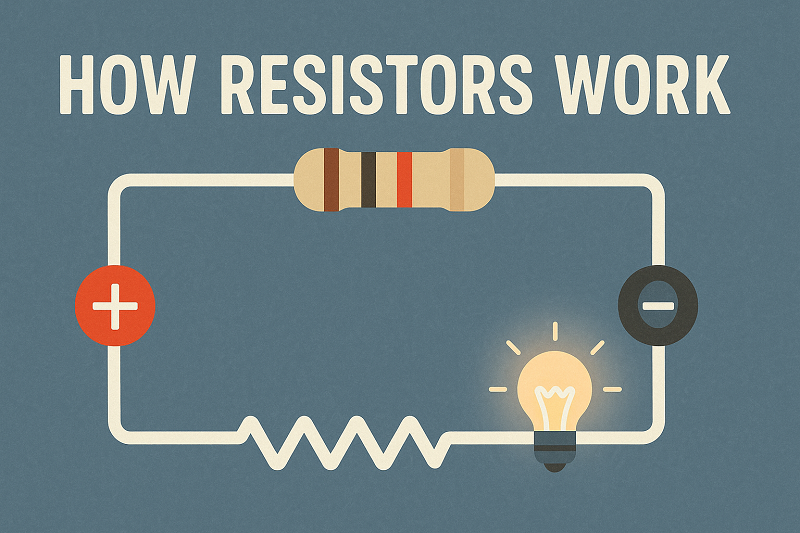
Resistors

Numeric Relay Overview: Working and Types

Ⅰ IntroductionAs the technology evolved, several improvements from a standard fuse to the circuit breaker have also been made to the safety devices. We have been using static relays and magnetic relays for years to secure an electrical network, and now the safety systems have also changed as the microprocessors have evolved.We've heard about various kinds of relays before, and Numerical Relay was one of them, so we're going to concentrate more on this kind of relay today. The formed type of a static and electromagnetic relay is numeric relays. They are a system used in an electrical network to calculate electrical parameters and transform them into numerical data that is mathematically and logically interpreted to determine whether to activate an electrical network. A numerical relay's primary function is to protect the electrical network from unpredictable currents of failure. Due to their flexible features, numerical relays are often favored. A single numerical relay can track various parameters, such as current, voltage, frequency, time of onset, time of offset, etc. And for the analysis and control of multiple faults such as over current, over flux, different current and more, the same relay can be used.CatalogⅠ IntroductionⅡ Working and Hardware Architecture of Numerical RelayⅢ Types of Numerical Relays  3.1 Based on Logic  3.2 Based on Characteristics  3.3 Based on Actuating Parameters  3.4 Based on ApplicationⅣ ConclusionⅤ FAQⅡ Working and Hardware Architecture of Numerical RelaySince they both have identical hardware architecture with minor variations, the numeric relay can be considered a miniature device.Their architecture can seem overwhelming, but all of the architecture in these major categories can be simplified.• Input Module• CPU• Memory• Multiplexer and Analog to digital converter• Output module• Digital input/Communication module Input ModuleThe power system uses analog parameters to operate. With existing transformers and future transformers, the high-powered analog signals are stepped down. Using lowpass filters, it is fed to the numeric relay. Owing to the corona or induction effect from a nearby high voltage line, the low pass filter is used to remove the noisy signal in the device. CPUThe central processing unit (CPU) is the system's brain, which processes and filters all data protection algorithms and digital inputs. MemoryThere are two memories, RAM and ROM, in the numerical relay. Random Access Memory (RAM) is responsible for the retention and processing of input data to the relay during compilation.Read-Only Memory (ROM) is the relay's storage unit. It stores the required software and other data related to events and disturbances. The Storage Unit is a must because it allows during the occurrence of a fault to evaluate and troubleshoot any incident. Multiplexer and Analog to digital converterOnly digital data can be processed by the CPU, but the feedback from the current transformer and future transformer is analog. The Analog to Digital converter is then used to translate the signal to digital data. A multiplexer is used to select the necessary analog input for conversion if multiple analog signals need to be converted. Output ModuleThe digital contacts that are actuated when a trip command is provided by the CPU are the output module. Pulses that are produced as a response signal are these digital contacts. According to the application of the relay, the response time may be modified. Digital input/Communication moduleAs with a computer, a relay also has serial and parallel ports to link the relay to the substation's control and communication systems. To extend the tripping command, the Auxiliary relays can be attached to the digital output contacts.Ⅲ Types of Numerical RelaysFor different types of safety, numerical relays are used and are graded based on characteristics, logic, parameters of action and application. Although they are categorized under different circumstances, their function remains the same, in the event of a fault in the electrical network, to enable the travel system.3.1 Based on LogicSuch classifications are made based on the relay's logical operation.• Over Current/ Earth Fault: It will cause the circuit breaker when excessive current flows through a device. Used for protection against transformers and feeders.• Directional overcurrent: When the fault forces the power to flow in a specific direction, it is controlled (Opposite to the specified direction). Used for the safety of transformers, generators, and bus bars.• Differential:  When the phase difference of two or more equivalent electric quantities exceeds the stated value, the differential relay is set to trip. It can protect transformers from localized faults and generators.• Under/ Over Voltage: Under such conditions, the voltage in an electric network may drop or rise below or above a fixed value, the circuit is tripped.• Distance: The function of this type of relay is dependent on the distance between the fault impedance and the location of the relay. They are primarily used to safeguard transmission lines.3.2 Based On CharacteristicsThese classifications are based on their tripping property• Instantaneous relay: If the trigger is triggered directly after a fault occurs, no time delay will occur.• Definite Time Relay: Only activated if the fault stays in place after a certain time.• Definite Minimum Time (IDMT) Inverse Time Relays: These relays are often used on transmission lines. When the line current is higher than the safe value, the circuit breaker is triggered.• Voltage restraint over current relay: The relay is only triggered if the conditions of both under-voltage and over-current arise at the same time.3.3 Based on Actuating Parameters• Current relays• Voltage relays• Frequency relays• Power relays Etc.3.4 Based on Application• Primary relay• Backup relayThe entire network could crash if the security system fails, so they use the backup relay. And if the primary relay goes wrong, doing this would help us secure the machine.Ⅳ ConclusionNumeric relays are often used for automatic safety in the generating stations and substations. Different components such as feeder, engine, generator, transmission line, transformers and bus bars can be secured by such relays. Relays are available from different firms, such as Siemens, ABB, Schnieder Electric, Alstom, Texas, etc. Each business has its own software that can help us communicate with their relays and program the security algorithm. You can construct your own algorithm for security and feed it to the relay once you know about the parameter and the various types of faults that could occur in a power system. It doesn't take years of training and practice to become an expert in the defense of the power system to become one overnight. To become an expert, keep learning and keep on investigating.Ⅴ FAQ1. What is numerical protection relay?Numerical relay is the relay in which the measured AC quantities are sequentially sampled and converted into numerical data that is mathematically and/or logically processed to make trip decisions. Numerical relay is actually the digital relay as a unit for which manufacturers has developed standardized hardware, which can be used in conjunction with suitably developed software to meet variety of production requirements and applications. 2. What is the difference between a relay and a fuse and a circuit breaker?A relay is a control component used for signalling or switching according to control voltage applied to it’s terminals. A fuse is a protective device to limit the let through energy based on the current limit being exceeded. These are used once & then disposed of (not re-usable.) The fuses can be selected according to application & rated current (IE a motor, transformer or capacitor protection device) A circuit breaker (CB) is also a protection device used to limit let through energy on a fault, also with different thermal characteristics according to application & some LV units with a variable current threshold & tripping curve. A CB has limits - IE on LV systems, some are rated say 35kA, other larger units 60 or 80kA according to the system & calculated worst case fault current. 3. What is meant by numerical relay?In utility and industrial electric power transmission and distribution systems, a numerical relay is a computer-based system with software-based protection algorithms for the detection of electrical faults. Such relays are also termed microprocessor-type protective relays. 4. What is numerical overcurrent relay?A 'Numerical over Current Relay' is a type of protective relay which operates when the load current exceeds a preset value. ... The overcurrent relay of IDMT is the relay that starts to operate after the intended time delay. The time delay is also known as operation time. 5. What are the advantages of numerical relay?• Compact Size. • Flexibility. • Reliability. • Multi-Function Capability. • Different types of relay characteristics. • Digital communication capabilities. • Modular frame.• Low burden. 6. Which transistor is used in the numerical relay?The high-powered analog signals are stepped down with the current transformer and Potential transformer. It is fed to the numeric relay using a lowpass filter. The low pass filter is used to eliminate the noisy signal in the system due to the corona or induction effect from a nearby high voltage line. 7. What is the difference between numerical relay and static relay?A big difference between conventional electromechanical and static relays is how the relays are wired. ... Electromechanical and static relays have fixed wiring and the setting is manual. Numeric relays, on the other hand, are programmable relays where the characteristics and behavior can be programmed. 8. How does a numerical relay work?Numerical relays use a specialized digital signal processor (DSP) as the computational hardware, along with associated software tools. The relaying voltage and currents are passed through an isolation transformer. 9. What do you mean by a numerical protection scheme?Numerical protection relays are digital systems in constant communication with substation automation systems through menu-driven interfaces. They have configurable binary inputs, outputs, and programmable logic. They monitor, measure, and record electrical values, faults and disturbances, and events. 10. What are the demerits of numerical relay?1 relay can perform only 1 function. There are some disadvantages of the microprocessor are given below, The microprocessor has a limitation on the size of data. Wide Range of setting, more accurate, Low burden hence low VA of CT is required which minimizes the cost. 
kynix On 2021-01-15   12900
General electronic semiconductor

Trojans are everywhere even the hardware

SummarryWhen I see this paper,The things occurred in my mind is that I need to let others to know it and prevent it.From morning until now,I always solve my computer's Trojans.This is terrible. Trojans may break our computer although it look like there doesn't matter.Trojans aren everywhere even the hardware in some instances, hardware Trojans could even open backdoors in custom silicon. BodyOutsourcing has reshaped the way electronics products are made – and helped to cut manufacturing costs massively. But, as production margins have fallen, so too has trust in the organisations that make up the supply chain. Companies which rely on outsourced manufacturing are having to come up with ways of ensuring that the products shipped to them have not had secure keys leaked or stuffed with viruses and compromised software. Even custom silicon is not safe.Almost a decade ago, researchers from Case Western Reserve University described to delegates at the IEEE High-Level Design Validation and Test Workshop the ways in which they could see hardware malware – or Trojans – being introduced to an IC-design project. The widespread use of foundry services, third-party intellectual property and standard-cell libraries – as well as designers bribed to make circuit-level changes – all provide ways in which Trojans could be sneaked into circuitry.Once it receives a trigger signal, the Trojan could open a backdoor to the group that wanted it introduced. In some use-cases, the Trojan may be introduced simply to compromise the product; no matter how it is used. However, the nature of IC design makes hardware Trojans difficult to deploy as they require skills and levels of access that are probably out of reach of most cybercriminals. But other, lower hanging, fruit remains available to them. State actors have the skills, access and motive that may make the surrepticious deployment of some kinds of silicon highly attractive to them. In practice, such organisations may not bother trying to introduce backdoors without the knowledge of the manufacturer or find other ways to make gain access to secrets. In 2015, the BBC identified declassified documents that confirmed the government convinced Crypto AG in the mid-1950s to compromise the security of its C-52 electromechanical encryption machines. Rather than making physical changes to the hardware itself, the company told the US National Security Agency (NSA) and the UK’s GCHQ which models target governments had bought – a practice that would allow the agencies to target decryption resources more effectively. In 2013, the NSA came under suspicion of encouraging the use of algorithms supplied by specialist RSA that had been subtly weakened to make decryption easier. While some ICs behave as if they have Trojans installed, in reality the backdoors were placed intentionally into the silicon by authorised designers. Usually, they are debug aids that were meant to stay secret, but often did not. Five years ago, Sergei Skorobogatov of the University of Cambridge and Christopher Woods of Quo Vadis Labs used side-channel emissions from the devices to uncover the key that would open the backdoor in the JTAG circuitry of an FPGA and to provide access to the encryption keys stored inside. Although side-channel emissions provide one way to determine whether an IC has been compromised with a backdoor, designers have other options available through the deployment of EDA techniques with Trojan detection in mind. As with anything in cybersecurity, a cat-and-mouse game has produced ever more subtle ways of introducing Trojans and more powerful ways of detecting them. The hardware Trojan is the subject of regular hacking competitions between research teams. For example, the Cyber Security Awareness Week (CSAW) organised by New York University has run several challenges around Trojans. In these challenges, red teams try to circumvent the detection mechanisms used by blue teams. 2013’s CSAW challenge focused on methods to beat FANCI, a largely effective detector developed at Columbia University and NYU. FANCI works on the basis that a Trojan would only have a loose connection to the design such that its logic would seem to be practically unreachable. Code-coverage analysis of the RTL can identify such unconnected lumps of circuitry and flag them up as possible Trojans. A couple of years later, the DeTrust technique created by Jie Zhang and colleagues at the Chinese University of Hong Kong showed one method for fooling FANCI: spreading the suspicious logic across many otherwise independent gates. Months later, Syed Haider and coworkers from the University of Connecticut developed the hardware Trojan catcher (HaTCH), designed to track down stealthier functions inserted at the logic level. Rather than isolate the Trojans before manufacture so they can be removed, HaTCH focuses on remediation. It adds tagging circuitry to legitimate cores that work to prevent any on chip Trojans from activating or succeeding in displaying malicious behaviour, such as opening a backdoor. A more wide-ranging technique that could serve as a defence against Trojans is to insist that all IP be supplied with formal proofs that describe the operations it would be allowed to perform. Any changes would be flagged by formal-verification tools during design and prototyping. Such approaches could still be vulnerable to attacks that tweak designs below the abstraction of RTL. As with the cases where the NSA is understood to have sought the help of manufacturers, weakened encryption is one of the most likely ways in which a practical hardware Trojan might work and evade detection by all but side-channel analysis. And it is possible using a tiny change at manufacture according. At the 2013 International Workshop on Cryptographic Hardware and Embedded Systems, Georg Becker and colleagues from the University of Massachusetts at Amherst showed a proof of concept that simply switched dopants used for one of the transistors in an inverter within a larger AOI standard cell (see figure 1). The result would be an inverter that generated a constant output.A transistor that no longer switched might be caught by a scan test looking for stuck-at faults. But embedded in a pseudorandom number generator, the inverter’s problem could be very hard to track down. Once there, the Amherst team estimated the fault could massively reduce the entropy of the random numbers it produced, resulting in very weak cryptographic keys. In 2014, Takeshi Sugawara of Mitsubishi Electric and a team from the company and Ritsumeikan University showed such a tiny change in manufacturing could be detected after the fact. A combination of focused ion beams and scanning electron microscopy can reveal the dopants diffused into the substrate. It is an expensive proposition, involving delayering of the design and extensive analysis against a layout that contains a map of the expected dopants. However, for the kinds of high-value cryptographic IC that might be the targets of well-financed attackers, it is arguably one more in a list of checks that are readily justified. As with other areas of embedded cybersecurity, the most feasible approach to dealing with the risk of hardware Trojans is one of focusing effort. Architectures such as Trustzone pull functions that need high levels of protection into a small portion of the overall SoC. In principle, this subset is much easier to verify than a design that calls for the either chip to analysed for vulnerabilities. If the secure core is guaranteed to not leak information or provide trapdoors, the value to an attacker of putting a Trojan in the more weakly protected part of the SoC diminishes greatly. For the user of SoCs and the buyer of IP to go into them, the question then becomes one of the level of expected risk and the degree of trust they can put in staff, suppliers and contractors.
kynix On 2018-01-24   434

Kynix

Kynix was founded in 2008, specializing in the electronic components distribution business. We adhere to honesty and ethics as our business philosophy and have gradually established an excellent reputation and credibility in our international business. With the accurate quotation, excellent credit, reasonable price, reliable quality, fast delivery, and authentic service, we have won the praise of the majority of customers.

Follow us

Join our mailing list!

Be the first to know about new products, special offers, and more.

Kynix

  • How to purchase

  • Order
  • Search & Inquiry
  • Shipping & Tracking
  • Payment Methods
  • Contact Us

  • Tel: 00852-6915 1330
  • Email: info@kynix.com
  • Follow Us

authentication

Kynix

© 2008-2026 kynix.com all rights reserve.