The Kynix Blog
Stay Ahead with Expert Electronics Insights,
Industry Trends, and Innovative Tips
- Electronic Components
- News Room
- General electronic semiconductor
- Components Guide
- Sort by
- Robots
- Transmitters
- Capacitors
- IC Chips
- PCBs
- Connectors
- Amplifiers
- Memory
- LED
- Diodes
- Transistors
- Battery
- Oscillators
- Resistors
- Transceiver
- RFID
- FPGA
- Mosfets
- Sensor
- Motors, Solenoids, Driver Boards/Modules
- Relays
- Optoelectronics
- Power
- Transformer
- Fuse
- Thyristor
- potentiometer
- Development Boards
- RF/IF
- Semiconductor Information
- PCB
- transistor
ⅠIntroduction The most common system is single-phase, which is mostly used in homes, whereas three-phase is commonly used in industrial or commercial buildings where heavy loads of power are required. Catalog ⅠIntroduction Ⅱ Three-phase Power Related Video: Ⅲ Single-phase AC Power Basics 3.1 What is Single-phase AC power? 3.2 Advantages of Single-phase 3.3 Disadvantages of Single-phase Ⅳ 3-phase Power Explained 4.1 What is 3-phase Power? 4.2 Advantages of Three-Phase System 4.3 Disadvantages of Three-Phase System Ⅴ Why We Need 3-phase Power? Ⅵ What Are the Differences Between Single-Phase Power and Three-Phase Power? Ⅶ FAQ Ⅱ Three-phase Power Related Video: Three-Phase Power Explained Three-phase Video Description: This video will take a close look at three-phase power and explain how it works. Three-phase power can be defined as the common method of alternating current power generation, transmission, and distribution. It is a type of polyphase system, and is the most common method used by electric grids worldwide to transfer power. Ⅲ Single-phase AC Power Basics Single-phase electric power is the distribution of alternating current electric power using a system in which all of the supply voltages vary in unison. When the loads are mostly lighting and heating, with only a few large electric motors, single-phase distribution is used. 3.1 What is Single-phase AC power? Before delving into that topic, it's a good idea to first understand single-phase alternating current (AC). Single-phase alternating current (AC) power is delivered via a three-wire system consisting of one "hot" wire, one neutral wire, and one ground wire. With alternating current power, the power current or voltage reverses on a regular basis, flowing one way on the hot wire that supplies power to the load and the other way on the neutral wire. During a 360-degree phase change, a full power cycle occurs, and the voltage reverses itself 50 or 60 times per second, depending on the system in use in different parts of the world. It is 60 times or 60 hertz in North America (Hz). It is critical to note that the two current-carrying legs are always 180 degrees apart. Consider the power as riding a wave, specifically a sine wave with a defined frequency and amplitude. During each cycle, the waves on each wire pass through zero amplitude twice (see Figure 1). There is no power delivered to the load during these times. Figure1:Single-phase These brief interruptions have no effect on residential and commercial building applications such as office environments, but they have serious consequences for the motors that power large machinery, as well as computers and other IT equipment. 3.2 Advantages of Single-phase Single-phase connections are designed for household supplies and residential homes. This is due to the fact that most appliances, such as televisions, lights, fans, refrigerators, and so on, require only a small amount of electricity to function.A single-phase connection works in a straightforward manner. It consists of a compact and lightweight unit in which the flow of electricity through the wires is reduced as the voltage increases.Because of the power reduction, it ensures that the power from a single-phase connection operates at peak efficiency and effectively transmits power.A single-phase connection is best suited for units rated up to 5 horsepower. 3.3 Disadvantages of Single-phase Ⅳ 3-phase Power Explained Three-phase electric power (abbreviated 3), is a type of alternating current that is commonly used in power generation, transmission, and distribution. It is a type of polyphase system that uses three wires (or four if a neutral return wire is used) and is the most common method used by electrical grids around the world to transfer power. 4.1 What is 3-phase Power? As the name implies, three separate currents are provided by three-phase power systems, each separated by one-third of the time it takes to complete a full cycle. However, unlike single-phase, where the two hot legs are always 180 degrees apart, the currents in 3-phase are separated by 120 degrees. Figure 2 shows that when one line is at its peak current, the other two are not. When phase 1 reaches its positive peak, phases 2 and 3 are both at -0.5. In contrast to single-phase current, there is no point at which no power is delivered to the load. In fact, one of the lines is at a peak positive or negative position at six different points in each phase. In practice, this means that the total amount of power supplied by all three currents remains constant; there are no cyclical peaks and valleys as with single-phase. Many computers and motors used in heavy machinery are built with this in mind. Instead of having to account for the variation inherent in single-phase AC power, they can draw a steady stream of constant power. They use less energy as a result. Consider the difference between a single-cylinder and a three-cylinder engine. Both use a four-stroke engine (intake, compression, power, exhaust). With a single-cylinder engine, you only get one "power" cycle for every four-cylinder stroke, resulting in rather uneven power delivery. A three-stroke engine, on the other hand, produces power in three alternating phases (again separated by 120 degrees), resulting in smoother, more consistent, and efficient power. Figure2:Three-phase 4.2 Advantages of Three Phase System There are numerous reasons why this power is preferable to single-phase power. The single phase power equation is Figure3: single phase power equation Which is a function that changes over time. In contrast, the three-phase power equation is Figure4: three-phase power equation Which is a constant function that is independent of time. As a result, the single-phase power is pulsing. This has no effect on low-rated motors, but it causes excessive vibration in higher-rated motors. As a result, three-phase power is preferable for high-tension power loads. A three-phase machine has a 1.5 times higher rating than a single-phase machine of the same size. Because single-phase induction motors have no starting torque, we must provide an auxiliary means of starting, whereas three-phase induction motors are self-starting and do not require any auxiliary means. In the case of a three-phase system, the power factor and efficiency are both higher. Which is a constant function that is independent of time. As a result, the single-phase power is pulsing. This has no effect on low-rated motors, but it causes excessive vibration in higher-rated motors. As a result, three-phase power is preferable for high-tension power loads. A three-phase machine has a 1.5 times higher rating than a single-phase machine of the same size. Because single-phase induction motors have no starting torque, we must provide an auxiliary means of starting, whereas three-phase induction motors are self-starting and do not require any auxiliary means. In the case of a three-phase system, the power factor and efficiency are both higher. 4.3 Disadvantages of 3-phase Power The most significant disadvantage of a three-phase connection is that it cannot handle the overload. As a result, it may cause damage to the equipment, increasing the likelihood of costly repairs. This is due to the high cost of individual components. Because the unit voltage is so high, a three-phase power connection necessitates a significant investment in insulation. Insulation varies with voltage, and wire size is determined by power distribution. Ⅴ Why We Need 3-phase Power? The ability to deliver ever-increasing amounts of power is especially important as data centers and server rooms become denser. More powerful computing systems are being crammed into the same spaces that once housed servers that used a fraction of the electrical power that today's computers and networks require. Not long ago, a single IT rack of ten servers would consume a total of five kilowatts (kW). Today, that same rack may house dozens of servers, each drawing 20 or 30 kW. At those levels, efficiency is important, as even a small percentage improvement in power consumption will result in significant dollar savings over time. Another issue is wiring. Take a look at a 15 kW rack. Using single-phase power at 120 volts AC (VAC), it takes 125 amps to power the rack, which would necessitate a wire almost one-quarter inch in diameter (AWG 4) — too thick to work with easily, let alone affordably. Because three-phase is more efficient, it can deliver the same amount of power (and more) while using less wiring. To support the same 15 kW rack with 3-phase power, three wires capable of supplying 42 amps (AWG 10) are required, each less than one-tenth of an inch in diameter. Ⅵ What Are the Differences Between Single-Phase Power and Three-Phase Power? The following are the key distinctions between a single-phase and three-phase connection. Ⅶ FAQ 1. How is 3phase power generated? Electric power is generated as three phase alternating current (AC) by turning mechanical turbines from the forces of water, steam, or other means in order to turn generators, thereby, converting the mechanical energy into electric energy. In the US, generators turn at 60 revolutions per second or at 60 hertz (Hz). 2. Why does three phase not need a neutral? A neutral wire allows the three phase system to use a higher voltage while still supporting lower voltage single phase appliances. In high voltage distribution situations it is common not to have a neutral wire as the loads can simply be connected between phases (phase-phase connection). 3. How many wires does 3 phase have? four wires Three-phase has four wires: three actives (called phases) and one neutral. The neutral wire is earthed at the switchboard. 4. How do you make 3 phase voltage? In a 3 phase system, there are three equal voltages or EMFs of the same frequency having a phase difference of 120 degrees. These voltages can be produced by a three-phase AC generator having three identical windings displaced apart from each other by 120 degrees electrical. 5. Does three-phase need a ground? Does the National Electrical Code (NEC) require a 480-volt (V), three-phase, 3-wire, delta-connected system to be grounded? No, it is optional. This article examines the NEC's electrical-system grounding provision. 6. What is the symbol for 3 phase? A three-phase system may be arranged in delta (∆) or star (Y) (also denoted as wye in some areas). 7.Is 240V single phase or 3 phase? 240V power is used in the US and parts of the world. In the US 120 / 240V 1 Phase 3 Wire is the standard for homes and 240V 3 Phase Open Delta is the standard for small buildings with large loads. In parts of the world 240V Single Phase 2 Wire is the standard for homes. 8. What is the value of 3 phase voltage? 3 phase system is expressed with line voltages. The line votage is 440 volt. Also the voltage between any one phase and neutral for a 3 phase system is 240 volts. 9. What is single-phase power used for? Single-Phase Power generates electricity to residential homes and domestic supplies, since most appliances require only a small amount of power to function, including fans, heaters, television, refrigerator, and lights. 10. Why does single phase have 2 wires? Two hot wires and one neutral wire provide the power. Each hot wire provides 120 volts of electricity. The neutral is tapped off from the transformer. A two-phase circuit probably exists because most water heaters, stoves and clothes dryers require 240 volts to operate. 11. Can we use 2 AC in single phase? You can, yes. The main MCB has a current rating of at least 25 ampere. If you use 1.5 ac, it has max load current of 7 to 8 amperes for a single ac, and the MCB size is to be selected. 12.Is 240 volt single-phase? Single Phase 120/240 It may also be called Split Phase 240. This configuration consists of 2 voltage legs that are 180 degrees apart. The voltage between the two legs (called phase to phase or line to line) is 240V and the phase to neutral voltage is 120V.
kynix On 2021-12-09
IntroductionOver voltage protection is necessary to prevent damage as a result of electrical transients. It is a power supply feature which shuts down the supply, or clamps the output, when the voltage exceeds a preset level. Most power supplies use an over-voltage protection circuit to prevent damage to the electronic components. They offer some form of overvoltage-protect (OVP) circuit to detect and then quickly pull down the overvoltage. When the voltage exceed the rated maximum breakdown voltage, do you know using Zener diode to make overvoltage protection circuit? Here introduces the Zener diode overvoltage protection circuit, which is the most common way.CatalogIntroductionⅠ Over Voltage BackgroundⅡ Zener Diode Input Protection BasicsⅢ Simple Overvoltage Protection Circuit Using Zener DiodeⅣ How Do You Choose a Zener Diode to Protect a Circuit?Ⅴ Zener Overvoltage Protection OverviewⅠ Over Voltage BackgroundEvery circuit design operates at various voltage levels, with 3.3V, 5V, and 12V being the most common voltage levels for a digital circuit. But every design is special, and having more than one operating voltage is also normal for a circuit. For example, a standard computer SMPS system will work at six different levels of voltage, namely ±3.3V, ±5V, and ±12V. In these cases, if a low-power device is operated by a high voltage, the component will be permanently impaired if various voltage levels are used to power different types of components. Therefore, to avoid over-voltage harm, the designer should always concentrate on implementing an over-voltage security circuit in his designs.There will be three different voltage ratings for any part or circuit, namely the minimum operating voltage, the suggested or normal operating voltage and the maximum operating voltage. For any circuits or parts, any value over the maximum operating voltage can be fatal. Using a Zener diode over voltage protection circuit is a very common and cost-effective solution. Ⅱ Zener Diode Input Protection BasicsIn order to protect the circuit from overvoltage conditions, Zener diodes are often the first option. A Zener diode follows the same diode theory, which blocks the current flow in the reverse direction. However, there is a drawback that the Zener diode blocks the flow of current in the reverse direction only for a restricted voltage defined by the voltage rating of the Zener diode. A 5.1V Zener diode blocks current to flow in the opposite direction up to 5.1V If the voltage is greater than 5.1V through the Zener diode, it allows the current to pass through it. This Zener diode function makes it an excellent over-voltage security component.Over-Voltage Protection Circuit using Zener DiodesⅢ Simple Overvoltage Protection Circuit Using Zener DiodeConsider a circuit, where need microcontroller over-voltage protection. Anything that has a maximum rating of 5V across the microcontroller IO pins. So voltage more than 5V will damage the microcontroller.Figure 1. Overvoltage Protection for MicrocontrollerThe diode used in the circuit above is a Zener diode of 5.1V. During an over-voltage case, it will work perfectly. It can transfer the current and regulate the voltage up to 5.1V if the voltage is more than 5.1V. In practice, however, it will behave as a regular diode and block less than 5.1V The image below is a simulation of the spice circuit of Zener diode protection. For the full simulation description, you can make it based on your need.Figure 2. Simulating Overvoltage Protection CircuitThere is an input voltage in the schematic above, which is dc supply. The R1 and D1 are two components that protect the output from protection from over-voltage. The D1, 1N4099, in this case, is a Zener diode. When the V1 reaches 6.8V, the output will be protected. The output would remain at a maximum of 6.8V as a reference voltage of 1N4099.Let's see how the above circuit works as the protection circuit of the Zener diode input and protects the output from more than 6.8V voltage.Using pspice cadence, the above circuit is simulated. The output remains constant at 5.99V at the 6V input voltage across the V1 (Which is 6.0V).The input voltage in the above simulation is 6.8V. The performance, therefore, is 6.78V, which is similar to 6.8V. Let's further raise the input voltage and create a situation of overvoltage.Now, 7.5V, which is more than 6.8V, is the input voltage. The performance is now now at 6.88V. This is how a Zener diode is successful in saving the connected circuit from a situation of overvoltage, even when the voltage returns to less than 6.8V, as shown in the previous stage, the circuit will operate normally again. In other words, a Zener diode does not get fried even during an overvoltage state, unlike a fuse.To pick different overvoltage margins in the above circuit, any other Zener diodes with different values such as 3.3V, 5.1V, 9.1V, 10.2V can be used. Ⅳ How Do You Choose a Zener Diode to Protect a Circuit?The next critical part is choosing the value of the Zener Diode. The points below will assist you in selecting the correct Zener Diode value and part number.1) Choose the voltage of the Zener diode first. It is the voltage value that will serve as a close circuit for the Zener diode and protect the load from overvoltage. The Zener voltage is 6.8V in Pspice, for the above example.There will be some cases where there is no usable targeted Zener diode voltage. In such instances, it is possible to choose a near value of the Zener diode. For example, for overvoltage security up to 7V, a near value is a 6.8V Zener diode.2) Calculate the load current that is linked across the circuit of overvoltage safety. This is 50mA for our example discussed above. Other than the load current, biasing current is required by Zener diodes. Therefore, the total current, plus the Zener diode biasing current, should be equal to the load current. For the above mentioned example, it can be total current=50mA+10mA=60mA.3) There is a power ranking for Zener diodes. Therefore, for proper heat dissipation, the correct Zener diode power rating is required. Based on the measured total current in Phase - 2, which is 60mA, the power rating can be calculated. Therefore, the power rating of the Zener diode would be equal to the voltage of the Zener diode, which connects the total current flowing through the diode.4) Calculate the value of the resistor by differentiating the voltage of the source and the general voltage. The limit which can be applied to the circuit would be the source voltage. For example, it can be 13V to maximize overvoltage that can occur or can be added as a supply voltage.The voltage drop through the resistor will then be = 13V-6.8V = 6.2V According to the law of the ohm, the resistor value will be = 6.2V / 0.060 A = 103R It is possible to choose the standard value 100R resistor.5) Zener diode typical values are 5.1V, 5.6V, 6.2V, 12V and 15V -most common; they are also have 3V, 5V, 12V, 18V, 24V.Ⅴ Zener Overvoltage Protection OverviewZener diode as a voltage regulator, it is suitable for overvoltage protection circuit. Because the easiest and simplest process to protect devices from overvoltage is overvoltage-protect circuit using Zener diodes. The voltage remains regulated in this technique and the cost of this circuit is much lower compared to other techniques.Although, surely, there are disadvantages to this sort of circuit. Power dissipation is the main downside of this type of circuit. It still dissipates heat due to the linked series resistor and results in energy wastage. Frequently Asked Questions about Zener Diode Overvoltage Protection Circuit Design1. What is overvoltage protection?Over voltage protection is a power supply feature which shuts down the supply, or clamps the output, when the voltage exceeds a preset level. Most power supplies use an over-voltage protection circuit to prevent damage to the electronic components. 2. Which is most common circuit protection device?The SPD(surge protection device) device is allied in parallel in the power supply circuit, which can be used on all stages of the power supply system. The surge protection device is the most frequently used and also well-organized kind of over-voltage protective devices. 3. What can cause overvoltage?The main causes include insulation failure, arcing ground and resonance etc. 4. How does a Zener diode regulate voltage?Zener diodes are widely used as voltage references and as shunt regulators to regulate the voltage across small circuits. When connected in parallel with a variable voltage source so that it is reverse biased, a Zener diode conducts when the voltage reaches the diode's reverse breakdown voltage.
kynix On 2021-01-14
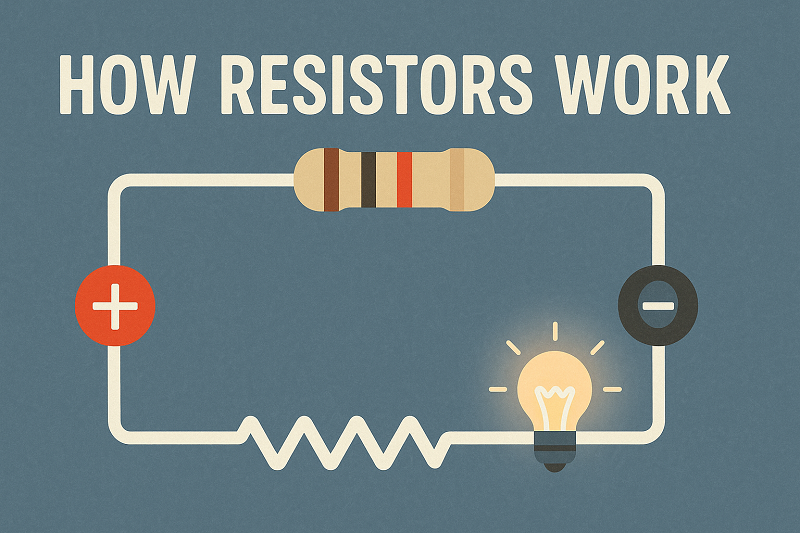
IntroductionResistors are usually connected in a circuit in various ways, and the two most basic ways are series and parallel. This article will mainly introduce these two connection methods, including their definitions, formulas, circuit diagrams, examples and identification methods. In addition, the article also introduces Ohm's law and Kirchhoff's law, which are very important in understanding the series and parallel connections of resistors.You may need these two calculators in reading this arrticle:① Ohm's Law Calculator② Parallel and Series Resistance CalculatorThe following video explains the basics of resistors in series and parallel, which can promote your understanding of this article. But it does not matter so much if you skip this video since the article explains in detail and is comprehensive.Resistors in series and parallel - deriving the formulaCatalogIntroductionCatalogI Series Connection of ResistorsII Parallel Connection of ResistorsIII Resistor Combination(Mixed Resistor Circuit)IV Ohm's Law 4.1 What is Ohm's Law? 4.2 What is Closed Circuit Ohm's Law? 4.3 The Key Points of Studying Ohm's LawV Kirchhoff's Law 5.1 Concepts 5.2 Kirchhoff's First Law (Nodal Current Law) 5.3 Kirchhoff's Second Law (Law of Loop Voltage) 5.4 Application Note of Kirchhoff's LawVI Series and Parallel Circuit Identification MethodsVII QuizⅧ FAQI Series Connection of Resistors(1) Circuit characteristicsFigure1. Resistors in seriesThe figure shows the series connection of n resistors, and the voltage and current reference directions are related. The circuit characteristics are derived from Kirchhoff’s law:(A) The resistors are connected in sequence. According to KCL, the current flowing through the resistors is the same;(B) According to KVL, the total voltage of the circuit is equal to the sum of the voltages of the series resistors, namely:(2) Equivalent resistanceFigure2. Equivalent resistance circuitSubstituting Ohm's law into the voltage expression, we get:The above formula illustrates that the series circuit of multiple resistors in Figure (a) and the circuit of single resistor in Figure (b) have the same VCR, which is equivalent to each other.The equivalent resistance is:In conclusion:The resistors are connected in series, and the equivalent resistance is equal to the sum of the sub-resistances;The equivalent resistance is greater than any one of the series resistance.The partial pressure of series resistanceIf the total voltage across the series resistor is known, what is the divided voltage on each resistor? From figure (a) and figure (b) we know:MeetIn conclusion:Resistors are connected in series, and the voltage on each sub-resistor is proportional to the resistance value. The higher the resistance value, the higher the voltage. Therefore, the series circuit can be used as a voltage divider circuit.Example 1: Calculate the voltage across the two series resistors as shown in the figure.Figure3. Circuit of Example1Solution: From the partial pressure formula of series resistance:(Note the direction of U2)(3) PowerThe power of each resistor is:SoTotal power:Draw conclusions from the above formulas:When resistors are connected in series, the power consumed by each resistor is proportional to the size of the resistor, that is, the larger the resistance, the larger the power consumed;The power consumed by the equivalent resistance is equal to the sum of the power consumed by each series resistor.II Parallel Connection of Resistors(1) Circuit characteristicsFigure4. Parallel circuit characteristics The figure shows the parallel connection of n resistors, and the voltage and current reference directions are related. The circuit characteristics are derived from Kirchhoff's law:(a) The two ends of each resistor are connected together. According to KVL, the two ends of each resistor are at the same voltage;(b) According to KCL, the total current of the circuit is equal to the sum of the currents flowing through the parallel resistors, namely:(2) Equivalent resistanceFigure5. Equivalent resistance in parallel connectionSubstituting Ohm's law into the current expression, we get:G =1/R is the conductanceThe above formula illustrates that the parallel circuit of multiple resistors in Figure (a) and the circuit of single resistor in Figure (b) have the same VCR, which is equivalent to each other.The equivalent conductance is:Therefore,Namely,The most commonly used formula to find the equivalent resistance when two resistors are connected in parallel:In conclusion:The resistors are connected in parallel, and the equivalent conductance is equal to the sum of the conductances and greater than the partial conductance;The reciprocal of the equivalent resistance is equal to the sum of the reciprocals of the sub-resistances, and the equivalent resistance is less than any parallel sub-resistance.Current distribution of parallel resistanceIf the total current of the parallel resistance circuit is known, find the current on each sub-resistance and call it a shunt. From figure (a) and figure (b) we know:Namely,MeetFor two resistors in parallel, there are:Conclusion: When the resistors are connected in parallel, the current on each sub-resistor is inversely proportional to the resistance value, and the current divided by the larger resistance value is smaller. Therefore, the parallel resistor circuit can be used as a shunt circuit.(3) PowerThe power of each resistor is:SoTotal power:Draw conclusions from the above formulas:When resistors are connected in parallel, the power consumed by each resistor is inversely proportional to the size of the resistor, that is, the larger the resistance, the smaller the power consumed;The power consumed by the equivalent resistor is equal to the sum of the power consumed by each parallel connected resistor.consumed by each series resistor.III Resistor Combination(Mixed Resistor Circuit)A circuit with resistors connected in series and connected in parallel is called a resistor combination or mixed resistor circuit. The part where the resistors are connected in series has the characteristics of a resistor series circuit, and the part where the resistors are connected in parallel has the characteristics of a resistor parallel circuit.Example 2: The circuit is shown in the figure, please calculate the voltage and current of each branch.Figure6. Example circuit 2Solution: This is a resistor series and parallel circuit. First find the equivalent resistance Reg = 11W, and the current and voltage of each branch are:The general steps for solving series and parallel circuits can be obtained from the above examples:⚫ Find the equivalent resistance or equivalent conductance;⚫ Apply Ohm's law to find the total voltage or total current;⚫ Apply Ohm's law or voltage division and shunt formula to find the current and voltage on each resistor.Therefore, the key issue in analyzing series-parallel circuits is to distinguish the relationship between series and parallel circuits.To determine the series-parallel relationship of the circuit, the following 4 points should be mastered:⚫ Look at the structural characteristics of the circuit. If two resistors are connected end-to-end, they are connected in series;⚫ Look at the relationship between voltage and current. If the current flowing through the two resistors is the same current, it is connected in series; if the two electrical groups bear the same voltage, it is connected in parallel.⚫ Equivalent to deformation of the circuit. For example, the left branch can be twisted to the right, the upper branch can be turned down, the curved branch can be straightened, etc.; the short circuit in the circuit can be compressed and extended at will; the multi-point grounding can be connected by a short circuit . Generally, if it is really a problem with a resistor series circuit, it can be distinguished.⚫ Find the equipotential point. For circuits with symmetrical characteristics, if two points can be judged to be equipotential points, according to the concept of circuit equivalence, one is to use short wires to connect the equipotential points; the other is to break the branch that connects the equipotential points. Open (because there is no current in the branch), thus obtain the series-parallel relationship of the resistance.IV Ohm's Law4.1 What is Ohm's Law?(1) The content of Ohm's lawWhen there is a potential difference between the two ends of the conductor, an electric field appears inside the conductor, and the charge moves in a directional motion under the force of the electric field to generate current. German physicist Ohm summed up Ohm's law in 1826 through a large number of experiments: Under steady conditions, the intensity of the current passing through a section of conductor is proportional to the voltage across the conductor.(2) Mathematical expression of Ohm's law Note: The unit of the physical quantity in the formula: the unit of I is ampere (A), the unit of U is volt (V), and the unit of R is ohm (Ω).The proportional coefficient R in the formula is determined by the properties of the conductor and is called the resistance of the conductor. Unit: Ohm (Ω). The reciprocal of resistance is called conductance and is represented by G, that isUnit: Siemens (S).(3) Understanding and explanation of Ohm's law● Applicable conditions of Ohm's law: applicable to pure resistance circuits (that is, when working with electrical appliances, the consumed electrical energy is completely converted into internal energy.)● I, U and R in the formula must correspond to the same conductor or the same circuit. If it is in different time, different conductor or different section of circuit, I, U, and R can not be mixed, therefore, the three physical quantities should be marked with angles in order to distinguish under normal circumstances.● For the same conductor (that is, R does not change), I and U are proportional; for the same power source (that is, U does not change), I and R are inversely proportional.● R=ρL/S is the definition of resistance, which means that the resistance of a conductor is determined by the material, length and cross-sectional area of the conductor itself. In addition, resistance is also related to factors such as temperature.● The formula transformed from Ohm's law is a measure of resistance. It indicates that the resistance of a conductor can be given by U/I, that is, the ratio of R to U and I is related, but the magnitude of R itself is related to the applied voltage U and the passing current Factors such as the size of I are irrelevant.● Knowing any two quantities among I, U and R, you can find another quantity.● Issues that need special attention and re-emphasis: I, U and R in the formula must be in the same circuit; when using the formula to calculate, the unit of each physical quantity must be unified.The above explanations are all part of Ohm’s law, which only applies to pure resistance circuits.(4) Pure resistance circuitA pure resistance circuit is a circuit with only resistance elements in addition to the power supply, or inductance and capacitance elements, but their influence on the circuit is negligible. The voltage and current have the same frequency and phase.The resistance converts all the energy obtained from the power supply into internal energy. This kind of circuit is called a pure resistance circuit. Here is a brief explanation from the energy point of view.Basically, as long as there is no conversion of electric energy other than internal energy, this circuit is a pure resistance circuit.4.2 What is Closed Circuit Ohm's Law?In an AC circuit, Ohm's law also holds, but the resistance R should be changed to impedance Z, that is, I = U/Z. If the circuit is closed and contains a power supply, it is called a full circuit, as shown in the figure below. The dotted line in the figure is the power supply, which is called an internal circuit. The circuit outside the power supply is called an external circuit. Since the power supply has internal resistance, the current not only has a voltage drop when passing through an external circuit, but also has an internal voltage drop when passing through an internal circuit. In the whole circuit, the current intensity is proportional to the electromotive force E of the power supply, and inversely proportional to the resistance (R+r) of the whole circuit (including the inner circuit and the outer circuit). This is the Ohm's law of the whole circuit, expressed by the formula:Where I- the current in the circuit, A; E- the electromotive force of the power supply, V; R- the resistance of the external circuit, Ω; r- the resistance of the internal circuit, Ω.From the above formula, in the circuit shown in the figure below, E=IR+Ir=Uouter+Uinner.Figure7. The simplest closed circuitIn the formula, U external = IR-external circuit voltage; U internal = Ir-internal circuit voltage.It should be noted that, since the internal resistance of the power supply itself and the internal resistance of the connecting wires are generally not large, the calculation results that are ignored in the calculation are basically correct. But sometimes it is necessary to calculate the internal voltage drop of the power supply, and to accurately calculate the current of the whole circuit, it is necessary to use the whole circuit Ohm's law. For example, in the figure below, if E=10V, r=0.1Ω, R=1kΩ, then:Figure8. An application example of Ohm's law of closed circuit① When S is connected to the 1 position, the circuit is in the open state,Ammeter readingThe reading of the voltmeter is U=IR=0.01×1000=10 (V), or U=E-Ir=10-0.01×0.1≈10 (V).②When S is connected to the 2 position, the circuit is in an open state, so the reading of the ammeter is 0; the reading of the voltmeter is U=E=10(V).③When S is connected to the 3 position, the circuit is in a short-circuit state, the reading of the ammeter is I=E/r=10/0.1=100(A)A; the reading of the voltmeter U=0(V).4.3 The Key Points of Studying Ohm's LawOhm's law is an important basic law in electricity. It is a law that is summarized and summarized through experiments. To master this law, we must pay attention to the following points:(1) Ohm's law applies to the entire circuit or a part of the circuit from the positive pole to the negative pole of the power supply, and it is a pure resistance circuit.(2) The current I "passing through" in Ohm's law, the voltage U at "both ends" and the resistance R of the "conductor" are all corresponding physical quantities on the same conductor or the same circuit. The above relationship does not exist between the current, voltage, and resistance of different conductors. Therefore, when using the formula I=U/R, the current, voltage, and resistance of the same conductor or the same circuit must be substituted into the calculation, and the three correspond one to one.(3) There is simultaneity among the three physical quantities in Ohm’s law. Even on the same part of the circuit, the closing or opening of the switch and the movement of the sliding position of the sliding varistor will cause the change of the circuit, which will lead to the current in the circuit. , Voltage, resistance changes, so the three quantities in the formula I=U/R are the same time value.(4) The difference between I=U/R and R=U/I:Ohm's law expression I=U/R means that the current in the conductor is related to the voltage across the conductor and the resistance in the conductor. When the resistance R is constant, the current I in the conductor is proportional to the voltage U across the conductor; when the voltage U across the conductor is constant, the current I in the conductor is inversely proportional to the resistance R of the conductor.R=U/I is derived from Ohm’s law expression. It means that the resistance value of a certain section of conductor is equal to the ratio of the voltage across the section of the conductor to the current passing through it. This ratio R is the property of the conductor itself and cannot be understood as R is directly proportional to U and inversely proportional to I. This is also the difference between physics and mathematics.(5) Ohm's law reflects the causal relationship between current intensity and voltage, and the restrictive relationship between current intensity and resistance under certain conditions. That is, when the resistance is constant, the current intensity is proportional to the voltage across the conductor; when the voltage is constant, the current intensity is inversely proportional to the resistance of the conductor. When establishing a proportional relationship, we must pay attention to its conditions. Ohm's law states that the current intensity through a conductor is determined by two factors, the voltage across the conductor and the resistance of the conductor.V Kirchhoff's LawKirchhoff's law includes the first law and the second law. They are the basic laws that are indispensable for the analysis and calculation of complex circuits.5.1 Concepts • BranchA two-terminal element connected in a circuit is a branch. Usually a certain current flows through the branch. (This definition is not universal. For example, if two components are connected in series and then connected in a circuit, it can only be regarded as a branch.)• NodeThe connection point between the branch and the branch is called a node. Usually the current diverges at the junction.• Loop loopA closed path formed by branches is called a loop.Figure9. 6 elements, 6 branches, 4 nodes, 3 independent circuits5.2 Kirchhoff's First Law (Nodal Current Law)The textual expression of KCL: For any node, the algebraic sum of the current flowing into (or out of) the node is equal to zero.Its mathematical expression:The regulation of current positive and negative: Generally, the current flowing into the node is positive, and the current flowing out of the node is negative.The physical meaning of KCL: conservation of chargeNote: KCL is not only applicable to a node, but also to a part of the circuit, as shown in the shaded part of the above figure:i3=i65.3 Kirchhoff's Second Law (Law of Loop Voltage)KVL’s literal expression: In any closed loop of the circuit, go around a circle in a certain direction, and the algebraic sum of the voltage of each segment is zero.That is: or. When applying the law of loop voltage, the electromotive force is often written on the left side of the equation, and the voltage is written on the right side of the equation.The method for determining the sign of each electromotive force and voltage in the second expression is as follows:① First select the current direction of each branch.② Any choice of the detour direction along the loop (clockwise or counterclockwise).③ If the direction of the current flowing through the resistor is the same as the detour direction, the voltage drop on the resistor is positive, otherwise, it is negative.④ If the direction of the electromotive force is the same as the direction of the orbit, the electromotive force is positive, otherwise, it is negative.The physical meaning of KVL: energy conservation.5.4 Application Note of Kirchhoff's Law• Kirchhoff’s law is a general law that the circuit should satisfy, and has nothing to do with the specific properties of the components;• Kirchhoff’s law applies to any lumped circuit, that is, nonlinear, time-varying circuits, etc.;• Application steps:A. Divide the branch roads and number them;B. Specify the branch current and voltage reference direction, and generally need to be associated;C. Select the appropriate node according to the meaning of the question, and apply KCL;D. Or choose the appropriate circuit according to the meaning of the question, apply KVL, and pay attention to independence.Example: Use KVL to derive the relationship between the total resistance and the sub-resistance and the voltage division formula in the series resistance circuit.Apply KVL according to the current and voltage reference direction and the detour direction of the loop calibrated in the figure:-u+u1+u2+…+un = 0 or u=u1+u2+…+un Because the voltage and current of each resistor obey Ohm's law: uk=iRk, there are:u = i × R1 + i× R2 +...... +i× Rn = i× ( R1+R2+…+Rn)= i Re among them: Re=R1+R2+…+Rn, which is the total resistance or equivalent resistance.uk = iRk=( u/Re ) Rk, which is the voltage division formula of the series circuitVI Series and Parallel Circuit Identification MethodsMethod 1: Current flow method(1) Starting from the positive pole of the power supply, use arrows to mark the path of the current along the connected wires, and finally return to the negative pole of the power supply;(2) Observe whether the current has a shunt and confluence point:If there is only one path for the current in the circuit, the components are connected in series (as shown in Figure a below);If there is a shunt point and a confluence point in the circuit, that is, the direction of the current is greater than one path, the components between the shunt point and the confluence point are connected in parallel (as shown in Figure b below)Figure10. Current flow methodMethod 2: Demolition methodRemove any electrical appliances:If the other electrical appliance cannot work, the two electrical appliances are connected in series (as shown in Figure a below)If the other consumer still works without being affected, the two consumers are connected in parallel (as shown in Figure b below)Figure11. Demolition methodMethod 3: Node MethodFor other non-intuitive non-series circuits, the situation is more complicated and needs to be judged according to several steps:The first step is to mark nodes. That is, use different letters (or symbols) to mark all nodes of the circuit. As shown in the following figure (a), the four points A, B, C, and D are all nodes in the circuit.The second step is to merge the nodes. According to the characteristics of the nodes, some of the nodes you have marked may be equivalent to the same node. The letters (or symbols) belonging to the same node must be changed to the same letter (or symbol), as shown in the circuit shown in Figure (a) Point A and point C are the same node, C should be changed to A, point B and point D should be the same node, D should be rewritten as B, that is to say, the circuit shown in Figure (a) essentially has two nodes A and B .Figure12. Node MethodThe third step is to determine the connection mode of the circuit. There are usually two ways to judge:Method one:Direct judgment: as shown in the figure (a) above, both ends of the resistors R1, R2 and R3 are independently connected to nodes A and B, so R1, R2 and R3 are connected in parallel.Method Two:Drawing judgment: that is, draw the intuitive equivalent circuit diagram of the original diagram. The specific drawing method of the intuitive equivalent circuit diagram of the circuit diagram in Figure (a) is: first determine the two points A and B on the paper, and then combine the original diagrams A and B. The components between the two points B are independently connected to the newly determined points A and B, as shown in the above figure (b), that is, the equivalent circuit diagram of figure (a) is figure (b).Warm reminder: The "node method" is generally used to identify irregular and more complex circuits, which has certain difficulties. There are many ways to identify series and parallel circuits, but you can choose the most suitable method according to your own understanding of the method when using it.VII QuizThe voltage dropped across the 300 ohm resistor isA. 6V B.9V C.2V D.30VAnswer: AⅧ FAQ1. What is the difference between two resistors connected in series, and two resistors connected in parallel?When resistors are in series then net resistance is the sum of individual resistances whereas in parallel it is the sum of the reciprocal of individual resistances.When a resistor is in series the current is the same through all resistors but the voltage is different. The sum of the voltage drop across each resistor is equal to the voltage across a resistor connected in series.When the resistor is in parallel the voltage across each resistor is the same while the current through each resistor is different.In series, the net resistance is higher (sum of each resistance) while in parallel net resistance is lower (net resistance is lower than smallest resistance connected in parallel). 2. Why are resistors connected in series and parallel?Connecting resistors in series increase their total resistance and the power they can handle by distributing the applied voltage. The current flow is the same for each resistor regardless of its resistance.Connecting resistors in parallel reduce their total resistance while at the same time increasing their power they can handle by sharing the current flow in the circuit. The voltage drop across each resistor is the same regardless of its resistance. 3. What is the difference between resistors in parallel and resistors in a series?For resistors in parallel, the voltage across them is the same while the current is the sum let take a case of two resistors connected in parallel the formula 1/Req=1/R1+1/R2 further simplify Req=R1*R2/(R1+R2)While for resistors in series their current is the same but the voltage is the sum and let still take the case of two resistors connected in series to obtain their equivalent Req= R1+R2. 4. How are resistors added in series and parallel?When resistors are connected one after each other this is called connecting in series. This is shown below. To calculate the total overall resistance of a number of resistors connected in this way you add up the individual resistances. This is done using the following formula: Rtotal = R1 + R2 +R3 and so on. 5. Why is resistance different in series and parallel?When resistors are connected in parallel, more current flows from the source than would flow for any of them individually, so the total resistance is lower. Each resistor in parallel has the same full voltage of the source applied to it, but divide the total current amongst them. 6. How do you calculate resistors in parallel?Parallel Resistor EquationIf the two resistances or impedances in parallel are equal and of the same value, then the total or equivalent resistance, RT is equal to half the value of one resistor. That is equal to R/2 and for three equal resistors in parallel, R/3, etc. 7. Why is resistance less in parallel?When resistors are connected in parallel, more current flows from the source than would flow for any of them individually, so the total resistance is lower. 8. How do you sum resistors in parallel?The sum of the currents through each path is equal to the total current that flows from the source. You can find total resistance in a Parallel circuit with the following formula: 1/Rt = 1/R1 + 1/R2 + 1/R3 +... If one of the parallel paths is broken, the current will continue to flow in all the other paths. 9. What happens when you add a resistor in series?When resistors are connected in series, the total voltage (or potential difference) across all the resistors is equal to the sum of the voltages across each resistor. ... In other words, the voltages around the circuit add up to the voltage of the supply. 10. What is the difference between series connection and parallel connection?A parallel circuit refers to a circuit with two or more two paths for the current to flow. ... In a series circuit, all the components are arranged in a single line. In a parallel circuit, all the components are arranged parallel to each other.
kynix On 2020-08-31
IntroductionIn electronics and electrical circuits, a Fuse is an electrical safety device that operates to provide overcurrent protection. In order to stop the damaging effects of overcurrent, when too much current flows through the low resistance element of the fuse, the element melts and breaks the circuit, because a special feature of the fuse is that it contains a piece of wire that melts easily. Fuses are widely used for the protection of electric motor circuits of different types. Before you read the following note, you can think about a question: what are the types of fuses and their uses?What is an Electric Fuse? and How to Prevent Short Circuit with Fuses?CatalogIntroductionⅠ Fuse Basic Overview1.1 What Are Fuses1.2 Fuse Working Principle1.3 Electrical Fuse Symbol1.4 Fuse MaterialsⅡ Electric Fuse Classification2.1 DC Fuses Basic2.2 AC Fuses BasicⅢ ConclusionⅣ Frequently Asked Questions about Fuse Types Basics and Its ApplicationsⅠ Fuse Basic Overview1.1 What Are FusesAn electrical fuse is a protection device built around a conductive strip that is designed to melt and separate in the event of excessive current. In other words, what are fuses for? The fuse breaks the circuit if a fault in an appliance causes too much current to flow. Except that, fuses are essentially temperature-sensitive devices. Even small variations from the controlled test conditions can greatly affect the predicted life of a fuse.1.2 Fuse Working PrincipleThe primary task of a fuse is to split the circuit if the circuit draws a current higher than desired, thus avoiding the harm due to short circuits.The simplest fuse type consists of a resistive part, carefully chosen for its melting point. A slight voltage drop (small enough so that the circuit downstream will not be impacted) is generated across the element when a current passes through this element, and some power is dissipated as heat. Thus, the element's temperature increases. This temperature rise is not necessary for normal currents to melt the filament. However, the melting point is easily reached if the current draw reaches the nominal current of the fuse. The resistive part melts and is disrupted by the circuit. The nominal current is determined by the thickness and length of the resistive material.To provide predictable trip currents, fuse components are made of zinc, copper, silver, aluminum, or other alloys. Over time, the element must not oxidize or corrode.1.3 Electrical Fuse SymbolWhat is the symbol of fuse? different fuse symbols in the electrical circuit diagram showed below.Electronic Symbols of Fuse1.4 Fuse MaterialsWhat are fuses made of? The material used for making fuse elements has a low melting point such as tin, lead, or zinc. A low melting point is, however, available with a high specific resistance metal shown in the table below. The material mainly used for fuse elements are tin, lead, silver, copper, zinc, aluminum, and an alloy of lead and tin. Ⅱ Electric Fuse ClassificationAfter you know what is a fuse in a circuit, the following are the types of fuse. There is a wide selection of PCB fuses in the market. Here introduce two major types: AC fuses, and DC fuses. The following note describes different types of fuses and their constriction, working characteristics.Types of Fuse Explained2.1 DC Fuses BasicCartridge FusesThis is the fused form that is the most common. In a glass envelope that is terminated by metal caps, the fuse part is encased. In a suitable holder, the fuse is mounted. As the glass envelope is transparent, whether the fuse is blown, it is easy to visually determine.This style has many versions, including the slow blow fuse and the quick blow fuse. Slow blow fuses have a larger element that can handle overcurrent and are unaffected by spikes in the appliance for a relatively short period of time. Quick blow fuses respond to existing spikes instantly.To withstand elevated temperatures, some versions of this fuse are encased in ceramic. Sand or oil is packed with fuses for high voltage applications. This is to stop arcing after it has blown between the two ends of the fuse. For direct PCB mounting, SMD variants of cartridge fuses also exist. Automotive, Blade Type & Bolted Type FusesThese fuses are designed especially for automotive systems running up to 32V and 42V at times. They come in the form of a 'sword' (a transparent plastic envelope with flat contacts) and are color-coded according to the nominal current. In other high-power circuits, some of these types are also used. Resettable Fuses/PolyfuseThese fuses are self-resetting, much as their name suggests. They contain black particles of carbon embedded inside organic polymers. The carbon black usually renders the mixture conductive. Heat, which expands the organic polymer, is created when a large current flows. The black particles of carbon are pulled apart, and conductivity decreases to the point that there is no flow of current. As temperatures decrease, conductivity is restored. The fuse does not, however, have to be replaced physically. This type of fuse is often referred to as a PTC, which means a positive temperature coefficient since the temperature rises with resistance.For computer power supplies and phone chargers, the PTC Fuse is ubiquitous. They are particularly handy here because it is difficult to replace them. They are used in aerospace devices for the same purpose.In their through-hole variants, PTCs are easily recognized by their yellow-orange colour and disc (and sometimes rectangular) form. With white markings, SMD poly fuses normally come in green or with gold markings in black. Virtually every current rating offers PTCs. Semiconductor FusesWith current flow, the power dissipated by a semiconductor increases exponentially, and semiconductors are thus used for ultrafast fuses. These fuses are commonly used to secure devices that are susceptible to even minor current spikes from semiconductor switching. Overvoltage Suppression FusesVoltage spikes may also often be dangerous to circuits, and with a fuse, an overvoltage safety system is also used to protect against both voltage and current spikes.There are NTCs (negative coefficient of temperature) put in parallel with the supply. NTC Fuses minimize resistance due to higher current flow and absorb spikes when the supply voltage spikes.Semiconductor-like devices that bidirectionally absorb voltage spikes are metal oxide varistors (MOVs). Using the linked post, you can learn more about MOV and its work.2.2 AC Fuses BasicHigh Voltage FusesIn high voltage AC transmission lines, these fuses are used where voltages can exceed several hundred kilovolts.1) HRC (High Rupture Current) FusesHRC fuses are fuses of a cartridge type consisting of a transparent steatite envelope (magnesium silicate). The fuse is packed with quartz powder that serves as an arc extinguishing agent (and, in the case of a liquid-filled HRC fuse, a non-conducting liquid like mineral oil).2) Expulsion FusesThese fuses are packed with chemicals such as boric acid, which creates heating gases. The arc is extinguished by these gases and ejected from the ends of the fuse. Copper, tin, or silver are made of fuse material. Low Voltage FusesThe low voltage fuses are divided into five types and those are rewirable, cartridge, drop out, striker, and switch fuses.1) Rewireable FusesThey are a quick fuse used in homes and offices that is reusable. A carrier and a socket are composed of them. The carrier is taken out, rewired and placed back in the socket when the fuse is blown, to restore normal service. They are slightly less effective than fuses from HRC.2) Cartridge FusesThey are very similar to DC fuses for cartridges. A transparent envelope covering the part of the fuse consists of them. It is possible to plug them in (blade type) or screw them into a fixture (bolt type).3) Drop Out FusesThey contain a spring-loaded lever arm that retracts when a fault occurs and must be rewired to restore normal service and put back in place. They are a form of fuse for expulsion.4) Striker Fuses A spring-loaded striker is provided with these fuses that can serve as a visual indication that the fuse has exploded and other switchgear is also triggered.5) Switch FusesHigh current fuses can be attached or disconnected by a handle that is manually controlled.Ⅲ ConclusionIn the field of electronics or electrical, the fuse is a small safety part in an electrical device or piece of machinery. It is considered the most crucial device which is employed in various electrical circuits. Many types of fuses with stock availability in the business can meet various circuit requirements. Ⅳ Frequently Asked Questions about Fuse Types Basics and Its Applications1. What are fuses?Fuses are sacrificial devices used to protect much more expensive electrical components from the damaging effects of overcurrent. They consist of a low-resistance metal or wire that is used to close a circuit. 2. What are the types of fuses?Different Types of Fuses – Constriction, Working & CharacteristicsDC FusesAC FusesCartridge FusesD – Type Cartridge FuseHRC (High Rupturing Capacity) Fuse or Link Type Cartridge FuseHigh Voltage FusesAutomotive, Blade Type & Bolted Type FusesSMD Fuses (Surface Mount Fuse), Chip, Radial, and Lead Fuses 3. Where are fuses used?Fuses are widely used for protection of electric motor circuits; for small overloads, the motor protection circuit will open the controlling contactor automatically, and the fuse will only operate for short circuits or extreme overload. 4. How many types of fuses are there?Fuses can be divided into two major categories, AC fuses, and DC fuses.5. What is the difference between Fuse and MCB (miniature circuit breaker)?Fuse is an electrical device that self-destructs and stops the current flow in a circuit whenever the current exceeds the predefined value. MCBs are resettable circuit protection devices that, on the occurrence of faults, stops the current flow in a circuit. 6. How do I know what fuse to use?You'll usually find the fuse rating on the side of your fuse, which will be given in amps. The fuse rating is the amount of current needed for the fuse to blow or break. When this happens, it stops the electrical power from flowing through the electrical circuit. 7. What are the different types of fuses?The fuse is the current interrupting device that breaks or opens the circuit by fusing the element and thus removes the faulty device from the main supply circuit. The fuses are mainly classified into two types, depends on the input supply voltages they are the AC fuses and the DC fuses. 8. What is the difference between AC and DC fuses?With AC circuits, the current is crossing the zero potential at 60 or 50 cycles a second. This helps in breaking the arc that forms when the fuse element melts and creates a gap. In dc circuits, the voltage does not go to a zero potential, making it more difficult to suppress the arc in the melting element's gap. 9. What is the difference between T and TL fuses?The difference between SL and TL fuses is their bases. An SL is a rejection base, while a TL is your typical edison base. The difference between S and T fuses is the same. SL and TL fuses are Loaded Link and are normally used in special, lighter applications, while S and T are used in heavier applications. 10. How do fuses protect us?The fuse breaks the circuit if a fault in an appliance causes too much current to flow. This protects the wiring and the appliance if something goes wrong. The fuse contains a piece of wire that melts easily. If the current going through the fuse is too great, the wire heats up until it melts and breaks the circuit.
kynix On 2021-01-19
Ⅰ Introduction1.1 Diode Structure and SymbolThis Video Clearly Explains the P-N Junction Semiconductor DiodeBasic diode consist of a tube, a case and two electrodes. The tube is a PN junction, and a pin is drawn at each end of the PN junction. Use plastic, glass, or metal material to make a package shell, as shown in the following figure. The electrode drawn out of the P area is called a positive electrode or anode, and the electrode drawn out of the N area is called a negative electrode or cathode.Figure 1. Simple Diode Structure and SymbolCatalogⅠ Introduction 1.1 Diode Structure and Symbol 1.2 Classification StandardⅡ Common Diodes DescriptionⅢ Diodes Comparison 3.1 Schottky Diode vs Common Diode 3.2 Transient Voltage Suppressor vs ESD Protection Diode 3.3 Light Emitting Diode vs Laser DiodeⅣ Diode Application 4.1 Rectification 4.2 Switch 4.3 Amplitude Limit 4.4 Freewheeling Role 4.5 DisplayⅤ Question Related to Diode types and Going Further 5.1 Question 5.2 Answer1.2 Classification Standard1) According to the material, it can be divided into germanium diode (Ge tube) and silicon diode (Si tube).2) According to the structure, it can be divided into point-contact diodes, surface-contact diodes and planar diodes. The point-contact diode has a small PN junction and cannot pass through a large forward current and withstand a high reverse voltage. However, it has good performance in high-frequency and is suitable for high-frequency detection circuits and switching circuits. The surface-contact diode has a large PN junction, can pass a large current and withstand a high reverse voltage, and is suitable for use in a rectifier circuit. When the planar diode is used as a switching tube in a pulse digital circuit, the PN junction contact is small, but the PN junction area is large when used for high-power rectification. There are two types of SMD diodes, leaded and leadless, and their common shapes are cylindrical and rectangular.3) According to use: include rectifier diode, detection diode, zener diode, varactor diode, photodiode, light emitting diode, switching diode, fast recovery diode, etc.Ⅱ Common Diodes DescriptionRectifier DiodesRectifier diodes can rectify AC power into pulsating DC power using the unidirectional conductivity characteristics. Because the forward current of the rectifier diode is relatively large, the structure always adopt to the surface-contact type. But this structure will cause a large junction capacitance. Generally, the operating frequency of the rectifier diode is less than 3KHz. Fully sealed metal structure packaging and plastic packaging are common for rectifier diodes. The rectifiers with a forward rated current of more than 1A are packaged in a metal shell to dissipate heat fully; the rectifiers with a forward rated current of less than 1A are mostly packaged with full plastic.Figure 2. RectifierWhen selecting a rectifier diode, the parameters such as its maximum rectified current, maximum reverse operating current, cut-off frequency and reverse recovery time are mainly considered. The rectifier tube used in the common series stabilized power supply circuit, its reverse recovery time of the cut-off frequency is not strict, therefore, only the maximum rectification current and the maximum reverse working current that meets circuit requirements can be selected. In addition, the rectifier circuit of the switching power supply and the pulse rectifier circuit should use rectifiers with high operating frequency and short reverse recovery time. Detection DiodesThe detection diode is a device that filters out the low-frequency signal superimposed on the high-frequency carrier. It has high detection efficiency and good frequency characteristics, and mostly uses a glass packaging structure. The detection diode has the characteristics of small forward voltage drop, high detection efficiency, small junction capacitance, and good frequency characteristics. When selecting a detection diode, high operating frequency, small reverse current, and sufficiently large forward current should be considered according to the circuit design requirements. Switching DiodesThe forward bias on-resistance of the switching diode is very low under, and the off-resistance is very large when the reverse bias is applied. Using the unidirectional conduction characteristics of the diode, the current can be turned on and off, so the tube is called a switching diode.Figure 3. Switching DiodeMedium-speed switch circuit and detector circuit can use 2AK series ordinary switch diode. High-speed switching circuit can choose RLS series, 1S series, 1N series, 2CK series high-speed switching diodes. The specific model of the switching diode should be selected according to the main parameters of circuits, such as forward current, maximum reverse voltage, reverse recovery time, etc. For example, the reverse recovery time (trr) refers to a time from the on-state to the fully off-state. Generally, the electron cannot be stopped immediately after being turned off, and a certain amount of reverse current flows, and the greater the leakage current, the greater the loss. The key characteristic of the switching diode is the fast on/off speed, which can meet the needs of high-frequency and ultra-high-frequency circuits. So it is often used in pulse digital circuits and automatic control circuits.Figure 4. Reverse Recovery Time (trr)Zener DiodesZener diodes achieve the purpose of voltage regulation according to the characteristic that the voltage basically does not change with the change of current when the PN junction reverses breakdown. It is divided according to the breakdown voltage, and its voltage regulation value is the breakdown voltage value. As a voltage regulator or voltage reference component, zener diodes can be connected in series to obtain a higher voltage regulation value. When selecting, the zener diode should comply with the circuit parameter requirements. For example, the stable voltage value of the zener diode should be the same as the reference voltage of the application circuit, and the maximum stable current should be higher around 50% than the maximum load current of the application circuit.Recommended Reading: Zener Diodes Tutorial: What is the Principle of Zener Diode? Avalanche DiodesThe avalanche diode is a microwave power device drew up on the basis of the voltage regulator technology. It can produce high-frequency oscillation under the effect of an external voltage. Avalanche diodes use avalanche breakdown to inject carriers into the crystal. Because the carrier takes a certain amount of time to travel across the semiconductor wafer, its current lags the voltage for a while. If the transit time is properly controlled, there will be a negative resistance effect on the current-voltage relationship, resulting in high-frequency oscillations. As for application, It is often used in microwave communications, radar, tactical missiles, remote control, telemetering, and other equipment. Fast Recovery DiodesThe fast recovery diode is a new type of semiconductor diode, which has sound switching characteristics and short reverse recovery time, and is usually used as a rectifier diode in high-frequency switching power supplies.The reverse recovery time is an important parameter for fast recovery diode. The definition of it is the time required for the diode to change from the forward on state to the cut-off state quickly, from zero output pulse to the reverse power supply to recover to 10% of the maximum reverse current.Super fast recovery diodes (SRD) are developed on the basis of fast recovery diodes, and their principal difference is that the shorter reverse recovery time. The reverse recovery time of an ordinary fast recovery diode is several hundred nanoseconds, and is generally several tens of nanoseconds for a SRD. The smaller the value, the higher the working frequency of diodes. When the operating frequency is in the range of tens to hundreds of kHz, the time for voltage changes of the ordinary rectifier diode is slower than the recovery time, and diodes cannot work normally based on unidirectional conduction. In this case, a fast recovery rectifier diode is required. Therefore, rectifier diodes used in switching power supplies for color TVs and other household appliances. Otherwise, electrical appliances may not work properly with ordinary rectifier diodes. Step Recovary Diodes Its structural characteristics are: a steep impurity distribution area at the boundary of the PN junction, thereby forming a "self-help electric field". Because the PN junction is under forward bias, it conducts with a small number of carriers, and has a charge storage effect near the PN junction, so that its reverse current needs a "storage time" before it can fall to the minimum (reverse saturation current value). The self-help electric field shortens the storage time, cuts off the reverse current quickly, and generates rich harmonic components. Utilizing these harmonic components, a special spectrum generating circuit can be designed, which mainly used in pulse and higher harmonic circuits. Schottky DiodesSchottky diode is a low-power, high-current, ultra-high-speed semiconductor device, its reverse recovery time is extremely short (can be as small as a few nanoseconds), the forward voltage drop is only about 0.4 V, but the rectified current can reach thousands of amps. These excellent characteristics are unmatched by fast recovery diodes.Figure 5. V-A CurveSchottky diode is a metal-semiconductor device made of precious metal (gold, silver, aluminum, platinum, etc.) as the positive electrode, and N-type semiconductor as the negative electrode, and the barrier formed on the contact surface of the two has rectifying characteristics. Schottky diodes are usually used in high-frequency, high-current, low-voltage rectifier circuits. In addition, some switching power supplies require it.Recommended Reading: Schottky Diode Characteristics and Its Applications Transient Voltage Suppressor (TVS)Transient voltage suppressor(TVS) is a commonly used circuit protection device, and has fast response time (sub-nanosecond level) and a fairly high surge absorption capacity. As its two ends are subjected to an instantaneous high-energy impact, the TVS can change the impedance value between the two ends from a high impedance to a low impedance at a very high speed to absorb an instantaneous large current and clamp the voltage on a predetermined value, to protect the subsequent circuit components from transient high voltage spikes. Its response to overvoltage is faster than the varistor or gas discharge tube. It is widely used in computers, electronic instruments, communication equipment, household appliances, and airborne/marine and automotive electronic equipment, also it can be used as a protective element such as overvoltage shock or lightning strikes.TVS can be divided into four categories according to their peak pulse power: 50W, 1000W, 1500W, and 5000W. It will turn on instantaneously when the voltage at both ends is higher than the rated value, and the resistance at both ends will change from high resistance to low resistance at a very high speed, absorbing a huge current and clamping the voltage at a predetermined value across the tube.Recommended Reading: Transient Voltage Suppressor Tutorial and Applications Light Emitting Diodes (LED)The light-emitting diodes are made of semiconductor materials such as gallium phosphide and gallium arsenide phosphide. In addition to the unidirectional conductivity characteristic of ordinary diodes, they can directly convert electrical energy into light energy. When a forward voltage is applied to the light-emitting diode, it is also in a conducting state. A forward current flows through the tube, it will emit light.The light-emitting color of the light-emitting diode is mainly determined by the material of the tube and the type of impurities incorporated. At present, the common light-emitting diodes have blue, green, yellow, red, orange, white and so on. The working current of the LED is usually 2~25mA. The operating voltage varies with different materials: ordinary green, yellow, red, and orange light-emitting diodes are about 2v; the operating voltage of white light-emitting diodes is usually higher than 2.4V, and the operating voltage of blue light-emitting diodes is usually higher than 3.3V. The working current of the LED cannot exceed the rated value, otherwise, there is a risk of burning. Therefore, a current limiting resistor is usually connected in series in the LED circuit. Infrared light-emitting diode is a special light-emitting diode, its shape is similar to LED, but it emits infrared light, which is invisible to human eyes under normal circumstances. Their working voltage is about 1.4V, and the working current is generally less than 20mA. In addition to single-color LEDs, there are two-color and three-color LEDs that can emit more than two colors of light.The PN junction of the light-emitting diode is packaged in a transparent plastic shell, and the shape is square, rectangular and round. Light-emitting diodes have the advantages of low driving voltage, small working current, strong anti-vibration and impact capabilities, small size, high reliability, power saving and long life, thus they are commonly used in circuits such as signal indication.Recommended Reading: Light-emitting Diode Basics Tutorial LED Driver Basics and Its Circuit Design Laser DiodesLaser diodes are a type of diode similar to LEDs. They have similar characteristics to diodes, but in forward bias mode, they emit light and the voltage drop across ends acts as a load. The laser diode has the advantages of high efficiency, small size and long life, but its output power is small (generally less than 2mW). Their linearity is poor, also monochromaticity is not very good, so its application in the cable TV system is greatly restricted and cannot transmit multichannel and high-performance analog signals.There are two common laser diodes:①PIN photodiodeWhen it receives power to generate photocurrent, it will bring quantum noise.② Avalanche photodiodeIt can provide internal signal amplification, and the transmission distance is longer than the PIN photodiode, but its quantum noise is greater. PhotodiodesThe shell of a photodiode is equipped with a glass window to facilitate receiving light. Its characteristic is that when light is irradiated to its PN junction, free electrons and holes can be generated in pairs, so that the concentration of minority carriers in the semiconductor is increased. Under a certain reverse bias voltage, the reverse current increases. Therefore, its reverse current increases linearly with increasing light intensity. When there is no light, the volt-ampere characteristics of the photodiode are the same as ordinary diodes. As a light control element, the photodiode can be used for various object detection, photoelectric control, automatic alarm, etc. When a large photodiode is made, it can be used as an energy source called a photovoltaic cell. At this time, it does not need an external power supply, and can directly convert light energy into electrical energy.Recommended Reading: Avalanche Photo Diode Diode for Alternating Current (DIAC)The DIAC is a diode that conducts electrical current only after its breakover voltage has been reached momentarily. It is a silicon bidirectional voltage trigger switching device. When the voltage applied across the diode exceeds its breakdown voltage, the two ends are turned on, and the conduction will not stop until the current is interrupted or it drops to the minimum of the holding current of the device. DISC is usually used in overvoltage protection circuits, phase shift circuits, thyristor trigger circuits, and timing circuits. Varicap or Varactor DiodesVaractor diodes are special semiconductor devices that use reverse bias to change the capacitance of a PN junction. It is equivalent to a variable-capacity capacitor. The capacitance of the PN junction between its two electrodes changes with the magnitude of the reverse voltage applied to the two ends. As the voltage increases, the capacity of the varactor diode decreases. Owing to this characteristic, it is mainly used in electric tuning circuits (such as the LNB of color TV sets), as an automatic fine-tuning capacitor controlled by voltage.When choosing a varactor diode, it should be focused on operating frequency, maximum reverse operating voltage, maximum forward current, and zero bias junction capacitancc in the circuit. The varactor diode with low revere leakage current and various junction capacitance should be selected. Freewheeling DiodesGenerally, a fast recovery diode or a Schottky diode is selected as a "freewheeling diode". It is generally used in the circuit to protect the component from breakdown by induced voltage or burned out. Connect in parallel to the two ends of the element that generates the induced electromotive force(EMF), and forms a loop with it, so that the high EMF generated in the loop is consumed by the current, thereby protecting the components in the circuit.Freewheeling diodes are often used with energy storage elements to prevent sudden changes in voltage and current, and provide a path. The inductor can provide a continuous current to the load through it, so as to prevent the load current from abruptly changing and play a role in smoothing current. In the switching power supply, a freewheeling circuit composed of diodes and resistors connected in series. The freewheeling diode of this circuit is connected in parallel with the transformer. When the switching tube is turned off, the freewheeling circuit can release the energy stored in the transformer coil to prevent the induced voltage from being too high to damage the switch tube. In fact, freewheeling diode is not a substantial component, it is just having freewheeling function in the circuit.Recommended Reading: What Is A Flyback Diode or Freewheeling Diode and It's Applications Gunn DiodeGunn diode, also called transferred electron device (TED), is a form of diode used in high-frequency electronics. Unlike ordinary diodes that have both a N-type region and a P-type region, it consists of N-type impurity semiconductor only.The Gunn diode has three regions: the two ends are N-type impurity doped regions, and there is a lightly doped thin layer between them. When a voltage is applied across the Gunn diode, electrical gradients at the central thin layer are the largest. Because in the conductor material, the current is proportional to the voltage, conductivity will be generated. Eventually, a higher electric field value will be generated at the central thin layer, resulting in a higher resistance to prevent further increase in conductivity, thus the current will start to decrease. This means that the Gunn diode has a negative resistance effect, or called negative differential resistance. It is commonly used to generate microwave signals and has been used as a simple and effective form of microwave generator in many RF circuit designs. Tunnel DiodesIt is a crystal diode with a tunneling current as the main current, and is a two-terminal active device. The base materials are gallium arsenide and germanium. The N-type region and the P-type region is highly doped (ie, with a high concentration of impurities). The tunneling current is produced by the quantum mechanical effect of semiconductors, which has the following three conditions: the conduction band and the full band are Fermi level; the width of the space charge layer must be narrow (below 0.01 microns); the holes in the P-type and N-type regions of will overlap with electrons at the same energy level. Tunnel diodes can be used in high-frequency amplifiers with low noise and high-frequency oscillators (whose operating frequency can reach the millimeter), and can also be used in high-speed switching circuits. PIN DiodesThis is a crystal diode with a layer of intrinsic semiconductor (or semiconductor with low concentration of impurities) between the P region and the N region. When its operating frequency exceeds 100MHz, due to the storage effect of minority carriers and the transit time effect in the intrinsic layer, diode loses rectifying function and becomes an impedance element, and its impedance value varies with the bias voltage. Therefore, the PIN diode can be used as a variable impedance element. It is often used in high-frequency switches such as microwave switches, phase-shifting, modulation, amplitude limit and other circuits. Damper Diodes Damper diode has a lower voltage drop and a higher operating frequency, can withstand a higher reverse operating voltage and peak current, and has a small forward voltage drop. It is similar to a high-frequency high-voltage rectifier diode, and used for damper and booster rectification. Vacuum DiodesVacuum diode, also called electron diode or valve, or vacuum tube. A tube with only one cathode and one anode. It is conducted by the electron emitted by the cathode based on heated filament. Because the filament has heat loss, the performance is poor than that of the semiconductor diode.When the anode potential is higher than the cathode, the electrons emitted by the cathode move to the anode to form an electron flow under the action of the electric field. When the cathode voltage is higher than the anode, the electric field force received by the electrons pulls the electrons back to the cathode, and cannot generate current. That is unidirectional conductivity. It is generally used for rectification and detection. There are two types of vacuum tube, vacuum and gas (filled with an inert gas). The latter can also be used for voltage stabilization, indication and system control.Recommended Reading: What is Vacuum Tube? Basic Structure and TypesFull Diode Symbols Display Ⅲ Diodes Comparison3.1 Schottky Diode vs Common DiodeFor common diode, the initial conduction voltage drop of the silicon tube is about 0.5V, the normal conduction voltage drop is about 0.7V, the conduction voltage drop is about 1V when it is close to the limit current. The initial conduction voltage drop of the germanium tube is about 0.2V, the normal turn-on voltage drop is about 0.3V, and the turn-on voltage drop is about 0.4V when it is close to the limit current. For Schottky diode, the initial turn-on voltage drop is about 0.4V, the normal turn-on voltage drop is about 0.5V, and the turn-on voltage drop is about 0.8V when it is approaching limit current.Both diodes are unidirectional and can be used in rectification applications. The difference is that the withstand voltage of common silicon diodes can be higher, but its recovery time is long, and it can only be used for low-frequency rectification. If it is used in high frequency, reverse leakage will occur to cause tube burned. Withstand voltage of Schottky diode is low, but its recovery time is short and can be used in high frequency occasions. 3.2 Transient Voltage Suppressor vs ESD Protection DiodeTVS is mainly for transient voltage suppression, and ESD is mainly used for electrostatic discharge protection. As for anti-static, it requires low capacitance value, generally between 1 ~ 3.5PF is the best, ESD meets the requirements well. However, TVS cannot do this, because the capacitance of TVS is relatively high. 3.3 Light Emitting Diode vs Laser DiodeLED uses the spontaneous emission of carriers injected into the active area to emit light, while LD emits light from laser radiation. The direction of the light emitted by the LED is random, and the LD light is in the same direction and phase. The LD has an optical resonant cavity, so that the generated photons oscillate and amplify in the cavity, and the LED has no that. The LED has no critical value, the spectral density is several orders of magnitude higher than that of the LD, the LED light output power is small, and the divergence angle is large. LEDs are commonly used in the indicator light of electrical equipment such as traffic lights. They have the characteristics of long service life and high photoelectric conversion efficiency. While LD is widely used in low-power photoelectric devices such as CD drives on computers and print part of laser printers.Ⅳ Diode Application4.1 RectificationAccording to the unidirectional conductivity, a diode can transform the alternating current into a pulsed direct current with a single direction.4.2 SwitchUnder the action of forward voltage, the resistance of the diode is very small, it is in the on state, which is equivalent to a switch on; under the action of the reverse voltage, the resistance is large, and it is in the off state, just like a switch off. Using the switching characteristics of the diode, various logic circuits can be made.4.3 Amplitude LimitAfter the diode is forward-conducted, its forward voltage drop remains basically the same (0.7V for silicon tube and 0.3V for germanium tube). Using this feature, diode often regarded as a limiting element in the circuit to limit the signal amplitude to a certain range.4.4 Freewheeling RoleIt plays a freewheeling role in the inductance of the switching power supply and inductive loads such as in relays.4.5 DisplayDiodes are commonly used in VCD, DVD, traffic lights and other displays. Ⅴ Question Related to Diode types and Going Further5.1 QuestionHow are diodes classified? 5.2 AnswerDiodes are classified according to their characteristics and are offered in a number of different types based on circuit requirements, including rectifier diodes, switching diodes, light emitting diodes, Schottky diodes, Zener diodes, and diodes designed for high-frequency applications, etc. Frequently Asked Questions about Different Types of Diode1. What are the different types of diode?Different Types of DiodesSmall Signal DiodeLarge Signal DiodeZener DiodeLight Emitting Diode (LED)Constant Current DiodesSchottky DiodeShockley DiodeStep Recovery Diodes 2. What is diode and its types?A diode is a two-terminal electrical device, that allows the transfer of current in only one direction. ... Most of the diodes are made from semiconductors such as Si (silicon), but in a few cases, Ge (germanium) is also used. It is sometimes beneficial to summarize the different types of diodes are existing. 3. How do you identify a Schottky diode?The Schottky diode is measured in both forward And reverse directions. If the re a, the measurement in Figure 8-25 indicates that the tube is a silicon diode. If it is a germanium diode, the forward voltage reading should be less than 0.3V. 4. What is the application of a diode?The application areas of diodes include communication systems as limiters, clippers, gates; computer systems as logic gates, clampers; power supply systems as rectifiers and inverters; television systems as phase detectors, limiters, clampers; radar circuits as gain control circuits, parameter amplifiers, etc.
kynix On 2020-06-20
CatalogIntroductionⅠ What is Latching Relay?Ⅱ How does a Latching Relay Work?Ⅲ How do You Reset a Latching Relay?Ⅳ Latching Relay Circuit Diagram & WorkingⅤ Latching Relay Types 5.1 Magnetic Latching Relays 5.2 Mechanical Latching Relays 5.3 Impulse Latching Relays 5.4 Two Types of Coils for Applying the Set and Reset Pulse VoltagesⅥ Difference between Latching and Non-Latching RelaysⅦ Advantages and Disadvantages of Latching RelayⅧ Applications of Latching RelayIntroductionA relay is a type of electrical switch that has input and output terminals for single or multiple control signals. More information regarding the precise nature of the task will need to be evaluated in order to identify which specific type of latching relay switch would be suitable for use in a given application or environment. In this article, we'll take a closer look at the many latching relay circuit switch types available, as well as how they work and in what kinds of applications they might be most useful. There are various varieties of relays available in the market depending on the requirement, such as a solid-state relay, reed relay, latching relay, automotive relay, delay relay, differential relay, timer relay, and so on. As a result, this page offers an introduction to latching relays, including how they function, different varieties, and applications. Ⅰ What is Latching Relay?A latching relay is a two-position electrically controlled switch. It can keep either contact position indefinitely without applying electricity to the coil. It is controlled by two momentary-acting switches or sensors, one of which sets and the other of which resets the relay. Because the latching relay remains in its position when the actuating switch is disengaged, it serves as a rudimentary memory device. These kinds of relays are also known as impulse relays or bistable relays. The latching relay symbol is depicted below.Latching Relay SymbolⅡ How does a Latching Relay Work?When a mains voltage pulse is applied to the latching relay's coil terminals, it closes or opens its contact. Depressing one of the pushbuttons causes the pulse to be created. All of the pushbuttons are linked in series.The zone's lighting circuit can be controlled from many locations by using latching relays. It is popular in corridors, stairwells, and large spaces.When latching relays are used instead of contactors in lighting circuits, no coil is required, resulting in a 2W savings per relay. Each relay saves more than 5 kWh of electricity per year on average (for average use of 8 hours a day). Furthermore, the latching relays provide illumination control with an infinite number of pushbuttons. The circuit with parallel keys is quite simple to implement! This makes it particularly ideal for use in more sophisticated lighting facilities, where, for example, the sequential control of utilities is required via a single circuit of pushbuttons.Because of their design philosophy, which consumes only a brief time of the impulse control, these devices can be employed to realize novel solutions while maintaining optimum energy savings.Ⅲ How do You Reset a Latching Relay?Applying a positive voltage to a latching relay allows it to be set and reset. When a positive voltage is applied to the push button, the relay is activated. Similarly, if a reverse voltage is applied via a pushbutton, the relay will reset.The first schematic depicts a circuit in which the 'Set' switch takes precedence. This means that if both the 'Set' and 'Reset' switches are pressed simultaneously, the relay will activate.The following design depicts a circuit in which the 'Reset' switch takes precedence. If you press the 'Set' and 'Reset' switches at the same time, the relay will turn off.Ⅳ Latching Relay Circuit Diagram & Workinglatching relay diagram The circuit diagram for a latching relay is illustrated below. This circuit can be designed with a single push button switch, a 12V battery, two relays such as RL1 and RL2, 1N4007 diodes such as D1 and D2, and a load such as a bulb. When you connect the power to the circuit, the output load will be turned off. When the switch SW1 is pressed for 1 second, the load in this circuit-like bulb is activated. If we press the same switch for 1 second again, the load will be turned off.Latching Relay Circuit with Single Push ButtonFirst, if the push button switch is not turned on and the power supply is turned on across the circuit, current flows over the common pin of the RL1 relay first, followed by current flowing through the coil of the second relay, RL2. As a result, just the second relay, RL2, is triggered in this scenario, whereas the RL1 relay is not.When the push button switch SW1 is held for one second, positive power flows through the COM & NO pins of the RL2 through RL1 relays, crossing the diode D1. Because the flow of current from RL1 is disconnected, the RL1 relay is now triggered, and the RL2 relay is deactivated. As a result, the current is supplied to the load, and the load is triggered.The RL2 relay is now turned off, and the NO and COM pins of the RL2 relay are linked. If we press the push-button again, a short circuit will form across these pins, and the voltage at the RL1 coil will drop to zero, deactivating the RL1.So, after deactivating the RL1 relay, the pins COM and NC are linked, and the current passes through the RL2 coil, activating the RL2. As a result, the output load is once again turned off in this circumstance.Ⅴ Latching Relay TypesLatching relays are available in three types magnetic latching, impulse sequencing & mechanical latching.5.1 Magnetic Latching RelaysA single pulse of current to a coil temporarily generates an electrical field that moves a reed switch in either direction in the widely used magnetic design for latching relays. When the pulse stops, the latching relay remains electromagnetically stuck in the position it was just moved to, and will not return to the opposite position until another, redirected pulse is transmitted through the coil(s) to move it back.Magnetic latching relays are especially helpful in cases where interrupting the current flow to the coils will not result in the undesirable consequence of moving the switch to a different position between the two contacts, in addition to offering the lower power consumption common to all latching relays.They can also conduct the switching motion very fast, are less bulky than their mechanical counterparts, and have a longer lifespan due to the very restricted range of physical movement within the switch.Magnetic Latching Relay5.2 Mechanical Latching RelaysA mechanical latching relay, as opposed to a magnetic latching device, employs a physical locking mechanism to keep the armature against the contact at the last position it was moved to. Electromechanical relays have several advantages and disadvantages:Mechanical Latching RelayThey have larger, heavier contacts than electromagnetic ones and, as a result, are less flexible in terms of space needs.Mechanical latching relays are superior at dealing with unexpected surge currents.Because of the quantity of mechanical movement required, switching speed is limited, making them inappropriate for various applications.In terms of the overall number of actions, mechanical latching relays typically have a little lower lifespan than their magnetic counterparts.However, the current size is an equally significant aspect in terms of overall longevity for any relay switch.The estimated lifetime of mechanical relays under greater loads is frequently substantially slower than that of magnetic reed equivalents.Its contacts will be less susceptible to deterioration during thermal cycling than an electromagnetic latching relay.5.3 Impulse Latching RelaysImpulse relays are a type of magnetic latching relay in which the contact state changes with each input pulse. When power is applied, the impulse latching relay automatically recognizes which position the switch is in and energizes the opposite coil to actuate or move it each time.The impulse latching relay often accomplishes this by the use of a solid-state steering circuit, which allows the input pulse to be unidirectional without the need to redirect or reverse the polarity. As a result, impulse switches are particularly suited to applications requiring the ability to turn a single device on or off from one or more places using a single momentary switch or push button.Impulse Sequencing Type5.4 Two Types of Coils for Applying the Set and Reset Pulse VoltagesA single-winding type and a double-winding type.Basic Operation:ItemBasic circuitOperation patternOutlineClassificationDouble-winding Latching RelaysThe input pulse of the set coil allows the operational condition to be maintained magnetically or mechanically in these Relays, but the input pulse to the reset coil side causes the Relay to be reset.Single-winding Latching RelaysThe set input pulse maintains the operational condition magnetically in these Relays, but the reset input pulse (input with the inverse polarity of the set input) resets the Relay.Ⅵ Difference between Latching and Non-Latching RelaysThe difference between latching and non-latching relay includes the following.Latching RelayNon-Latching RelayA latching relay will stay in the last position when it was powered last.A non-latching relay goes back to its regular position.This relay is also known as a keep impulse, bi-stable, and lock up the relay.It is also known as a typical mechanical relay.As compared to a non-latching relay, this relay consumes less power.This relay consumes more power.These relays have noiseless switching within household applications.These relays have some noise while operating.These relays, unlike non-latching relays, are not intended to be utilized in very sensitive applications. When the latching relay is worried, it loses a lot of sensitivity.Non-latching relays have high sensitivity as compared to latching relays.The latching relays include indicating knobs that are used to control the position of the relay manually.This relay doesn’t have to indicate a knob feature.The life service of latching relay is no longer.The life service of the non-latching relay is longer.These relays are more expensive.Non-latching relays are not expensive as compared to latching relays.These relays are very efficient, so they do not have a broad range of application regions.Non-latching relays are used anywhere in electronics & automation.Ⅶ Advantages and Disadvantages of Latching RelayAdvantagesThe advantages of latching relay include the following.It necessitates pulse excitation and can operate through a single coil if not a double coil.Its size is tiny, allowing it to be readily linked to a PCB.Load capacity is high.Power consumption is reduced.Reliable, safe, and with long service life.Safe and dependable.These relays essentially save crossbar switches, allowing lighting control to be accomplished by push buttons rather than a combination of three-way and crossbar switches.These relays help to save conductors.They offer greater convenience in handling all loads while leaving the house.When compared to contractors with the same nominal current, these relays simply control more bulbs.It takes less time to connect the devices while utilizing this relay.It helps to save electricity.DisadvantagesThe disadvantages of latching relay include the following.Latching relays need two control signals for turning ON & OFF the load.When compared to static relays, electromagnetic relays require a large load range of transformers.They use more materials than electromagnetic relays.The relays do not have directional capability.It must be serviced and tested on a regular basis.Ⅷ Applications of Latching RelayThe applications of latching relay include the following.These relays merely allow a consumer to control a circuit by sending a single pulse to the relay's control circuit.These are employed in a variety of industrial applications for a variety of objectives, including the following.It is utilized in industrial sorting and counting systems.It is utilized in power supply, as well as HVAC, anti-condensation, and refrigeration systems.It is used in cleaning equipment in sectors such as automated car washes.Commercial coffee machines, as well as automated meal preparation systems, are available.
kynix On 2022-04-19
Join our mailing list!
Be the first to know about new products, special offers, and more.
Feature Posts
How Resistors Work: From Basic Principles to Advanced Applications2025-07-30
DC Switching Regulators: Principles, Selection, and Applications2025-05-30
FPGA vs CPLD: In-depth Analysis of Architecture, Performance and Application2025-05-07
MOSFET Technology: Essential Guide to Working Principles & Applications2025-05-04
SMD Resistor: Types, Applications, and Selection Guide2025-04-30