info@kynix.com
 00852-6915 1330


 0
0




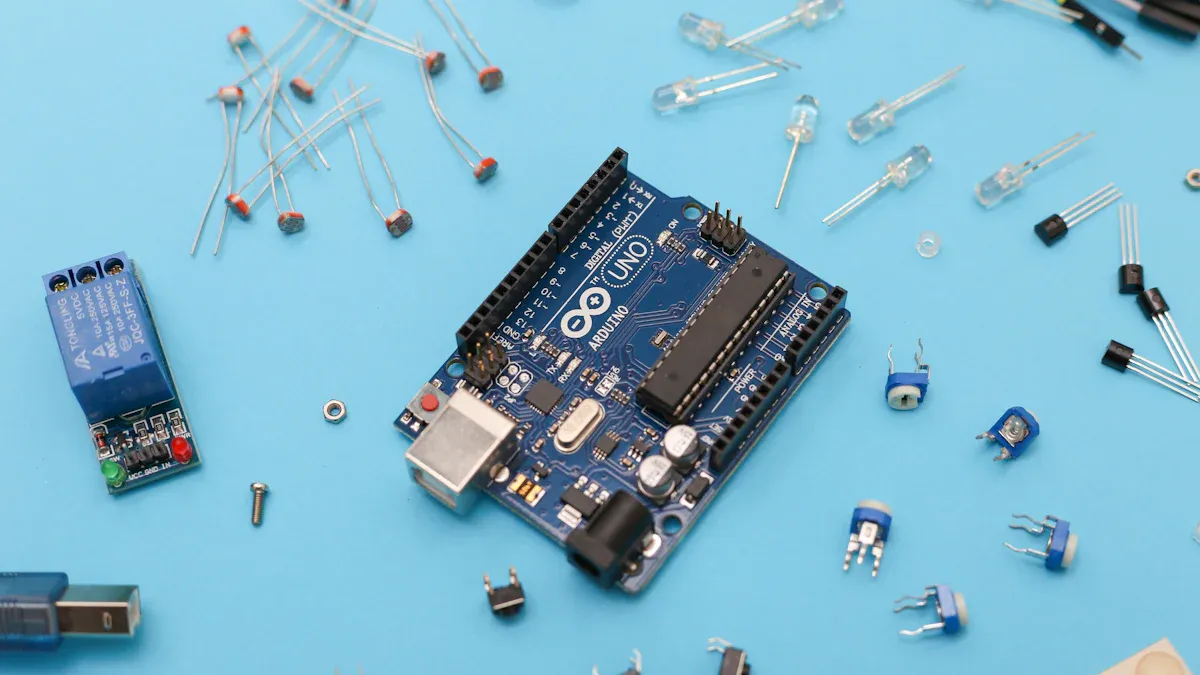
You can build an Arduino color sensor even if you have never tried diy electronics projects before. Many beginners find this project fun and easy to start. In fact, 99% of teams in the RoboCup Junior Rescue League use Arduino color sensors, showing how approachable they are. People often share stories about their first project using color detection and RGB lights. This tutorial helps you learn new skills and gives you confidence to explore more color-based projects.Color Sensors and ArduinoTypes of Color SensorsYou can find several types of color sensors for Arduino projects. The most popular color sensor module choices include the TCS3200, TCS230, and TCS34725. The TCS3200 TCS230 modules use a photodiode array and a frequency converter to detect color. These modules select red, green, or blue filters using control pins. The TCS34725 module uses a 4×3 photodiode array and has a built-in white LED for better color accuracy. This module also includes an IR blocking filter, which helps you get more precise RGB color readings.Some people build their own color sensor module using an RGB LED and photodiodes. This DIY approach lets you experiment with basic color detection, but it may not match the accuracy of a dedicated TCS230 TCS3200 color sensor module. Many Arduino color sensor tutorials recommend starting with a ready-made module for reliable results.Tip: The TCS3200 color sensor module is widely used in Arduino color sensor projects. Research shows that these modules work well for sorting and object recognition tasks, especially in industrial settings.Choosing a Sensor ModuleWhen you choose a color sensor module, think about your project needs. The TCS3200 TCS230 modules offer high resolution and adjustable gain. You can use them for color sorting, environmental monitoring, or even medical diagnostics. The TCS34725 module stands out for its built-in LED and I2C communication, making it easy to connect to Arduino.Here is a quick comparison of the TCS3200 TCS230 color sensor module features:Feature/AspectTCS3200 DetailsSensor ArchitectureCMOS circuit with photodiode and frequency converterPhotodiode Array16x4 array for high resolution color detectionOutput SignalFrequency output proportional to filtered light intensityOperating ModesFrequency mode and pulse output modeAdjustable GainYesPin Configuration8 pins: S0, S1, OE, GND, VCC, OUT, S2, S3Color FiltersRed, Green, Blue, Clear selectable via S2 and S3 pinsTypical Supply Voltage5VApplicationsColor correction, IoT color data, object recognition, environmental monitoringTo get started, you need these components and tools:Arduino board (Uno or Nano)TCS3200 TCS230 color sensor module or TCS34725 moduleJumper wiresBreadboardRGB LED (optional for visual output)USB cable for ArduinoYou can connect the module to Arduino using digital pins for the TCS3200 TCS230 color sensor or I2C pins for the TCS34725 module. Most modules come with clear pin labels, making setup simple. You will also need a computer to upload code and view RGB color data.Arduino Color Sensor SetupWiring the SensorYou can connect your color sensor module to your Arduino board using simple steps. Most beginners start with the TCS3200 or TCS34725 module because they have clear pin labels and work well with Arduino. The wiring process is straightforward if you follow the instructions carefully.For TCS3200/TCS230 ModulePlace the module on your breadboard.Connect the VCC pin on the module to the 5V pin on your Arduino.Connect the GND pin on the module to the GND pin on your Arduino.Attach the S0 and S1 pins to any two digital pins on your Arduino. These pins control the frequency scaling.Attach the S2 and S3 pins to two more digital pins. These pins select the color filter (red, green, or blue).Connect the OUT pin to a digital pin. This pin sends the frequency output to your Arduino.If your module has an OE (output enable) pin, connect it to GND to enable the sensor.Tip: Use short jumper wires and keep your breadboard steady. This helps prevent loose connections and makes your setup more reliable.For TCS34725 ModulePlace the module on your breadboard.Connect the 3.3V pin on the module to the 3.3V pin on your Arduino.Connect the GND pin to the GND pin on your Arduino.Attach the SDA pin to the A4 pin on your Arduino Uno.Attach the SCL pin to the A5 pin on your Arduino Uno.If your module has an onboard LED, you can connect its pin to any digital pin to control it.Technical documentation for these modules gives clear wiring instructions. For example, the TCS34725 sensor connects SDA to A4 and SCL to A5. User comments and hardware tests show that correct wiring is important for getting good sensor readings. Many users also use breadboards and Dupont wires for easy connections.Note: Always double-check your wiring before powering up your Arduino. Incorrect connections can cause the sensor to give wrong values or not work at all.Circuit DiagramA good circuit diagram helps you see how each wire connects your color sensor module to the Arduino. Many tutorials and official documents provide these diagrams. You can follow them to avoid mistakes.TCS3200/TCS230 Circuit DiagramHere is a simple wiring table for the TCS3200/TCS230 module:Module PinArduino PinFunctionVCC5VPower supplyGNDGNDGroundS0D2Frequency scalingS1D3Frequency scalingS2D4Color filter selectionS3D5Color filter selectionOUTD6Frequency outputOEGNDOutput enableYou can use the following code block as a reference for your pin assignments:#define S0 2#define S1 3#define S2 4#define S3 5#define sensorOut 6The S0 and S1 pins set the frequency scaling. S2 and S3 select which color filter the sensor uses. The OUT pin sends the frequency signal to your Arduino. You can change the digital pins in your code if you use different pins on your board.TCS34725 Circuit DiagramFor the TCS34725 module, the wiring is even simpler because it uses I2C communication:Module PinArduino PinFunction3.3V3.3VPower supplyGNDGNDGroundSDAA4I2C dataSCLA5I2C clockLEDD7 (opt.)LED controlTip: Always match your wiring to the example schematics in the tutorial or official documentation. This helps you avoid common mistakes and makes troubleshooting easier.Many users share photos and diagrams of their setups online. These resources show how to connect each pin and test the voltage supply. Following these examples helps you get your arduino color sensor working quickly.Minimizing Ambient Light InterferenceAmbient light can affect your color readings. You can take simple steps to reduce this problem:Place your sensor close to the object you want to measure.Shield the sensor from direct sunlight or strong room lights.Use the built-in LED on the TCS34725 module to provide consistent lighting.Create a small enclosure or use black tape around the sensor to block extra light.Note: Consistent lighting gives you more accurate color readings. Many users report better results when they control the light around the sensor.By following these wiring steps and tips, you can set up your arduino color sensor with confidence. Careful wiring and good lighting help you get reliable color data for your project.Arduino Color Detection CodeInstalling LibrariesBefore you start writing code for arduino colour sensing, you need to install the right libraries. Libraries help your arduino communicate with the color sensor and make coding easier. If you use the TCS3200 or TCS230 sensor, you can write your own code without extra libraries. For the TCS34725 sensor, you need the Adafruit_TCS34725 library.To install a library in the Arduino IDE:Open the Arduino IDE on your computer.Go to the menu and click on Sketch > Include Library > Manage Libraries.In the Library Manager, type TCS34725 in the search box.Find Adafruit TCS34725 and click Install.Tip: Always check that your library matches your sensor model. The wrong library can cause errors in your code.Uploading the CodeNow you can write and upload the code to your arduino. The code reads color data from the sensor and sends it to your computer. You can use the Serial Monitor to see the rgb values in real time.Here is a simple example for the TCS3200 sensor. This code sets up the sensor pins, reads the frequency output, and converts it to rgb values.#define S0 2#define S1 3#define S2 4#define S3 5#define sensorOut 6int redFrequency = 0;int greenFrequency = 0;int blueFrequency = 0;void setup() { pinMode(S0, OUTPUT); pinMode(S1, OUTPUT); pinMode(S2, OUTPUT); pinMode(S3, OUTPUT); pinMode(sensorOut, INPUT); // Set frequency scaling to 20% digitalWrite(S0, HIGH); digitalWrite(S1, LOW); Serial.begin(9600);}void loop() { // Read Red digitalWrite(S2, LOW); digitalWrite(S3, LOW); redFrequency = pulseIn(sensorOut, LOW); // Read Green digitalWrite(S2, HIGH); digitalWrite(S3, HIGH); greenFrequency = pulseIn(sensorOut, LOW); // Read Blue digitalWrite(S2, LOW); digitalWrite(S3, HIGH); blueFrequency = pulseIn(sensorOut, LOW); // Convert frequency to RGB values (simple scaling) int R = map(redFrequency, 25, 72, 255, 0); int G = map(greenFrequency, 30, 90, 255, 0); int B = map(blueFrequency, 25, 70, 255, 0); Serial.print("R: "); Serial.print(R); Serial.print(" G: "); Serial.print(G); Serial.print(" B: "); Serial.println(B); delay(100);}This code uses the pulseIn function to measure the frequency for each color filter. The map function converts the frequency to rgb values. You can adjust the numbers in the map function to match your sensor and lighting.For the TCS34725 sensor, you can use the Adafruit library. Here is a basic example:#include <Wire.h>#include "Adafruit_TCS34725.h"Adafruit_TCS34725 tcs = Adafruit_TCS34725();void setup() { Serial.begin(9600); if (tcs.begin()) { Serial.println("Found sensor"); } else { Serial.println("No TCS34725 found ... check your connections"); while (1); }}void loop() { uint16_t r, g, b, c; tcs.getRawData(&r, &g, &b, &c); Serial.print("R: "); Serial.print(r); Serial.print(" G: "); Serial.print(g); Serial.print(" B: "); Serial.print(b); Serial.print(" C: "); Serial.println(c); delay(100);}You can upload the code by clicking the right arrow button in the Arduino IDE. Wait for the message "Done uploading" before you continue.Note: The code examples above use simple scaling. For more accurate color detection, you can calibrate your sensor using white and black reference cards.Viewing Color DataAfter you upload the code, you can view the color data on the Serial Monitor. Open the Serial Monitor in the Arduino IDE by clicking the magnifying glass icon. You will see the rgb values update every second.Many arduino color detection projects use averaging to improve accuracy. The code can take several readings and calculate the average rgb value. This reduces errors from noise or small changes in lighting. You can also calibrate your sensor by measuring known colors and adjusting the code.The code averages multiple rgb readings to reduce measurement errors.You can set up predefined rgb value ranges for colors like white, black, red, green, yellow, and blue.Calibration helps the code adjust for different lighting conditions.You can use an rgb led to show the detected color. Connect the led to three PWM pins on your arduino. In your code, write the rgb values to the led pins using analogWrite. This gives you a visual way to see the color your sensor detects.Here is a simple example:#define RED_LED 9#define GREEN_LED 10#define BLUE_LED 11// After calculating R, G, B valuesanalogWrite(RED_LED, R);analogWrite(GREEN_LED, G);analogWrite(BLUE_LED, B);Tip: Use a diffuser or white cap on the rgb led for smoother color blending.The arduino colour sensing code supports reliable detection. It can distinguish subtle differences, such as pale yellow and dark yellow, by comparing blue reflection ratios. The detection speed is about 30 milliseconds per reading, which is fast enough for most uses. Some users have used this approach with 64 sensors on an electronic chessboard, showing that the code works well for larger setups.MetricDescriptionDetection SpeedAbout 30 milliseconds per color reading, with room for optimization.Color DiscriminationCan tell apart subtle color differences using blue reflection ratios.Scalability & DeploymentUsed with 64 sensors on a chessboard, showing practical use.Cost-effectivenessEach sensor costs about $1, making it affordable for bigger projects.Calibration equations help you get accurate rgb color readings. For example, the red channel uses the equation R = -0.287 × T + 496, with an R2 value of 0.987. This means the code gives you reliable and accurate results when you calibrate with known color cards.The arduino color detection code includes a function to average readings, which smooths out noise. You can balance the sensor by calibrating with white and black samples before you measure other colors. You can check the output rgb values in real time on the Serial Monitor. This lets you confirm that your sensor works and your readings are correct.Note: Consistent lighting and careful calibration give you the best results with arduino colour sensing.Calibration and TroubleshootingCalibrating for AccuracyCalibration is a key step for getting accurate color readings from your Arduino sensor. When you calibrate, you teach your sensor how to recognize different colors by mapping its raw output to real RGB values. This process helps your sensor tell the difference between similar shades and gives you reliable results in your practical implementation.To calibrate your sensor, follow these steps:Place a white card in front of the sensor and record the frequency or raw values for red, green, and blue.Repeat this with a black card to get the minimum values.Use colored cards (red, green, blue) and record the sensor readings for each.Map these frequency ranges to RGB values between 0 and 255 in your code.Test with other colors and adjust your mapping if needed.Studies show that calibration improves the sensor’s ability to detect colors accurately. By comparing real-time readings to your stored calibration data, your sensor can identify colors with much higher precision. Researchers use methods like Linear Discriminant Analysis to confirm that calibration makes a big difference in color detection performance.Many users report that without calibration, the sensor struggles to give consistent results. You might see the same color produce different readings, or the sensor might confuse similar shades. Proper calibration fixes these problems and makes your sensor much more reliable.Common IssuesYou may face some common issues when working with Arduino color sensors. Inconsistent readings often happen because of electrical noise or changes in lighting. Many users notice that analog readings can jump around, even when the sensor is not moving.Here are some troubleshooting tips:Average multiple readings in your code to smooth out noise.Use short, shielded wires and add a small resistor to the sensor input.Place capacitors on the power lines to reduce voltage spikes.Keep the sensor close to the object and block out extra light with a cover.Make sure your voltage reference is stable.A table below shows how users solve these problems:ProblemSolutionNoisy readingsAverage samples, use shielded cablesVoltage spikesAdd capacitors to supply linesLighting interferenceUse covers, control ambient lightUnstable referenceCheck and stabilize voltage sourceBy following these steps, you can get smooth and accurate color readings. Calibration and troubleshooting are important for any practical implementation with Arduino color sensors.You have finished your first Arduino color sensor project. Take a moment to celebrate your success. Many beginners see real gains in STEM skills when they build hands-on projects like this.Outcome MeasureMeasurable Benefit DescriptionMath AchievementIncrease from 3.25 to 3.85 (p = 0.019)Science ContentSignificant improvement (p < 0.05)You can expand your color sorting machine by adding an i2c 16x2 arduino lcd display module or trying new color sensors. Keep exploring and share your results or questions in the comments.FAQHow do you power the color sensor module?You can use the 5V or 3.3V pin on your Arduino board. Most modules work with both voltages. Always check your sensor’s datasheet before connecting power.Can you use a different Arduino board for this project?Yes, you can use Uno, Nano, or Mega boards. Just match the sensor pins to the correct Arduino pins. The code works with most standard Arduino models.Why do your color readings change in different rooms?Light changes the sensor’s readings. Bright sunlight or dim lamps affect results. Try to use the sensor in the same lighting or use a cover to block extra light.What should you do if the sensor gives wrong colors?Check your wiring first.Calibrate the sensor with white and black cards.Make sure you use the correct code and library for your sensor model.
On 2025-07-02